Heidenau Camp
Displacement in Europe
Heidenau bei Tostedt, Landkreis Harburg, Lower Saxony, Germany · Documented 1945–1958
Heidenau was one of the largest Ukrainian communities in Britain’s occupation zone, housed in barracks built for an airfield that was never finished. It had a gymnasium, several newspapers, a church administration and a Petliura monument that still stands.
Introduction
Heidenau was a major Ukrainian displaced-persons camp near Tostedt, south of Hamburg. The United Ukrainian American Relief Committee listed it among the principal Ukrainian camps in the British occupation zone in 1948, and a family-tracing notice of May 1948 gives a resident’s address as Heidenau bei Tostedt, Kreis Harburg, DP Camp 253. That places it firmly in Lower Saxony and distinguishes it from the town of Heidenau in Saxony and from the separate Lysenko camp in Hannover.
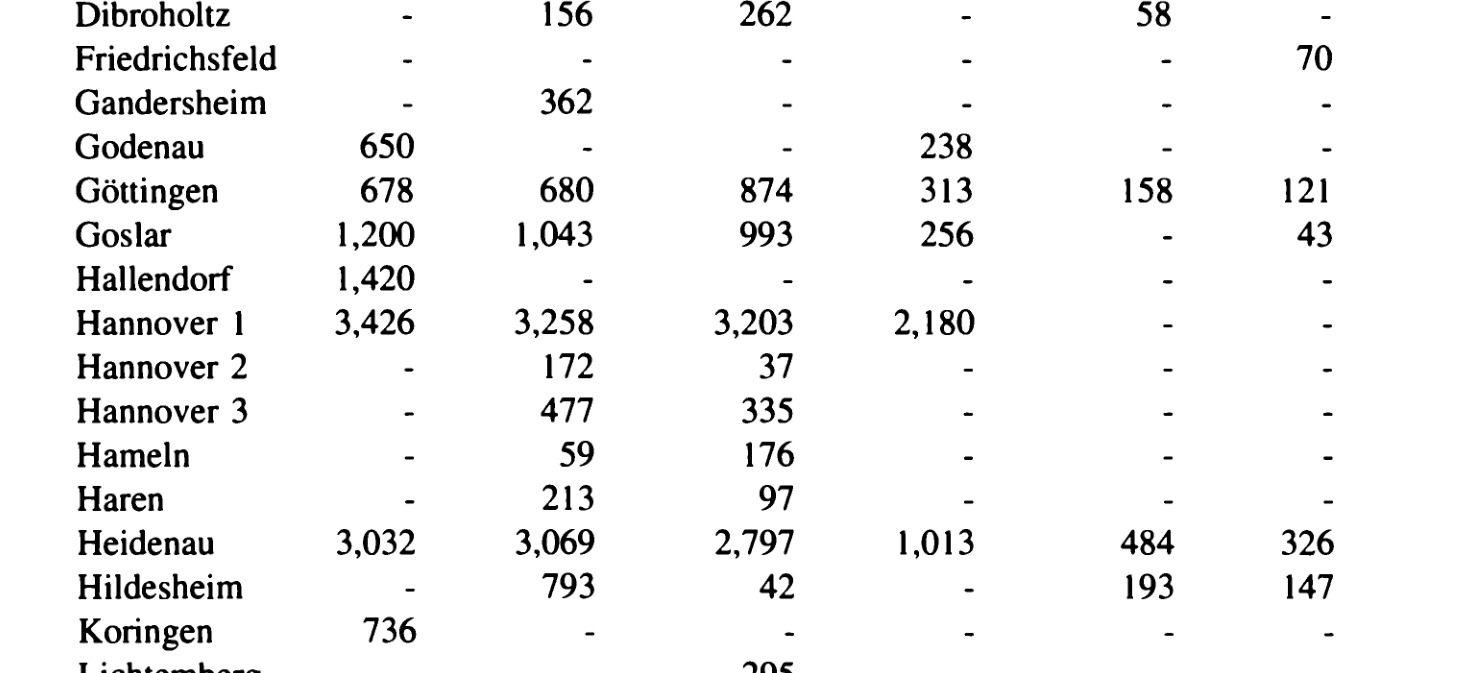
The Encyclopedia of Ukraine records 3,030 Ukrainians at Heidenau in its comparison for 1946–1947, and a local newspaper account of the historian Jan-Hinnerk Antons’s research speaks of around 4,000 over the life of the camp. This was a substantial community rather than a short overnight stop: camp records continued into 1958, while schools, religious institutions and newspapers connected residents with other displaced Ukrainians.
The camp newspaper Luna printed the community’s own account of its arrival. In a memoir published for the first anniversary, Teklia Ivaskiv wrote that there had come to be too many people in the Munster camp, that the need arose to open a new camp elsewhere, and that on 13 August 1945 the British moved a large part of the camp’s inmates to Heidenau, where «почали ми творити свою „державу“ наново» — we began to build our ‘state’ anew. The anniversary issue also recalls that a year earlier the community had taken over the camp almost completely wrecked, with barracks left without windows and doors and heaped with rubble and rubbish, and had set about rebuilding from the first day.
A history in dates
- 1937–1938Survey and building work begin for an airfield at Heidenau, with three barrack camps for the workforce.
- April 1945British troops take the area; the camps first hold liberated Red Army prisoners of war.
- 25 June 1945Ukrainian community representatives meet to coordinate protection and relief.
- August 1945A monument inscription dates the founding of the camp to this month.
- 13 August 1945The British move a large part of the inmates of the Munster camp to Heidenau, according to the anniversary memoir in Luna.
- September 1945The surviving arrival register begins.
- December 1945A photographed visit connects Heidenau with the London-based relief bureau.
- 8 March 1946The newly elected camp administration elects Drozdovsky camp leader at its organisational meeting.
- 1 April 1946Bookkeeping courses open in the camp, described as the germ of a commercial school.
- 9–10 May 1946Sixteen priests of the Ukrainian Autocephalous Orthodox Church of the British zone hold a congress in the camp under Metropolitan Polikarp.
- 25 May 1946The Union of Veterans dedicates a monument to Symon Petliura.
- 1946–1947A comparative survey records 3,030 Ukrainians.
- 26 May 1946A football match on the camp sports ground ends in a brawl with Serbs from the neighbouring camp, during which men from that camp open fire on the crowd.
- 26–27 July 1946The camp’s gymnasium holds its first matura examinations before a commission appointed by the British education office in Celle.
- 10 August 1946Heidenau, Munster and Burgdorf represent the Ukrainian camps at the district UNRRA exhibition of folk art and production at Schloss Edingen, Celle.
- 13 August 1946About three thousand residents walk in procession to the neighbouring Yugoslav camp, whose leaders were about to be taken away, to show their solidarity.
- 18 August 1946The camp marks the anniversary of its founding with a service, a procession led by the clergy and church choir, and an exhibition of the camp workshops’ production.
- 10 September 1946The organisational meeting of the Union of Ukrainian Youth takes place in the camp.
- 11 March 1947UNRRA Team 225 files a monthly welfare report for Heidenau.
- 1947Heidenau is one of two principal Plast branches in the British zone, and a co-operative publishing house issues books there.
- 17 July 1949A report on British-zone closures says Heidenau will be liquidated once larger groups have left.
- July 1956A federal border guard unit moves into the main camp.
- March 1958Final date covered by the surviving camp-book series.
Sources for this section
- Einsatzhafen Heidenau
- Ukrainische Displaced Persons in Deutschland
- Nedilia: Ukrainian independent weekly, Aschaffenburg
- Луна / Luna, the Heidenau camp weekly, 1946
- Camp books of the DP camp Heidenau
- Central Ukrainian Relief Bureau
- Germany
- The Nation in a Nutshell? Ukrainian Displaced Persons Camps in Postwar Germany
- Plast: Ukrainian Scouting, a Unique Story
Before 1945: an unfinished airfield
The barracks at Heidenau were not built for refugees. In the second half of the 1930s the Luftwaffe planned a new airfield beside the village to relieve the flying school then based at Stade. Ground surveys were made in 1937 and building began the following year on what had been mostly heath and a little woodland.
Three separate camps went up to house the workforce and, later, the airfield’s own personnel. The main camp between the railway line and the village centre had more than thirty buildings, mostly wooden huts but including a solidly built waterworks. A north camp of about ten huts held the sick bay, and a south camp of about twenty huts stood out by the planned landing ground, where 1,500 men are said to have been quartered in 1938. The field was cleared and levelled, but work stalled once the war began and the airfield was never finished.
British troops took the area in April 1945. The Allies first used the Heidenau camps to care for liberated Red Army prisoners of war, and the barracks then became accommodation for displaced persons.
The three barrack camps built for the airfield
| Camp | Position | Buildings |
|---|---|---|
| Main camp | Between the railway line and the village centre | More than 30, mostly wooden huts, with a solidly built waterworks |
| North camp | North edge of the village | About 10 huts, including the sick bay |
| South camp | South, beside the planned landing ground | About 20 huts; 1,500 men said to be quartered there in 1938 |
Sources for this section
Organising after liberation
On 25 June 1945, representatives of Ukrainian communities from the western occupation zones met at Heidenau. They sought separate assembly centres for Ukrainians who did not wish to return to the Soviet Union, and contacts with international organisations and Ukrainian communities overseas. The meeting placed Heidenau within the emerging network of refugee self-help.
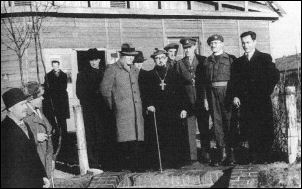
A photograph dated December 1945 records a visit by the Central Ukrainian Relief Bureau. Founded in London that September, the bureau channelled Canadian and American Ukrainian assistance, opposed forced repatriation and advocated western resettlement. Its representatives’ presence shows the practical connection between the camp and overseas relief.
The camp had an elected administration under a commandant appointed by the British. The anniversary memoir records that the engineer Drozdovsky stood at the head of the camp, named to the post by the British authorities, and that the residents would not have chosen anyone else; he signed camp announcements in the paper as Ol. Drozdovsky, camp commandant. Luna reported in its issue of 17 March 1946 that the newly elected camp administration, at its organisational meeting on 8 March under the chairmanship of Mr Yalovy, had unanimously elected Drozdovsky camp leader.
Learning and youth organisations
Teaching continued within the camp. A biographical study of an Orthodox priest who served there records a camp-based university with a department of Ukrainian language and literature during 1945–1948. This documents organised advanced teaching, although the source does not establish that the institution had German university accreditation.
The camp’s secondary school was named after Taras Shevchenko. Antons’s study of the British-zone camps quotes former pupils and reproduces a classroom photograph from it, and describes teachers who were also public figures: one taught there while serving as a Ukrainian Catholic priest and local Plast chaplain, another was the head of the youth association for the whole British zone. The same study shows how deliberately national the teaching was, and how the political divisions of the emigration reached into school commemorations.
Plast’s organisational history identifies Heidenau and Hannover as the two city branches anchoring its British-zone network in 1947, alongside smaller branches. Youth activities therefore belonged to a wider system that linked camps, trained leaders and maintained Ukrainian scouting during displacement.
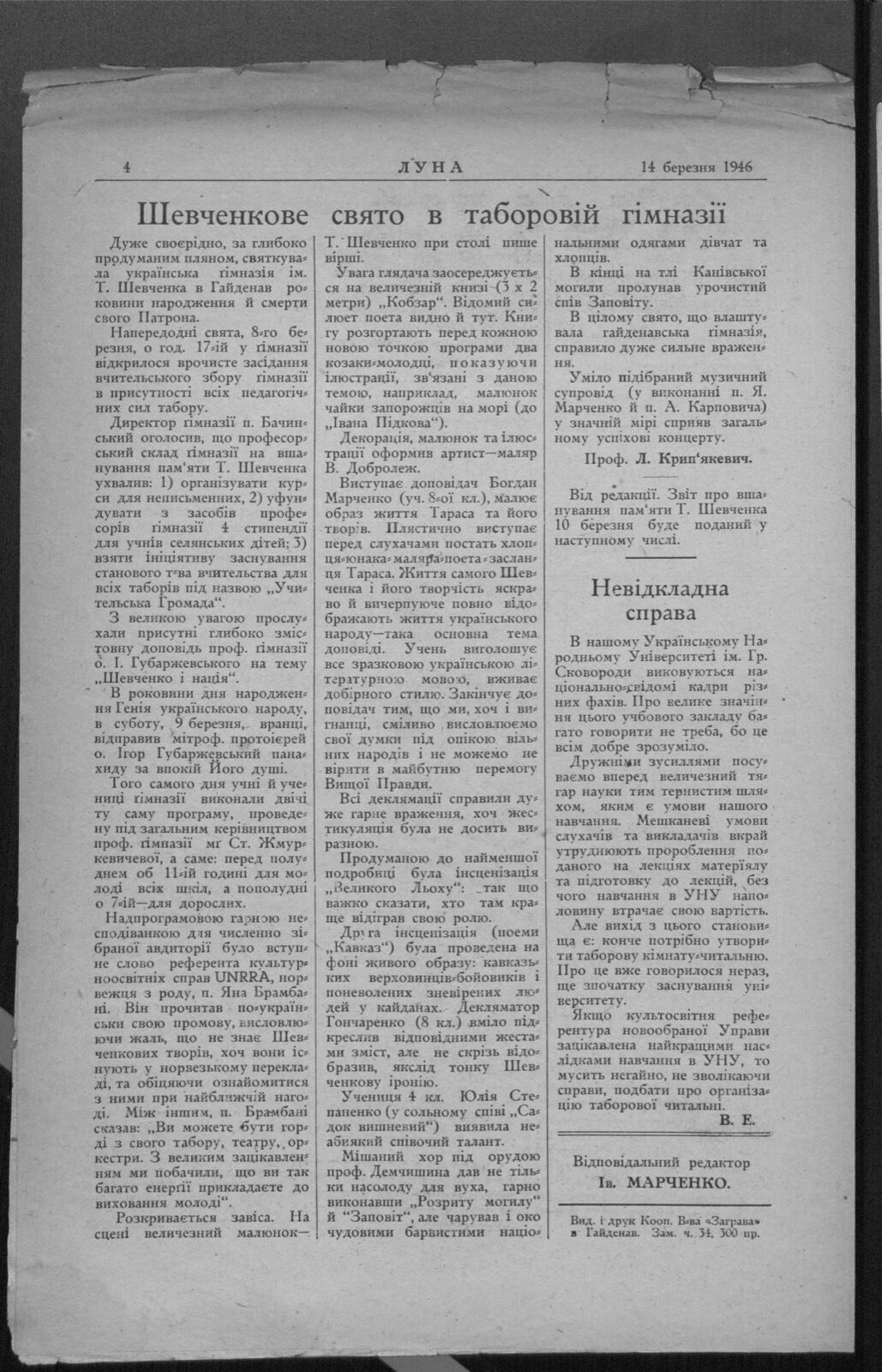
Luna’s report on the 1946 commemoration names the gymnasium’s staff and their resolutions. On the eve of the festival, 8 March, the teaching body met at five in the afternoon in the presence of all the camp’s teaching staff, and the director, Mr Bachynsky, announced that in Shevchenko’s memory the teachers had resolved to organise courses for the illiterate, to fund four scholarships for peasant children out of their own means, and to take the initiative in founding a professional teachers’ association for all the camps under the name Teachers’ Community. Fr Ihor Hubarzhevsky, a teacher at the gymnasium, read a paper on “Shevchenko and the nation”, and on 9 March the pupils performed the same programme twice, in the morning for the schoolchildren of all the schools and in the afternoon for adults. The camp’s UNRRA cultural and educational officer, a Norwegian named in the report as Yan Brambani, spoke unexpectedly in Ukrainian, regretted that he did not know Shevchenko’s works although they existed in Norwegian translation, and told the audience that they could be proud of their camp, its theatre and its orchestra.
The gymnasium ended its school year on 9 July 1946, and its pupils sat the camp’s first matura examinations on 26 and 27 July before a commission appointed by the British education office in Celle. Other teaching was more practical. Bookkeeping courses began in the camp on 1 April 1946, described in Luna as already the germ of a commercial school and to be taught by specialists rather than by gymnasium teachers. In June 1946 the paper reported a plan to open a branch of the Ukrainian Technical and Husbandry Institute of Regensburg in the camp, starting with a first-year course, and noted that fifteen residents wished to enter a higher technical school and that the camp had qualified lecturers for higher mathematics, physics and chemistry.
The Ukrainian People’s University was the largest of the camp’s teaching ventures. Luna reported in March 1946 that about 500 people had studied in its departments and courses during the first semester, and that 2,193 lecture hours had been delivered; by September the paper put the number who had studied there at about 600 and said that the diplomas they received were confirmed by the British authorities. Visiting scholars taught as well: the paper records that Professor Bohdan Krupnytsky came to the camp five times and gave the residents twenty lectures on Ukrainian history.
Plast was the largest youth body. A Plast week was held at Heidenau, where the paper says boys’ and girls’ troops had been formed earliest, and seventeen representatives from sixteen camps completed instructors’ courses there. By June 1946 the four Heidenau troops had grown to 302 members, and a council meeting reported in July that ninety per cent of the primary school’s pupils were organised in Plast. The Union of Ukrainian Youth followed in the autumn: its organisational meeting took place in the camp on 10 September 1946, addressed by the pastors of both churches and by the camp commandant, and a general meeting on 19 September, attended by the heads of the camp’s institutions, admitted sixteen young men and women, with forty-six further applications before the presidium.
Provision for the youngest children and training for women were organised too. The camp kindergarten marked the first anniversary of its existence on Sunday 14 July 1946; it took 111 children, described in the paper as almost all the camp’s children aged between three and six. On 18 July 1946 the embroidery workshop of the camp’s women’s organisation showed Ukrainian embroideries in the camp library-reading room. Two nursing sisters from Heidenau were among seventeen sisters of various nationalities from British-zone camps who completed six-month courses at Belzen, and ten more Ukrainian sisters from Heidenau, having finished the theoretical course in the camp, were to do their practice there.
A community in print
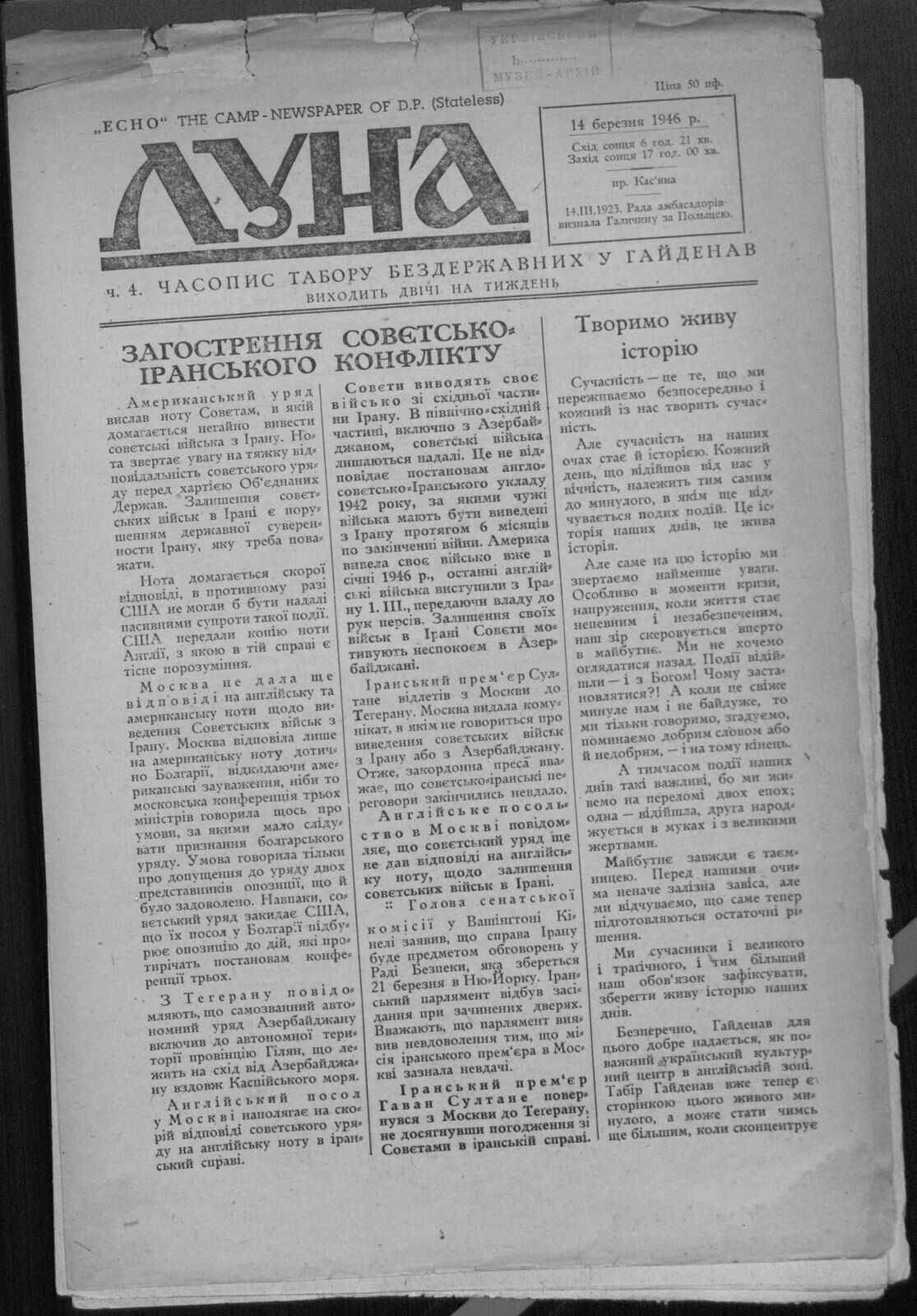
Heidenau supported Ukrainian publishing of its own. The short-lived weekly Luna appeared at Heidenau in 1946, beginning and ceasing publication within that year.
Book publishing went on alongside the papers. A review of September 1947 in the Aschaffenburg weekly Nedilia notices a 64-page collection of humorous sketches issued by the co-operative publishing house Zahrava at Heidenau, with drawings by an emigre artist. Printing mattered beyond announcements: a community separated from home could exchange news, debate its future and keep Ukrainian-language reading in circulation.
The colophon of the same issue records how Luna was made: it was published and printed by the Zahrava co-operative publishing house at Heidenau, under the responsible editor Iv. Marchenko, as order number 34 in a run of 300 copies.
Luna’s masthead of 14 March 1946 styles it the newspaper of the camp of the stateless at Heidenau, appearing twice a week and priced at 50 pfennig, above an English line reading “THE CAMP-NEWSPAPER OF D.P. (Stateless)”. The colophon repeated the editorial address as D. P. Camp (Stateless), Heidenau, bei Tostedt, Kreis Harburg. Writing in the paper’s first surviving issue, the historian B. Krupnytsky argued that Heidenau was well suited to the work of recording the emigration, as a significant Ukrainian cultural centre in the British zone, and that the camp was already a page of that living past.
Printing was a commercial undertaking as well as a community one. Advertisements in September 1946 list the stock the Zahrava publishing house held for sale at Heidenau, including a prayer book of the Ukrainian Autocephalous Orthodox Church and the literary and popular-science monthly Pokhid, and announce that the co-operative’s printing works took outside orders. The camp’s cultural and educational section issued a photographic gazette of its own, Fotooko, which had reached a third number by June 1946 with photographs of the life of the school, the theatre and the gymnasium.
Heidenau newspapers
| Title | Format | Years |
|---|---|---|
| Luna | Printed weekly | 1946 |
Sources for this section
Church administration across camps
Records preserved by the Ukrainian History and Education Center include correspondence sent from the Ukrainian Autocephalous Orthodox Church Administration in Heidenau to the parish at Seedorf. The collection spans 1947–1950 and includes circulars, reports and financial papers. Heidenau thus served an administrative role extending beyond its own congregation.
The head of that church was present in person. Metropolitan Polikarp conducted a memorial service at Heidenau in 1948 for Hetman Pavlo Skoropadsky, at which the secondary school’s principal spoke, and on 6 August 1949 the camp community marked the Metropolitan’s name day, beginning with a sermon by one of its priests. An archpriest of the same church later emigrated from Heidenau to London.
The camp also hosted the church’s zonal business. On 9 and 10 May 1946 a congress of the clergy of the Ukrainian Autocephalous Orthodox Church of the British zone met at Heidenau; sixteen priests took part and Metropolitan Polikarp presided. Bishop Mstyslav came to the camp on Wednesday 7 August 1946 and visited the parish church, where a moleben was celebrated in his presence before a great number of people.
The Greek Catholic parish was visited in the same year. Luna announced that Fr Mykola Voiakovsky, head of the Greek Catholic Church for all three occupation zones of Germany, would arrive at Heidenau on Saturday 14 September 1946, and reported in October that the apostolic visitator had come to the camp during a visitation of the Ukrainian camps of the British zone, printing a photograph of him with camp clergy. The two rites could share an occasion: a panakhyda held in the camp church on 9 June 1946 for Ukrainians who had fallen in the struggle for the freedom and independence of their country was celebrated in both the Greek Catholic and the Orthodox rite, with more than a thousand residents, the paper says, praying around a symbolic grave.
The Petliura monument
Veterans in the camp built a monument to Symon Petliura for the twentieth anniversary of his assassination. A description published in June 1948 gives its height as 2.95 metres, built of red stone, with a bronze relief of the Chief Otaman set below the cross and beneath that a grey marble tablet inscribed to him from the Union of Veterans at Heidenau and dated 25 May 1946. The work was paid for partly by the veterans themselves and partly by residents’ donations, and was led by the head of their union.
In front of the monument a base carried a white marble tablet with the names of camp residents who had died between the founding of the camp in August 1945 and November 1947. That dating is the clearest local statement of when the camp began, and it matches the surviving arrival register. The monument outlived the camp: Antons photographed it in the Ukrainian section of the local cemetery.
Closure and the site afterwards
The surviving camp books begin with arrivals recorded on 3 September 1945. Later volumes follow arrivals and departures through March 1958. These dates describe the surviving registration series, not an unchanging Ukrainian population throughout that period.
The end came with the general run-down of the British zone. A report of 17 July 1949 records that 138 camps had been closed in a year, leaving 220 of the previous 318, and that Heidenau too would be liquidated once one or two larger groups had left it, with the remaining residents concentrated in large multinational camps. The local press summary of Antons’s research puts the camp’s final years at 1957.
In July 1956 the federal service flag was raised over the main camp when a federal border guard construction unit moved in from Hamburg-Harburg; it stayed until 1962, when it left for a new barracks at Winsen. The buildings were later demolished. Only the waterworks of the main camp survives, housing now covers the main camp site, sports grounds stand where the north camp was, and the levelled airfield can still be made out.
Camp institutions, work and neighbours
The camp ran its own court and its own tracing service. A courtroom report in Luna in June 1946 describes three professional judges at the table and twelve lay assessors, with a prosecutor and a defender, and says the court imposed, according to the circumstances, arrest of between one day and three months, compulsory labour or a fine. A Search and Liaison Bureau worked from the camp, and the standing notice beneath the paper’s tracing columns gave its addresses as the Auskunftbüro der vermißten Ukrainer, Heidenau, bei Tostedt, Kreis Harburg for Germany and, for enquiries from abroad, an inquiry and information bureau at 253 D. P. Assembly Centre, 800 Control Unit, B.A.O.R., via Great Britain.
Work outside the camp was growing in the summer of 1946. Luna reported in June that 360 people already worked outside the camp daily, in the forest and on the motorway, that peat cutting was planned, and that the total number at work was 835 men and 125 women. The camp also took part in the district’s public life: at an exhibition of folk art and production arranged by the district UNRRA at Schloss Edingen in Celle on 10 August 1946, the Ukrainians were represented by the camps of Heidenau, Munster and Burgdorf, and the paper reproduced a photograph of a sculpture by a Heidenau woman shown there.
Relations with the neighbouring camps ran both ways in the same summer. On 26 May 1946 a quarrel among players at a football match on the Heidenau sports ground turned into a brawl between Ukrainian residents and Serbs living in their own camp nearby, and Luna reported that at its height a group of soldiers and non-commissioned officers arrived from the Serbian camp and opened fire on the crowd with pistols and rifles. On the afternoon of 13 August a Serb came to Heidenau to say that vehicles had arrived to take away the leaders of his camp; within half an hour, the paper says, a crowd of three thousand had gathered on the camp square and set off calmly through the village streets — men, women, children and the old — to show their solidarity.
Commemoration filled much of the camp calendar. On 25 May 1946 the memory of Symon Petliura and Yevhen Konovalets was honoured with a requiem liturgy in the church at eight in the morning and a memorial service on the camp square at nine. On 21 June the gymnasium marked the thirtieth anniversary of Ivan Franko’s death in the camp theatre. On Sunday 18 August the residents marked the anniversary of the founding of their temporary settlement: after the service the camp gathered on the decorated central square and walked in procession, led by the clergy and the church choir, and an exhibition of the products of the camp workshops and studios opened in the art studio and library. Visiting performers came as well, among them the choir and bandura chapel of Hryhoriy Kytasty and Volodymyr Bozhyk, then performing in the American and lately in the British zone.
Sources for this section
Sources
- Report: history, accomplishments, statistics and plans
United Ukrainian American Relief Committee · 30 June 1948
Original scan, PDF 31, printed 27; location listed as Heidenau bei Tochstedt, British zone.
- Germany
Internet Encyclopedia of Ukraine · Historical survey
1946–1947 Ukrainian camp population comparison.
- Ukrainische Displaced Persons in Deutschland
Bundeszentrale für politische Bildung · 2014
Heidenau meeting on 25 June 1945; full passage read.
- Central Ukrainian Relief Bureau
Ukrainians in the United Kingdom, Roman Krawec · Updated 2015
Original webpage and December 1945 Heidenau photograph.
- Ihor Hubarshevsky
Ukrainians in the United Kingdom · 2021
Camp university department and parish service 1945–1948; personal names omitted from article.
- Plast: Ukrainian Scouting, a Unique Story
Orest Subtelny and collaborators · 2016
Original PDF 154, printed 126, British-zone network 1947.
- Camp books of the DP camp Heidenau
Arolsen Archives · 1945–1958
Catalogue description only; no individual register images or names published.
- Seedorf DP camp church records
Ukrainian History and Education Center · 1947–1950
Original finding aid: uaoc-6, circulars and correspondence from Heidenau.
- Einsatzhafen Heidenau
Relikte in Niedersachsen und Bremen · Accessed September 2026
Documentation site kept by private researchers, citing the Bundesgrenzschutz and Bundeswehr unit histories and two private archives. Used for the 1937–1938 airfield project, the three barrack camps, the care of liberated Soviet prisoners in 1945, the border guard occupation of 1956–1962 and the surviving waterworks.
- The Nation in a Nutshell? Ukrainian Displaced Persons Camps in Postwar Germany
Harvard Ukrainian Studies 37, no. 1–2; Jan-Hinnerk Antons · 2020
Peer-reviewed study of the DP camps. Camp named after Bohdan Khmelnytsky, p. 188; Taras Shevchenko Gymnasium and its teachers, pp. 196–198; UNRRA Team 225 welfare report of 11 March 1947, note 81; Petliura monument and its survival in the local cemetery, p. 201; Metropolitan Polikarp’s memorial service of 1948. Former pupils quoted there were camp children and are not named here.
- Nedilia: Ukrainian independent weekly, Aschaffenburg
Ukrainian Museum-Archives of Cleveland / United States Holocaust Memorial Museum · 1947–1949
Digitised run, CC BY-NC-ND 4.0. Items used: 21 September 1947 (Zahrava publishing house at Heidenau); no. 124, 16 May 1948 (address Heidenau bei Tostedt, Kr. Harburg, DP Camp 253); 20 June 1948 (description and inscription of the Petliura monument, and the founding of the camp in August 1945); no. 183, 17 July 1949 (British-zone closures); no. 189, 28 August 1949 (Metropolitan Polikarp’s name day on 6 August 1949).
- Von Heidenau bis zum Maidan?
Kreiszeitung Wochenblatt, Landkreis Harburg · Accessed September 2026
Local press report of a lecture by Jan-Hinnerk Antons: about 4,000 Ukrainian displaced persons, former forced labourers and anti-communists, at Heidenau from 1945 to 1957. A press summary rather than a dated administrative return.
- Ukrainian Population Migration after World War II, Table 6
Ihor Stebelsky, in The Refugee Experience, Canadian Institute of Ukrainian Studies Press · 1992
Scan published by diasporiana.org.ua; no reuse licence is stated by the holder. Page image rendered from the digitised volume and the camp’s row read visually.
- Луна / Luna, the Heidenau camp weekly, 1946
Zahrava co-operative publishing house, Heidenau bei Tostedt; digitised from the Ukrainian Museum-Archives of Cleveland, Displaced Persons Camp Periodicals Collection, via the United States Holocaust Memorial Museum and the Internet Archive · 1946
The digitised run of 157 page images, read in full as page images. The issue of 14 March 1946 carries at page 4 the report «Шевченкове свято в таборовій гімназії» (The Shevchenko festival in the camp gymnasium) and, at the foot of the last column, the colophon naming the responsible editor Iv. Marchenko and the Zahrava co-operative publishing house at Heidenau, with a print run of 300 copies. The first-anniversary issue carries the community's own account of its arrival, its administration, its gymnasium and its churches. The Internet Archive notes that electronic versions may not include the complete run of a title. Creative Commons BY-NC-ND 3.0.
Last researched 13 September 2026