Hellbrunn Camp
Displacement in Europe
Nonntal, Salzburg, Austria · 1945–1961
Polish and Ukrainian refugees made a temporary home in the former Hellbrunn barracks in Salzburg, one of the centres of Polish life in postwar Austria. Camp photographs, population returns and a child’s recollections trace both community life and the long journey towards reunion.
Introduction
Hellbrunn Camp occupied the Hellbrunner barracks and neighbouring huts in Salzburg’s Nonntal district. It began operating on 5 June 1945 and housed Polish and Ukrainian refugees among a changing eastern European population.
The Salzburg Museum’s 2023 exhibition maps Hellbrunn as a distinct camp south of the old city. Its name refers to the Salzburg camp, separate from other similarly named places and from the city’s Lexenfeld camp.
The buildings were the Hellbrunner Kaserne on Hellbrunner Strasse. When American troops entered Salzburg a thousand men of the Hungarian army, employed on engineering work in the city, were still quartered there; they were replaced by refugees from eastern Europe. Through the summer of 1945 the camp held 4,000 people, and the repatriation transports that began that summer brought the figure down to about 2,000 by the autumn.
Sources for this section
A history in dates
- 5 June 1945The refugee camp opens in the former Hellbrunn barracks, where a thousand Hungarian soldiers had been quartered.
- Summer 1945Up to 4,000 people are accommodated; repatriation transports reduce the number to about 2,000 by autumn.
- 1946The camp holds 1,100 Poles and 700 Ukrainians and is one of the centres of Polish life in Austria.
- 1947The IRO takes over the administration and the number of places is limited to 2,000; residents moved to the Asten camp write to President Truman and are returned.
- August 1947 – March 1950The IRO’s series of instructions for internal camp use, now in the Archives nationales de France, is issued.
- 30 September 1948A statistical return records 887 Ukrainian residents.
- 1948–1949Family photographs record everyday life around the huts.
- 30 June 1950A second return records 58 Ukrainian residents.
- 1952Austrian authorities assume administration.
- September 1953The site holds an Austrian old people’s home and a welfare camp of 580 people.
- 1958A United Nations photograph caption records eighty refugees still living in the camp since the end of the war.
- May 1961The camp closes as residents leave for housing or emigration.
- 2008The provincial archive reports receiving the recovered camp entrance board.
Sources for this section
A Polish and Ukrainian community
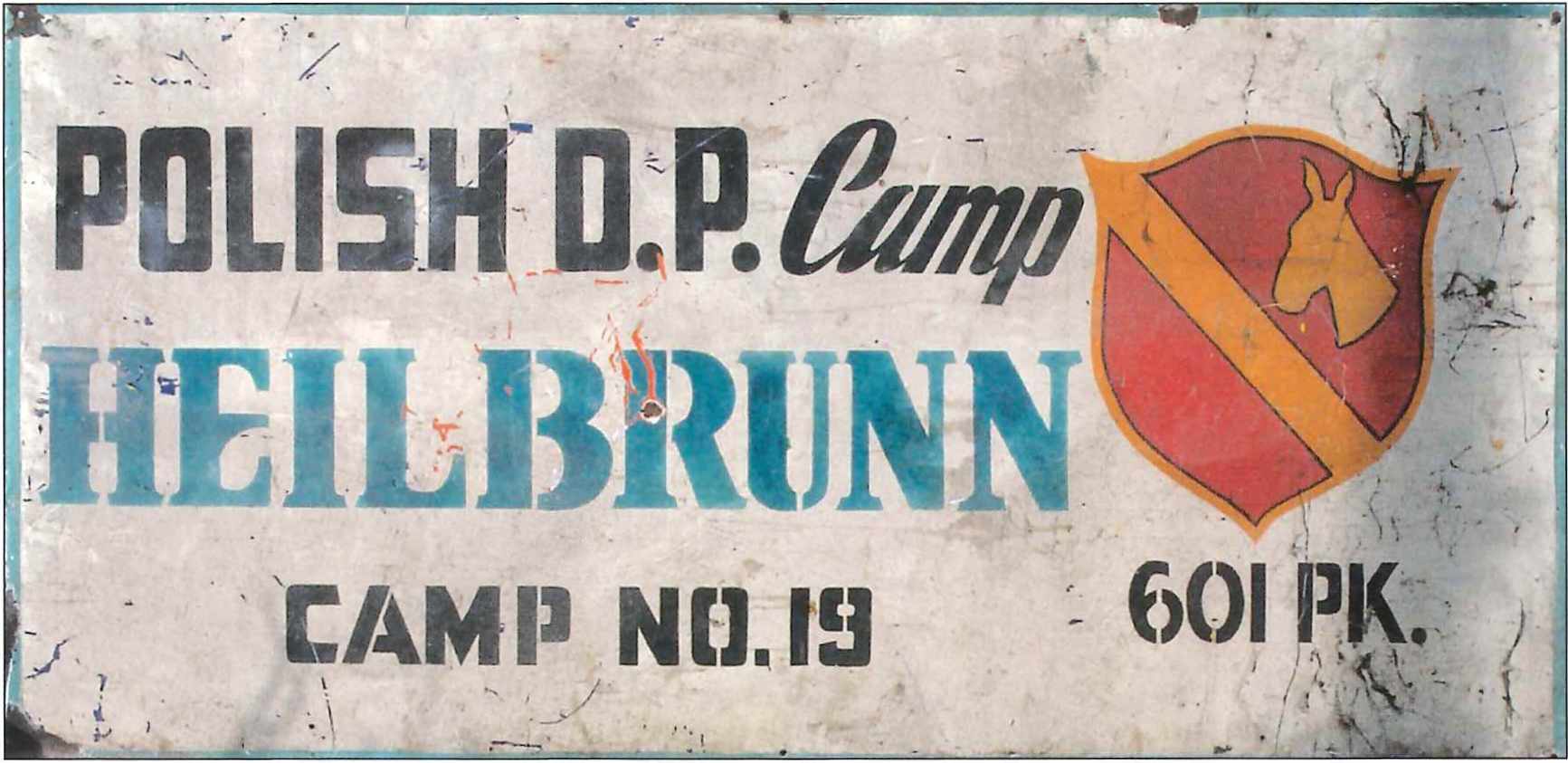
A surviving entrance board calls the site a Polish DP camp and gives Camp No. 19. The Salzburg provincial archive identified the board as Hellbrunn’s after it was found in the cellar of the Posthof. Its painted spelling, “Heilbrunn”, is a historical error preserved on the object.
The Polish designation did not mean that every resident was Polish. Archival population returns reproduced by historian Ihor Stebelsky record 887 Ukrainians at Hellbrunn on 30 September 1948 and 58 on 30 June 1950. These are Ukrainian counts on particular dates, not the camp’s entire population or cumulative arrivals.
The two returns show a substantial reduction in the recorded Ukrainian population during the main resettlement years. They cannot by themselves identify how many people emigrated, transferred to other camps or moved into local housing. Hellbrunn remained open long after the second count.
Ukrainian residents in the IRO returns
| Date | Ukrainian residents |
|---|---|
| 30 September 1948 | 887 |
| 30 June 1950 | 58 |
Administration and the argument over return
UNRRA administered the camp from the start, working as team 316 in the Salzburg district; the IRO took over the administration in 1947, and from 1952 the provincial government ran all the refugee camps in Salzburg. The difference in standards showed in the accounts: a camp under Austrian administration cost about 50 Schillings where an IRO camp cost about 110.
In 1946 there were 1,100 Poles and 700 Ukrainians in the camp, and Hellbrunn was one of the centres of Polish life in Austria. Repatriation became the year’s great point of dispute. The transports east came to a standstill during the winter of 1945 to 1946, and personal reasons, the political situation and a hardening anti-communist conviction lay behind most refusals to go. In 1947 some residents were moved to the Asten camp, wrote a protest letter to President Truman and were returned to Hellbrunn. After the peak of 4,000 people, the number of places was limited to 2,000 in 1947.
The IRO’s own files on the camp survive in the Archives nationales de France. The guide to those records by Yury Boshyk and Boris Balan lists, in series AJ 43, volume 983, a dossier of miscellaneous documents on the Hellbrunn camp including the series of “Instructions for internal camp use” running from August 1947 to March 1950. Hellbrunn’s dossier is listed separately from the file on the Jewish camps in Austria.
Recorded population of the camp
| Date | People | What the figure counts |
|---|---|---|
| Summer 1945 | 4,000 | All residents at the camp’s peak |
| Autumn 1945 | about 2,000 | All residents after repatriation transports began |
| 1946 | 1,100 Poles and 700 Ukrainians | Two national groups, not the whole camp |
| 1947 | 2,000 | Places, after the number was limited |
| September 1953 | 580 (240 foreign-language) | Residents of the Austrian welfare camp on the site |
| September 1953 | 200 foreign-language | Residents of the Austrian old people’s home on the site |
Making a home in the barracks
Privacy was scarce. Families partitioned the barracks with corrugated metal and fibreboard, sometimes creating fifteen living spaces inside one hut. Workshops supplied goods for residents and for sale, while three canteens served meals. Medical care developed to include a hospital, clinic and laboratory.
Work and welfare grew up alongside the huts. Some residents worked in the camp’s own workshops, whose products were not only for their own use but were also sold. Medical care was provided at first by the Red Cross and UNRRA, later by a hospital, a clinic and a laboratory, and meals were served in three canteens. The kindergarten and other facilities were maintained by private relief organisations, and cultural events were part of camp life. The compiled register of Austrian camps notes that the former barracks also held an old people’s home and a children’s home.
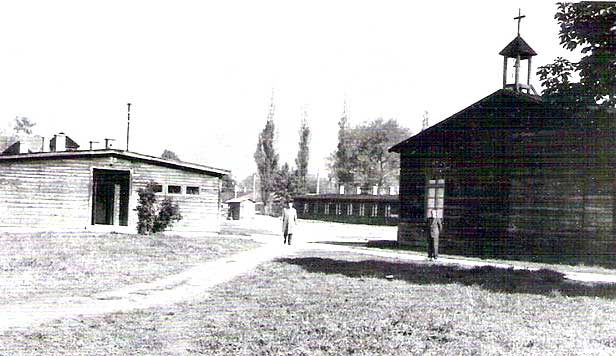
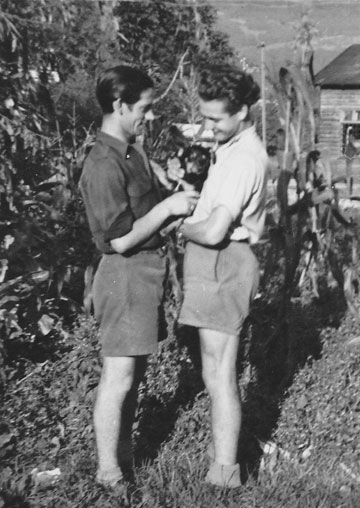
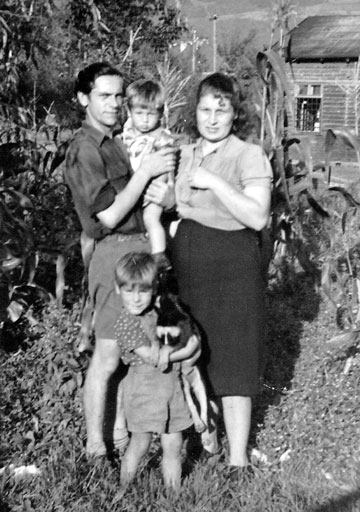
Photographs from 1948–1949 place family life among the wooden buildings. One shows parents with two children and a dog; another shows two men, one identified in its original caption as a Polish tailor. A further personal photograph, posted in 2022 by a man who spent the first two years of his life in the camp, shows him with his father there in late 1948 or early 1949; he recalled that he believed his parents had met at Hellbrunn after the war, and that the family left in 1949 for Canada. The images preserve ordinary relationships within a camp often remembered only through administrative numbers.
Separation and reunion
One former child resident recalled that illness prevented him from accompanying his Ukrainian family to the United States in 1949. He returned to Hellbrunn, where the family’s former barracks now accommodated children. Around ten shared his room, and a small group walked out to school each day.
His account continues through a nearby camp and a children’s home in Itzling before reunion with his family in the United States in October 1952. The sequence illustrates how medical difficulties and separate placements could prolong displacement for a child after the rest of the household had emigrated.
Sources for this section
What is known of Ukrainian life here
Two kinds of Ukrainian figure survive for Hellbrunn: the count of 700 Ukrainians in 1946 and the IRO returns of 887 in September 1948 and 58 in June 1950. No Ukrainian school, parish or scout unit specific to this camp has been traced. Ukrainian scouting in the Salzburg area is recorded instead at the Lexenfeld camp, where teachers from the Ukrainian school founded Plast circles under the patronage of Austrian scouts from Salzburg, and the city itself became the Austrian headquarters of Plast in February 1948 and the place where its bulletins were printed. That was a different camp in the same city, and it should not be read back into Hellbrunn.
Sources for this section
From international relief to permanent homes
UNRRA first administered Hellbrunn; IRO administration followed, then Austrian responsibility from 1952. The camp finally closed in May 1961 as residents emigrated or obtained housing. Its huts were removed.
The camp outlasted the resettlement years by a decade. By September 1953 the register records two Austrian establishments on the site, an old people’s home with 200 foreign-language residents and a welfare camp with 580 people, of whom 240 were foreign-language; administration is given as fully Austrian from the middle of 1958. The camp finally closed in May 1961. A United Nations photograph caption of 1958 records eighty refugees who had lived in the camp since the end of the Second World War, and who, it says, seemed condemned to remain unless a private campaign or group raised the money to finance their resettlement.
The surviving entrance sign and family photographs record different parts of that history: an official public identity, shared buildings and private lives. The provincial archive’s preservation of the sign makes it possible to connect an object recovered decades later with a named camp in the city.
Surviving views of the camp
| Evidence | What it preserves |
|---|---|
| Entrance board | Polish DP camp identity and Camp No. 19 |
| Buildings photograph | Huts and a chapel-like building |
| Family photographs, 1948–1949 | Daily life beside the huts |
| Museum map, 2023 | Hellbrunn’s position within Salzburg’s camp network |
Sources
- Camp Hellbrunn
Salzburgwiki · Updated 5 June 2026
Article read in full in its wikitext form, including the passages on the Hellbrunner Kaserne, the 1946 Polish and Ukrainian counts, the Asten transfer and Truman letter, the IRO cost comparison, accommodation, workshops, canteens, medical care and closure. The article cites Gabriele Huber and Regina Thumser’s 2000 chapter, which has not itself been read.
- Population Migration after World War II, Table 5
Ihor Stebelsky, The Refugee Experience · 1992
Printed p 43, PDF 70 visually inspected by parent: Hellbrunn 887 on 30 September 1948, 58 on 30 June 1950. Revised 1992 table resolves 1986 header/footnote discrepancy.
- DP Camps in Austria, H: Hellbrunn
DP Camps.org, contributed recollections and photographs · Accounts 2014–2022; photographs 1948–1949
Retrospective child account used without names. Conflicting exact intermediate transfer dates omitted. Actual Hellbrunn photographs distinguished from Lexenfeld photograph.
- Salzburger Landesarchiv: Jahresbericht 2008
Salzburg provincial archive, Mitteilungen der Gesellschaft für Salzburger Landeskunde 149 · 2009
Printed pages 464 and 467: recovered entrance board and photograph. Historical misspelling identified by the archive.
- DP Hotspot Salzburg: exhibition map
Salzburg Museum / Stadt Salzburg · 2023
PDF page 3, Hellbrunn mapped as location 07 south of the old city. Original map visually inspected.
- AustriaCampsV7.xls, compiled register of camps in Austria
Klaus Fohringer, published by DP Camps.org · Workbook last saved 24 July 2021
Workbook downloaded and read; sheet Blatt 1, the three Hellbrunn rows. Gives UNRRA team 316 Salzburg, the former barracks with an old people’s home and a children’s home, Austrian administration from mid-1958, and the September 1953 figures. A compiled secondary register with heavy abbreviation; its rows cite Huber and Thumser 2000 and Stieber.
- Camp Hellbrunn, wikitext source
Salzburgwiki · Retrieved 13 September 2026
The unrendered article text, saved verbatim to the page source file so that every German passage relied on can be checked word for word.
- Research Report No. 2: Political Refugees and “Displaced Persons,” 1945–1954
Yury Boshyk and Boris Balan, Canadian Institute of Ukrainian Studies · 1982
PDF downloaded and searched; printed page 41 lists the IRO records in Archives nationales de France series AJ 43, volume 983, dossier 10, the Hellbrunn camp documents including the instructions for internal camp use, August 1947 to March 1950. Jewish camp files are listed separately in volume 984.
- Пласт в Австрії
Ukrainian Wikipedia · Retrieved 13 September 2026
Wikitext read. Used only to place Ukrainian scouting in the Salzburg area at the Lexenfeld camp and in the city as the Austrian headquarters, and so to mark the absence of any Hellbrunn-specific Ukrainian institution.
- Refugee camp at Hellbrunn
United Nations Photo Library, asset UN7491567, image no. 74730 · Catalogued 1958; the caption itself gives no exact date
Photograph caption read in full. It records eighty refugees living in Camp Hellbrunn since the end of the Second World War who, it says, seem condemned to remain unless a private campaign or group raises the money for their resettlement. Reuse of the image is restricted by the library's terms.
- Hellbrunn DP camp photographs
PolishOrigins Forum · Post of 2 June 2022
Forum post by a former child resident read in full. He states that he spent the first two years of his life in the camp, that he believes his parents met there after the war, that the family left in 1949 for Canada, and that an attached photograph of himself with his father was taken in the camp in late 1948 or early 1949. A self-published recollection, used only for what the writer says of his own childhood.
Last researched 13 September 2026