Schloss Hirschberg am Haarsee
Displacement in Europe
Near Weilheim · Germany · 1946–1948
A Ukrainian seminary kept its teaching, its library and its student papers going in a Bavarian country house, through eviction to a camp and back, until it left Germany altogether for the Netherlands.
Introduction
Schloss Hirschberg am Haarsee became a home for Ukrainian theological students after the Second World War. Here, south of Munich near Weilheim, a seminary combined accommodation, study and religious life for displaced Ukrainians. Its brief history crossed several borders and institutions: UNRRA accommodation at Hirschberg, a forced move to Mittenwald, a return under a rental agreement, and finally a new home in the Netherlands.
Sources for this section
A history in dates
- 1349A dairy farm on the site is recorded when Duke Ludwig V places it under the monastery at Polling.
- 1907–1909Carl Hocheder builds the house above the Haarsee for Karl von Hirschberg.
- 1923The Hirschberg family lets the house to the banking family von Bleichröder.
- 1943The state confiscates the house and runs it as a guest house of the Reich Foreign Ministry under the cover name Waldbichl.
- 19–23 September 1943Mussolini stays in the house after his rescue from the Gran Sasso.
- 18 October 1944 – 1 May 1945The Hungarian regent Miklós Horthy is held in the house under guard.
- 8 February 1946The Ukrainian seminary takes over rooms in Schloss Hirschberg.
- 31 March 1946The students establish their theological student society.
- June 1946A church report registers 72 students.
- 4 December 1946UNRRA withdraws recognition of the seminary; lorries take the students and teachers to Mittenwald the next day.
- 1 February 1947A rental agreement for the castle is signed.
- 15 March 1947Teaching resumes at Hirschberg.
- September 1947 and March 1948Father van der Male visits Hirschberg while arranging the move to the Netherlands.
- November 1947Cardinal Tisserand asks in Brussels for a house in Belgium or the Netherlands.
- End of December 1947The Dutch military mission grants visas to the teachers and seminarians.
- 24 April 1948The seminary crosses into the Netherlands at Venlo: six professors, two lay teachers and forty-two seminarians.
- 21 June 1948Bishop Ivan Buchko inaugurates the seminary in the Augustinian monastery at Culemborg.
- 1948A different religious school succeeds the Ukrainian seminary at the castle.
- April 1949Dutch Catholic radio broadcasts the seminary’s Easter liturgy live from Culemborg.
- February 1950Bishop Buchko announces the closure of the Culemborg seminary.
- April 1951The seminary is transferred to Canada by decision of the Roman congregation.
- 1961–2000The Federal Intelligence Service runs a training academy in the house under the cover name Wildpark.
Sources for this section
- Schloss Hirschberg am Haarsee
- Geschichte der Ukrainisch-Katholischen Kirche in Deutschland vom Zweiten Weltkrieg bis 1956
- Byzantine Kyivan Rite Students in Pontifical Colleges and in Seminaries, Universities and Institutes of Central and Western Europe (1576–1983)
- Українська греко-католицька семінарія у м. Кулемборг, Нідерланди (1948–1950)
- 60 years of Fockenfeld
The house before the seminary
The site above the Haarsee began as a dairy farm, a Schwaige recorded in 1349 when Duke Ludwig V placed it under the monastery at Polling. The house the seminary knew was new: Karl von Hirschberg, a royal Bavarian chamberlain and cavalry general, bought the ground in 1906 with his wife’s dowry and had Carl Hocheder build him a country house there between 1907 and 1909, two and a half storeys on a rectangular plan in a baroque manner with art-nouveau detail, with central heating, a lift and a swimming pool, for something like a million gold marks. The place-name Hirschberg am Haarsee was registered in 1908 and the estate was settled as a family entail in 1913.
War loans and inflation broke the family’s fortune, and from 1923 the house was let to the Berlin banking family von Bleichröder. James von Bleichröder, an art collector, moved the majority of his art collection to the castle when the family arrived. The state confiscated it in 1943 and ran it under the cover name Waldbichl as a guest house of the Reich Foreign Ministry. Mussolini was brought there on 19 September 1943, days after his rescue from the Gran Sasso, and stayed until the twenty-third; his family remained until 2 November. From 18 October 1944 until 1 May 1945 the Hungarian regent Miklós Horthy was held in the house under guard.
The castle and the first students
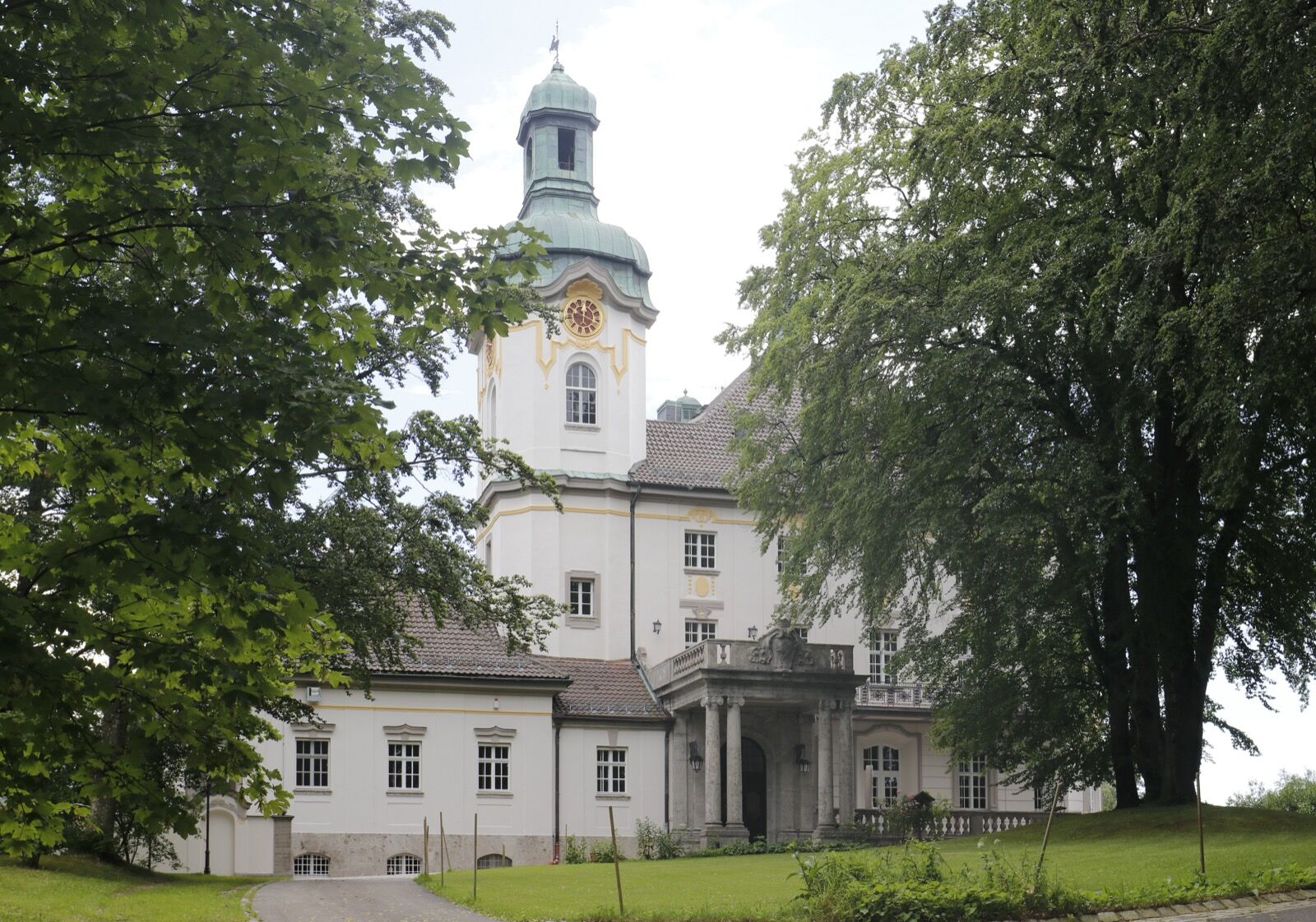
The site was the castle at Haarsee near Weilheim, recorded in the DP inventory under Eberfing. It should not be confused with the better-known Schloss Hirschberg near Beilngries. Church officials negotiated with UNRRA for rooms, and the seminary took over the building on 8 February 1946. Students arrived from different places, including existing German seminaries where they had continued their education during displacement.
Recruitment was initially uncertain: moving into a new institution under relief administration meant giving up relatively secure places elsewhere. By June 1946 a church report registered 72 students, while a list dated 6 June 1946 printed by Blazejowskyj carries 68 names, and its room-assignment list only 62. Some were still studying at other seminaries, so this is an enrolment figure rather than proof that 72 people were simultaneously living in the castle.
Father Vasyl Laba was rector. Father Volodymyr Malanchuk, who taught there, took the building of the library in hand himself. UNRRA provided the material support and it was UNRRA that allotted the house — described in the seminary’s own account as Mussolini’s former residence in Germany — for the students’ use.
Sources for this section
- Geschichte der Ukrainisch-Katholischen Kirche in Deutschland vom Zweiten Weltkrieg bis 1956
- Byzantine Kyivan Rite Students in Pontifical Colleges and in Seminaries, Universities and Institutes of Central and Western Europe (1576–1983)
- DP camp inventory: Schloss Hirschberg, entry 876
- Hirschberg am Haarsee, 1912 postcard
- Українська греко-католицька семінарія у м. Кулемборг, Нідерланди (1948–1950)
Study, books and community
Teaching followed the tradition of the theological academy in Lviv. The planned course lasted five years, with philosophy and theology alongside languages and related subjects. Ukrainian was the language of teaching. Lessons occupied at least five hours a day, and students sat semester and annual examinations. A library eventually held more than 2,000 volumes.
The programme also created a shared cultural life. A student society founded on 31 March 1946 organised educational, artistic and sporting activities. Another association concentrated on religious devotion. Students used a small press for lecture materials and their own publications: Seminarijni Visti appeared in 12 issues, while a humorous paper commented on life inside the seminary. The chapel moved from a music room into a larger castle salon as space became insufficient.
Keeping the seminary open
Food and money remained persistent concerns. Ukrainian communities collected donations; church bodies and overseas organisations contributed funds, books and relief parcels. Relief administration also affected the internal organisation. UNRRA treated the institution as a DP camp and expected the corresponding self-government, whereas the seminary had its own academic and religious leadership.
On 4 December 1946 UNRRA’s representatives said by telephone that they no longer recognised the seminary’s existence, that they regarded the seminarians and their teachers as displaced persons, and that they were to move at once from Hirschberg to the camp at Mittenwald. Lorries came the next day and took them all. Rector Laba and Professor Sopuliak stayed behind at Hirschberg in protest. The camp had no conditions for study, and the interruption lasted about three months before the students and staff returned.
Getting back was not the same as being secure. The apostolic visitator for Ukrainian Catholics in Germany, Father Mykola Voiakovs’kyi, tried to place the seminary in German seminaries, but every option proved too expensive; UNRRA handed the Hirschberg house back to the German authorities and the rent rose sharply. Food for the students came from American aid and through Caritas in Munich. Church negotiations nevertheless secured a rental agreement for the castle on 1 February 1947, and classes restarted there on 15 March. The returning student group was smaller than before the interruption.
Sources for this section
- Geschichte der Ukrainisch-Katholischen Kirche in Deutschland vom Zweiten Weltkrieg bis 1956
- Byzantine Kyivan Rite Students in Pontifical Colleges and in Seminaries, Universities and Institutes of Central and Western Europe (1576–1983)
- Українська греко-католицька семінарія у м. Кулемборг, Нідерланди (1948–1950)
A move to the Netherlands
Cardinal Eugène Tisserand, secretary of the Congregation for the Eastern Churches, raised money for the seminary on a journey to North America, and in Brussels in November 1947 asked the Redemptorist Father van der Male and Bishop Ivan Buchko to look for somewhere in Belgium or the Netherlands. The Dutch Apostolate of Reunion, a society begun after Metropolitan Andrey Sheptytsky’s visit to the Netherlands in 1921 and by then 175,000 members strong, took up the search and offered two houses, one at Sittard and one the Augustinian monastery at Culemborg. Culemborg was chosen. The Augustinians moved into the right wing of their own house and repaired the left wing for the seminary at their own cost, and Dutch donors furnished it. Father van der Male came to Hirschberg twice to see the community he was moving, in September 1947 and in March 1948.
The Dutch military mission granted visas at the end of December 1947, but American permission to leave Germany took months more. The seminary crossed into the Netherlands at Venlo on 24 April 1948 and travelled on by rail through Eindhoven; six professors, two lay teachers among them the musician Myroslav Antonovych, and forty-two seminarians made the journey. Bishop Buchko sang the inaugural liturgy in the Byzantine rite in the monastery chapel at half past nine on the morning of 21 June 1948, with the seminary’s theological choir under Antonovych. The Dutch minister of justice, Johan van Maarseveen, told the professors and students that he hoped the Netherlands would become a second homeland to them. Oleksandr Malynovs’kyi, formerly apostolic administrator of the Lemko region, became president and rector for discipline, and Laba remained rector of the seminary.
The choir carried the seminary’s name around the country and helped pay for it: a four-day tour of Limburg in August 1948, a liturgy and a concert of Ukrainian folk songs at Tilburg in the spring of 1949. At Easter 1949 Dutch Catholic radio broadcast the liturgy from Culemborg live, and it was heard in the Netherlands and by Ukrainians in France, Germany, England, Austria and America, relayed over loudspeakers in the displaced-persons camps. Bishop Buchko announced the seminary’s closure on the same station in February 1950. Ten of its seminarians had been ordained priest there and two deacon; the rest went on to Canada or back to Germany, and in April 1951 the Roman congregation moved the seminary itself to Canada.
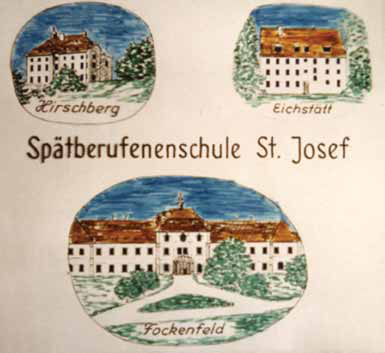
Hirschberg then entered another educational phase. The German Spätberufenenschule St Josef used the castle from 1948 before moving to Fockenfeld. Its later commemorative artwork preserves a small image of Hirschberg alongside its other homes. This was a successor institution, separate from the Ukrainian displaced students’ seminary.
A school in displacement
| Stage | Location | Meaning |
|---|---|---|
| 1946 | Hirschberg am Haarsee | Seminary under UNRRA administration |
| Winter 1946–47 | Mittenwald | Temporary displacement; teaching interrupted |
| Spring 1947–spring 1948 | Hirschberg am Haarsee | Return under rental agreement |
| 1948–1950 | Culemborg, Netherlands | Seminary continues abroad |
What became of the house
From 1961 until June 2000 the Federal Intelligence Service ran its training academy for higher civil-service entrants in the building under the cover name Wildpark, and in 1984 the heads of the Western intelligence services met there as the Berne Club. The federal property office then put the house up for sale at 3.9 million euros. A buyer took it in 2004 for an equestrian resort that the courts stopped in 2011, a hotel scheme failed against state planning rules in 2016, and since the summer of 2018 it has been in private hands. The town of Weilheim bought the Haarsee itself, some 6.4 hectares, in 2012 to keep the shore open to the public.
Sources for this section
Sources
- Geschichte der Ukrainisch-Katholischen Kirche in Deutschland vom Zweiten Weltkrieg bis 1956
Bernadetta Wojtowicz / Harrassowitz · 2000
Archival research, pp 100–115: seminary creation, UNRRA conflict, Mittenwald transfer, return, curriculum and Netherlands relocation. Page 103 visually read because OCR blank.
- Byzantine Kyivan Rite Students in Pontifical Colleges and in Seminaries, Universities and Institutes of Central and Western Europe (1576–1983)
Dmytro Blazejowskyj · 1984
Printed pp 36–37: opening 8 February 1946, April 1948 departure, five-year Ukrainian-language study, library and student organisations. Some dates differ from Wojtowicz; precise return date not assumed.
- DP camp inventory: Schloss Hirschberg, entry 876
Arolsen Archives · 26 October 2023
Eberfing/Kreis Weilheim, AC 95-412, Team 194. Administrative DP camp closing range 1946–47 does not mark the end of the later independently rented seminary.
- 60 years of Fockenfeld
Licht / Oblates of St Francis de Sales · 2006
Printed p 21: successor school at Hirschberg 1948–1955; original commemorative artwork depicts Hirschberg, Eichstätt and Fockenfeld. Dates describe subsequent school, not Ukrainian seminary.
- Hirschberg am Haarsee, 1912 postcard
Wikimedia Commons / Lech-Isar-Land · 1912
Historical view identifies the castle at Haarsee, not Hirschberg near Beilngries. Asset retrieval 403; not included as local photograph.
- Schloss Hirschberg am Haarsee, Landkreis Weilheim-Schongau
Henning Schlottmann, via Wikimedia Commons · 27 June 2020
Photograph licensed CC BY-SA 4.0. Shows the castle at Haarsee near Weilheim, the building the Ukrainian seminary took over from UNRRA on 8 February 1946.
- Schloss Hirschberg am Haarsee, picture postcard of 1912
Postcard reproduced in Lech-Isar-Land 2011, Heimatverband Lech-Isar-Land e.V., Weilheim in Oberbayern; via Wikimedia Commons · 1912
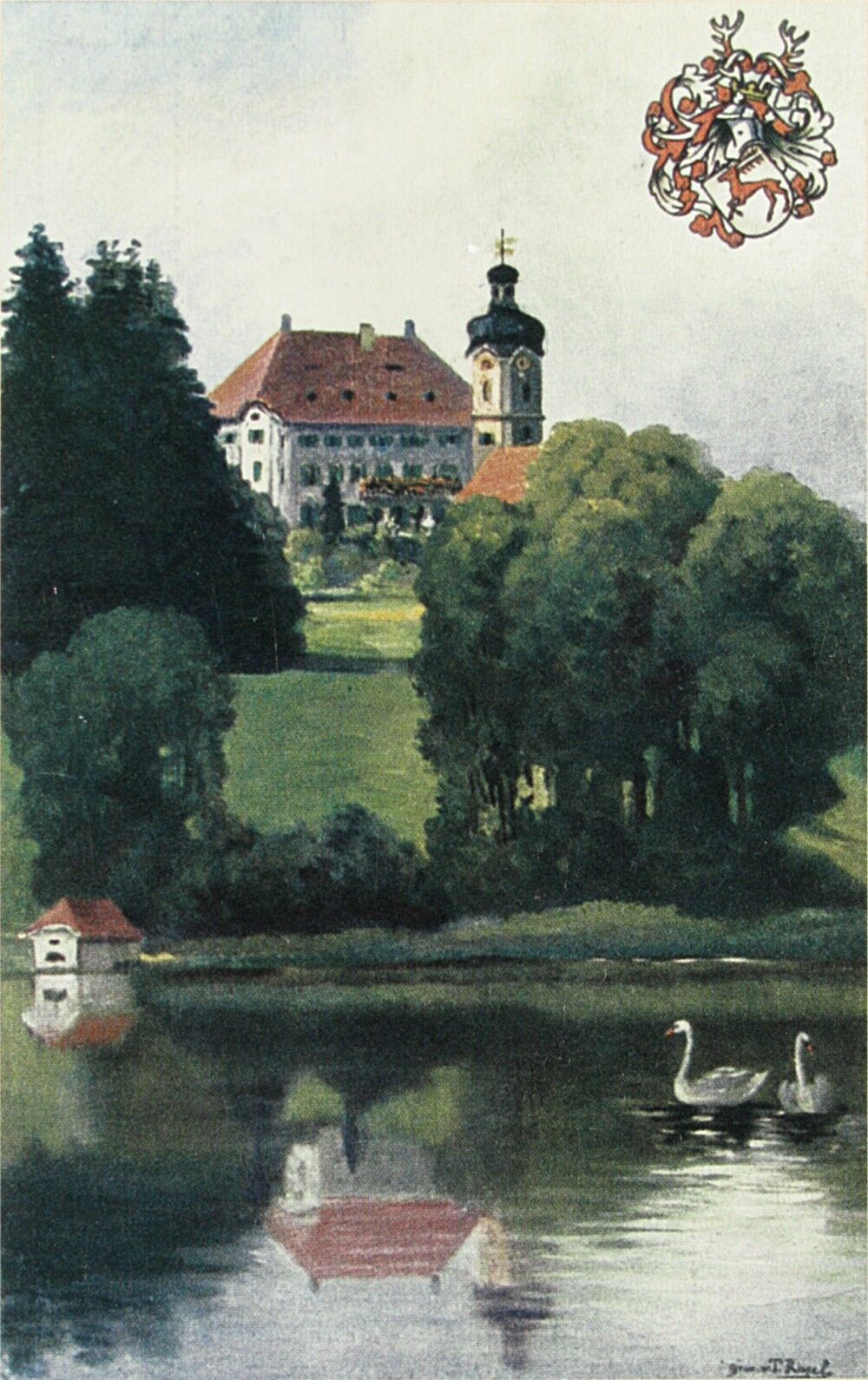
Public domain by reason of age. A picture postcard of the castle and its grounds, showing the building as it stood a generation before the seminary arrived.
- Schloss Hirschberg am Haarsee
German Wikipedia, citing Georg Paula and Stefanie Berg-Hobohm, Landkreis Weilheim-Schongau (2003), Klaus Gast, Die Geschichte der „Schwaige Haarsee“ (2011) and Volker Koop, In Hitlers Hand (2010) · Article read 14 September 2026
Full article read: the medieval dairy farm on the site, the building of the house in 1907–1909, its architect, cost and fittings, the Bleichröder tenancy, the 1943 confiscation and the guests held there, the post-war uses of the house and its sale. The cited literature has not been inspected.
- Українська греко-католицька семінарія у м. Кулемборг, Нідерланди (1948–1950)
Ukrainian People magazine, Chicago; drawing on Fr Volodymyr Malanchuk’s own account in the Dutch journal Volksmissionaris, no. 65, November 1948, and on Dutch newspaper reports · 4 September 2021
Full article read. Gives the rector and library-builder at Hirschberg, the UNRRA telephone call of 4 December 1946 and the removal to Mittenwald, the negotiations that followed, the crossing into the Netherlands on 24 April 1948 and the numbers who made it, the inauguration at Culemborg on 21 June 1948 and its guests, the choir’s Dutch tours and the Easter 1949 broadcast, and the closure announced in February 1950. Malanchuk’s original article has not been inspected.
- An Eccentric from an Esteemed Family (biography of James von Bleichröder)
kunst-raub-rueckgabe.de, by Anke Luensmann · 30 June 2025
Sections ‘A Bavarian idyll’ and ‘Art, culture, and fast cars’ read: the move of the von Bleichröder family to Hirschberg Castle in 1923 and the transfer of most of James von Bleichröder’s art collection there. The page carries nothing on 1946–1948.
Last researched 14 September 2026