Hötting Camp
Displacement in Europe
Höttinger Au, Innsbruck, Tyrol, Austria · Postwar refugee accommodation, 1945–1964
Ukrainians formed a small national group in a refugee camp on Innsbruck’s western edge, in the French occupation zone. Its wooden huts, built for prisoners of war in 1915, went on sheltering families until about 1964.
Introduction
Hötting Camp occupied land between the Gießen watercourse and Scheuchenstuelgasse in the Höttinger Au, on the western edge of Innsbruck. The site was built in 1915 for Russian prisoners of war and was reused for refugees after the Second World War. Its wooden huts became part of the city’s answer to a severe housing shortage.
Hötting had been a separate municipality until it was incorporated into Innsbruck in 1938. The camp therefore stood in what had recently become a city district rather than in the historic centre.
Sources for this section
A history in dates
- 1915The original camp is built for Russian prisoners of war.
- 1938Hötting is incorporated into the city of Innsbruck.
- Spring 1946UNRRA’s direct camp work in the French zone is concentrated on Kufstein and Landeck; Hötting is administered by the French authorities.
- 1947Eighteen priests serve almost 10,000 Ukrainians across Tyrol.
- 30 September 1948An IRO return records 41 Ukrainian residents at Hötting.
- 30 June 1950An IRO return records 31 Ukrainian residents.
- Autumn 1956Refugees from the Hungarian rising are housed in the Innsbruck camps.
- 1957Twelve huts house 135 households.
- 1960Sixty-five households remain.
- Around 1964The last refugee families are rehoused and the huts demolished.
The Ukrainian residents
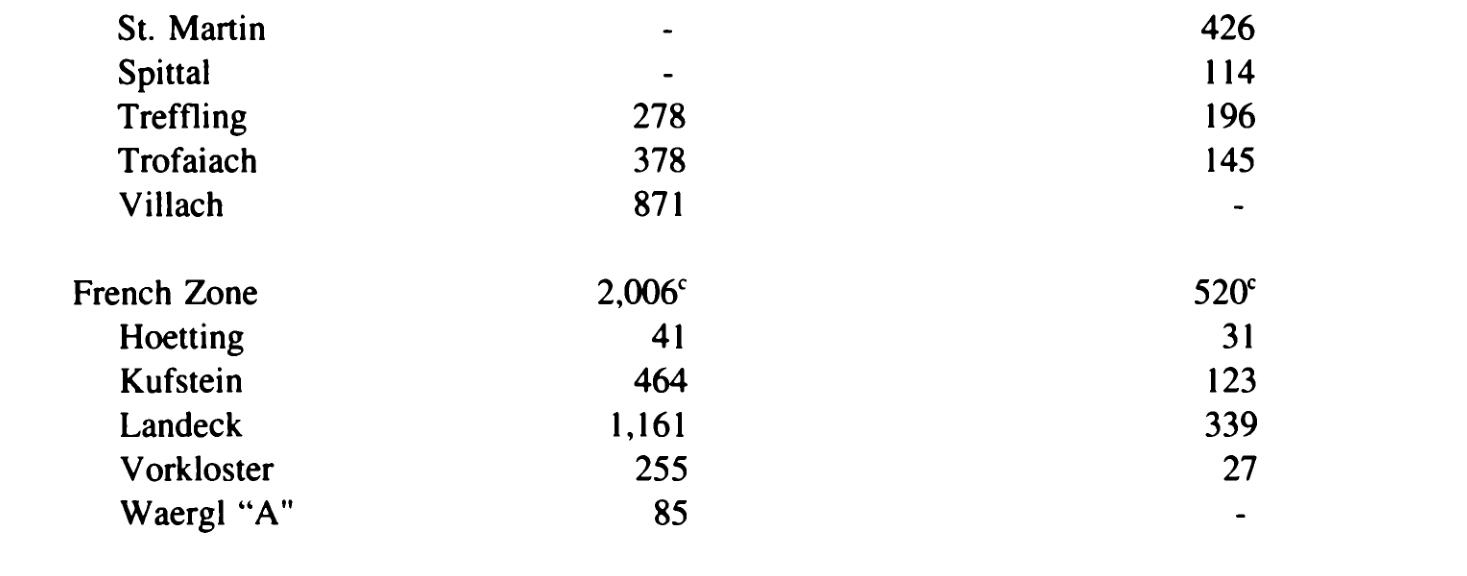
Ihor Stebelsky’s Table 5 of Ukrainians in the PCIRO or IRO camps of Austria lists Hötting in both of its columns: 41 Ukrainians on 30 September 1948 and 31 on 30 June 1950. The figures come from returns of the IRO Field Service Office in Salzburg held in the Archives nationales de France. They count a nationality, not families and not everyone accommodated on the site.
The same table gives 2,006 Ukrainians in the French zone of Austria on 30 September 1948 and 520 on 30 June 1950, with much larger groups at Landeck and Kufstein. Hötting was one of the small entries in that list. Its inclusion matters because the settlement pattern extended beyond the best-known assembly centres to modest communities attached to established towns.
Ukrainians recorded in the IRO returns for the French zone of Austria
| Camp or zone total | 30 September 1948 | 30 June 1950 |
|---|---|---|
| Hötting | 41 | 31 |
| Kufstein | 464 | 123 |
| Landeck | 1,161 | 339 |
| Vorkloster | 255 | 27 |
| Wörgl A | 85 | no entry |
| French zone total | 2,006 | 520 |
Sources for this section
Within the French occupation zone
Archival research by Julia Maspero places Hötting among the camps administered by the French authorities rather than UNRRA during the early occupation. In spring 1946 UNRRA’s direct camp responsibility in the zone was concentrated on Kufstein and Landeck. Management arrangements therefore differed even between camps sheltering people with similar displaced-person status.
The Wörgl museum exhibition, listing the Tyrolean camps that UNRRA organised, names Landeck, Haiming, Kematen, Kufstein and Wörgl A, and does not include Hötting. The two accounts agree in leaving Hötting outside the UNRRA camp network, even though its residents later appear in IRO nationality returns.
Ukrainian life in Tyrol
The Ukrainian population of the province was far larger than any one camp. Tyrol counted almost 10,000 Ukrainians in the postwar years, more than 7,000 of them Greek Catholic, and in 1947 eighteen priests served them. Most were pushed onward to North America and Australia by conditions in Austria, so the Ukrainian population of the province fell sharply during the 1950s.
The organised centre of that community lay elsewhere in Tyrol. Landeck had a Greek Catholic deanery that published the weekly Nedilni Visti from October 1945 to August 1947, and the daily Taborovi Visti ran there from June 1945 to June 1947. Innsbruck itself was a student centre: the journals Na Varti from September 1945, Stezhi from June 1946, Studentskyi Shliakh and Zveno were published in the city, and the IRO archive holds a file on a student centre at Innsbruck covering June 1949 to June 1950.
None of those titles or institutions is recorded as belonging to Hötting camp. They describe the town and the province around it, and they show what the small group counted at Hötting could reach on foot or by post.
Huts that became long-term homes
Bomb damage, a rising population and requisitioned apartments intensified Innsbruck’s housing shortage: the city held about 91,000 people in 1945 and about 99,000 in 1947. At Hötting temporary accommodation endured. Twelve huts housed 135 households in 1957, and 65 households remained in 1960. Sanitary conditions were poor.
The Hungarian rising of autumn 1956 brought a further wave of refugees, and the Innsbruck camps were used to house them before most emigrated to North America or Australia. The final 68 ethnic-German refugee families were rehoused around 1964, when the remaining huts were demolished.
Sources for this section
The camp entrance
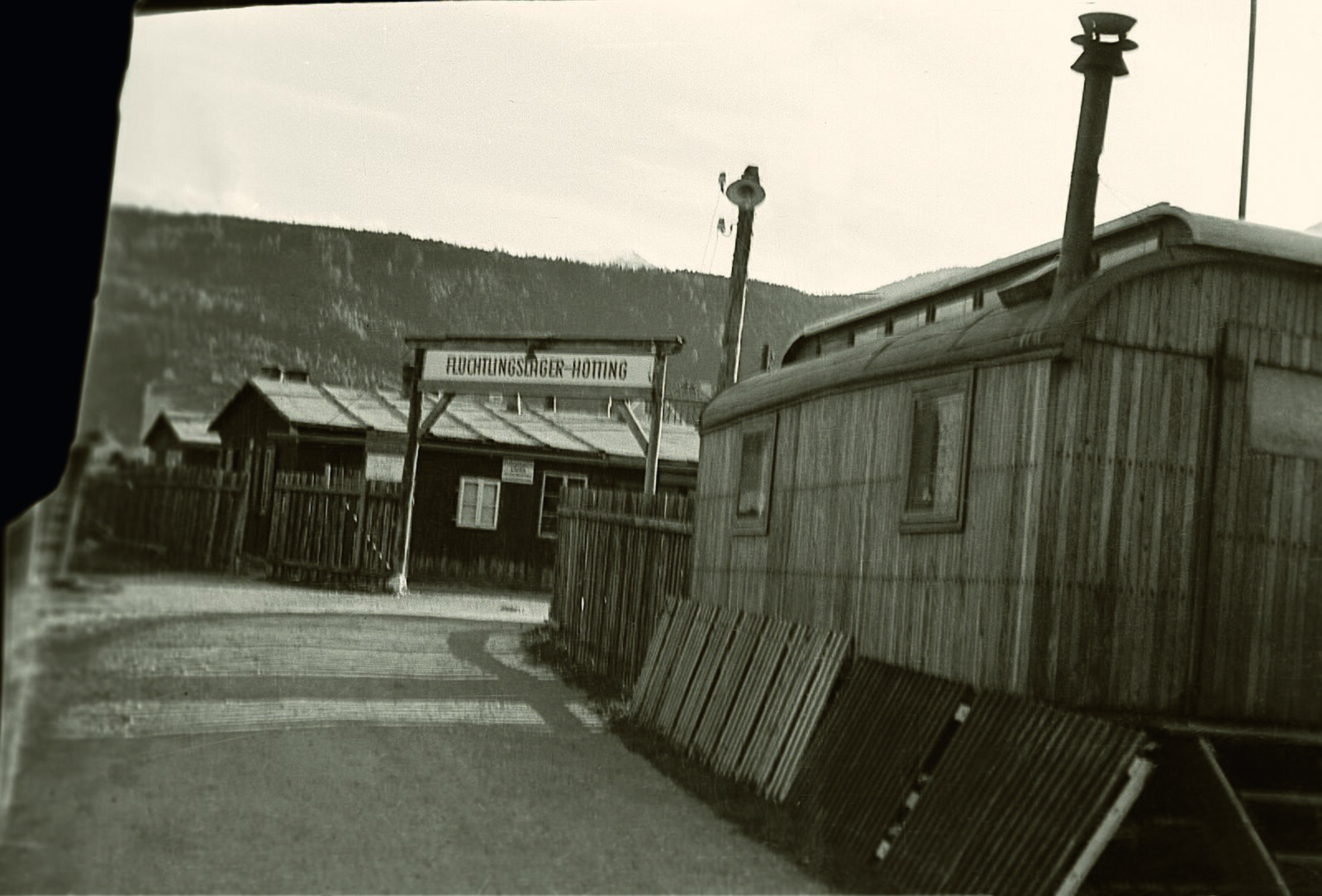
The city archive’s photograph shows a sign identifying the refugee camp above the entrance. Long timber buildings line the passage, with stove pipes rising above the roofs and fencing along the frontage. It preserves the scale and materials of accommodation that could easily disappear behind a population total. The archive does not supply an exact date for the photograph.
Sources for this section
Sources
- Flüchtlingslager Hötting
Lukas Morscher, Stadtarchiv/Stadtmuseum Innsbruck · 7 July 2020
Exact site, housing history and original photograph Kr/Ne-593. Full article and photograph inspected.
- Ukrainian Population Migration after World War II, Table 5
Ihor Stebelsky, in The Refugee Experience: Ukrainian Displaced Persons after World War II (Edmonton: CIUS Press) · 1992
Appendix, Table 5, “Ukrainians in the PCIRO or IRO Camps of Austria”, printed page 43 (PDF page 70). Page image rendered from the PDF and read directly. The two columns are headed 30 September 1948 and 30 June 1950, and footnote a cites the IRO Field Service Office return for the end of September 1948, Archives nationales de France, AJ 43, box 1119. Stebelsky’s earlier 1986 printing in Ukrainskyi Istoryk carries the same figures as Table 6, printed page 49, where the first column is headed 31 August 1948 against the same footnote.
- La politique française à l’égard des personnes déplacées, identique en Allemagne et en Autriche après la seconde guerre mondiale ?
Julia Maspero, Austriaca 95 · 2022; online 2023
Printed page 69, relevant passage read in search-indexed original PDF. Full retrieval returned publisher anti-bot screen; no claim to have inspected underlying archival files.
- 120 Jahre ukrainisch-katholische Gemeinde Innsbruck
Liborius Lumma, Andreas-Petrus-Werk · 7 October 2019
Full article read. Gives almost 10,000 Ukrainians in Tyrol, over 7,000 Greek Catholic, and eighteen priests in 1947. Province-level figures, not camp figures.
- NS-Zwangsarbeit: Das vergessene Lager in Wörgl, postwar panel
Heimatmuseumsverein Wörgl / Anne Frank Verein Österreich · 2016
Exhibition PDF read. Cited here for the Tyrolean DP total and for the list of UNRRA-organised camps in Tyrol, which does not include Hötting.
- Research Report No. 2: Political Refugees and “Displaced Persons”, 1945–1954
Yury Boshyk and Boris Balan, Canadian Institute of Ukrainian Studies · 1982
Printed page 41 for the IRO file “Centre d’étudiants d’Innsbruck, juin 1949 - juin 1950” in Archives nationales de France AJ 43 983; printed pages 221–223 for Ukrainian periodicals published at Innsbruck and Landeck. Place-of-publication entries, not camp attributions.
Last researched 13 September 2026