Jaworzno
Displacement in Europe
Jaworzno · Poland · Ukrainian detention: 1947–1949
Ukrainians and Lemkos detained during Operation Vistula were imprisoned in a separate section of the Central Labour Camp at Jaworzno, on the site of a former Auschwitz subcamp. Close to four thousand people passed through it and more than 160 died there.
Introduction
Jaworzno’s Central Labour Camp, Centralny Obóz Pracy or COP, was a place of detention under Poland’s communist authorities. In 1947 a separate Ukrainian section became part of the repression accompanying Operation Vistula. Thousands of Ukrainians and Lemkos were imprisoned there as families elsewhere were expelled from their homes and dispersed across northern and western Poland.
A history in dates
- June 1943The German Neu-Dachs subcamp opens.
- February 1945Polish communist authorities take over the German camp buildings; a central labour camp is organised there.
- 23 April 1947The Politburo decides to create a transit camp for suspected Ukrainians at Jaworzno.
- 25 April 1947Department III of the Ministry of Public Security issues two instructions on the handling of deported Ukrainians.
- 9 May 1947The first transport of Ukrainian civilians reaches Jaworzno.
- November 1947A reduction in pressure on Ukrainians is ordered.
- December 1947Releases from the Ukrainian section begin at the end of the month.
- March 1948More than 3,000 people have been released from the Ukrainian section.
- 8 January 1949The separate Ukrainian and Lemko section is formally closed.
- 1951–1956An experimental prison for young political prisoners operates from 1951 to 1955; the Central Prison at Jaworzno is wound up in August 1956.
- 23 May 1998A monument at the burial ground is unveiled by the presidents of Poland and Ukraine.
Sources for this section
- Neu-Dachs
- Centralny obóz pracy Jaworzno 1945–1949, including the section ‘Podobóz ukraiński’
- Nieznane instrukcje MBP dotyczące akcji ‘Wisła’
- Policy towards the Ukrainian community, 1944–1956
- В Явожно вшанували пам’ять українських жертв польського концтабору
- Obóz II Totalitaryzmów: the permanent exhibition
- 78. rocznica akcji ‘Wisła’
A site with successive regimes
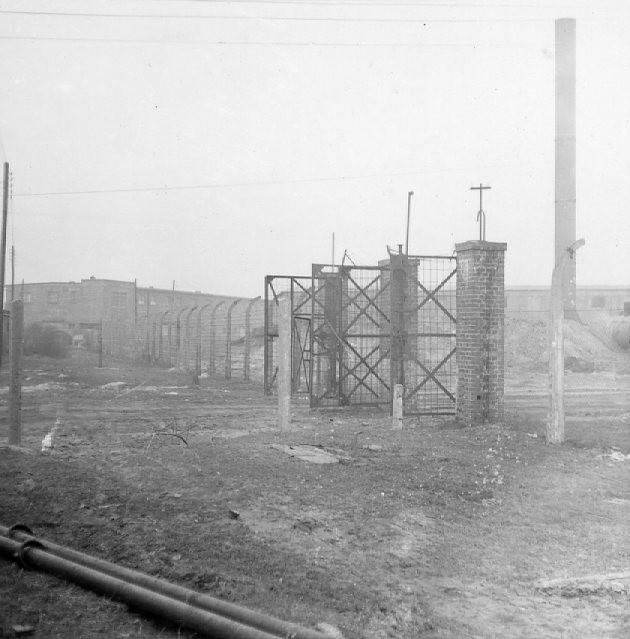
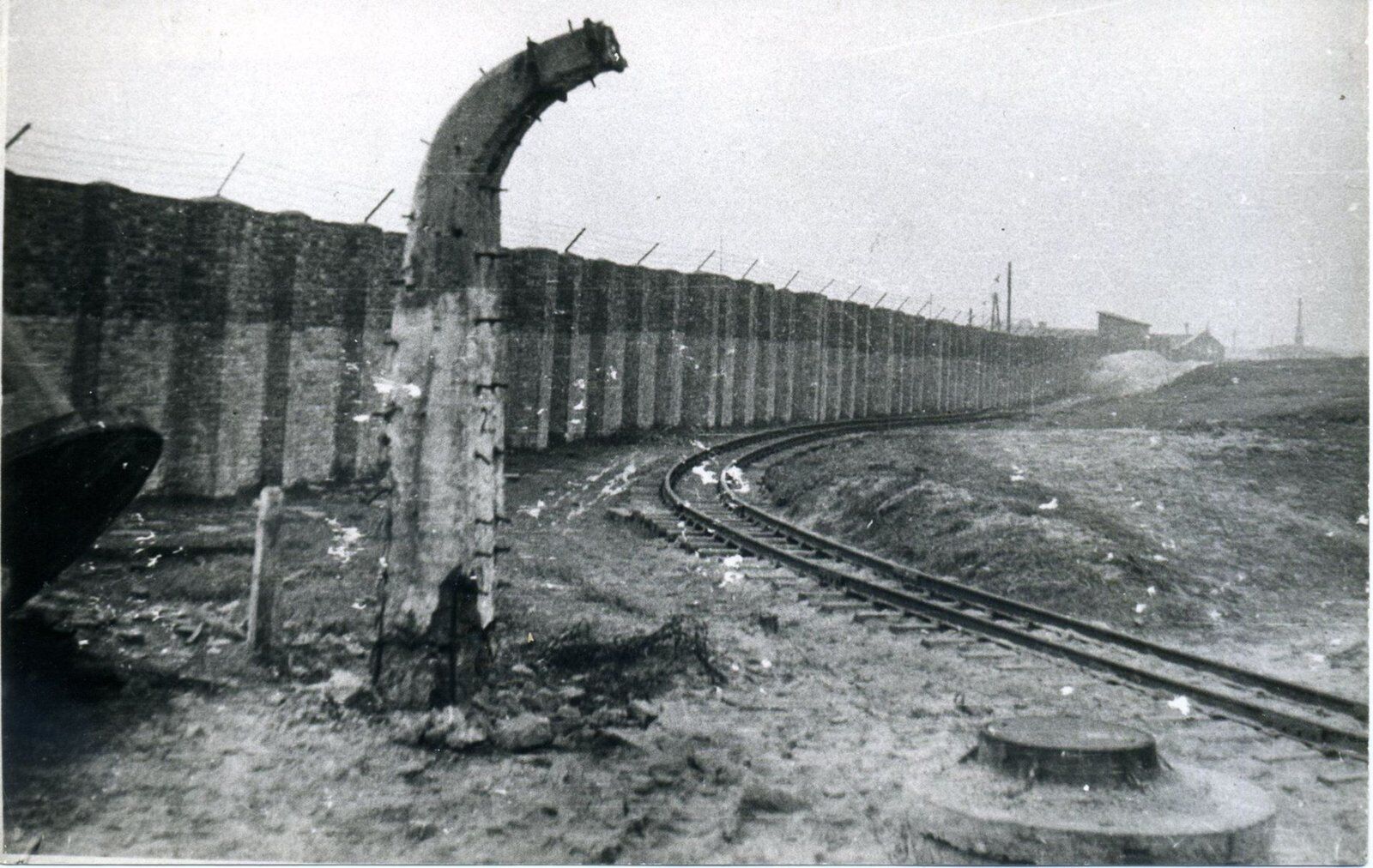
The German authorities had established Neu-Dachs, an Auschwitz subcamp, in June 1943 to supply labour to local coal mines. Electrified fencing enclosed residential huts and service buildings. Exhausting work, poor conditions and selections of prisoners deemed unfit for labour were central to its operation. In January 1945 many prisoners were forced on a long evacuation march towards Gross-Rosen.
In 1945 the new Polish authorities reused the German camp infrastructure for COP Jaworzno. The Ukrainian section belonged to this later institution, under different authorities. After the labour camp’s closure in 1949 the site was rebuilt for a prison for young political prisoners, followed by a central prison that closed in 1956.
Conversion into a prison began in June 1949. The experimental prison for young political prisoners worked from 1951 to 1955 and closed, as the Central Prison at Jaworzno, in August 1956.
Successive institutions on the site
| Period | Institution |
|---|---|
| 1943 to 1945 | Neu-Dachs, a subcamp of Auschwitz |
| 1945 to 1949 | Central Labour Camp, Ministry of Public Security |
| 1947 to 1949 | Ukrainian and Lemko section within that camp |
| 1951 to 1955 | Experimental prison for young political prisoners |
| 1956 | Central Prison at Jaworzno, wound up in August |
The decision of April 1947
The Politburo of the Polish Workers’ Party decided on 29 March 1947 to resettle the Ukrainian population, and on 23 April 1947 to create a transit camp for suspected Ukrainians inside the Jaworzno camp. The first transport reached it on 9 May 1947. Instructions signed on 25 April 1947 by Lieutenant Colonel Józef Czaplicki of the Ministry of Public Security ordered county offices to scatter arriving families and recruit informers among them.
Operation Vistula and detention
Operation Vistula followed the earlier forced movement of Ukrainians from Poland to Soviet Ukraine. In 1947 the authorities deported about 150,000 Ukrainians and Lemkos within Poland instead. Jaworzno was a detention destination within that campaign; it was not the destination of every deported family.
Security officers screened deportees at collection points, searching for suspected links to the Ukrainian underground and recruiting informants. Suspects could be sent to Jaworzno. Suspicion and collective responsibility shaped this process: detention did not mean that everyone held had been convicted of an offence.
People reached the section by arrest on a charge of collaboration with the Ukrainian Insurgent Army, often fictitious, or by selection out of deportation transports at the filtration point at Oświęcim.
Inside the Ukrainian section
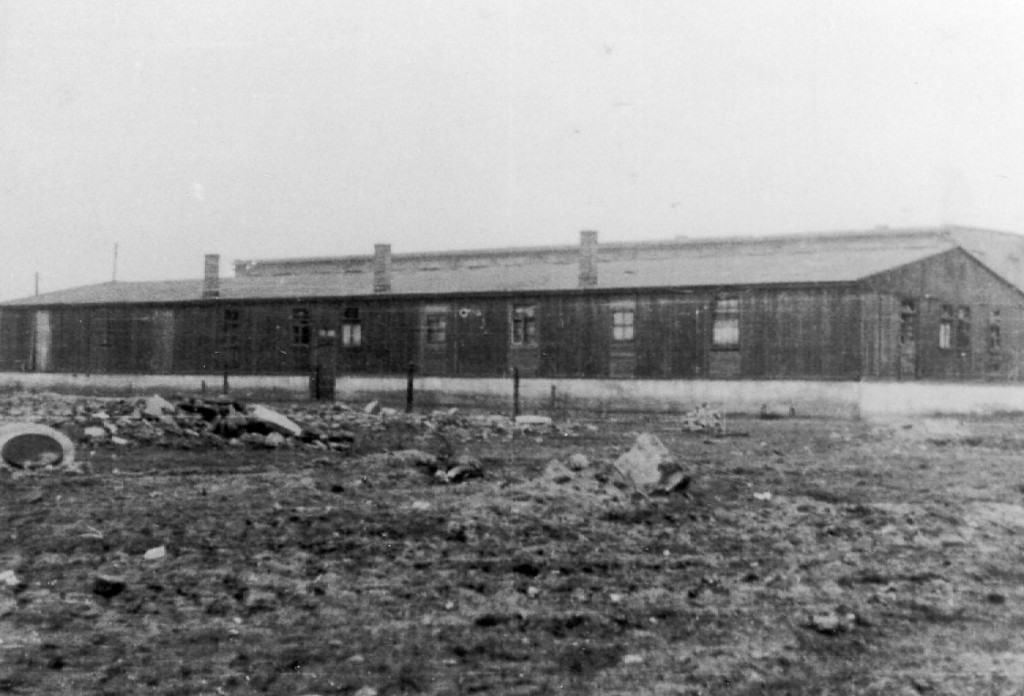
No separate camp was built. The Ukrainians were held in a fenced off part of the Central Labour Camp, barracks 8 to 15: women in barracks 8 and 9, men in barracks 10 to 14, and barrack 15 used for interrogations. These were run by a special investigative group of the Ministry of Public Security with soldiers of the Internal Security Corps. The commandants were Captain Stanisław Kwiatkowski and, from March 1948, Lieutenant Teofil Hazelmajer.
A Ukrainian historical encyclopaedia describes the ground the detention inherited: fifteen wooden barracks and several brick buildings on 6.6 hectares, the barracks fitted with triple-tiered plank bunks, the whole enclosure ringed by a double row of barbed wire and twelve guard towers with machine guns and searchlights.
Layout of the Ukrainian section
| Barracks | Use |
|---|---|
| 8 to 9 | Women |
| 10 to 14 | Men |
| 15 | Interrogations |
Conditions, work and food
Conditions are recorded for the camp as a whole rather than the Ukrainian section alone: severe overcrowding, with a Red Cross delegation in December 1947 finding prisoners sleeping two to a bed, and prisoners hired out to Silesian and Kraków collieries.
Hunger dominates the published testimony of Father Mitrate Stepan Dzyubyna, a Greek Catholic priest held in the camp: “The most painful was the hunger. We were constantly hungry, dry as ghosts... All this led to the condition that after four months, prisoners were swelling from hunger, falling lifeless during the morning roll call. Sometimes, several corpses were carried out in one roll call.”
The same account records violence as a daily reality for the imprisoned Ukrainians: beatings during meal distribution, in the washroom and while queuing for the toilet, and above all during interrogations, from which prisoners could return with broken ribs, knocked-out teeth and torn-off fingernails.
Prisoners and losses
The Ukrainian section held people subjected to harsh interrogation and damaging living conditions. Published research records thousands passing through it and more than 160 deaths. The detained community included Greek Catholic and Orthodox clergy, whose imprisonment also disrupted the religious life of the displaced population.
Published totals differ: the Institute of National Remembrance gives almost 4,000 held, 162 deaths and 27 clergy, 22 Greek Catholic and five Orthodox, while the Jaworzno museum portal gives 3,871 and 161. Indictments were drawn against 547 people, who were sent to the prison in Kraków. The Ukrainian Institute of National Memory, cited in a 2025 press account, gives close to 4,000 imprisoned and around 200 deaths attributed to torture.
Published figures for the Ukrainian section
| Measure | Figure | Source scope |
|---|---|---|
| People interned | 3,873 | Pisuliński, 2004 |
| People interned | 3,871 | Muzeum Miasta Jaworzna portal; IPN Przystanek Historia |
| People interned | almost 4,000 | IPN publication description, 2012 |
| Deaths | 161 | Pisuliński, 2004; Muzeum Miasta Jaworzna portal |
| Deaths | 162 | IPN publication description, 2012 |
| Clergy detained | 27 | 22 Greek Catholic and 5 Orthodox, IPN, 2012 |
| Sent to Kraków with indictments | 547 | Muzeum Miasta Jaworzna portal |
| Released by March 1948 | more than 3,000 | Muzeum Miasta Jaworzna portal |
Release did not restore the old life
A reduction in pressure on Ukrainians was ordered in November 1947, and releases from Jaworzno followed in early spring 1948. Returning to a home village remained restricted. Some former prisoners received permission, while people returning without authorisation could be removed again. For many families, release therefore meant joining a dispersed community rather than recovering the life they had left.
More than two thousand decisions to discontinue proceedings were ready by September 1947, yet most of those concerned were held for nearly another year. Releases began at the end of December 1947 and more than 3,000 people had left by March 1948. The section closed formally on 8 January 1949.
Deaths and the burial ground
The camp’s dead were buried first in the parish cemetery in Jaworzno and later in woodland south west of the Jan Kanty colliery. Published totals for the whole camp and its subordinate sites vary widely and are not a measure of the Ukrainian section.
Preserving the history
The city museum’s permanent exhibition, opened in 2014, brought together original objects from successive periods: a German-era prisoner uniform, a COP prisoner’s rosary, concrete fence posts and barbed wire. Reconstructions helped explain the buildings while preserving the distinction between original objects and recreated settings. The exhibition presents the camp’s changing institutions as a connected history of one site.
A monument at the burial ground was unveiled on 23 May 1998 in the presence of Presidents Aleksander Kwaśniewski and Leonid Kuczma, with tablets in Polish, Ukrainian and German. Commemorations are held each September with the Association of Ukrainians in Poland.
Sources
- Policy towards the Ukrainian community, 1944–1956
Jan Pisuliński, Pamięć i Sprawiedliwość 6/2, pp. 161–184 · 2004
Full text, particularly pp. 177–179, supports screening, internment totals and the circumstances of release.
- The Ukrainian and Lemko experience of postwar deportations in Poland
Volksbund Deutsche Kriegsgräberfürsorge · Accessed 2026
Institutional educational account distinguishing deportation to Soviet Ukraine from Operation Vistula within Poland.
- Neu-Dachs
Auschwitz-Birkenau State Museum · Accessed 2026
The museum’s account and archival photographs describe the German subcamp and its surviving site.
- Jaworzno 1943–1956: the city museum’s permanent exhibition
Museum of the City of Jaworzno / Institute of National Remembrance · 30 October 2014
Institutional account of the site’s successive regimes and original objects preserved in the exhibition.
- Greek Catholic and Orthodox clergy in COP Jaworzno, 1947–1949
Igor Hałagida, editor / Institute of National Remembrance · 2012
Publisher’s description: detention, deaths and clergy in the Ukrainian section.
- Centralny obóz pracy Jaworzno 1945–1949, including the section ‘Podobóz ukraiński’
Muzeum Miasta Jaworzna, portal ‘Obóz dwóch totalitaryzmów’ · 2014, accessed 2026
Museum portal published under CC BY-SA 3.0 Poland, drawing on Ł. Kamiński, E. Misiło, G. Motyka, K. Miroszewski and A. Dziurok in ‘Obóz dwóch totalitaryzmów. Jaworzno 1943–1956’ (2007). Supports the Politburo decisions, the first transport, the barrack numbers, interrogation, staff, releases and burial.
- Obóz II Totalitaryzmów: the permanent exhibition
Muzeum Miasta Jaworzna · Accessed 2026
Museum page giving the dates of the successive institutions on the site, including the juvenile political prison of 1951–1955 and the Central Prison of 1956.
- 78. rocznica akcji ‘Wisła’
Urząd Miejski w Jaworznie · 27 September 2025
City account of the annual commemoration, the location of the burial ground and the monument unveiled on 23 May 1998 by Presidents Kwaśniewski and Kuczma, with the trilingual inscription.
- В Явожно вшанували пам’ять українських жертв польського концтабору
Ukrinform · 18 September 2017
Ukrainian agency report on the annual commemoration at Jaworzno and on the formal closure of the Ukrainian and Lemko section on 8 January 1949.
- Nieznane instrukcje MBP dotyczące akcji ‘Wisła’
Igor Hałagida, Pamięć i Sprawiedliwość 6/2, pp. 359–364 · 2004
Documentary edition of the two instructions of 25 April 1947 signed by Lieutenant Colonel Józef Czaplicki, with the note that the instructions on arrest and imprisonment at Jaworzno remain unfound. Same journal issue as source 1.
- Akcja ‘Wisła’. Zasada odpowiedzialności zbiorowej
Michał Wenklar, Przystanek Historia / Institute of National Remembrance · 20 April 2020
IPN popular history article describing detention without sentence at Jaworzno and attributing the 161 deaths to typhus, hunger, exhausting work and torture.
- Operation “Vistula”: Deportations of the Ukrainian Population from Poland
deportation.org.ua, Encyclopedia section (Anastasiia Saienko; editors Oleksii Havryliuk and Maksym Sushchuk) · Accessed 14 September 2026
Section “Jaworzno Camp” read in full: detention without judicial decisions; the camp’s layout of fifteen wooden barracks and several brick buildings on 6.6 hectares, with triple-tiered plank bunks, a double row of wire and twelve guard towers; a quoted testimony by Father Mitrate Stepan Dzyubyna on hunger; and an account of beatings and of injuries from interrogation. The article’s own reference list points to a study of Ukrainians at Jaworzno, 1945–1949, and to a published camp memoir, neither of which was read here.
- Operation Vistula: the expulsion of Ukrainians from post-war Poland
Martin Fornusek, The Kyiv Independent · 4 August 2025
Body text read for the figures attributed to the Ukrainian Institute of National Memory: close to 4,000 Ukrainians imprisoned at Jaworzno, of whom around 200 died of torture.
Last researched 13 September 2026