Kaiser-Wilhelm-Kaserne
Displacement in Europe
Amberg, Bavaria, Germany · Displaced-person accommodation, opened 24 January 1946, closed between 30 September 1949 and 30 September 1950
The largest of Amberg’s registered displaced-persons camps occupied a nineteenth-century infantry barracks, with accommodation for 2,600 people and Polish, Polish-Ukrainian and Russian residents on the register. A Ukrainian newspaper notice places a displaced Ukrainian contact there in March 1946, before the local histories say civilian accommodation began.
Introduction
Kaiser-Wilhelm-Kaserne was the largest single piece of displaced-person accommodation in postwar Amberg. The Arolsen inventory records it as opening on 24 January 1946 with a capacity of 2,600, and lists its population categories as Polish, Polish-Ukrainian and Russian. A Ukrainian-language newspaper notice gives the barracks as a family-tracing contact address as early as March 1946. A later local history describes American troops using the site after 1945, under the name Fort Hess through 1947, followed by accommodation for Poles and Ukrainians. The register and the newspaper establish the earlier civilian presence; the local history’s sequence of military and civilian use needs to be read with that evidence in mind.
A history in dates
- April 1866Construction begins on the barracks.
- 1889The first battalion of the 6th Infantry Regiment moves into the barracks.
- 21 April 1945A police account records the barracks locked in the last days of the war.
- 24 January 1946The inventory records the assembly centre as opening.
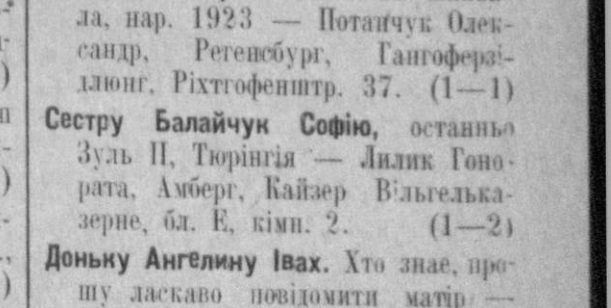
- 24 March 1946Honorata Lylyk’s notice in Slovo gives block E, room 2 at the barracks as the reply address in the search for her sister.
- 1 May 1946A Latvian newspaper register lists a DP camp at the Kaiser-Wilhelm-Kaserne in Amberg.
- 1947The name Fort Hess falls out of use, and the local dossier has accommodation for Poles and Ukrainians follow.
- 31 October 1947Capacity is recorded as 2,600.
- January 1949Kaiser-Wilhelm-Kaserne is one of four DP accommodation sites in Amberg.
- Between 30 September 1949 and 30 September 1950The inventory places the closure of the camp within this interval.
- 1951Federal Border Guard personnel use the premises.
- 1956Soldiers return to the site.
- October 1995The college opens in the former barracks.
Sources for this section
The barracks in the final days of war
Jakob Stein’s retrospective police account describes an incident on 21 April 1945. A German non-commissioned officer brought six captured soldiers to the police station and was directed to Kaiser-Wilhelm-Kaserne. He returned saying the barracks was locked and that he had released the prisoners. This episode belongs to the collapse of wartime authority, before the displaced-person accommodation documented here.
Sources for this section
The camp in the register
The inventory record for the barracks gives an opening date of 24 January 1946 and a closing date somewhere between 30 September 1949 and 30 September 1950. Capacity was 2,600 on 31 October 1947, well over three times the figure recorded on the same date for the Aufbauschule camp in the same town. The assembly-centre identifiers were AC 93-375 A, AC 93-447 and AC 275, later NBO-481, and supervision came from UNRRA Team 133 at Amberg and Team 570 at Vilseck.
Capacity is registered provision on one date and not an occupancy figure, and the three recorded categories are not a breakdown. The record’s own archive references point to the monthly returns for Amberg among the papers of the International Tracing Service and to files at the Staatsarchiv Amberg, including the district’s monthly reports to the military government on inhabitants, refugees and displaced persons for 1945 to 1950.
The camp in the register
| Record | Detail |
|---|---|
| Name in the register | Kaiser Wilhelm Kaserne |
| Opening | 24 January 1946 |
| Closing | Between 30 September 1949 and 30 September 1950 |
| Capacity | 2,600 on 31 October 1947 |
| Assembly centre | AC 93-375 A; AC 93-447; AC 275; later NBO-481 |
| UNRRA teams | T 133 Amberg; T 570 Vilseck |
| Population categories | Polish, Polish-Ukrainian, Russian |
Sources for this section
Searching for a sister
On 24 March 1946, the Regensburg Ukrainian weekly Slovo printed a tracing notice from Honorata Lylyk, looking for her sister Sofia Balaichuk, last reported in Suhl II in Thuringia. The reply address was specific: Amberg, Kaiser-Wilhelm-Kaserne, block E, room 2. Among columns of similar searches, this small announcement connects the barracks to the effort to reunite families separated by war. It records a contact address rather than the outcome of the search.
The notice matters chronologically as well as humanly. It is dated two months after the inventory’s opening date and about a year before the local press dossier’s account has civilian accommodation beginning. Block and room numbers imply an established residential allocation rather than an improvised stay.
Several camps within one city
Kaiser-Wilhelm-Kaserne belonged to a wider network of accommodation in Amberg. The other three locations named for January 1949 were Möhlkaserne, Leopoldkaserne and a tuberculosis sanatorium. The city recorded 5,152 displaced persons alongside 10,132 refugees. These figures describe Amberg as a whole; they do not give the population of Kaiser-Wilhelm-Kaserne or the number of Ukrainians living there. Refugees and expellees were counted in a separate category from displaced persons and the two cannot be added together.
The other barracks in the town were separate installations with their own chronologies. The Leopoldkaserne was begun in 1913 and opened on 28 September 1914; the Möhlkaserne was begun in 1934, opened on 20 October 1935 and became the American Pond Barracks from 1950.
The published Ukrainian population table has one row for Amberg and does not break the town down by camp. It records 10 Ukrainians in the UNRRA return of 24 August 1946, 135 in the return of 31 May 1947 and 86 in the return compiled for December 1947. Even if all of them had been living in this barracks, they would have been a small minority of a camp registered for 2,600 people. The register’s Polish and Polish-Ukrainian categories point the same way, towards a mainly Polish community with a Ukrainian element within it.
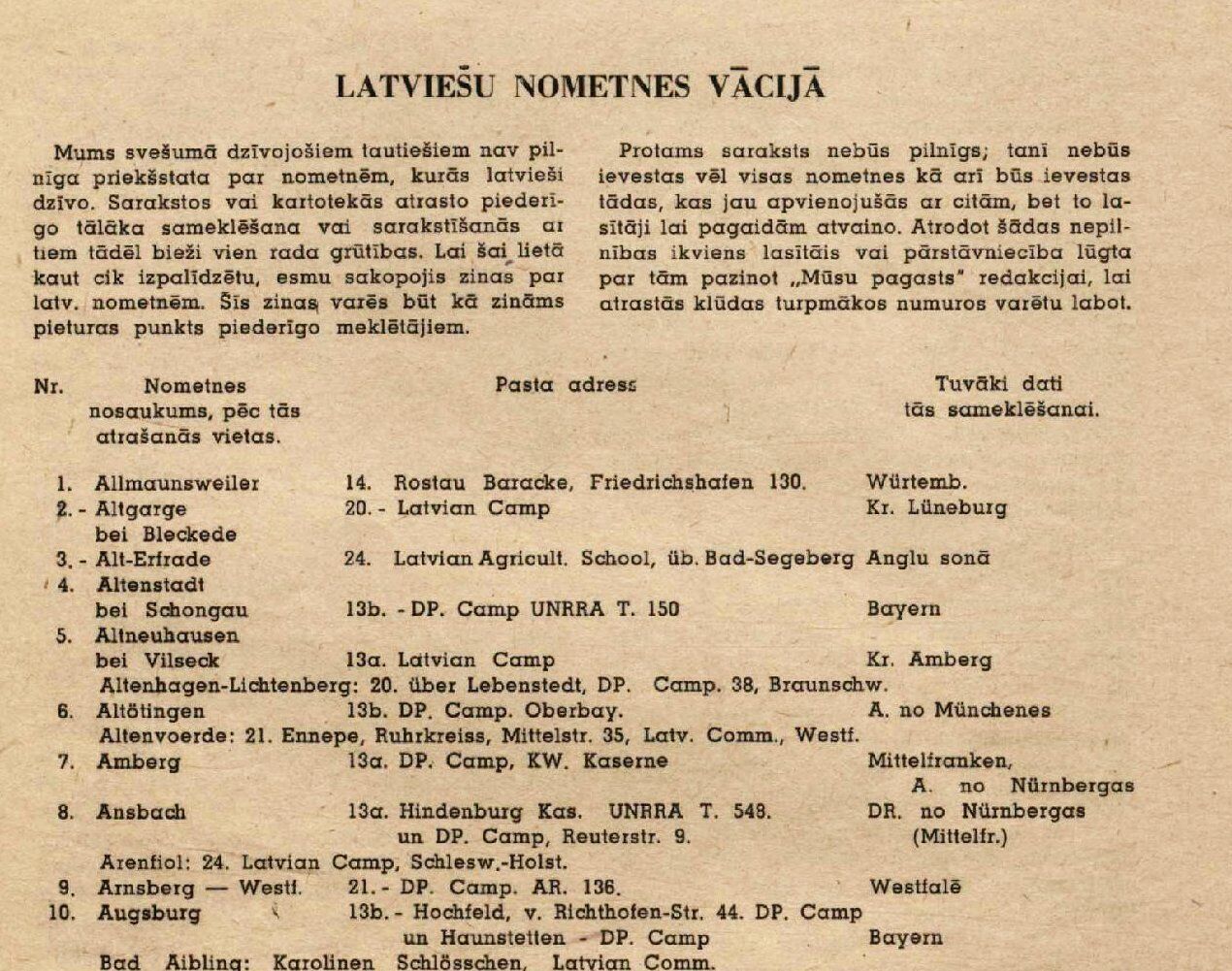
A register of Latvian camps in Germany, printed in the parish newspaper Mūsu Pagasts on 1 May 1946, lists a DP camp at the “KW. Kaserne” in Amberg, postal district 13a, east of Nuremberg. The entry places the barracks among the Latvian camps in the spring of 1946, beside the Polish, Polish-Ukrainian and Russian categories that the inventory records. The register gives no numbers and no duration.
Amberg’s population records, city-wide context
| Date | Category in the source | Number |
|---|---|---|
| January 1946 | Refugees and expellees | 11,856 |
| January 1949 | Refugees | 10,132 |
| January 1949 | Displaced persons | 5,152 |
| September 1950 | Expellees | 7,368 |
Ukrainians recorded at Amberg
| Return | Ukrainians | Scope |
|---|---|---|
| Questionnaire returns, 1946 to 1947 | No figure | Amberg town |
| UNRRA, 24 August 1946 | 10 | Amberg town |
| UNRRA, 31 May 1947 | 135 | Amberg town |
| PCIRO, December 1947 | 86 | Amberg town |
The buildings before and after displacement
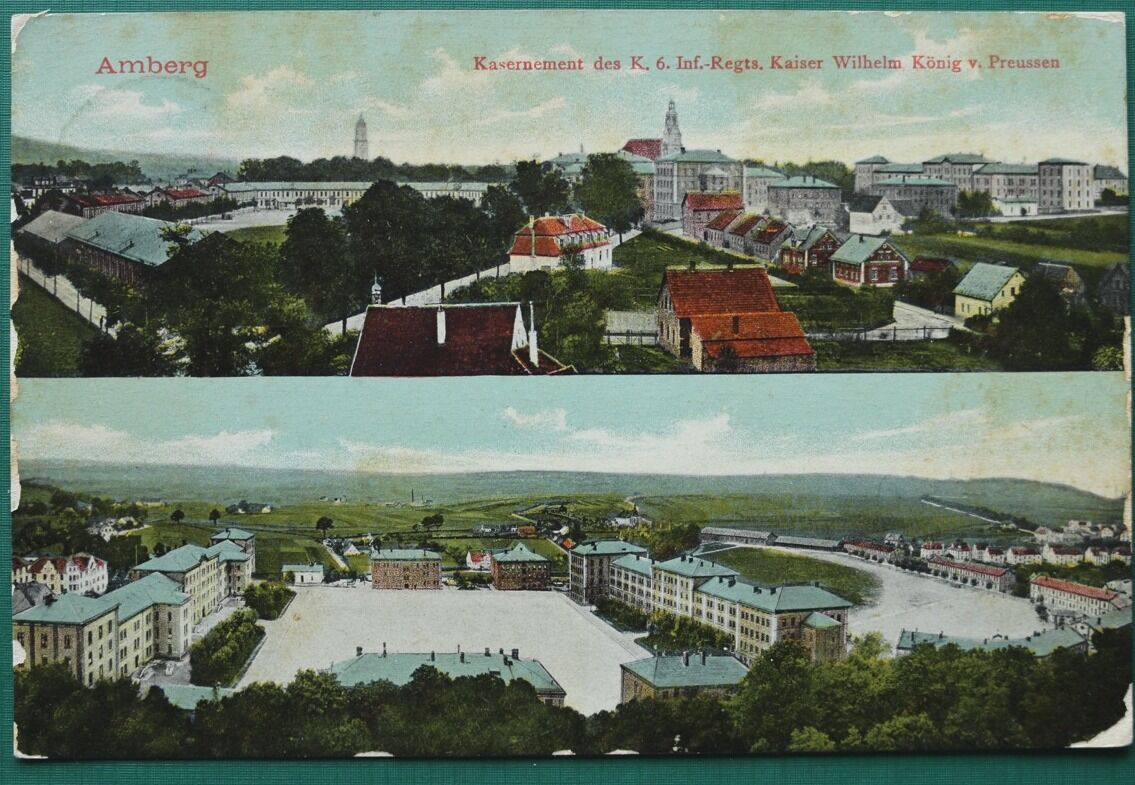
The barracks project was approved in 1864 and construction began in April 1866; the first battalion of the 6th Infantry Regiment moved in in 1889. After 1945 the barracks first served as quarters for American soldiers, and was called Fort Hess until 1947; the local dossier then has it become accommodation for homeless Poles and Ukrainians.
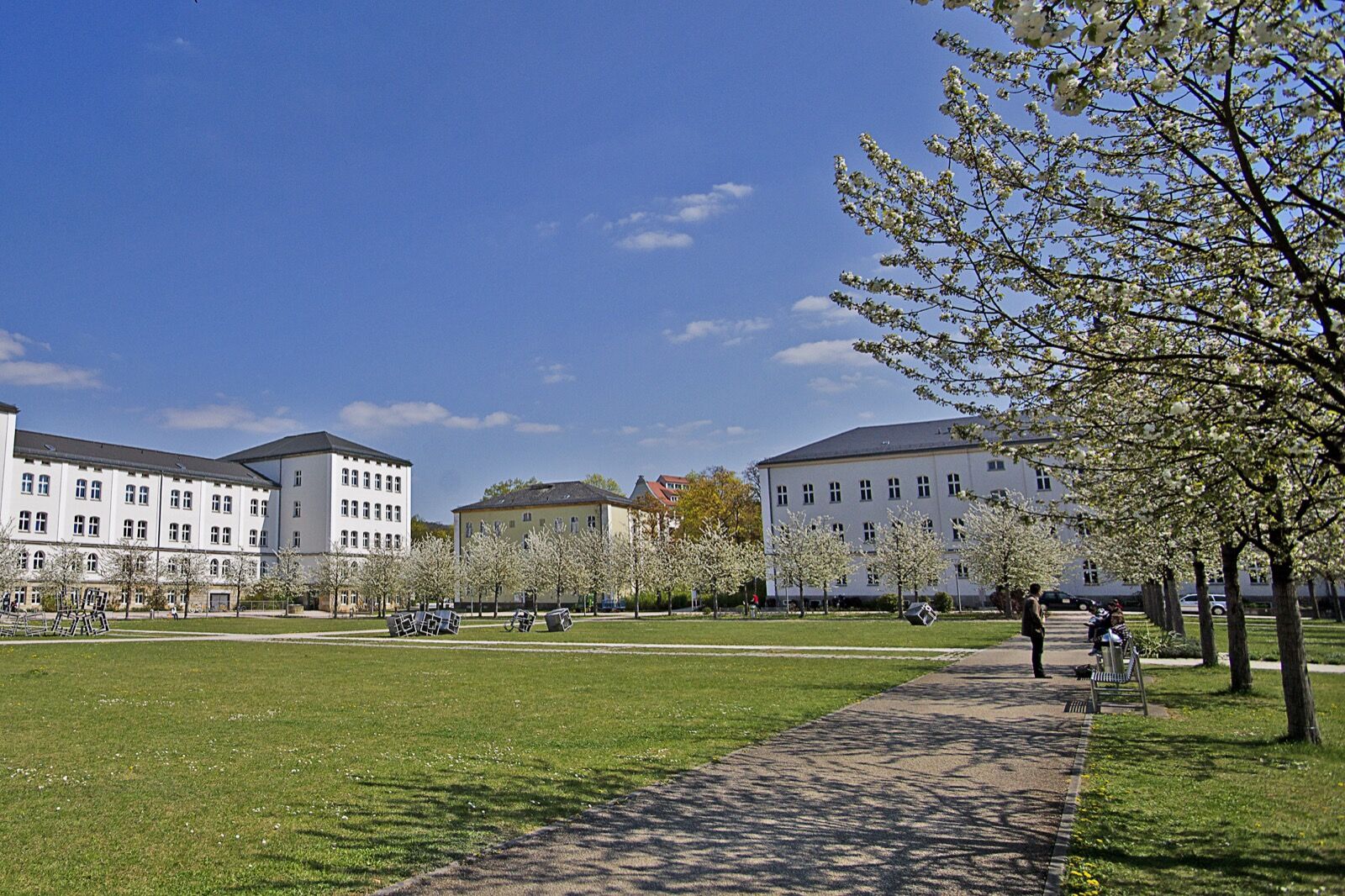
In 1951, after the displaced-person phase, the Federal Border Guard used the premises. Soldiers returned in 1956 with the reintroduction of conscription, and Panzerbrigade 12 was raised there in 1959. Much later the site became a college: the Free State of Bavaria bought the ground in order to install a Fachhochschule in it, which was opened at the beginning of October 1995, and since 2013 it has been the Ostbayerische Technische Hochschule Amberg-Weiden.
Sources for this section
Sources
- Dossier: Das Ende der Garnisonsstadt Amberg
Onetz, Oberpfalz-Medien · Undated
Kaiser-Wilhelm sections read again in full: approval 1864, building from April 1866, I./Inf. Rgt. 6 in 1889, American quarters from 1945 under the name Fort Hess to 1947, then accommodation for homeless Poles and Ukrainians, Bundesgrenzschutz in 1951, soldiers again five years later, Panzerbrigade 12 in 1959, the purchase of the site by the Free State of Bavaria for a Fachhochschule, and its opening by the Bavarian education minister at the beginning of October 1995. The dossier’s separate accounts of the Leopoldkaserne and Möhlkaserne were read to keep the installations apart.
- Wiederaufbauatlas: Amberg
Haus der Bayerischen Geschichte · Undated
Full city entry read: 11,856 refugees and expellees in 39 camps in January 1946; 10,132 refugees and 5,152 displaced persons in January 1949 at Kaiser-Wilhelm-Kaserne, Möhlkaserne, Leopoldkaserne and the TBC sanatorium; 7,368 expellees in September 1950. Population categories and geographic scope checked.
- Слово, Ukrainian weekly, no. 12(19), Regensburg, 24 March 1946, p. 5
Diasporiana · 24 March 1946
Masthead on PDF page 1 and the notice on PDF page 5 visually checked; printed page 5, rightmost column. The notice gives Amberg, Kaiser-Wilhelm-Kaserne, block E, room 2 as the reply address of Honorata Lylyk, seeking her sister Sofia Balaichuk. Scanned original held locally. The searcher’s surname is printed Лилик, transliterated Lylyk.
- Jakob Stein, Kriegsereignisse im Frühjahr 1945 in Amberg
Stadtarchiv Amberg, electronic edition 2015 · 2015
PDF page 5 visually checked; editorial provenance on PDF page 2 read. Manuscript reference StadtAAm HS 52.
- DP camp inventory, record 691: Kaiser Wilhelm Kaserne
Arolsen Archives
Catalogue row read in full: Amberg/Oberpfalz, US zone; categories Polish, Polish-Ukrainian and Russian; opening 24 January 1946; closing between 30 September 1949 and 30 September 1950; AC 93-375 A, AC 93-447 and AC 275, later NBO-481; Teams 133 Amberg and 570 Vilseck; capacity 2,600 on 31 October 1947; archive references to ITS monthly returns for Amberg and Staatsarchiv Amberg files 16832, 6437 and 6762. This is a separate record from the Aufbauschule camp, record 689.
- Ukrainian DP population table, Table 7
Ihor Stebelsky, in The Refugee Experience, 1992 · 1992
Printed page 48, Bavaria section, row Amberg: no figure in the questionnaire returns of 1946 to 1947, then 10 (24 August 1946), 135 (31 May 1947) and 86 (December 1947). One row for the whole town, with no breakdown by camp. Page rendered from the PDF at 300 dpi and read visually.
- Amberg, Kasernement des K. 6. Inf.-Regts. Kaiser Wilhelm König v. Preussen
Wikimedia Commons · Postcard posted 28 November 1909
Printed picture postcard by Gebr. Metz, Tübingen, out of copyright and held on Commons as a public-domain work. Two panoramas of the Kaiser-Wilhelm-Kaserne quarter, the lower one showing the barrack blocks around the parade square.
- Amberg, Kaiser Wilhelm Kaserne, Nord- und Ostgebäude
Wikimedia Commons · Photographed 15 June 2011
Photograph by Joachim Hummich, Creative Commons Attribution-ShareAlike 3.0. The Commons description identifies the north, north-east and south-east buildings of the former infantry barracks and their use by the college.
- Latvian camps in Germany, Mūsu Pagasts, Nr. 1-2
Mūsu Pagasts, reproduced in facsimile by latvians.com · 1 May 1946
Facsimile sheet 1 of 6 read: a numbered register of Latvian camps in Germany, entry No. 9, “Amberg 13a. DP. Camp, KW. Kaserne Mittelfranken, A. no Nürnbergas”, placing a DP camp at the Kaiser-Wilhelm-Kaserne among the Latvian camps. The register gives the district as Mittelfranken, where Amberg lies in the Oberpfalz. Compiled by an unnamed editor.
Last researched 13 September 2026