Kapellenschule Camp
Displacement in Europe
Kapellenstraße 20, Augsburg-Oberhausen, Germany · Displaced-persons camp, 5 January to autumn 1946
A schoolhouse in Augsburg-Oberhausen was opened as a displaced-persons camp in January 1946 and closed before the end of that year. A contemporary UNRRA report records about 160 Ukrainians screened here among a mixed Polish, Baltic and stateless population.
Introduction
The Kapellenschule was one of Augsburg’s smaller displaced-persons accommodation sites. Ukrainians lived in the schoolhouse alongside people recorded as Polish, Latvian, Lithuanian and stateless. The camp had its own administrative identity, AC 94-283, under UNRRA Team 114. It was distinct from the much larger community at Somme-Kaserne.
A history in dates
- 1913–1914Construction of the school building under the builder Peter Baindl.
- 22 February 1915Teaching begins after a wartime delay.
- 5 January 1946The inventory opens the Kapellenschule as an assembly centre.
- 12 January 1946A newspaper family-tracing notice records a Kapellenschule residential address.
- 22 August 1946UNRRA reports about 160 Ukrainians screened at the camp.
- October–December 1946The camp inventory places closure within this interval.
A schoolhouse becomes accommodation
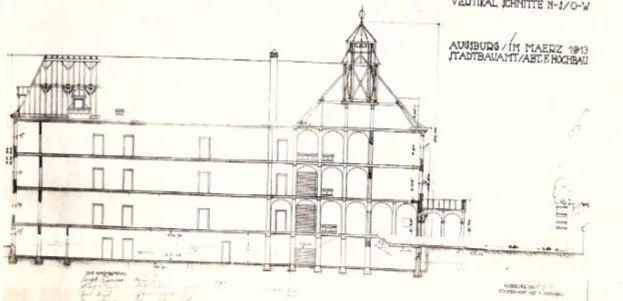
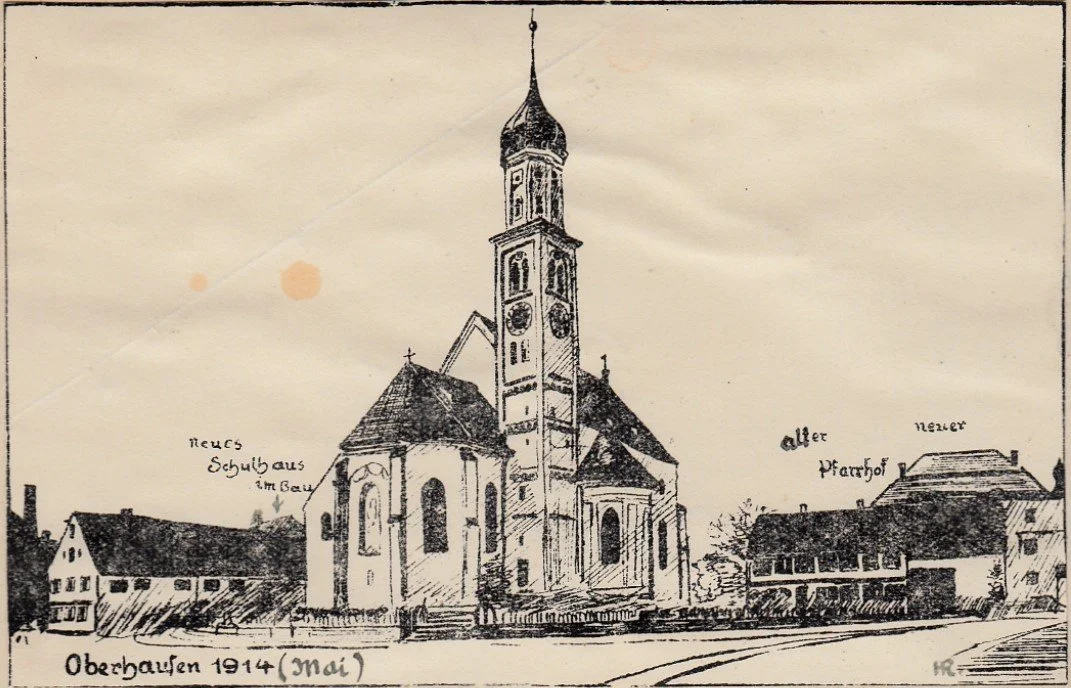
The building stood in Oberhausen, a district incorporated into Augsburg in 1911. Construction began in 1913 under the builder Peter Baindl and finished at the end of 1914, at a cost of about 679,500 marks, as the growing city needed more classrooms. The First World War delayed the start of lessons until 22 February 1915. The original drawings preserve both the school’s planned interior and its place beside the neighbourhood church.
During the Second World War the building suffered damage, was used as accommodation and intermittently ceased teaching. Its subsequent DP-camp role was a separate postwar use of an existing school building. The surviving camp records make it possible to identify the people housed here without treating the school’s entire history as a camp history.
Sources for this section
What the camp record holds
The inventory entry opens the camp on 5 January 1946 and closes it between 19 October and 20 December 1946, so its whole recorded life fits inside a single year. It sits in District 5 of the American zone under UNRRA Team 114 at Augsburg, with a team director recorded from 24 January 1946 and a named field supervisor. The nationality field lists Polish, Latvian, Ukrainian, Lithuanian and stateless residents.
No capacity is recorded. The inventory’s standard capacity date, 31 October 1947, falls after the camp had already closed, so the blank is not an oversight to be filled from the size of the building. The archive reference points to the running strength and change reports for Augsburg held by the International Tracing Service.
The camp in the Arolsen inventory
| Field | Recorded value |
|---|---|
| Opening | 5 January 1946 |
| Closing | Between 19 October and 20 December 1946 |
| Assembly centre number | AC 94-283 |
| UNRRA team | Team 114, Augsburg |
| District | 5 |
| Nationalities | Polish, Latvian, Ukrainian, Lithuanian, stateless |
| Capacity | Not recorded |
Sources for this section
Searching for family
A Lithuanian newspaper published on 12 January 1946 included the Kapellenschule among the addresses from which displaced people sought relatives. Such a notice records the school as a lived residential address, not simply an administrative office. It also places family tracing alongside accommodation as part of the community’s everyday concerns.
Sources for this section
Ukrainians in the 1946 screening
On 22 August 1946 the UNRRA liaison office at the 9th Infantry Division headquarters in Augsburg reported to UNRRA headquarters at Arolsen on the screening of Ukrainians in the American zone. The zone director wrote that more than 88,000 people had been screened in the division’s area, which covered Districts 1, 2 and 5, but that no accurate breakdown of Ukrainians was possible because screening teams reported unevenly and there was still confusion in the lower military echelons about classifying Ukrainians by citizenship and nationality.
Within that survey, Kapellenschule under Team 114 had about 160 Ukrainians screened. Screening determined eligibility for displaced-persons assistance. The figure counts Ukrainians screened, not everyone living in the school, and it is not a census of the camp. UNRRA did not recognise Ukrainian as a separate nationality until the summer of 1947, which is why Ukrainians appear in these records under Polish, Russian or stateless headings.
The same report describes an eviction of about 230 people as “Soviet citizens” who were in fact Russian Ukrainians. That happened at Hindenburg-Kaserne, a different Augsburg camp under the same UNRRA team, where about 700 Ukrainians were screened. The zone director challenged the interpretation of the directive and had it corrected, but many of those evicted had already scattered across the American zone. Nothing in the report places that incident at the Kapellenschule.
What the contemporary record establishes
| Date | Recorded measure | Figure |
|---|---|---|
| 22 August 1946 report | Ukrainians screened at Kapellenschule, Team 114 | About 160 |
| 22 August 1946 report | Ukrainians screened at Hindenburg-Kaserne, Team 114 | About 700 |
| 22 August 1946 report | People evicted at Hindenburg-Kaserne as “Soviet citizens” | About 230 |
| 22 August 1946 report | People screened across the 9th Division area (Districts 1, 2 and 5) | More than 88,000 |
Sources for this section
Returning to education
The camp inventory places closure between 19 October and 20 December 1946. It does not identify a single destination for the residents, and none of the Augsburg rows in the published Ukrainian population tables can be read as the Kapellenschule after that date. The school’s own history describes a gradual return to teaching amid severe room shortages, with several schools sharing the building. Repairs continued through the 1950s and 1960s; the institution became a combined primary and secondary school in 1969 and adopted the Kapellen-Mittelschule name in 2010.
Sources for this section
Sources
- Report on screening Ukrainian displaced persons, 22 August 1946
UNRRA; reproduced in Yury Boshyk, ed., Ukraine during World War II (CIUS, 1986) · 22 August 1946
Document 16, printed pp. 223–224: report of the UNRRA Liaison Office, 9th Infantry Division Headquarters, Augsburg, signed by the zone director. UN Archives PAG-4/3.0.11.0, 1.4:2. Full document read: Districts 1, 2 and 5, more than 88,000 screened, Kapellenschule about 160 Ukrainians, Hindenburg-Kaserne about 700 and the eviction of about 230 people there. Editor’s note on p. 222 for UNRRA’s recognition of Ukrainian nationality in summer 1947.
- History of Kapellen-Mittelschule
Kapellen-Mittelschule Augsburg · Accessed 13 September 2026
School’s own institutional history; 1913–1914 construction, opening 22 February 1915, wartime damage, postwar room shortage and later school history. Original 1913 section plan and 1914 drawing.
- Displaced-persons camp inventory: Kapellenschule
Arolsen Archives
Record 731: Kapellenschule, Augsburg, District 5, opening 5 January 1946, closing between 19 October and 20 December 1946, AC 94-283, UNRRA Team 114 Augsburg with a team director recorded from 24 January 1946 and a field supervisor, nationalities Polish, Latvian, Ukrainian, Lithuanian and stateless, capacity field blank. Archive reference: ITS running strength and change reports for Augsburg, Dok-ID 81962352-81963928. Clean catalogue record checked; raw spreadsheet binary disregarded.
- Family-tracing notices, 12 January 1946
Žiburiai, Lithuanian displaced-persons newspaper · 12 January 1946
Contemporary notice 302 gives Augsburg Kapellenschule as a resident address. Only collective historical activity described; no names or identifying notice image reproduced.
Last researched 13 September 2026