Karlova Ves Refugee Camp
Displacement in Europe
Bratislava · Slovakia · 1939
From 26 June 1939 the Slovak army housed its Ukrainian refugee camp in separate barracks at Karlova Ves, then a vine-growing village on the western edge of Bratislava. An appeal written that summer by the camp commandant records a military routine, a steady trickle of new arrivals from Carpathian Ukraine and Galicia, and support that reached beyond the people sleeping in the barracks.
Introduction
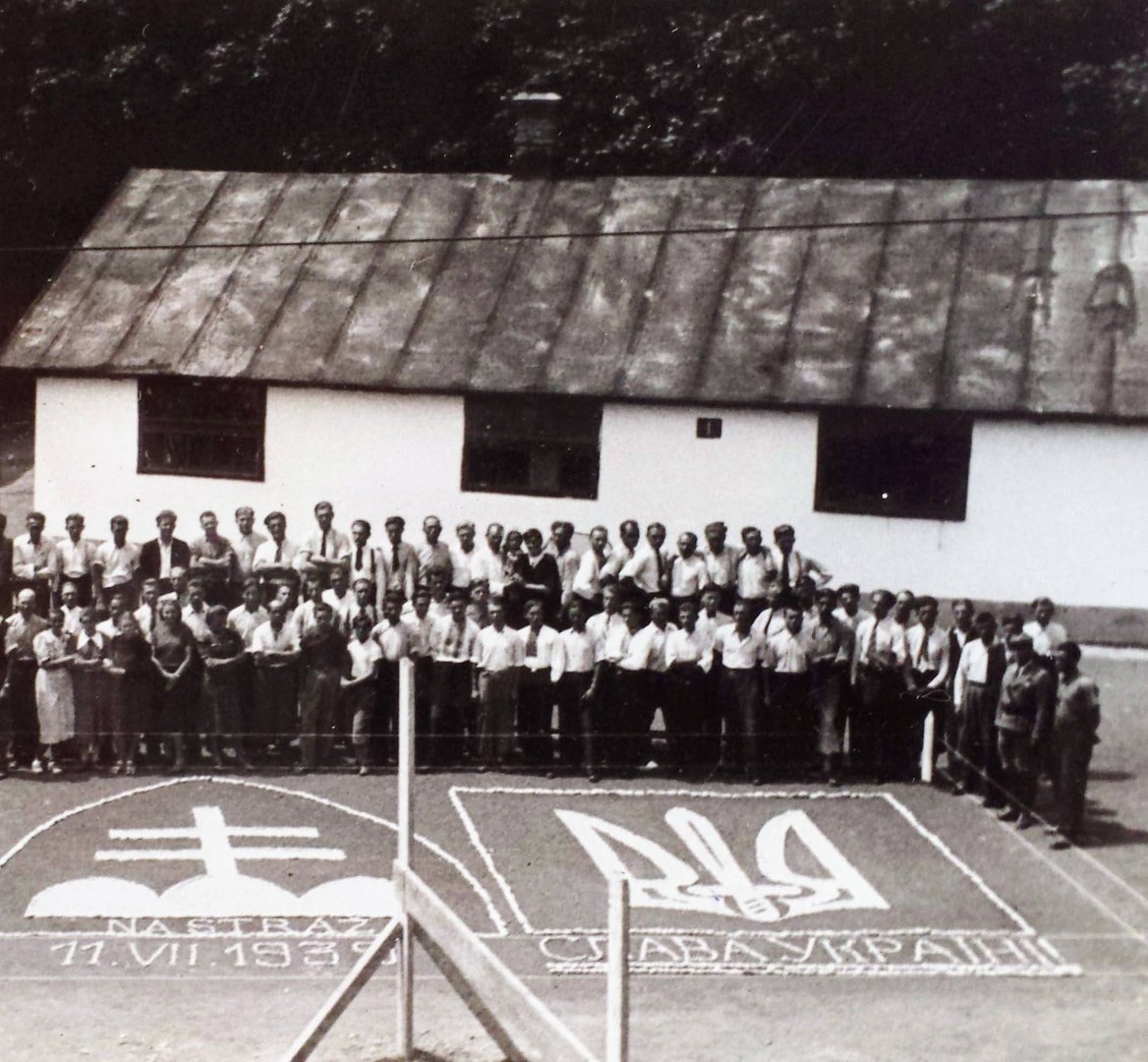
The Slovak military moved the Ukrainian refugee camp into separate Karlova Ves barracks on 26 June 1939. Its earlier Bratislava accommodation had been the Danube barracks. These were successive locations, not interchangeable names for one building.
The move came with appointments. The Slovak command named Captain Leonid Klymenko, who had led the body since its internment in eastern Slovakia in March, commandant at Karlova Ves, and the platoon commander Yurko Meshko its quartermaster and adjutant. The camp remained a military formation under its own Ukrainian officers, quartered and inspected by the Slovak army.
Sources for this section
A history in dates
- 24 November 1938Germany occupies Devín and Karlova Ves becomes a separate municipality.
- March 1939Captain Leonid Klymenko takes command of the Ukrainian camp formed after the Sich units cross into Slovakia.
- 26 June 1939The Slovak military command moves the camp to separate barracks at Karlova Ves and appoints Klymenko commandant and Yurko Meshko quartermaster and adjutant.
- 12 July 1939Oleksander Hranovsky and Volodymyr Kossar visit the barracks; the camp supports 180 people that day.
- Summer 1939About ten new refugees a month reach the camp from Carpathian Ukraine, with others arriving from Galicia.
- 2 December 1943A Ministry of the Interior decree joins Karlova Ves to Bratislava.
Sources for this section
A village on the city’s edge
Karlova Ves was not yet part of Bratislava. Founded in 1780 by Count Karol Jozef Hieronym Pálffy and named after him, it had been a hamlet of Devín and remained a wine-growing village, its people also working at the Patrónka cartridge factory of 1871 and the city waterworks of 1886. When Germany occupied Devín on 24 November 1938 Karlova Ves became a municipality in its own right, and in early February 1939 its inhabitants asked to be joined to Bratislava. That was granted only by a Ministry of the Interior decree of 2 December 1943.
The old village that stood here was demolished from 1964 for blocks of flats.
Sources for this section
Who kept arriving
The camp did not hold a fixed group, and the people at Karlova Ves were not only the soldiers of March. In April and May 1939, while the camp was still at the Danube barracks, Sich members reached Bratislava singly and in groups, among them men whom the Hungarian authorities had held in camps and released half alive, together with transports of Ukrainians expelled from Carpathian Ukraine. In June and July the arrivals were workers and peasants who could no longer bear Hungarian rule and could find no work at home, and young men taken for the Hungarian army who did not want to serve. In the last days before the appeal was written, Ukrainians were also coming from Galicia, where the commandant said new persecutions had begun.
He put the rate at an average of ten new refugees a month from Carpathian Ukraine, and expected the movement to grow after the harvest, when people who had gathered their grain would leave rather than starve.
Sources for this section
Daily life
Residents rose at six, exercised, cleaned the barracks and attended military instruction. Meals centred on bread, soup and preserved food. The command’s appeal sought clothing, footwear, travel documents, rail fares and fuel. Food and shelter alone could not meet the needs of people arriving with few possessions.
The commandant set out the day in full. After the six o’clock rise came physical drill and a breakfast of coffee or cocoa with bread, then the tidying of the barracks and yard, then military exercises. Dinner at twelve was a single dish, a bean, pea or potato soup or another cooked with tinned food. The hours to two were free for washing and rest. From two until six came military training, lectures on military subjects and talks on the history of the Ukrainian armed struggle. Supper at six was tea with bread and tinned food or jam, the evening until nine was free, and the camp mounted its own guard.
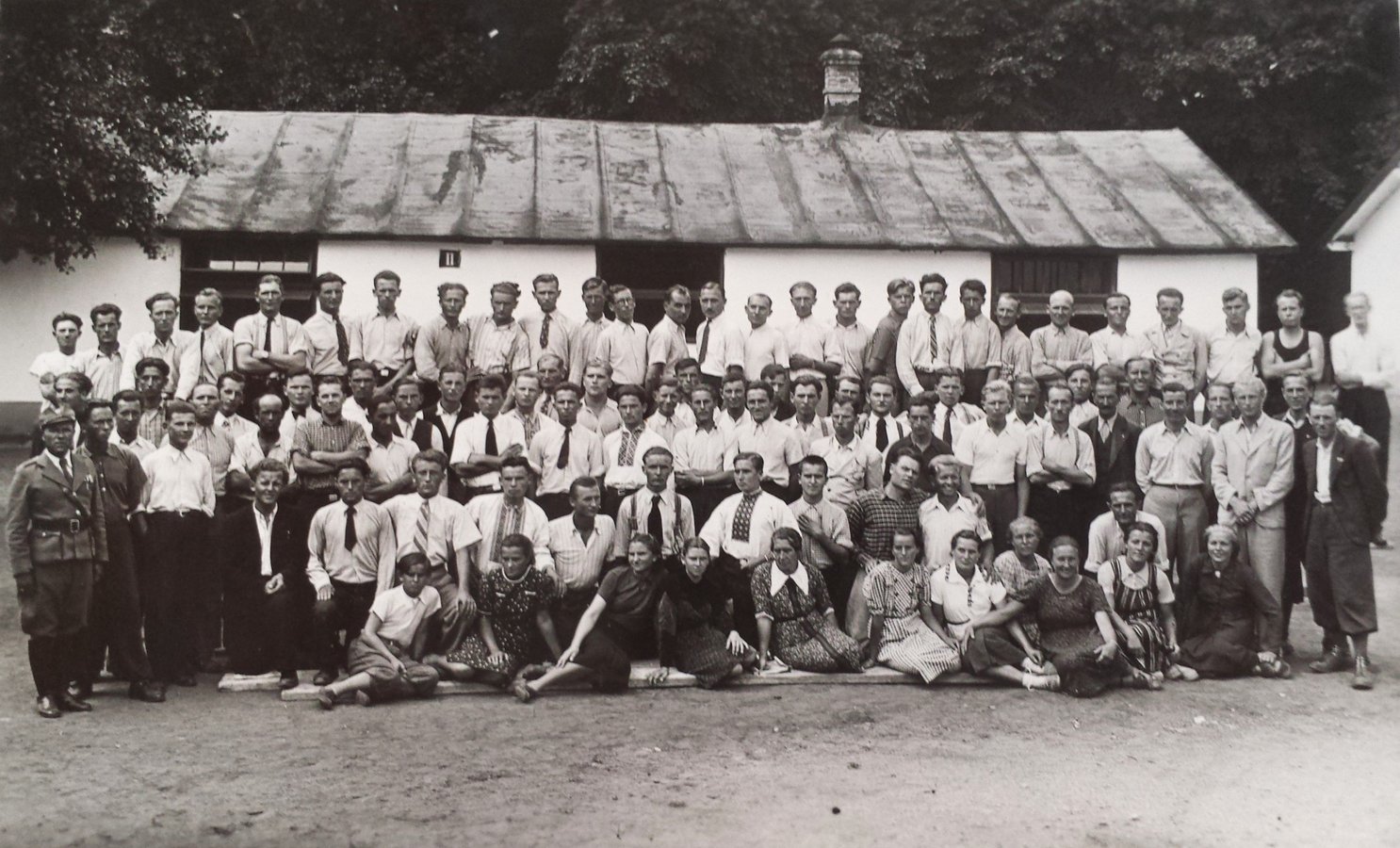
Slovak garrison commanders inspected the camp. The most recent inspection before the appeal was made by Colonel Bodický, commander of the Bratislava garrison, who issued an order thanking the Ukrainian camp command for the order and discipline he found there.
Assistance on 12 July 1939
| Group | People |
|---|---|
| Living and eating in camp | 112 |
| Eating in camp; privately housed | 68 |
| Total supported | 180 |
Sources for this section
The visit of 12 July 1939
On 12 July 1939 the barracks were visited by Professor Dr Oleksander Hranovsky and the engineer Volodymyr Kossar, described in the report as presidents of the Organisation for the Rebirth of Ukraine in America and Canada. Hranovsky taught entomology at the University of Minnesota and led that organisation from 1935 to 1963, which is why the appeal survives among the emigration papers held at his university. Kossar was a leading figure of the Ukrainian National Federation in Canada.
On the day of the visit the camp supported 180 people. Of these, 112 both lodged and ate in the barracks; the rest were families who ate in the camp but slept in private lodgings. Apart from food and accommodation, the commandant wrote, the camp received no other assistance from anyone.
What the camp asked for
The appeal was addressed to Ukrainians in the United States and Canada, because the emigration in Europe was itself in hard circumstances. Men reaching the camp from Hungarian prisons arrived almost naked and barefoot and could not be sent to work in that state, so the camp needed clothing, linen and footwear or the money to buy them, together with money for refugees’ photographs and visa fees and for rail fares from the border to Bratislava, so that men did not wander Slovakia for weeks begging. Heating and lighting for the barracks was named as the coming urgent need, with a reserve of warm clothing and an information bulletin for the refugees in the camp and at work. The commandant gave no estimates of cost, promising instead that whatever was sent would be accounted for monthly.
Sources for this section
A wider Ukrainian setting
Bratislava already had a Ukrainian community with cultural, professional and student organisations. The Commercial Academy evacuated from Transcarpathia operated in the city during 1939–1940. This educational continuity formed part of the same displacement landscape, although the academy and its students’ accommodation were separate from the Karlova Ves barracks.
Sources for this section
Sources
- Contemporary appeal for the Ukrainian refugee camp in Bratislava
1939 camp report, IHRC Archives, republished by Local History on 10 June 2025
Original report transcribed with archival attribution, located by Danylo Kravets of the Lviv National Library. Explicit 26 June move to Karlova Ves and the appointments, the full daily routine and the Bodický inspection, the pattern of arrivals in spring and summer 1939, the 12 July support totals and the list of needs. Photographs attributed to the University of Minnesota IHRC Archives; precise barracks address is not supplied.
- Bratislava
Canadian Institute of Ukrainian Studies, Encyclopedia of Ukraine
Institutional reference confirms the pre-existing Ukrainian community and evacuated Commercial Academy operating in Bratislava in 1939–1940. It does not locate the separate student residence.
- História Karlovej Vsi
Mestská časť Bratislava - Karlova Ves, drawing on Matúš Šrámek, Karlova Ves taká bola (2014) · Accessed 13 September 2026
The borough council’s own history of the village: its foundation in 1780, its wine-growing character, the Patrónka factory and waterworks, the tram of 1929, separation from Devín on 24 November 1938, the February 1939 request to join Bratislava and the decree of 2 December 1943, and the demolition of the old village after 1964. It says nothing about barracks or a refugee camp.
- Granovsky, Alexander
Internet Encyclopedia of Ukraine, Canadian Institute of Ukrainian Studies · Accessed 13 September 2026
Identifies the visitor of 12 July 1939: University of Minnesota entomologist and president of the Organization for the Rebirth of Ukraine, 1935 to 1963.
- Ukrainian National Federation
Internet Encyclopedia of Ukraine, Canadian Institute of Ukrainian Studies · Accessed 13 September 2026
Names Volodymyr Kossar among the leading figures of the Canadian federation in its early years. The encyclopedia has no separate entry for him and gives no dates of office.
- Табір українських біженців у Братиславі (The camp of Ukrainian refugees in Bratislava)
Immigration History Research Center Archives, University of Minnesota, reproduced by Lokalna Istoriia · Photograph dated by its ground inscription to 11 July 1939
Photograph captioned by the publisher ‘Табір українських біженців у Братиславі’ and credited to the archive of the Immigration History Research Center at the University of Minnesota. The men of the camp are drawn up in front of a long single-storey barrack; on the ground before them two emblems have been laid out in whitewashed stones, a Slovak double cross with the words ‘NA STRÁŽ 11.VII.1939’ and a Ukrainian trident with ‘СЛАВА УКРАЇНІ’. The date falls within the camp’s time at Karlova Ves, which began on 26 June 1939. Neither the publisher nor the archive states a reuse licence.
- Подяка за матеріальну допомогу для табору (Thanks for material help for the camp)
Immigration History Research Center Archives, University of Minnesota, reproduced by Lokalna Istoriia · 18 July 1939
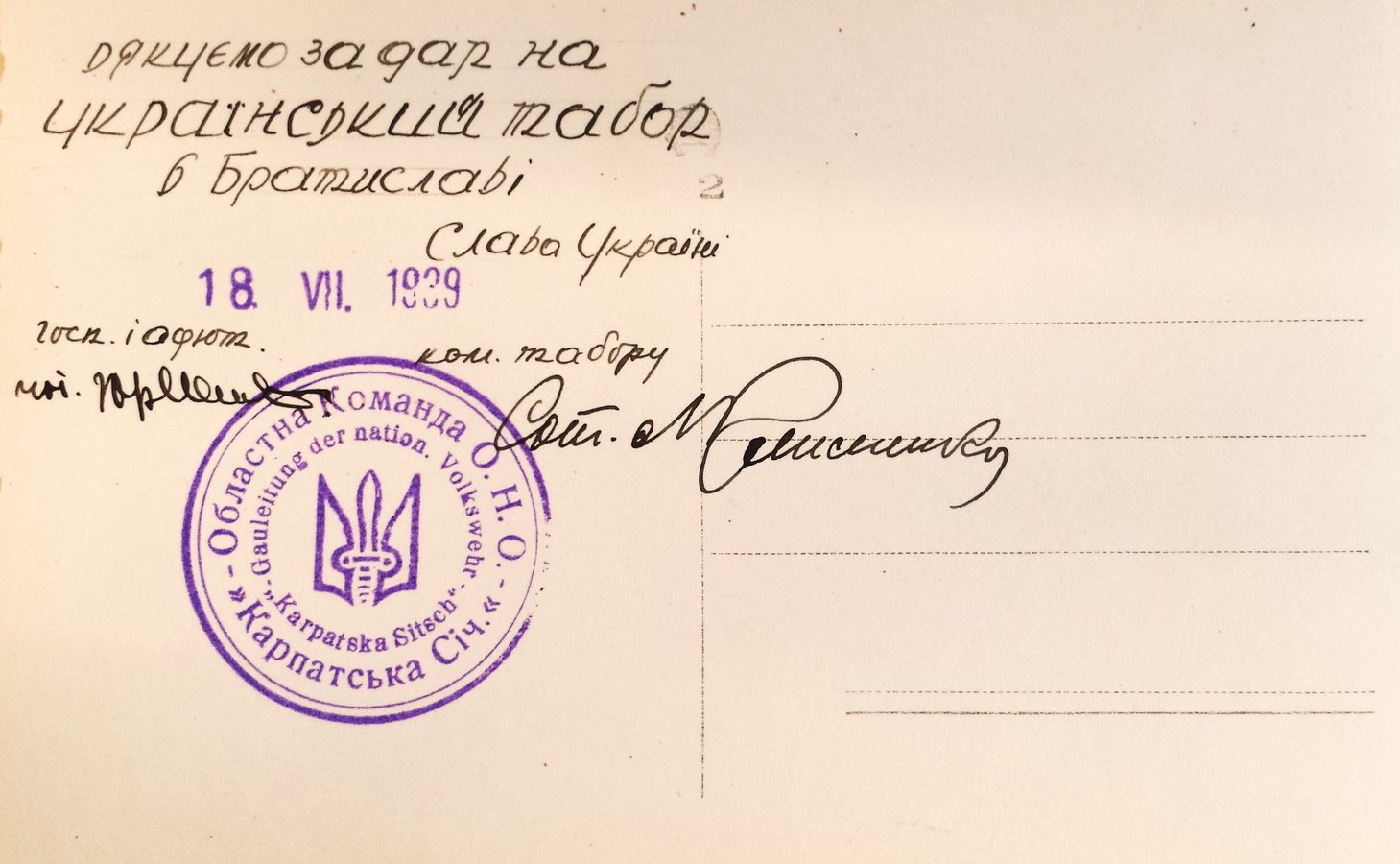
The written side of a card acknowledging a gift to the camp, reading ‘Дякуємо за дар на український табір в Братиславі. Слава Україні’ — thank you for the gift to the Ukrainian camp in Bratislava, glory to Ukraine. It carries a date stamp of 18 July 1939, the signatures of the quartermaster and adjutant and of the camp commandant, and the violet seal of the Obласна Команда О.Н.О. ‘Karpatska Sitsch’. Neither the publisher nor the archive states a reuse licence.
Last researched 13 September 2026