Karlsfeld Camp
Displacement in Europe
Karlsfeld, near Munich, Germany · 1945–1946
In wooden barracks north of Munich, built for forced labourers and taken over by UNRRA, one of the largest Ukrainian communities in the American zone ran schools, scouting, a sports club and its own weekly papers. The community was dispersed to other camps during 1946, and very little about the camp’s administration survives in the German record.
Introduction
Karlsfeld was one of the major Ukrainian displaced-persons communities established near Munich after the Second World War. Its importance extended beyond accommodation: schools and youth organisations developed there, then continued elsewhere when residents were transferred in 1946.
A history in dates
- 1944–1945An Organisation Todt subcamp of Dachau of the same name holds prisoners nearby; it is a separate institution.
- 11 December 1945The Arolsen alphabetical list gives this as the opening date of DP-Camp Karlsfeld.
- 1945The sports society Lev is founded in the camp.
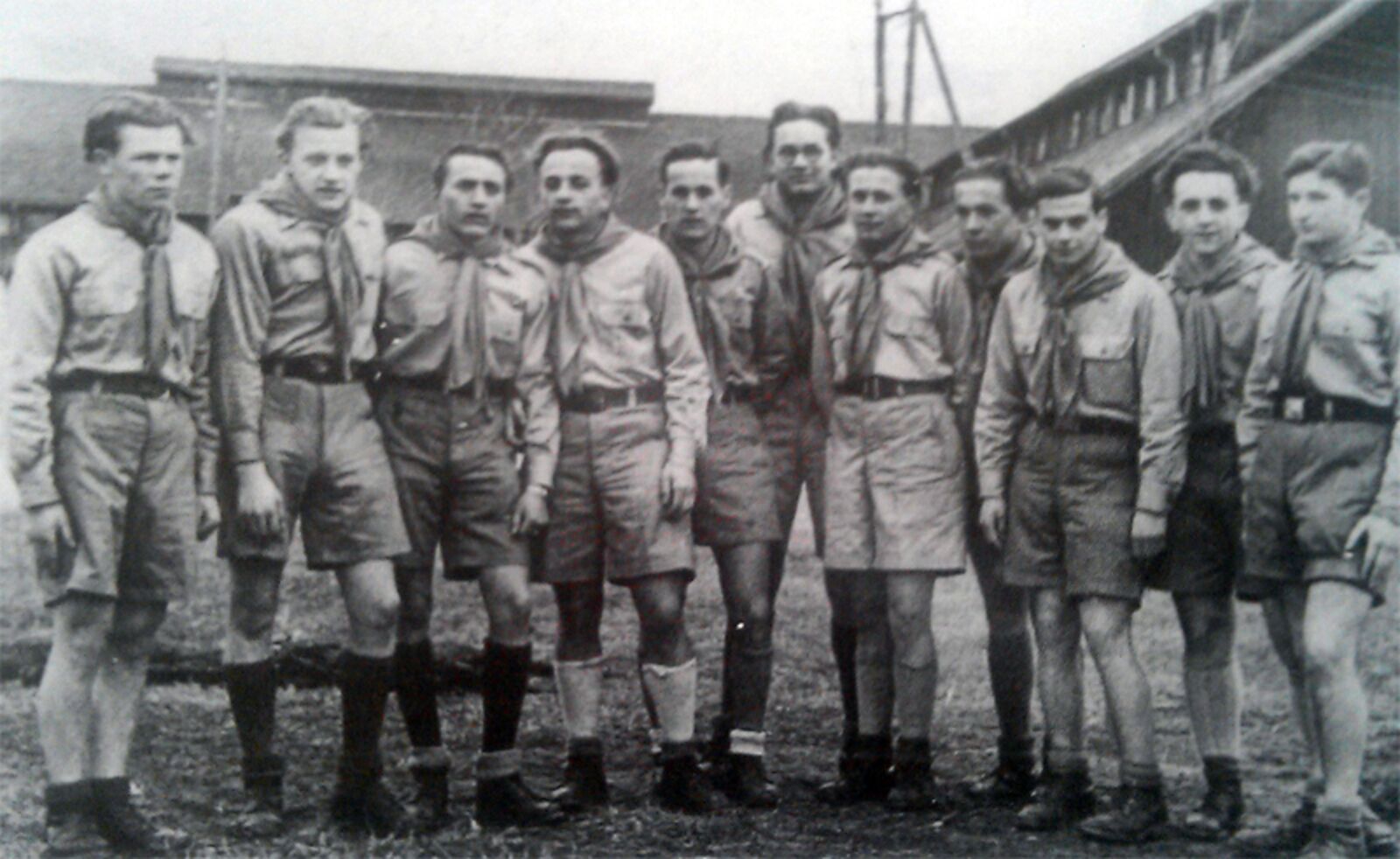
- Autumn 1945A photograph records an organised Plast scout patrol beside the Karlsfeld barracks.
- 1945–1946The secondary school grows to 562 students.
- Late 1945 to December 1947The religious weekly Khrystyianskyi Shliakh is published under a Munich-Mittenwald-Karlsfeld imprint.
- 1946A Ukrainian weekly and the scouts’ monthly Skob are issued at Karlsfeld and filed by UNRRA Team 125.
- Spring 1946Part of the school community transfers to Berchtesgaden, and the camp football team wins the first Ukrainian displaced-persons championship.
Sources for this section
- Subcamps and external work details of Dachau concentration camp
- DP-Lager: Dachau and its surroundings, Karlsfeld
- Galician sport in the DP camps
- The foundation of Plast in Bavaria: oral history and photographs
- Commemorative Book of Ukrainian Gymnazium in Berchtesgaden
- Research Report No. 2: Political Refugees and Displaced Persons, 1945–1954
- UNRRA Germany Mission administrative history, box and folder list
The barracks and what stood near them
A memoir by Bohdan Havrylyshyn, who lived here as a young man, describes a camp of several wooden barracks that had earlier been intended for Ukrainian forced labourers and were adapted by UNRRA for Ukrainian refugees. Rooms held eight double bunks and a single table with two narrow benches, with about fifteen young men to a room, and he records that the food and necessities supplied through UNRRA were sufficient.
Two other institutions in the same area must be kept separate from this camp. The Dachau subcamp list records an OT-Lager Karlsfeld that existed in 1944 and 1945 with between 700 and 1,000 prisoners, mainly Jews, working on bunker construction for BMW, alongside the much larger SS labour camp at Allach. The Rothschwaige transit camp and the Nizanim kibbutz on the Rothschwaige estate, both within the Karlsfeld municipal area, are further distinct places. None of them is the Ukrainian displaced-persons camp described here.
How little the administrative record holds
The German record for this camp is unusually thin. The Arolsen alphabetical list of displaced-persons camps in the American zone knows a DP-Camp Karlsfeld and gives an opening date of 11 December 1945, but nothing else. A local study by Petra Röhrle notes an assembly centre set up at Karlsfeld whose location cannot be reconstructed, and records that the military government regarded Karlsfeld in the immediate post-war period as a danger area of the district. The German survey that gathers these findings states plainly that the position of the displaced persons in Karlsfeld itself remains largely unclear.
The camp is also absent from the published Ukrainian population tables. Table 7 of Stebelsky’s survey, which lists camp by camp for the American zone from 1946 to 1948, has no Karlsfeld row, which fits a camp wound up during 1946 before the later returns were compiled.
What does survive is the paper the community itself generated. The UNRRA files in the United Nations Archives include a Team 125 folder for 1946 holding a Ukrainian religious and social weekly and the scouts’ monthly Skob, issued at Karlsfeld. Team 125 was the Munich-Laim team, which places Karlsfeld administratively alongside the Laim camp.
Life inside the barracks
A childhood recollection published in 2005 describes a camp enclosed by wire, with families sharing rooms in long barracks. Blankets divided one room into five family spaces. Bunk beds, photographs and the luggage saved during flight made up the household; washing facilities and toilets stood at the end of the corridor.
The same account remembers a father leaving each morning to teach geography and mathematics in the refugee-organised school. Possessions retained from home carried an emotional importance far beyond their practical value. This description records one family’s experience rather than a standard room allocation for the whole camp.
Sources for this section
Rebuilding education
An oral-history interview describes a camp council, primary school, secondary school, teacher training and commercial education. The witness remembered wooden, two-storey workers’ huts associated with the BMW factory. His recollection of thousands of residents conveys the scale of the settlement, although it does not supply a dated census.
The secondary school expanded to 562 students in 1945–46, with 42 teachers recorded on 9 November 1945. Space shortages required two teaching shifts in two buildings. In spring 1946, approximately half the teachers and students moved to Berchtesgaden, where the school continued.
Surviving commercial-school publications also show practical training. A bibliography records a 45-page purchasing manual issued at Karlsfeld in 1945 and a 52-page work on consumer goods bearing a Munich-Karlsfeld imprint. These modest publications connected classroom work with skills useful for future employment.
Education at Karlsfeld
| Activity | Recorded evidence |
|---|---|
| Secondary school | 562 students in 1945–46; 42 teachers on 9 November 1945 |
| Commercial training | Purchasing manual (1945), 45 pages |
| Consumer-goods study | Munich-Karlsfeld publication, 52 pages |
| Plast scouting | Photographed autumn 1945 |
Scouting and community life
The Plast scouting movement formed local groups as young people gathered in the camp. A surviving photograph records the Lys patrol of the Ivan Bohun unit in autumn 1945, standing together beside the barracks. The oral-history account places scouting alongside the schools and camp council as an institution rebuilt by refugees themselves.
The Shevchenko Scientific Society holds reports, rules, correspondence and lesson plans documenting Karlsfeld’s educational and cultural programmes. These records preserve the organised work behind community life. Their catalogue spans 1945–1949, a date range for the papers rather than proof that the camp remained open throughout those years.
Printing and sport
A bibliography of Ukrainian displaced-persons publications records two weeklies connected with the camp: Khrystyianskyi Shliakh, a religious weekly given as Munich-Mittenwald-Karlsfeld and published from late 1945 to December 1947, and Visti z Nashoho Zhyttia, a weekly issued at Karlsfeld in 1946. The same bibliography lists an English-language textbook printed at Karlsfeld in 1946 and a 1950 memoir volume whose subtitle names Rudolfstadt, Coburg, Dachau and Karlsfeld as the camps its author passed through.
Organised sport began here as well. An account of Galician sport in the displaced-persons camps states that sporting life in the emigration began at the Ukrainian camp in Munich-Karlsfeld, where the society Lev was founded in 1945 and developed everything from football to chess and table tennis. Its football team, by then recorded as Karlsfeld-Mittenwald, won the first Ukrainian displaced-persons championship in the spring of 1946 and won again in the following season.
Printing recorded at Karlsfeld
| Title or item | Description in the source |
|---|---|
| Khrystyianskyi Shliakh | Weekly, religious, imprint Munich-Mittenwald-Karlsfeld, from late 1945 to December 1947 |
| Visti z Nashoho Zhyttia | Weekly, Karlsfeld, recorded for 1946 |
| Ukrainian religious and social weekly, and Skob, scouts’ monthly | Held in the UNRRA Team 125 file for Karlsfeld, 1946 |
| English-language textbook | Printed at Karlsfeld, 1946 |
The community moves on
The 1946 transfers dispersed people and institutions rather than ending their work. The Berchtesgaden school history traces its direct connection to Karlsfeld, while research on Orlyk’s camp newspaper records a large group arriving from Karlsfeld in May. The two camps belong to the same migration story but were separate facilities.
The same dispersal shows in the memoir and in the sports record. Havrylyshyn moved on to the Ellwangen camp to rejoin family already there, and the Lev club’s later titles are recorded under a Karlsfeld-Mittenwald and then a Mittenwald name. Institutions travelled with the people who ran them.
Karlsfeld after the camp
The municipality itself was transformed by the same years, although by a different population. Karlsfeld had 1,009 inhabitants in 1939 and 1,669 in 1946, and by 1950 expellees and refugees made up about a third of the municipality. Owner-built housing dominated the 1950s, and about 150 unauthorised settlement buildings were legalised in 1960. Camp residents were not counted in these municipal figures, so the growth of the village is not a measure of the camp.
Sources for this section
Sources
- Displaced persons camps
Internet Encyclopedia of Ukraine · 1984; online edition
Overview identifies this camp among the larger Ukrainian communities.
- The foundation of Plast in Bavaria: oral history and photographs
Memory of Nations / Museum-Archive of the Plast Movement · Interview 16 April 2013
Transcript and 1945 camp photograph inspected; no personal names reproduced.
- A childhood Christmas at Karlsfeld
Bay Weekly · 2005
Published first-person childhood recollection; indexed full passage read, direct download unavailable.
- Commemorative Book of Ukrainian Gymnazium in Berchtesgaden
Former students and supporters · 1997
Original scan, printed pp. 11–12, school history and transfer inspected.
- Publications by Ukrainian Displaced Persons and Political Refugees in 1945–1954
University of Alberta archival bibliography · 1988
Printed p. 154: purchasing and consumer-goods teaching publications.
- Collection on the Displaced Persons camp in Karlsfeld
Shevchenko Scientific Society Archives · Collection 216
Catalogue-level description only.
- The journal Orlyk in Berchtesgaden
National University of Ostroh Academy · 2022
Analysis of camp journal, including transfers from Karlsfeld.
- DP-Lager: Dachau and its surroundings, Karlsfeld
German Wikipedia, citing Petra Röhrle and the Arolsen alphabetical list · retrieved 13 September 2026
Opening date 11 December 1945 in the Arolsen alphabetical list; an assembly centre whose location cannot be reconstructed; Karlsfeld treated as a danger area of the district.
- Subcamps and external work details of Dachau concentration camp
Haus der Bayerischen Geschichte · reference table
OT-Lager Karlsfeld, 1944–1945, 700 to 1,000 prisoners, mainly Jews, on BMW bunker construction.
- Karlsfeld
Haus der Bayerischen Geschichte, Wiederaufbauatlas · retrieved 13 September 2026
Municipal population 1939 to 1961; expellees and refugees about a third of the municipality by 1950; owner-built housing in the 1950s.
- Research Report No. 2: Political Refugees and Displaced Persons, 1945–1954
Yury Boshyk and Boris Balan, Canadian Institute of Ukrainian Studies, University of Alberta · 1982
Entries for Khrystyianskyi Shliakh, Visti z Nashoho Zhyttia, an English textbook printed at Karlsfeld in 1946 and a 1950 memoir volume naming Karlsfeld.
- UNRRA Germany Mission administrative history, box and folder list
United Nations Archives, AG-018-039, via dpcamps.org · 1945–1949
Team 125 file of a Ukrainian religious and social weekly and the scouts’ monthly Skob, Karlsfeld, 1946.
- Galician sport in the DP camps
Zbruc · retrieved 13 September 2026
The sports society Lev founded at Munich-Karlsfeld in 1945 and its championships in 1946 and 1946–47.
- I Remain Ukrainian: from camp to camp
Bohdan Havrylyshyn, memoir, Kyiv 2011, on Ukrainian Wikisource · 2011
Wooden barracks built for Ukrainian forced labourers and adapted by UNRRA; room conditions; gymnasium completion courses; Plast; departure to Ellwangen.
- Munich
Encyclopedia of Modern Ukraine · retrieved 13 September 2026
Gives about 3,000 Ukrainians at Karlsfeld, undated.
- Karlsfeld, Luftbild mit See, 3. Juli 1946
Heimatmuseum Karlsfeld e.V., published in the Atlas zum Wiederaufbau of the Haus der Bayerischen Geschichte · 3 July 1946
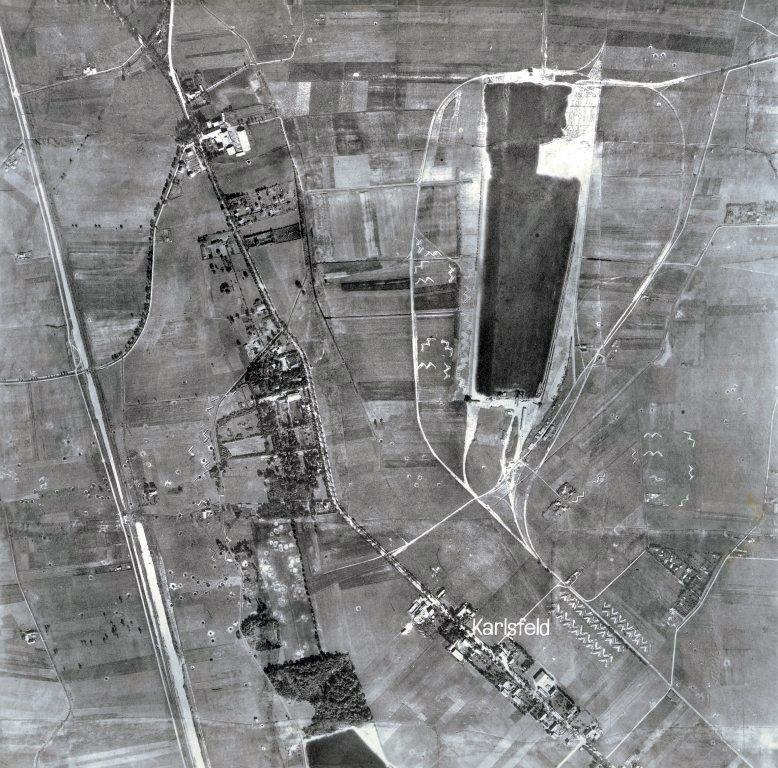
Aerial photograph captioned by the atlas as “Karlsfeld, Luftbild mit See, 3. Juli 1946” and credited to Heimatmuseum Karlsfeld e.V. The holder states no reuse licence. The village name is printed on the image; the camp itself is not marked.
Last researched 13 September 2026