Kastamonu
Arrival and settlement
Kastamonu · Turkey · 1949–1954
Half of Kastamonu’s derelict army barracks was repaired by the Red Crescent in 1949 to house the last military refugees from the Yozgat camp, men of several nationalities who would not go home. Fire destroyed the building on 14 March 1954 and the remaining residents were moved back to Yozgat.
Introduction
Kastamonu’s Red Crescent guesthouse opened in June 1949 for refugees transferred from Yozgat. Doğru Söz described one resident as “Ukraynalı Rus”, a Ukrainian Russian, and quoted him on conditions behind the Iron Curtain. This establishes a Ukrainian connection within a mixed refugee institution; it is a single identification, not a Ukrainian count.
The interior ministry chose Kastamonu because the town was thought secure and had a fully equipped hospital. With the war over, the word camp was dropped for its psychological effect and the place was called a guesthouse, although its residents remained under police supervision throughout.
Sources for this section
A history in dates
- 13–15 December 1948An interministerial commission decides to open a Red Crescent guesthouse at Kastamonu for the 53 refugees left at Yozgat.
- 28 January 1949Rıza Tunç arrives as manager and begins repairs to part of the military barracks.
- February 1949An inspection party rejects the former infirmary and selects the main barracks block; 15,000 lira is allocated for repairs.
- 2 June 1949The first refugees arrive from Yozgat, reaching the building at four in the morning during a power cut.
- 3 June 1949Doğru Söz reports the opening, describing the guesthouse as furnished for 120 people, and quotes a resident it calls a Ukrainian Russian.
- 4 June 1949The interior ministry issues the guesthouse instruction, later translated into six languages for the residents.
- 6 June 1949The British embassy press attaché and his wife visit and praise the arrangements.
- 24 June 1949Two civilian Bulgarians arrive, bringing the recorded total to 54.
- 6 July 1949The first dose of a combined typhoid and typhus vaccine is given.
- 9 July 1949The manager sends the first monthly report, covering food, health, leave, work and recreation.
- 24 July 1949Shoes are bought as a Ramazan Bayramı gift for 26 Muslim residents and shoe rubbers for 31 others.
- November–December 1949Returns give 33 residents in November and 38 in December.
- 24 January 1950A local paper describes the coffee house, reading room, library, radio and the residents’ own repair shop, and notes numbers falling as people join relatives.
- 29 March 1951A newspaper reports former residents awaiting departure for New Zealand in Istanbul.
- 14 March 1954Fire destroys the guesthouse, starting in the roof space above the bath section.
- 15 March 1954The governor publishes an open letter after the local press blames the residents for the fire.
- 30 March 1954The Red Crescent reports preparations for a new rented guesthouse in Yozgat.
- 13 May 1954A Kastamonu paper claims a Russian agent lodged at the guesthouse had started the fire; no cause was ever established.
A barracks adapted for civilian life
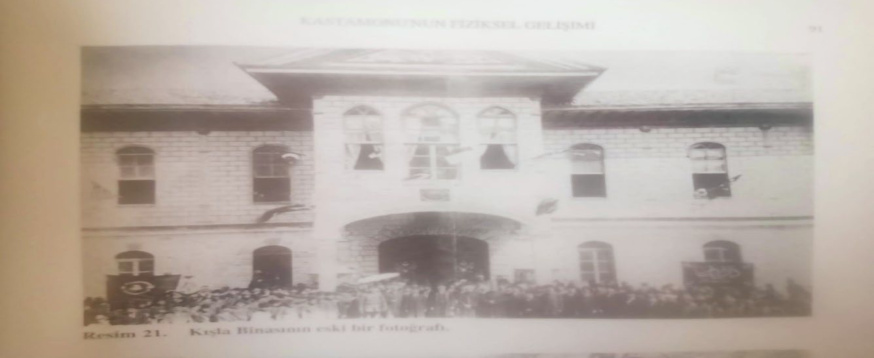
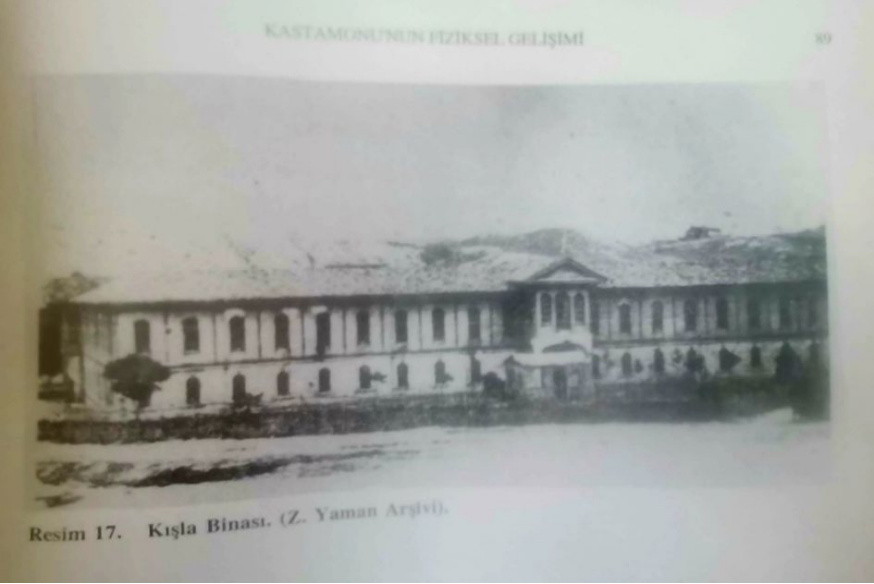
The building was the Kastamonu military barracks, held by the Ministry of National Defence. Writing to calm the town after the 1954 fire, the governor Niyazi Akın described it as a token of sacrifice built during the First World War for units of the Turkish army; the local press said it had been raised by Kastamonu villagers at a cost approaching a million lira and had served a public need for forty years. A photograph dated 24 August 1925 shows Mustafa Kemal inspecting a guard of honour drawn up in front of it. Emptied during the Second World War and left unguarded, it had fallen into ruin, and the neglect was resented locally.
In 1949 a party toured the military barracks to find a building fit for the refugees. It included the Red Crescent inspector Doctor Mecit Sayan and Namık Erverdi of the security directorate, with the provincial public works director, the acting head of the military affairs office and the acting police chief. The block formerly used as an infirmary had two wards and five rooms and could take only a hundred to a hundred and twenty people.
Inspectors considered two buildings. The former infirmary lacked adequate water, laundry and dining facilities. They selected the larger main barracks, which had a sound roof, a kitchen and abundant water from a courtyard fountain. Windows, plaster and electrical installations needed repair. Stoves would heat the rooms, while the high ceilings allowed bunks to be arranged in pairs.
Rıza Tunç, appointed manager by the Red Crescent head office, reached Kastamonu on 28 January 1949 and began work at once. He reported rotten floorboards being replaced on the upper storey of the two-storey building, a separate gang building new lavatories below, and others at the kitchen, scullery, laundry and painting. Thirty stoves with three hundred lengths of pipe were ordered for heating, while pipes, a water pump, taps, a water heater and basins had to be sent for from Istanbul.
The money came through the Red Crescent. Parliament voted the association 939,858 lira for 1949, of which 189,496 lira was for moving the Yozgat refugees and keeping them at Kastamonu; 15,000 lira went to the barracks repair, where the bath house and kitchen were derelict, and about 23,000 lira more to furniture. Kitchen and table goods were costed for a hundred people but bought for a hundred and twenty.
Red Crescent expenditure on the guesthouse, 1949
| Item | Amount (lira) |
|---|---|
| Parliamentary grant to the Red Crescent for 1949 | 939,858 |
| Allocated to moving and keeping the Yozgat refugees at Kastamonu | 189,496 |
| Repair of the barracks | 15,000 |
| Furniture and fittings (estimate) | about 23,000 |
| Advance sent to Kastamonu, 24 May 1949 | 31,000 |
| Running cost, May 1949 | 5,957.18 |
| Estimated monthly running cost from July 1949 | about 5,000 |
Red Crescent administration
Formal administration rested with a commission chaired by the governor of Kastamonu and including the police chief, the provincial gendarmerie commander, the director of health and social assistance, the mayor, the president of the chamber of commerce and the head of the local Red Crescent branch. The Red Crescent met the cost of establishing and running the guesthouse and of the residents’ food, lodging and medical treatment, while custody and responsibility stayed with the governorship. The paid staff were a manager, a doctor, a clerk, a bursar, a servant, a laundress and a laundress’s assistant, each vetted for good conduct, health and a clean record.
On 4 June 1949 the interior ministry issued a written instruction setting out how the guesthouse was to be run. The security directorate had it translated into French, Russian, Bulgarian, Romanian, Greek and Arabic, and each resident had to sign that he had understood it. Residents could go out at hours fixed by the governor but not beyond the municipal boundary without the ministry’s special permission. Penalties ran from a warning through loss of leave to a proposal for deportation. Letters home were limited to fifteen lines, written openly and posted only through the manager, who sent them to Ankara to be read; incoming letters were read there too. Private radios were forbidden, although the guesthouse had one of its own.
Daily life and work
Life combined material support with supervision. Residents could go into town within the municipal boundary, subject to morning and evening checks. Cleaning and serving meals were shared through a duty rota. A resident duty officer and non-commissioned officer supervised the building for twenty-four hours, including precautions against fire and checks that everyone had returned to bed.
The July 1949 report describes tea with cheese, olives or eggs at breakfast, two dishes at lunch and dinner, and regular soup and salad. Laundry was washed weekly and baths scheduled twice a week. Recreation included volleyball, table tennis, chess and backgammon. Medical care extended to vaccination and basic dentistry.
That report puts the cost of feeding one man at 120 kuruş a day for about 2,720 calories, with the whole guesthouse costing roughly 5,000 lira a month. Forty-one men attended sick parade in June, and the first dose of a combined typhoid and typhus vaccine was given on 6 July 1949. One man suspected of tuberculosis was cleared at the tuberculosis hospital. Half a bar of soap a week was issued for washing, and men shaved themselves or were shaved by a resident who was a barber.
The people transferred from Yozgat brought practical skills: radio and typewriter repair, electrical work, metalworking, carpentry, cooking and gardening. These offered routes into paid work, either inside the guesthouse or in Kastamonu. Correspondence over wages reveals the change from military categories to civilian relief: officials debated the continuation of officers’ pay before adopting accommodation, food, clothing and modest spending money as the basis of support.
The settlement reached in June 1949 gave officers thirty lira a month net and other ranks sixteen, the Yozgat rate. A man who found work in the town needed the governor’s permission and had to repay the Red Crescent the cost of his keep, though never more than seventy-five per cent of his daily earnings. The association also calculated that employing residents inside the building at about two lira a day would be cheaper than hiring local labour.
Clothing was an immediate concern. Administrators asked whether worn-out garments should be replaced from central supplies or bought locally, and tailoring clothes in Kastamonu was also considered. In July 1949 the manager reported that several men had no shoes, borrowed from one another to walk to the market and in some cases went barefoot; coats, suits, shoes, shirts and socks were asked for from Ankara, and the Red Crescent had shoes made at a state factory at fifteen lira a pair. These everyday requests show the work involved in replacing years of institutional dependence with a more ordinary civilian routine.
Leave was granted by the governor’s order in a morning and an afternoon period, and on Saturdays and Sundays parties of no more than ten could go to cinema matinees. Returns were checked by the police post at the guesthouse. Two Muslim residents who came back late, and four Russian residents who climbed out of a window to go fishing, each lost a week’s leave on the governor’s order; the administration treated both incidents as trivial.
Journalists shown round in January 1950 described a dining hall, a coffee house, a reading room with a library and a radio, and a repair shop on the ground floor that the residents had set up themselves for mending small articles. The guardroom and its policeman were on the ground floor, the manager’s, administrators’ and doctor’s rooms above, and the residents slept in separate wards by nationality.
Internal order was partly delegated. Leaders were chosen for the Turkish, Russian and Bulgarian groups, while the Egyptian, Italian and German residents answered directly to the duty officer. A separate fire instruction required the bell to be rung continuously, two numbered teams to bring out the hand pumps and buckets, and the town brigade to be called.
Faith, schooling and suspicion
Religious observance was accommodated within the rules. During Ramadan the Muslim residents were allowed out to Teravih prayers. At the governor’s particular wish, shoes were bought as a Ramazan Bayramı present in July 1949 for twenty-six Muslim residents, and shoe rubbers for the thirty-one of other faiths and nationalities then in the building.
No school or church was established for the residents, and the sources record no organised Ukrainian religious or cultural life at Kastamonu. What they do record is local unease. When one newly arrived resident called at the town lycée on his second day and spoke to the deputy head and the German master, a Kastamonu paper objected that it was dangerous for such people to mix with pupils and called on the provincial police to take notice.
Sources for this section
Arrivals and accommodation
The opening transfer was of fifty-three people, of whom fifty-two arrived; one scheduled traveller remained in hospital. The transfer figures cover all nationalities, not Ukrainians alone.
The party reached the building at four in the morning on 2 June 1949 during a power cut, and were shown by candlelight to beds numbered in their names. Two civilian Bulgarians arrived on 24 June, and the monthly report of 9 July 1949 gives fifty-four residents: twenty-eight Russian, twenty-one Bulgarian, two Egyptian, one Greek, one German and one Italian by nationality. Many of those counted as Russian or Bulgarian nationals were Turks by origin, among them four Turkish officers and eight other ranks who had served in the Russian army, nine in the Bulgarian and one in the Greek.
The building was reported capable of holding a hundred and fifty, was furnished for a hundred and twenty, and in July 1949 still had beds and place settings for sixty-six more. It never filled. Numbers fell instead as people left to join relatives: a separate set of returns gives thirty-three residents in November 1949 and thirty-eight in December. The sources do not explain the rise between those two months.
Opening transfer and provision, June 1949
| Measure | People | Meaning |
|---|---|---|
| Transfer list | 53 | Scheduled travellers |
| Actual arrivals | 52 | One person remained in hospital |
| Initial furnishing | 120 | Provision, not occupancy |
Nationalities recorded in the monthly report, July 1949
| Nationality | People |
|---|---|
| Russian | 28 |
| Bulgarian | 21 |
| Egyptian | 2 |
| Greek | 1 |
| German | 1 |
| Italian | 1 |
| Total | 54 |
Recorded numbers at the guesthouse, 1949
| Date | People | Source scope |
|---|---|---|
| 2 June 1949 | 52 | Arrivals from Yozgat; one of the 53 remained in hospital |
| 24 June 1949 | 54 | Manager’s return after two civilian Bulgarians arrived |
| 24 June 1949 | 52 | A separate return of the same date, broken down by army and origin |
| 9 July 1949 | 54 | First monthly report |
| November 1949 | 33 | Camp return |
| December 1949 | 38 | Camp return; the sources do not explain the rise |
Through Istanbul to a new home
A March 1951 newspaper report followed former Kastamonu residents to an Istanbul hotel while they awaited departure for New Zealand. Interviewees recalled clean accommodation and an allowance of fifteen lira a month for small personal purchases. The account describes opportunities to leave the guesthouse and find work, alongside continued police oversight.
One former resident had developed acrobatic skills during his time in camp and was performing with variety troupes in Istanbul. The hotel gathering included music and conversation about the approaching voyage. This was a stage between institutional accommodation and resettlement overseas; the article’s favourable interviews describe those particular travellers’ experiences.
Departures of this kind were the normal way out. A local report of January 1950 already noted that numbers were falling as residents went to relatives, and the 2025 study concludes that most had left before the fire. No source seen gives a count of those who reached New Zealand or Australia, or names Ukrainians among them.
Sources for this section
Fire and transfer back to Yozgat
Fire destroyed the guesthouse on 14 March 1954. It broke out at about half past seven on the Sunday evening in the roof space above the bath section and reduced the building to rubble; only the flour mill next to it and the outbuildings were saved. The interior was largely timber finished with oil paint, which is the likely reason the brigade could not hold it. A national paper put the loss at close to a million lira.
The cause was never established. A Kastamonu paper announced the fire under the headline that the great barracks had become a heap of ash and blamed sabotage by the residents; the governor published an open letter the following day appealing for calm. The prosecutor’s inquiry pointed towards indiscipline and neglect, the manager of the day was questioned, and the provincial treasury was reported to be preparing a claim for four and a half million lira if negligence rather than intent were found. In May the same paper claimed that a Russian agent lodged there earlier had probably started it. Two elderly Kastamonu witnesses interviewed in 2023 said the refugees had burned the building from inside. How many people were in the building that night, and how many got out, is not known.
A Red Crescent letter dated 30 March described preparations for transfer to a newly rented building in Yozgat, separate from the earlier military camp. The association’s inspector Mehmet Ali Yalım had gone to Yozgat and taken a building on lease with the provincial governor, and Nazım Kafaoğlu was proposed as manager of the new guesthouse at 250 lira a month. The Kastamonu barracks was not rebuilt for this purpose and the guesthouse was not re-established in the town.
Sources for this section
Sources
- Kastamonu Refugee Guesthouse after the Second World War
Özlem Kılınççeker, KAREN 11/23, pp. 41–66 · 2025
Archive-based study using the Red Crescent archive, carton 2883. The Ukrainian description appears on p. 52, quoting Doğru Söz, 3 June 1949. Pages 44–48 cover the barracks, the repairs and the funding; pp. 51–59 the arrival, the 4 June instruction, internal order and the July 1949 monthly report; pp. 60–62 the fire, the inquiry and the 1954 transfer. The barracks photographs are reproduced as appendices from Eyüpgiller’s 1999 city history.
- Refugees in Turkey and Red Crescent assistance during the Second World War
Süleyman Tekir and Eda Şahin, Belgi 26, pp. 107–125 · 2023
The Kastamonu section, pp. 112–116, uses Red Crescent records for the inspection party, the selection of the barracks, building alterations, the staff establishment, resident duties, the July 1949 nationality figures and calorie allowance, and the conditions of movement.
- Refugees and prisoners in Turkey through archival documents
Ulvi Keser, Çağdaş Türkiye Tarihi Araştırmaları Dergisi VIII/18–19, pp. 185–208 · 2009
Pages 205–207 reproduce and discuss correspondence about occupations, clothing, work, allowances and the transition from Yozgat, give a breakdown of the 24 June 1949 population including the Turks serving in foreign armies, and record 33 residents in November 1949 and 38 in December.
- City report: at the refugees’ hotel
İkdam Gece Postası, pp. 2 and 4; Gaste Arşivi · 29 March 1951
Contemporary interview report, beginning on page 2 and continuing on page 4. Former Kastamonu residents describe accommodation and work while awaiting a voyage to New Zealand. Resident names are omitted here.
- Mustafa Kemal inspecting a guard of honour in front of the Kastamonu barracks, 24 August 1925
İşte Atatürk photographic archive · Photograph dated 24 August 1925
Dated photograph of the barracks in military use, reproduced as an appendix in the 2025 study. The site reserves all rights and states that its material may not be used without permission, so the image is not reproduced on this page.
Last researched 13 September 2026