Kingencleugh Agricultural Hostel
Arrival and settlement
Mauchline, Ayrshire, Scotland · Prisoner-of-war Camp 112 from 1943; Ukrainian hostel documented in 1948
Kingencleugh, south of Mauchline, was prisoner-of-war Camp 112: an Italian working camp from 1943 and a German one from April 1945, with outlying hostels across Ayrshire. After the prisoners went home the huts became an agricultural hostel, listed in the Ukrainian community’s directory and thanked by name in a Ukrainian Orthodox pastoral notice of 1948.
Introduction
At Kingencleugh, near Mauchline, a wartime prisoner-of-war camp became accommodation for displaced Europeans. Ukrainian residents appear in both the community’s later camp directory and a contemporary Orthodox church publication from 1948. The camp’s changing role can be followed through a Red Cross inspection, an aerial photograph and a local account of the postwar housing debate.
The camp stood at NS 50308 25931 in Mauchline parish, and Historic Environment Scotland records it as Kingencleugh, Camp 112, German Working Company. The English Heritage gazetteer lists number 112 as Kingencleugh (Kingendengh) Camp, Mauchline, Ayrshire, a German working camp. Before it was built the ground was farmland.
Sources for this section
- Peter Kormylo, Ukrainians in Scotland, PhD thesis
- Ihor Hubarzhevsky, Thanks, Brotherhood’s Letter 4–5, August–September 1948
- Camp 112 – Kingencleugh Camp, Mauchline, Ayrshire, research file, including a transcription of the ICRC visit of 30 May 1945
- Kingencleugh and Ballochmyle Hatchery, aerial photograph SAW007910
- David McClure and correspondents, Research Postings, thread on German prisoner-of-war camps in Ayrshire, quoting the Third Statistical Account of Ayrshire, page 699
- Kingencleugh, Camp 112, German Working Company, place record 180976
- Roger J. C. Thomas, Prisoner of War Camps (1939–1948), Twentieth Century Military Recording Project, gazetteer entry 112
A history in dates
- 1943Camp opened for Italian prisoners, with hostels at Dalry, Kilmaurs and Maybole.
- November 1944A War Office list recorded an Italian working camp of non-co-operators.
- April 1945German working-camp phase began on 10 April; the first German prisoners were transferred in from Happendon, Camp 19, on 19 April.
- 30 May 1945Red Cross inspector recorded accommodation, work, education and welfare in the German camp.
- Before September 1945New hostels for German prisoners opened at Crosshill and Dailly.
- 1946A Royal Air Force sortie photographed the camp; the number 112 passed to Doonfoot Camp near Ayr.
- 1947Aerofilms photographed the camp and hatchery in two frames, SAW007909 and SAW007910.
- August–September 1948A Ukrainian church newsletter thanked the manager after a recent pastoral visit.
- 1951The local statistical account described displaced Central Europeans occupying the camp.
- 2019The camp research file records the site as farmland.
Sources for this section
- Camp 112 – Kingencleugh Camp, Mauchline, Ayrshire, research file, including a transcription of the ICRC visit of 30 May 1945
- Kingencleugh, Camp 112, German Working Company, place record 180976
- Camp 14 (& 112) – Doonfoot (Bun) Camp, Ayr, research file
- Kingencleugh and Ballochmyle Hatchery, aerial photograph SAW007910
- Kingencleugh and Ballochmyle Hatchery, aerial photograph SAW007909
- Ihor Hubarzhevsky, Thanks, Brotherhood’s Letter 4–5, August–September 1948
- David McClure and correspondents, Research Postings, thread on German prisoner-of-war camps in Ayrshire, quoting the Third Statistical Account of Ayrshire, page 699
Italians, then Germans
The compiled research file for Camp 112 dates its opening to 1943, when it held Italian prisoners and ran outlying hostels at Dalry, Kilmaurs and Maybole. A War Office list of November 1944 recorded it as an Italian working camp whose prisoners were classed as non-co-operators. On 19 April 1945 the first German prisoners arrived from Happendon, Camp 19, graded politically white or grey rather than committed Nazis, and before September 1945 further hostels for Germans opened at Crosshill and Dailly.
Outlying hostels recorded under Camp 112
| Hostel | Phase recorded | Detail in the source |
|---|---|---|
| Dalry, Ayrshire | Italian, 1943; still open 1946 with Germans | Believed to have been at Tofts, Dalry, NGR NS 297 495 |
| Kilmaurs, Ayrshire | Italian, 1943 | Local memories place it 2.5 km south of Kilmaurs, NGR NS 399 394 |
| Maybole, Ayrshire | Italian, 1943 | Dailly Road, Maybole, NGR NS 300 094 |
| Crosshill, Ayrshire | German, before September 1945 | Capacity given as 50 |
| Dailly, Ayrshire | German, before September 1945 | Capacity given as 50 |
A working camp in rural Ayrshire
A Red Cross inspection dated 30 May 1945 describes Kingencleugh as a former Italian camp that had become a German working camp on 10 April. Major H. F. Leschallas commanded it. The report, available in a modern transcription, recorded 586 German prisoners against a capacity of 600; a further 518 Italian prisoners lived in hostels as far as 25 miles away under the same command. The prisoners worked predominantly in agriculture. These figures describe the wartime organisation before the Ukrainian hostel phase.
Inside the huts
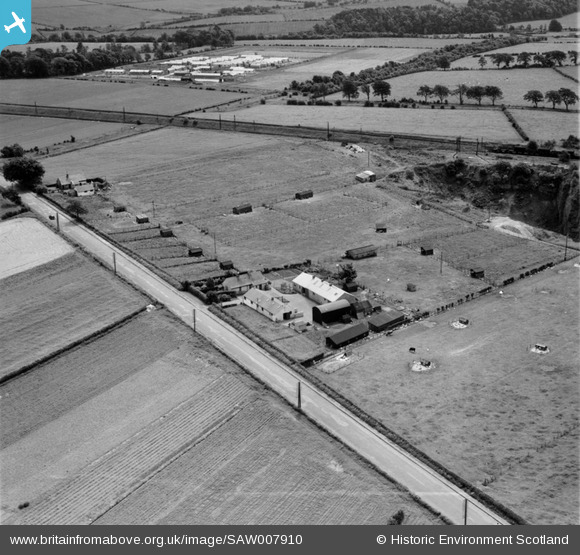
The inspector counted 26 huts, including 16 living huts, two dining huts and separate buildings for a kitchen, theatre, reading room, chapel and infirmary. Concrete paths and roads joined them, with flowerbeds around the buildings. Electric lighting and stove heating were provided. The 1947 aerial photograph places the hutted compound in its agricultural surroundings, behind the Ballochmyle hatchery. Its regular layout is visible beyond the railway line.
Aerofilms photographed the site twice in 1947, and both frames are catalogued as showing Prisoner of War Camp 112, Kingencleugh, behind the Ballochmyle hatchery.
The German camp on 30 May 1945
| Feature | Recorded figure | Scope |
|---|---|---|
| Prisoners present | 586 | German main camp |
| Capacity | 600 | Main camp |
| Italian prisoners elsewhere | 518 | Outlying hostels under the same command |
| Huts | 26 | All types counted by inspector |
| Living huts | 16 | Average 35 men per hut in report |
| English class | 164 | Pupils, not all residents |
Learning, music and everyday routines
The May 1945 inspection gives an unusually detailed view of life within the German camp. English classes enrolled 164 pupils; smaller groups studied French, Spanish, mathematics, agriculture and rhetoric or literature. A twelve-member theatre group had its own hut. Protestant and Catholic choirs, a piano and an accordion supported musical life. The report also recorded the frustration of waiting for correspondence from home. These activities belong to the prisoners described by the inspector; the later Ukrainian residents brought a separate chapter to the same named camp.
The number moves to Doonfoot
In 1946 the camp number 112 was reallocated to Doonfoot Camp near Ayr, so Kingencleugh either closed as a camp or was reduced to a hostel; the 1947 camp list gives 112 as Doonfoot. Doonfoot was a separate and larger site, and appears in the Ukrainian records under its own name. What happened at Kingencleugh between the prisoners leaving and the hostel opening is not recorded.
Ukrainian residents and an Orthodox visit
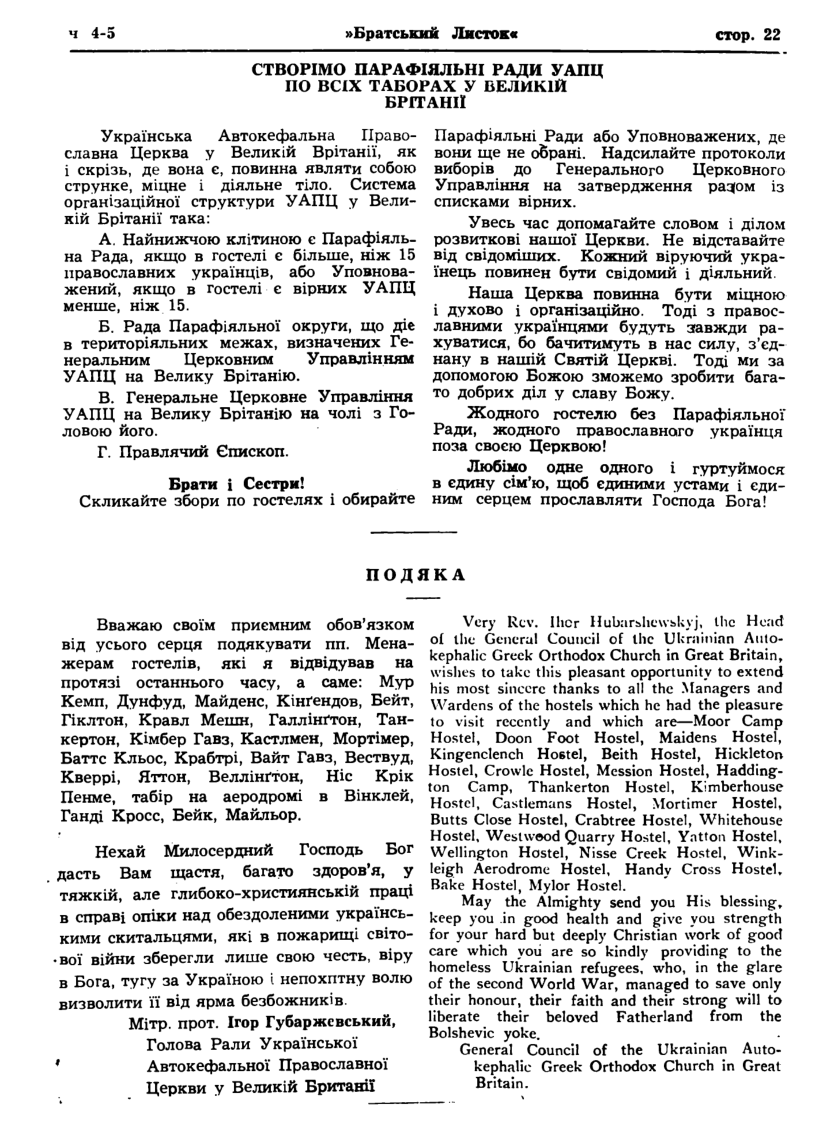
By the late 1940s, Kingencleugh was part of the network of hostels used by Ukrainians in Scotland. Peter Kormylo’s map calls it an agricultural hostel. In the August–September 1948 Brotherhood’s Letter, the head of the General Council of the Ukrainian Autocephalic Greek Orthodox Church in Great Britain, Ihor Hubarzhevsky, thanked managers and wardens at hostels he had recently visited. His list includes Kingenclench, the period spelling used here for Kingencleugh, alongside Beith, Maidens and Doonfoot. Addressed to those caring for Ukrainian refugees, the notice records a direct connection between the hostel and an emerging national church network.
The notice names, in order, Moor Camp, Doon Foot, Maidens, Kingenclench and Beith, before hostels elsewhere in Britain, so the four Ayrshire hostels fall together at the head of the list. The same page appealed for parish councils in every hostel, with a council where more than fifteen Orthodox Ukrainians lived and a single representative where there were fewer. Nothing says which side of that threshold Kingencleugh fell on.
From 1947 the camps passed from the War Office to civilian bodies and were redesignated hostels, run by organisations including the National Service Hostels Corporation, the Ministry of Agriculture and the YMCA. Which body ran Kingencleugh has not been established.
A place to live after displacement
Local expectations for the site were different from its eventual postwar use. David McClure’s transcription of the Third Statistical Account records hopes that the former camp might relieve the local housing shortage once the German prisoners returned home. Instead, the 1951 account described it as occupied by displaced people from Central Europe. Read beside the Ukrainian directory and the 1948 pastoral notice, it shows Kingencleugh’s passage from wartime confinement into the accommodation landscape of postwar migration.
That account is the Third Statistical Account of Ayrshire by John Strawhorn and William Boyd, Edinburgh 1951, whose page 699 records that some 500 prisoners, first Italians and later Germans, went out from the camp to labour on farms around. In the same exchange another correspondent recalled the outline of the hut foundations still visible eight to ten years earlier; the dated postings run to 2005. The research file records the site as farmland in 2019.
Sources for this section
- Peter Kormylo, Ukrainians in Scotland, PhD thesis
- Ihor Hubarzhevsky, Thanks, Brotherhood’s Letter 4–5, August–September 1948
- David McClure and correspondents, Research Postings, thread on German prisoner-of-war camps in Ayrshire, quoting the Third Statistical Account of Ayrshire, page 699
- Camp 112 – Kingencleugh Camp, Mauchline, Ayrshire, research file, including a transcription of the ICRC visit of 30 May 1945
Sources
- Peter Kormylo, Ukrainians in Scotland, PhD thesis
University of Glasgow · 2021
Original map printed page 100 and directory pages 322–323 checked. Agricultural Hostel, Kingencleuch; entry 17, Kingencleugh Hostel, Mauchline, Ayrshire. Ukrainian camp identity. No dates or numbers given for individual hostels.
- Ihor Hubarzhevsky, Thanks, Brotherhood’s Letter 4–5, August–September 1948
Bratskyi Lystok, Brotherhood of St Michael the Archangel, via diasporiana.org.ua · August–September 1948
Printed/PDF page 22 inspected visually and its text layer extracted. English name Kingenclench Hostel; Ukrainian companion spelling and Mauchline directory support identification. The same page carries the appeal to form parish councils, with the fifteen-member threshold. Recent visit only, not a precise date or a parish foundation.
- Camp 112 – Kingencleugh Camp, Mauchline, Ayrshire, research file, including a transcription of the ICRC visit of 30 May 1945
WW2 POW Camps in the UK · Compiled; file dated 2025
Complete freely downloadable file read, including the 1943 opening, the Italian and German phases with their War Office and Foreign Office references (WO 32/10737, FO 939/383), the Red Cross transcription with its Fredk Bieri signature attribution, the 1946 reallocation of the number to Doonfoot, the Third Statistical Account quotation and the 2019 note on the site. Original ICRC scan not provided. All 1945 figures belong to the German camp or to explicitly Italian outlying hostels.
- Kingencleugh and Ballochmyle Hatchery, aerial photograph SAW007910
Historic Environment Scotland · 1947
Catalogue details and actual 580-pixel original image inspected. Oblique view south. Hutted compound in background, hatchery foreground. Photograph centre coordinates not used as exact camp coordinates.
- David McClure and correspondents, Research Postings, thread on German prisoner-of-war camps in Ayrshire, quoting the Third Statistical Account of Ayrshire, page 699
Ayrshire History · Postings dated to 2005
Published historical society thread read in full, retrieved through the Internet Archive because the live page did not respond. Gives the underlying book as John Strawhorn and William Boyd, Third Statistical Account of Ayrshire, Edinburgh 1951, and the Kingencleugh passage on page 699; also the note that from 1800 Kingencleugh was the property of the Alexanders of Ballochmyle, and a correspondent’s recollection of hut foundations. The 1951 book was not inspected directly.
- Kingencleugh, Camp 112, German Working Company, place record 180976
Historic Environment Scotland, National Record of the Historic Environment · Archaeology note by RCAHMS, 2 March 2001
Record read in full. Site number NS52NW 103, NGR NS 50308 25931, Mauchline parish, East Ayrshire. Note: “A Prisoner-of-War camp is visible at this location on a Royal Air Force aerial photograph taken in 1946 (CPE/Scot/UK 176: 2130).” The record carries no description of the hostel phase.
- Roger J. C. Thomas, Prisoner of War Camps (1939–1948), Twentieth Century Military Recording Project, gazetteer entry 112
English Heritage · 2003
Gazetteer page read in a freely available copy of the report. Entry: “112 Kingencleugh (Kingendengh) Camp, Mauchline, Ayrshire, German Working Camp, Scotland”. The Scottish entries in this gazetteer carry no grid reference, condition grading or site comment.
- Camp 14 (& 112) – Doonfoot (Bun) Camp, Ayr, research file
WW2 POW Camps in the UK · Compiled; file dated 2023
Read in full, and used only to establish that the number 112 was carried by Doonfoot in the 1947 camp list and to keep the two Ayrshire sites distinct. The December 1944 tunnel escape and the camp magazine belong to Doonfoot, not to Kingencleugh.
- Kingencleugh and Ballochmyle Hatchery, aerial photograph SAW007909
Historic Environment Scotland, Aerofilms collection · 1947
Catalogue entry read. Companion frame to SAW007910, same title and viewpoint, NRHE collection item 1268581, grid reference NS502265, produced from a crop marked negative. Image not downloaded for this page.
- Roman Krawec, Post-war camps and hostels
Ukrainians in the United Kingdom, online encyclopaedia · Accessed 2026
Read in full for the national framework only: the transfer of camps from the War Office to civilian bodies from 1947, their redesignation as hostels, and the bodies that administered them. Kingencleugh is not named in this entry.
Last researched 13 September 2026