Klungset Bedehus
Displacement in Europe
Klungset, Fauske · Norway · Prayer house from about 1915; forced-worker lodging 1942–1943
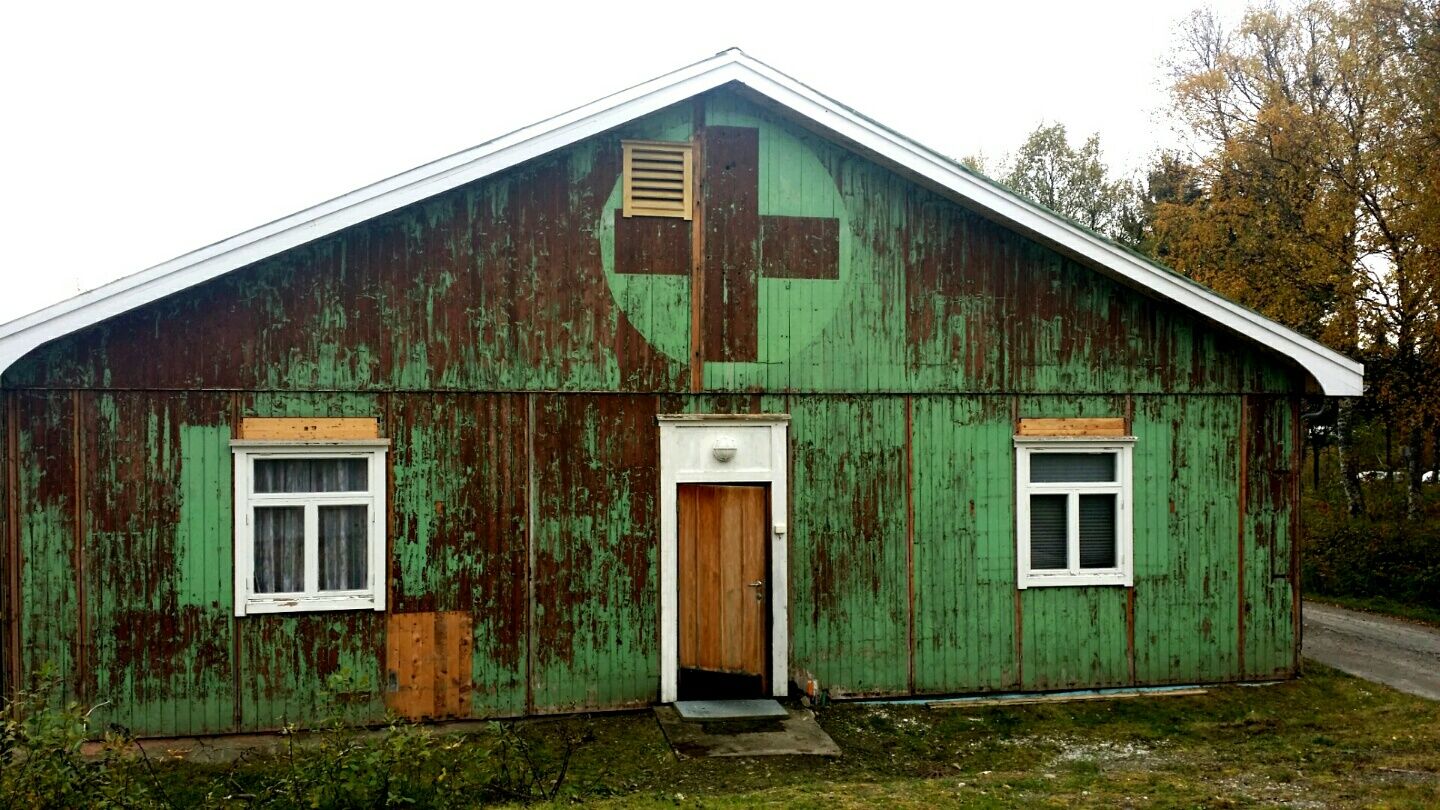
Klungset’s old prayer house, built by the local mission society about 1915, lodged Ukrainian forced workers who helped build the German military hospital beside the farm. It outlasted the occupation and is now the settlement’s community hall.
Introduction
Klungset’s old prayer house accommodated Eastern European forced workers during the German occupation. Nordlandsmuseet documents a Ukrainian resident employed on the nearby hospital’s construction. The prayer house was his lodging; the hospital was his worksite.
Sources for this section
A history in dates
- May 1940Local recollection places a collecting station for Norwegian wounded in the prayer house during the fighting before the German occupation of Fauske.
- October 1914The earliest newspaper notice places a bazaar in Klungset prayer house.
- About 1915Klungset mission society builds the prayer house and lets it to other societies.
- 1942The documented Ukrainian worker reaches Bodø through Germany.
- 1942–1943Organisation Todt directs construction of Klungset hospital.
- 1942–1943A Ukrainian work commando lodges in the prayer house.
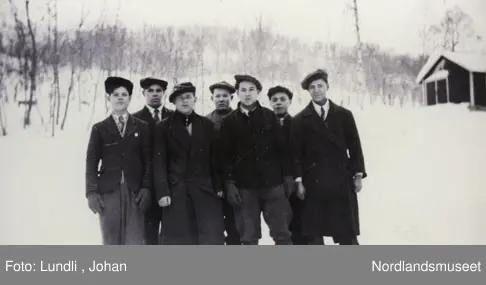
- 1943A photograph records seven Eastern European workers at Klungset.
- 6 June to 5 July 1945Swedish Red Cross staff run the hospital, then hand over to Soviet staff.
- 1972Klungset health society takes over the prayer house; it passes to the grendelag in 2001.
Sources for this section
- Da krigen kom til Fauske
- Notices for Klungset bedehus in Salten and Nordlandsposten, 1914 to 1980
- Gårdshistorie for Fauske. Bind 1: Området Rødås-Klungset
- Eastern European workers at Klungset: photograph and collection history
- Klungset camp: history and heritage protection
- Fauske under 2. verdenskrig. Bind 3: 1942/1943
- Klungset camp: heritage documentation
The mission society’s own house
Klungset mission society was active before 1900, and about 1915 it built a house of its own, known as Klungset bedehus, which it let out to other clubs and societies nearby. A temperance lodge affiliated to the IOGT met there.
Notices in the Salten newspaper show the house in use from October 1914, when the Klungset lodge held a bazaar there to pay for an organ, and afterwards for bazaars in aid of the building and for inner mission festivals.
Requisitioned quarters
The building’s wartime use began before the occupation. A local history talk, drawing on the narrator’s mother, who was twenty-two and lived nearby, recalls the prayer house as a collecting station for Norwegian wounded during the fighting between Mo and Fauske in May 1940, where the injured were cared for before being sent on to Bodø.
The occupation authorities took meeting halls and schools across Fauske. With the school buildings gone, teaching at Klungset was carried on in the prayer house instead.
Some of the concrete work at the hospital was done by a Ukrainian work commando that lodged in the prayer house while the job lasted. The local war history describes these Ukrainians as Ostarbeiter, nominally voluntary civilian workers whose regular workplace was the Frostfilet plant at Langstranda in Bodø. Prisoners of war, who made up the bulk of the labour on the installation, were held in guarded camps; civilian eastern workers were lodged in requisitioned buildings such as this one.
One of the Ukrainians sent over from Frostfilet was Vladimir Kozlov, who lodged in the prayer house and became friendly with Magnus Nordvik of Solheim, the house just to the east. The same volume records around 850 Soviet civilian workers, most of them Ukrainians, reaching A/S Frostfilet in early June.
From Ukraine to northern Norway
His journey led from Ukraine through Germany, then by ship to Bodø in 1942. He worked at a German fish-processing factory on Langstranda before assignments elsewhere in the district brought him to Klungset.
Sources for this section
Building the hospital
The installation stood on the boundary of the Klungset farm, which is how it took the name Ortslazarett Klungset, and work began early in 1942.
The hospital formed part of the occupation authorities’ construction effort around the planned Arctic railway. Organisation Todt directed its construction in 1942–1943. It primarily served German troops, engineers, contractors and civilian workers connected with the works. Riksantikvaren records that prisoners of war made up a large part of the construction workforce but received limited treatment at the hospital.
The buildings combined rapid timber construction with a substantial concrete basement. Prefabricated wall sections and roof structures accelerated the work above ground. Below were treatment and service spaces, including operating and X-ray rooms, kitchens, bathrooms and storage. These surviving structures document the scale and technical demands of the project on which forced labourers worked.
A building register of 1946 lists fourteen buildings with up to 200 beds; Riksantikvaren’s own summary gives twelve.
The places in this history
| Place | Role |
|---|---|
| Old Klungset prayer house | Forced workers’ accommodation; built about 1915, now the community hall |
| Langstranda, Bodø (A/S Frostfilet) | Regular workplace of the Ostarbeiter sent to Klungset |
| Klungset military hospital (Ortslazarett Klungset) | Construction worksite; later medical relief |
| Klungset camp guarded compounds | Where prisoners of war were held, distinct from the prayer house |
A record preserved locally
His colour drawings record the journey, factory work and German authority, with Russian annotations in mirror script. Preserved by a local family, they entered the museum collection in 1995.
The museum catalogues twenty-four items under FA.F.10006, the drawings and two photographs taken by Johan Lundli in 1943. It records that he is thought to have died in the border mountains while trying to reach Sweden, and that his full name is not known.
The hospital after liberation
In June 1945 the Swedish Red Cross brought personnel, special food and medical equipment to Klungset to help severely ill former Soviet prisoners prepare for their journey home. The hospital later became a Norwegian military storage facility. Its surviving buildings and underground rooms received heritage protection, preserving the worksite’s history alongside the museum’s record of the workers.
The Swedish Red Cross staffed the hospital from 6 June to 5 July 1945, flying in 35 tonnes of special food and equipment. Soviet staff then ran it until the last patients left Fauske aboard the hospital ship Stella Polaris in July or August.
Sources for this section
The prayer house afterwards
The prayer house outlasted its wartime use, with a mission gathering there in September 1949 and the Free Evangelical Assembly still meeting in it in 1980.
A plot was separated off for the house in 1968 as bnr. 39 Heggdal. Klungset health society took it over in 1972, and in 2001 it passed to Klungset grendelag as the community hall.
How many forced workers lodged there at any one time, and how long each commando stayed, is not recorded in any source found.
The prayer house and its holders
| Date | Holder or use |
|---|---|
| October 1914 | First newspaper notice of a gathering in the house |
| About 1915 | Built by Klungset mission society; let to other societies |
| 1942–1943 | Lodging for a Ukrainian work commando during the occupation |
| 1949, 1980 | Mission gathering; Free Evangelical Assembly meetings |
| 1968 | Own plot separated off as bnr. 39 Heggdal |
| 1972 | Taken over and modernised by Klungset health society |
| 2001 | Transferred to Klungset grendelag |
Sources
- Eastern European workers at Klungset: photograph and collection history
Nordlandsmuseet / DigitaltMuseum, FA.F.10006-0024 · Record updated 8 May 2026
Museum provenance explicitly identifies Ukrainian residence at the old prayer house.
- Klungset camp: history and heritage protection
Riksantikvaren · Heritage designation: 28 September 2015
Official account of the hospital’s construction, purpose, wartime labour, Swedish Red Cross relief and subsequent military use.
- Klungset camp: heritage documentation
Nordland County Council / Riksantikvaren · Undated documentation, hosted 2020
Architectural documentation of the hospital complex, especially the construction description and protected underground spaces. This describes the worksite, not the prayer-house lodging.
- Dimitri - en østarbeider fra Ukraina (museum article) and collection FA.F.10006
Nordlandsmuseet / DigitaltMuseum, article DF.7335 · Published 11 February 2015
The museum’s narrative of Dimitri, his lodging in the old prayer house, his drawings and his presumed death in the border mountains, with the contents of the collection.
- Gårdshistorie for Fauske. Bind 1: Området Rødås-Klungset
Fauske kommune, via Nasjonalbiblioteket (URN:NBN:no-nb_digibok_2016012008099) · 2013
Farm and society history: Klungset mission society, the building of the prayer house about 1915, the IOGT lodge, and the building’s later holders in 1968, 1972 and 2001.
- Notices for Klungset bedehus in Salten and Nordlandsposten, 1914 to 1980
Salten and Nordlandsposten, digitised by Nasjonalbiblioteket · 1914 to 1980
Eighteen digitised hits for the phrase Klungset bedehus, dating the building’s use before, and again after, the occupation. None of them falls in the occupation years.
- Fauske under 2. verdenskrig. Bind 3: 1942/1943
Via Nasjonalbiblioteket (URN:NBN:no-nb_digibok_2020070848544) · 2019
Local war history: the Ukrainian work commando lodged in the prayer house, Vladimir Kozlov, the name and start date of Ortslazarett Klungset, the requisitioning of other meeting halls and schooling held in the prayer house.
- Da krigen kom til Fauske
Fauske historielag · undated local history talk
Read in full 13 September 2026. A first-person local account, hedged by the narrator and resting on his mother’s recollection, that the prayer house served as a collecting station for Norwegian wounded during the fighting of May 1940 before they were sent on to Bodø. Presented as recollection, not archival record.
Last researched 13 September 2026