Gneisenau-Kaserne
Displacement in Europe
Koblenz-Horchheim · Germany · 1945–1949
Ukrainians formed a large minority in Gniezno, a Polish-led camp in the Horchheim barracks with an elected congress, workshops, a hospital and a Ukrainian Greek Catholic choir. UNRRA Team 20 ran it from May 1945 until the IRO took over in 1947, and the camp was cleared in 1949.
Introduction
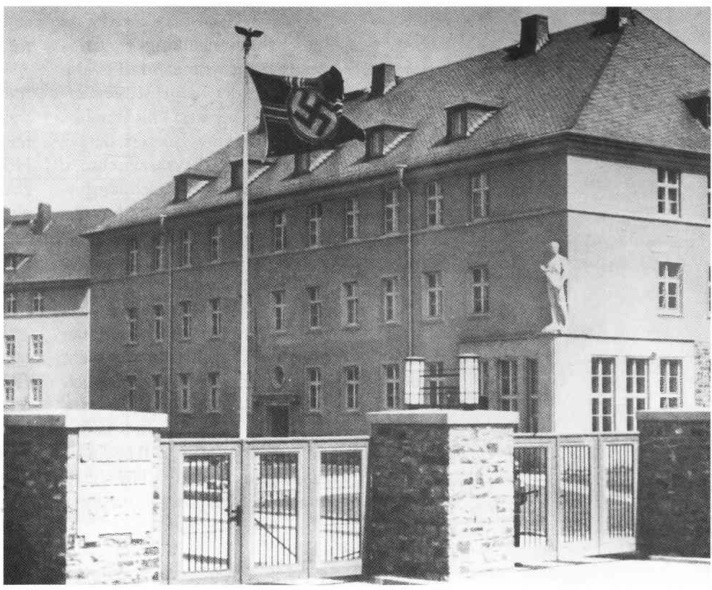
Gneisenau-Kaserne in Koblenz-Horchheim became one of the French occupation zone’s most important places of Ukrainian displacement. Ukrainians lived within a larger, predominantly Polish camp community that adopted the name Gniezno. Behind the barracks’ military frontage, residents formed a small civic world while waiting to return home or find somewhere else to settle.
A history in dates
- 27 March 1945American units occupy the right bank of Koblenz.
- 22 April 1945Foreigners are allocated to four barracks by nationality; Gneisenau is designated for Poles.
- 21 May 1945UNRRA Team 20 arrives and finds about 3,500 Poles and Ukrainians.
- 1 July 1945The first camp congress is elected, one deputy per hundred residents.
- December 1945A Polish work party is authorised to rebuild the Koblenz post office.
- 6 January 1946The camp adopts the name Gniezno.
- April–June 1946The main repatriation transports leave for Poland.
- 1946–1947Approximately 1,370 Ukrainians are recorded.
- 30 June 1947UNRRA ceases work and the IRO takes over.
- April 1949The camp is fully evacuated according to French-archive research.
- July 1949French occupation personnel are housed in the barracks.
A distinct camp in Koblenz
American units took the right bank of Koblenz on 27 March 1945. On 11 April the acting mayor proposed the right-bank barracks to the American command as accommodation for displaced people, and by 22 April a circular from the Ehrenbreitstein administrative office told all departments that foreigners were to be housed in barracks. The four sites were allocated by nationality: the Flak barracks at Niederberg for French, Dutch, Belgian and Luxembourg nationals, Augusta at Pfaffendorf for Italians, Gneisenau at Horchheim for Poles and the Bruchmüller barracks at Niederlahnstein for Russians.
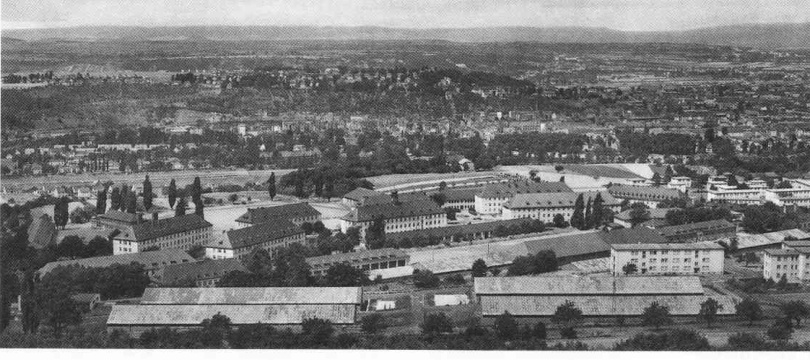
The compound stood on the right bank of the Rhine in Horchheim. It belonged to a network of four barrack camps established in and around Koblenz in spring 1945, but each had its own identity. Augusta-Kaserne in Pfaffendorf and the barracks at Niederlahnstein were separate centres, not alternative names for Gneisenau.
Municipal administrative figures often counted several camps together. For example, the 16,000 people reported at Gneisenau and Augusta on 29 April 1945 were a combined population. That figure cannot describe Gneisenau alone, still less its Ukrainian residents.
Relief and community government
UNRRA Team 20 reached the Gneisenau barracks on the evening of 21 May 1945. Its American director, who wrote a retrospective report in March 1947, began with five people instead of the thirteen a camp of 3,000 was supposed to have, and found about 3,500 Poles and Ukrainians in war-damaged buildings normally meant to hold 1,500. By early June the recorded population was 2,803 Poles. Administration of the camps from outside, and the transports, lay with the French military department known as the PDR, based at Niederlahnstein.
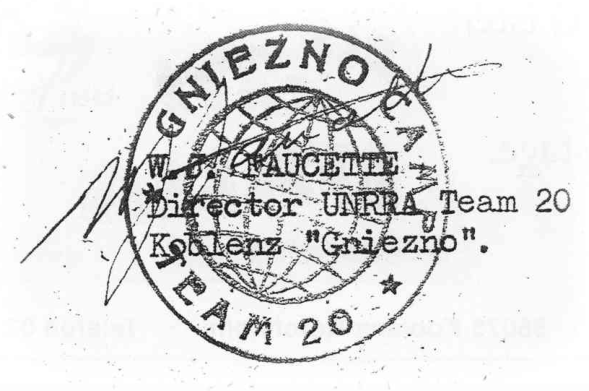
An elected congress followed on 1 July 1945, with one deputy for every hundred residents; the first had 35 members and elections were repeated every six months because the population changed so fast. The congress chose a president and a camp leader and formed a cabinet with an accountant and commissars for public welfare, education and culture, registration and public works. The director held a veto he never had to use, and justice inside the camp was administered by a former Polish judge whose sentences he confirmed, sometimes softening them. On 6 January 1946 the French approved the change of name to Gniezno, which then appeared on letterheads and stamps.
The original seating plan makes the arrangement visible: congress members and cabinet faced a presiding group, with separate places for the international director, liaison officer and visitors. The surviving official seal carries the camp’s chosen name beside its UNRRA team number.
Learning, faith and daily life
A Ukrainian Greek Catholic choir formed part of the religious life, alongside a Roman Catholic women’s association; the camp chaplain ran religious lectures and study groups for young people, and Corpus Christi in June 1946 was marked by a procession through the camp. Schools and workshops offered education and vocational training, the library held 800 volumes by July 1946, and English and French language courses were the mainstay of the adult programme. An 80-bed hospital and a children’s clinic supported medical care, with serious cases and operations sent to the requisitioned St Joseph hospital at Niederlahnstein.
Residents were employed within the camp as cobblers, barbers, cooks, nurses, teachers and casual labourers, and in December 1945 the Koblenz postal directorate asked the French military government to let a Polish work party rebuild the city’s post office. UNRRA kept work voluntary until the end of 1946, when the French authorities imposed compulsory labour on displaced people.
Family life resumed quickly. Marriage had been forbidden to forced labourers, and mass weddings of dozens of couples in a day were not unusual in Koblenz; 78 children were born to Gneisenau residents in May 1946 alone, the mothers going to the hospital at Arenberg. Up to fifteen unaccompanied children are documented at the camp, the responsibility of UNRRA’s Child Search Tracing Section; nine were repatriated on 26 April 1946 and eight left in August for Reutlingen, where five boys began training as car mechanics.
The camp also took part in the region’s social life. Its theatre visited Niederlahnstein, residents attended cinema screenings at Augusta twice a week, and a football match against German sides from Horchheim on 25 August 1946 was abandoned in the rain after the camp won the opening game. A camp newspaper produced at Gneisenau from September 1945 served all three camps in the region.
Children, young people and newborns at Gneisenau, 1946
| Month | Children and young people | Newborns |
|---|---|---|
| March 1946 | 360 | 7 |
| April 1946 | 218 | 13 |
| May 1946 | 261 | 78 |
| June 1946 | 172 | 11 |
| July 1946 | 233 | 7 |
| August 1946 | 270 | 7 |
Sources for this section
A Ukrainian community within a larger population
The Ukrainian historical overview gives approximately 1,370 Ukrainians for 1946–1947. A later study of French-zone camps records around 3,500 people of all backgrounds in March 1947, against an estimated maximum capacity of 2,000. The two figures answer different questions: one identifies the Ukrainian community, the other the pressure on the whole compound.
Sources for this section
Return, resettlement and closure
Repatriation ran mainly in 1946. No large transport left Gneisenau before March that year; a group of 900 departed on 26 April, a convoy of the same size on 6 May and 300 people from Niederlahnstein station on 21 May, and the director recorded the repatriation of 1,023 Poles on 1 June. Conditions could be poor: the welfare officer complained that a party of 124 leaving on 31 August 1946 sat in overcrowded wagons from morning until after ten at night, with luggage limited to 60 kilograms a person. By 1 August he already judged the number willing to return insignificant.
UNRRA ceased work on 30 June 1947 and the IRO took over, shifting attention towards resettlement; 44,109 fully supported displaced people remained in the French zone on 1 July 1947. The camp was evacuated in 1949; research in French records dates the completion to April, and local history records French military occupants by July.
What survives
The buildings outlasted the DP camp, but its everyday history survives chiefly through records and scattered images. Municipal hospital and civil registers document the years of displacement alongside international relief records. Their coverage differs: ordinary postwar returns could omit people in large camps altogether, as well as those already repatriated. Combining these sources explains why a single list cannot represent everyone who lived here.
Numbers from the municipal database show how far the record reaches. Of 4,722 people documented at Koblenz as forced labourers or displaced persons, 4,275 came from eastern European countries, among them 734 from Ukraine. For 1,026 of them the Gneisenau barracks were the first recorded place of accommodation, against 310 at Augusta and 307 at Niederlahnstein. Copies of the UNRRA files from the UN Archive in New York are held, with German translations, by the Stadtarchiv Koblenz.
Sources that preserve the camp’s history
First recorded place of accommodation in the Koblenz municipal database
| Camp | People |
|---|---|
| Gneisenau-Kaserne, Horchheim | 1,026 |
| Augusta-Kaserne, Pfaffendorf | 310 |
| Deines-Bruchmüller-Kaserne, Niederlahnstein | 307 |
Sources
- Eine Kaserne als Wartesaal: Displaced Persons in der Horchheimer Gneisenau-Kaserne
Petra Weiß / Horchheimer Kirmeszeitung · 2005
Printed pages 83–87 and 89. Based on UNRRA Team 20 reports and Stadtarchiv Koblenz records; includes genuine archival photographs and camp documents.
- Foreign forced labourers and displaced persons in Koblenz: municipal archive research
Landesarchivverwaltung Rheinland-Pfalz / Stadtarchiv Koblenz · April 2004
Printed pages 27–35: source coverage, hospital and civil registers, four distinct barrack camps and joint population figures.
- Sur les traces des camps de personnes déplacées
Julia Maspero, in Après les camps, Academia · 2019
Printed page 178: Gniezno name, population and capacity estimates, evacuation April 1949; based on French diplomatic archives and earlier local research.
- The Refugee Experience: Ukrainian Displaced Persons after World War II
Canadian Institute of Ukrainian Studies Press · 1992
Ihor Stebelsky chapter, printed page 27: Gneisenau in Koblenz identified as the largest Ukrainian concentration in the French zone, over 1,000.
- Germany: Ukrainians after the Second World War
Canadian Institute of Ukrainian Studies · Accessed September 2026
1946–1947 overview lists approximately 1,370 Ukrainians at Gneisenau.
- Zwangsarbeitereinsatz im Gebiet des heutigen Rheinland-Pfalz: archival documentation
Walter Rummel / regionalgeschichte.net · 2008
Explains that postwar local returns excluded people already repatriated and residents of major DP camps, explicitly including Gneisenau and Augusta.
- Gniezno Camp, Team 20: official seal and congress seating plan
UN Archives; reproduced by Petra Weiß · 31 March 1947 seal; seating plan undated
Original seal identifies Gniezno Camp and Team 20. Seating plan shows president, deputy president, secretary, congress, cabinet, liaison officer, director and visitors; printed page 87.
- Die Koblenzer Lager für Displaced Persons 1945–1947
Petra Weiß, Jahrbuch für westdeutsche Landesgeschichte 29 (2003), pp 467–507 · 2003
The author’s fuller study, cited at the end of her 2005 article as carrying the literature and source references, including the Augusta camp. Not obtained and not used to substantiate any claim here.
Last researched 13 September 2026