Conti Camp
Displacement in Europe
Continental works, Limmerstraße, Korbach, Kreis Waldeck, Hesse, Germany · 1946–1949
At the Continental tyre works in Korbach, displaced Ukrainians rebuilt a community with schools and youth organisations. The camp took in people from at least two smaller Waldeck camps before it closed in March 1949 and its residents were scattered again.
Introduction
Conti was a displaced-persons camp at the Continental factory site on Limmerstraße in Korbach, in the Waldeck district of northern Hesse. Its Ukrainian community appears under the distinct name “Korbach (Conti)” in postwar population tables, and the camp catalogue names the site plainly as the Continental tyre manufacturer. The camp ran from January 1946 to March 1949 and drew people in from smaller camps around it.
A history in dates
- 1907A rubber works opens at Korbach with 180 employees; it becomes part of Continental in 1929.
- 1941Forced labourers make up 51 per cent of the Korbach works’ payroll.
- Maundy Thursday 1945American troops enter Korbach and production stops.
- 24 January 1946The catalogue entry for Camp Conti begins, as does the entry for Landau in Kreis Waldeck.
- 1946–1947 surveyThe Ukrainian questionnaire survey records 477 residents at Conti.
- June 1947The camp at Grebenstein closes and its residents move to Korbach.
- 31 May 1947The UNRRA return records 77 Ukrainians.
- 1947Landau’s camp is disbanded and its residents are transferred to Conti, according to a later recollection.
- 31 October 1947A capacity of 1,250 and a headcount of 1,240 are recorded for all nationalities.
- December 1947The PCIRO return records 976 Ukrainians.
- 23 January 1948Korbach is among the source camps for Ukrainian arrivals at Gießen’s workers’ camp.
- 22 March 1949The catalogue records the closure of Camp Conti.
- October 2009A local school group researches Korbach’s DP camp in the tracing-service archive.
Sources for this section
- Studie gibt Einblicke ins Korbacher Continental-Werk in der Zeit des Nationalsozialismus
- DP camp inventory: Conti, Landau, Grebenstein and Rhoden
- Population Migration after World War II, Table 7
- The Refugee Experience, Table 7 column definitions
- About DP camps long forgotten
- Ukrainian displaced persons in Germany
- Annual report 2009
The Continental works before 1945
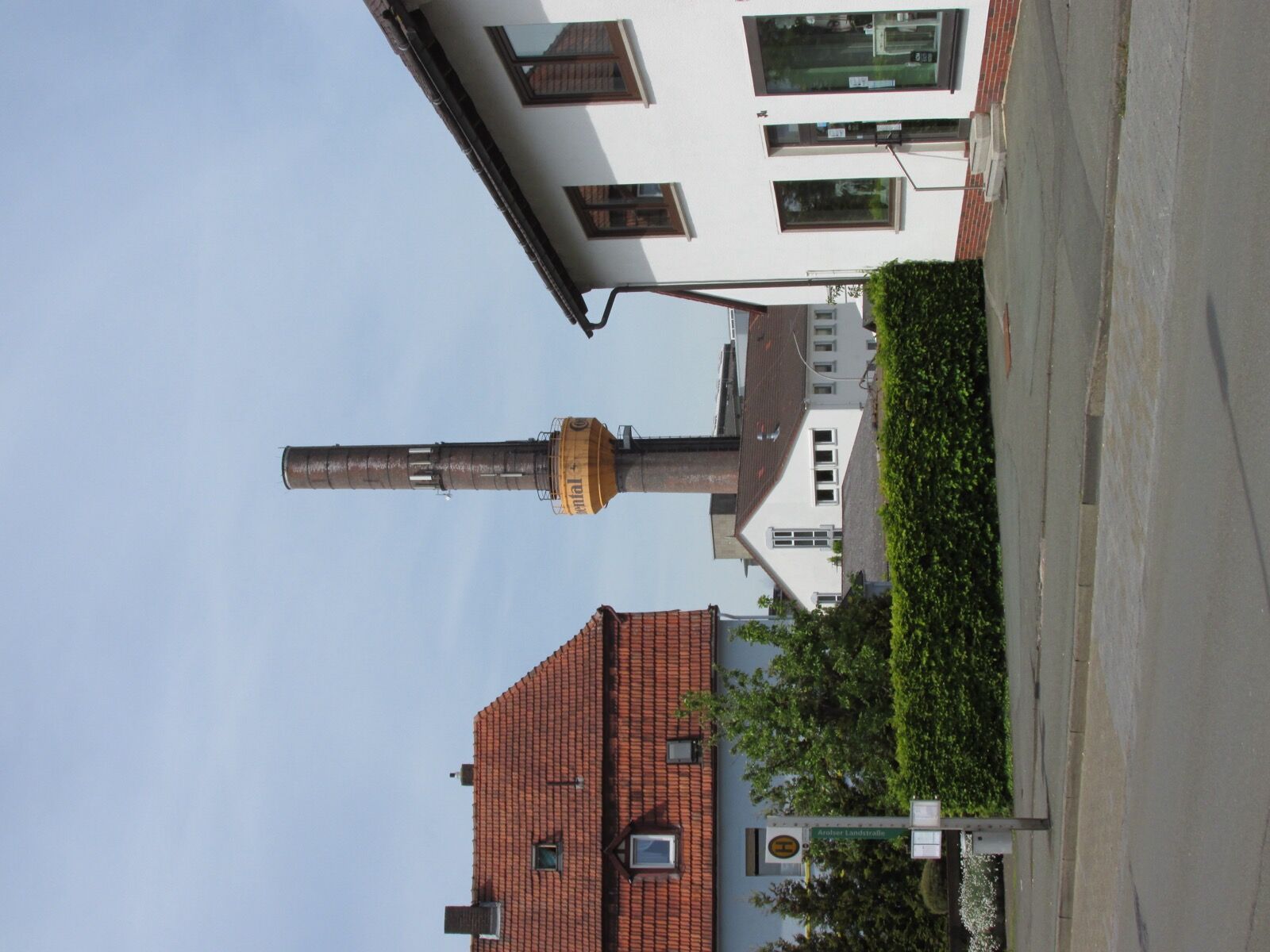
The Korbach plant opened in 1907 with 180 employees as a branch of a Frankfurt rubber-goods company, and passed to Continental of Hanover when the two firms merged in 1929. During the Second World War it produced tyres, aircraft tyres, rubber containers for aircraft tanks and padding for tank tracks. A study of the Continental group under National Socialism records that forced labourers and prisoners of war were used in growing numbers and already made up 51 per cent of the Korbach workforce in 1941, with the payroll rising from about 1,100 at the end of 1940 to 1,738 in November 1943. American troops entered Korbach on Maundy Thursday 1945 and production stopped.
The camp for displaced people therefore stood on a site that had itself depended on coerced labour. The study does not describe a displaced-persons camp on the works site, so the link between the wartime plant and the postwar camp rests on the location rather than on a documented continuity of buildings or people.
Sources for this section
A camp on an industrial site
Research into the region’s displaced-persons camps identifies the Continental works as the Korbach location, and the camp catalogue confirms it. The catalogue records an opening date of 24 January 1946 and closure on 22 March 1949, the assembly-centre number AC 527, the later designation K 105, a capacity of 1,250 and a headcount of 1,240 on 31 October 1947, and residents of various nationalities. Relief work was organised through UNRRA Team 51 Korbach under the Kassel area teams. Its factory setting distinguishes Conti from other accommodation in the wider district.
Catalogue record for Camp Conti
| Record | Value |
|---|---|
| Opening | 24 January 1946 |
| Closure | 22 March 1949 |
| Assembly centre | AC 527 |
| From September 1948 | K 105 |
| UNRRA team | Team 51 Korbach |
| Capacity, 31 October 1947 | 1,250 |
| Headcount, 31 October 1947 | 1,240 |
| Nationalities recorded | Various |
Transfers from the smaller Waldeck camps
A recollection published in The Ukrainian Weekly in January 2013 describes a camp at Landau in Kreis Waldeck, formed immediately after the war, which was disbanded in 1947 with its population transferred to Camp Conti. The catalogue supports the identification: its Landau entry sits in Kreis Waldeck, opened on the same day as Conti, closed before 31 October 1947, and was served by the same UNRRA team and the same team director. This is the Waldeck Landau, not the town in the Palatinate or Landau on the Isar.
Conti was not the only receiving camp for the district, nor Landau the only feeder. The catalogue notes that the camp at Grebenstein in Kreis Hofgeismar was closed in June 1947 and its residents moved to Korbach. A further camp at Rhoden in Kreis Waldeck, also under Team 51, closed late in 1946. Stebelsky’s Ukrainian figures for Landau, which fall from 460 in the wartime questionnaire survey to 357 in May 1947 and then disappear, are consistent with these movements without proving the date or composition of any single transport.
Ukrainian residents
The Ukrainian questionnaire survey collected in 1946 and 1947 counted 477 residents at Conti. The UNRRA return of 31 May 1947 recorded 77, and the PCIRO return compiled at the start of January 1948 recorded 976. The scale of the change illustrates how different a camp could look within the same year, and the December figure sits close to the all-nationality headcount of 1,240 recorded six weeks earlier. The returns and the Landau recollection should be read together, but they do not establish the date or composition of each intervening transport.
Ukrainian residents at Conti
| Return | Source of the figure | Ukrainian residents |
|---|---|---|
| 1946–1947 survey | Questionnaires of the Central Representation of the Ukrainian Emigration | 477 |
| 24 August 1946 | UNRRA summary, American zone | Not listed |
| 31 May 1947 | UNRRA summary, American zone | 77 |
| December 1947 | PCIRO summary compiled 2 January 1948 | 976 |

Schools, youth and religious life
The 2013 recollection describes active Ukrainian social, political and religious life in the three camps it discusses, including Conti. Schools and the youth organisations Plast and SUM were part of that life. The writer adds that these camps were left out of the standard lists because of their small size. The account preserves an important record of community institutions, although it does not provide separate class sizes or membership figures for Korbach.
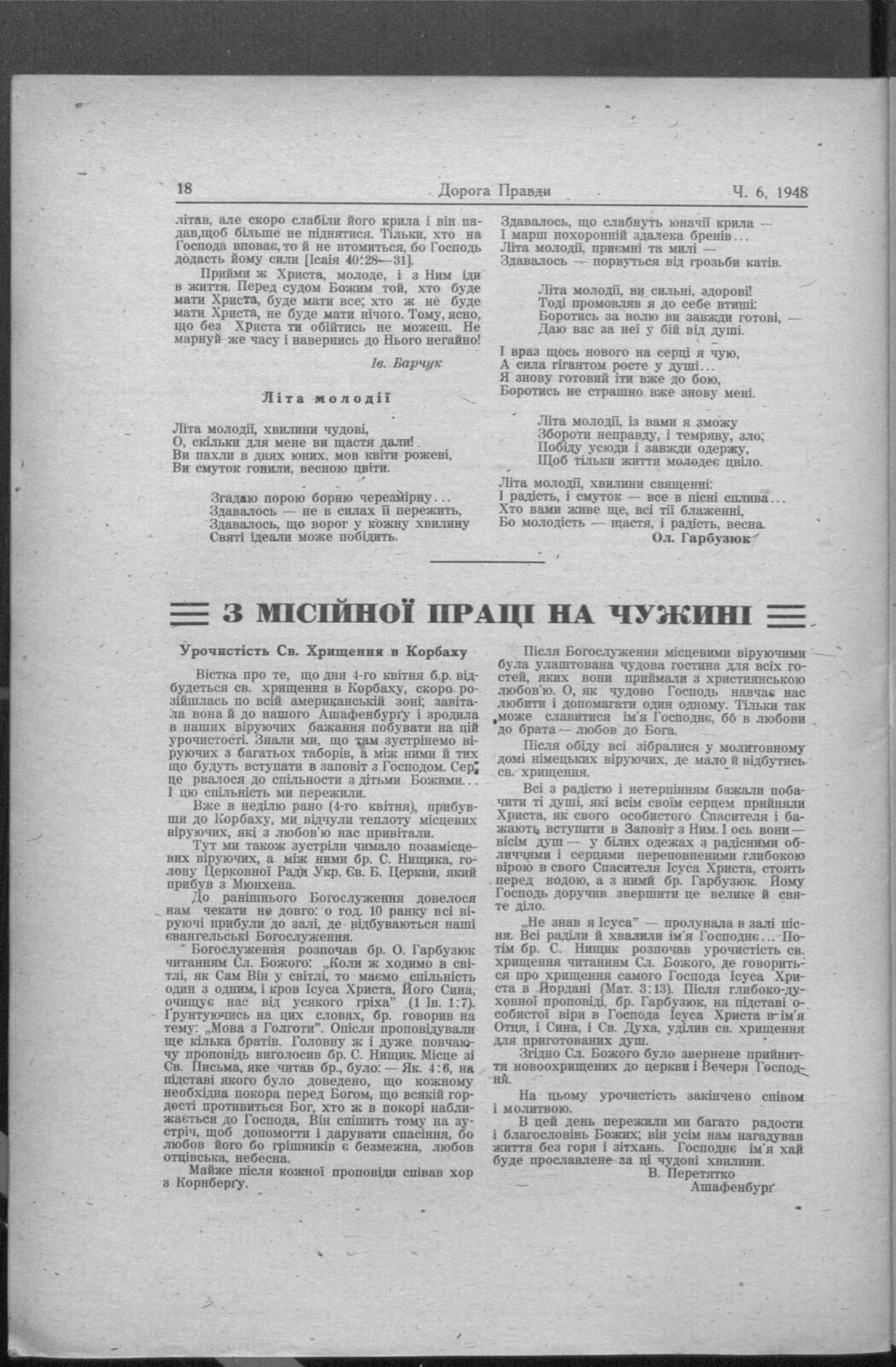
A Ukrainian evangelical congregation at Korbach is documented in the Baptist monthly Doroha Pravdy, which printed an account of the baptism held there on 4 April 1948. News that the service would take place had spread quickly through the whole American zone and brought believers from many camps, among them S. Nyshchyk, chairman of the church council of the Ukrainian Evangelical Baptist Church, who came from Munich. The visitors arrived on the Sunday morning and were warmly welcomed by the local believers; the morning service began at ten in the hall where the congregation’s services were held, and was opened by Brother O. Harbuziuk with a reading and a sermon on the theme “Speech from Golgotha”. The choir from Cornberg sang after almost every sermon. In the afternoon those present gathered in the prayer house of the German believers, where eight people in white robes were baptised, and the newly baptised were then received into the church and the Lord’s Supper was held. The account was written by V. Peretiatko of Aschaffenburg.
Further moves and working life
Korbach was also one of the places from which Ukrainian displaced people moved to a labour-service camp near Gießen. The first arrivals there are dated to 23 January 1948 in historical research published by Germany’s Federal Agency for Civic Education. The arrivals came from several camps, including Aschaffenburg, Cornberg and Mainz-Kastel. This documents a route out of Korbach rather than a single transfer of the entire Conti population. The catalogue’s closure date of 22 March 1949 gives an end point that the 2013 letter, which mentions closure without a date, does not supply.
Preserving the camp’s history
In October 2009, pupils from Bad Arolsen’s Christian-Rauch school researched the Korbach and Kassel-Hasenhecke camps in the International Tracing Service archive. The archive’s annual report describes a focus on camp life and displaced people’s experiences. This local research helped reconnect the factory location with its postwar role as a place of refuge.
Sources for this section
Sources
- Population Migration after World War II, Table 7
Ihor Stebelsky, The Refugee Experience, Canadian Institute of Ukrainian Studies Press · 1992
Ihor Stebelsky’s chapter in The Refugee Experience. Table 7, “Ukrainians in UNRRA and IRO Camps of the American Zone of Germany”, covers the American zone of Germany, printed pages 47–51. The Korbach (Conti) row is in the Land Hessen section on printed page 47 and reads 477 / – / 77 / 976. The four columns are a questionnaire collection of 1946 and 1947, the UNRRA summary of 24 August 1946, the UNRRA summary of 31 May 1947 and the PCIRO summary of 2 January 1948 (the column is headed “Dec. 1947”). Stebelsky’s earlier 1986 printing in Ukrainskyi Istoryk numbers these tables one higher and paginates them differently: the American zone is Table 8, printed pages 53–56.
- As if we were part of history
Hessische/Niedersächsische Allgemeine
Report of local archival research explicitly locates camp on Continental works at Limmerstraße.
- About DP camps long forgotten
The Ukrainian Weekly
13 January 2013 p. 4 letter: Landau closure/transfer to Conti in 1947, subsequent Conti closure, institutions across three named camps. No exact Conti closure date supplied.
- Ukrainian displaced persons in Germany
Federal Agency for Civic Education
Research identifies Korbach among origins of Gießen arrivals from 23 January 1948. Does not establish an all-camp transfer.
- Annual report 2009
International Tracing Service / Arolsen Archives
Institutional report confirms school research into Korbach and Kassel-Hasenhecke DP camps in October 2009.
- DP camp inventory: Conti, Landau, Grebenstein and Rhoden
Arolsen Archives · 26 October 2023
Record 1138 for Conti: 24 January 1946 to 22 March 1949, AC 527, later K 105, capacity 1,250 and headcount 1,240 on 31 October 1947, UNRRA Team 51 Korbach, note “Conti = Continental Reifen-Hersteller”. Records 1150, 1008 and 1410 cover Landau in Kreis Waldeck, Grebenstein and Rhoden.
- About DP camps long forgotten (source text)
Vsevolod Kohutiak, The Ukrainian Weekly · 13 January 2013
The letter as printed on p. 4, read in full from the newspaper’s own archive PDF. It names Landau in Kreis Waldeck, the 1947 transfer to Camp Conti, the later closure of Conti, and Plast and SUM in all three camps discussed.
- Studie gibt Einblicke ins Korbacher Continental-Werk in der Zeit des Nationalsozialismus
Waldeckische Landeszeitung, on Paul Erker’s study of Continental under National Socialism · Accessed 13 September 2026
Forced labour at 51 per cent of the Korbach workforce in 1941, payroll figures for 1940 and 1943, wartime products, and the American entry into Korbach at Easter 1945. The report describes no camp for displaced people on the works site.
- The Refugee Experience, Table 7 column definitions
Canadian Institute of Ukrainian Studies Press · 1992
Footnotes to Table 7, printed p. 51: the first column is a questionnaire collection of 1946 and 1947 held at the Ukrainian Free University, the second the UNRRA summary of 24 August 1946, the third the UNRRA summary of 31 May 1947, the fourth the PCIRO summary of 2 January 1948 (the column itself is headed “Dec. 1947”).
- The Continental works chimney at Korbach, seen from the Arolser Landstraße
GeorgDerReisende, via Wikimedia Commons · 18 May 2020
Photograph licensed CC BY-SA 4.0. Shows the Continental tyre works at Korbach, the factory site on which the Conti camp stood.
- “Урочистість Св. Хрищення в Корбаху”, Doroha Pravdy (Дорога Правди), number 6, 1948, page 18
Ukrainian Museum-Archives of Cleveland, DP Camp Periodicals Collection, via the Internet Archive · 1948
Marked in the collection as public domain or an orphan work and offered under CC BY-NC-ND 3.0. Doroha Pravdy was the monthly of the Ukrainian Evangelical Baptist Church in Germany, whose editorial address in 1948 was Cornberg über Bebra, Marktplatz 6. Under the standing head “З місійної праці на чужині” the page reports the baptism held at Korbach on 4 April 1948.
Last researched 13 September 2026