Landeck Camp
Displacement in Europe
Landeck, Tyrol, Austria · Wartime camps from 1941; displaced persons camp 1945–1949
In the Austrian Alps, displaced Ukrainians rebuilt education, theatre and a lively camp press. Landeck combined the practical work of relief with a cultural life that continued beyond the camp.
Introduction
Landeck was one of the principal centres of Ukrainian displaced life in post-war Austria. American troops of the 44th Infantry Division set up reception camps at Ehrwald, Haiming, Imst and Landeck in May 1945 for people stranded in Tyrol, and the military government ordered the mayors of those places to provide for former forced labourers until they could be repatriated. Landeck then formed part of the relief system in the French zone, where people who had survived war and displacement sought a more permanent future.
The Ukrainian community built a kindergarten, schools, a theatre and several periodicals. These institutions gave residents more than temporary shelter: children could learn in Ukrainian, adults could read news in their own language, and performers could resume work interrupted by war.
Sources for this section
A history in dates
- Spring 1941Landeck is made the seat of a branch camp of Stalag Markt Pongau.
- 1941–1943Three prisoner-of-war camps are laid out in the town.
- 1945The Ukrainian kindergarten begins with 35 children; the daily Taborovi visti and weekly Nedilni visti start appearing.
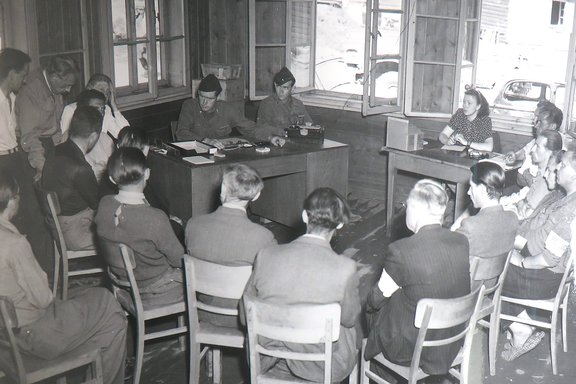
- May 1945A displaced-persons camp operates at Landeck under the initial American occupation; a 20 May photograph records a meeting of civilian leaders and camp officers.
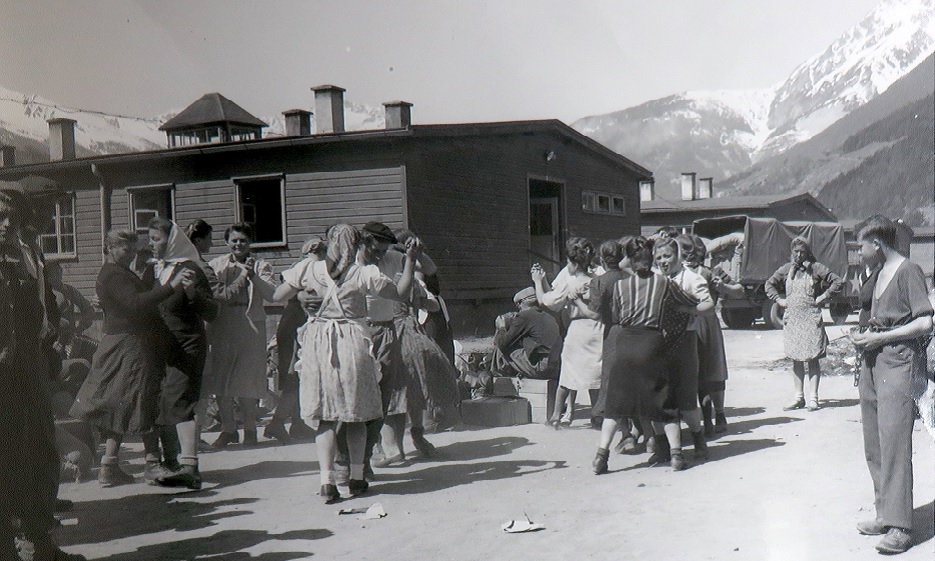
- 20 May 1945Liberated Soviet forced labourers are photographed dancing in a displaced persons camp at Landeck.
- 1946A Ukrainian theatre studio is founded, the satirical weekly Proty shersty appears, and Iunak is published locally.
- November 1946A camp health report describes systematic inspections of barracks and communal facilities.
- 1947The theatre’s founders move to Bavaria; the three listed Landeck newspapers end their publication runs.
- May 1947The ITS list records Team 199 at Landeck under Area Team IV, Innsbruck.
- 30 September 1948A camp return records 1,161 Ukrainian residents.
- 20 September 1949The last date given for Landeck in the ITS list of Austrian camps.
- 30 June 1950A later return records 339 Ukrainian residents.
Sources for this section
- Die Kriegsgefangenenlager in Landeck
- Ukrainian Women in Austria and Attempts to Resume the Activities of the Union of Ukrainian Women (1945–1957)
- Press
- French occupation authorities: displaced persons and refugees service
- Landeck camp photographs, May–June 1945
- 20. Mai 1945: Tanz der Befreiung, Landeck
- Olimpiia Dobrovolska
- Iunak: Landeck issue of 1 May 1946
- Recivilising Refugees
- Alphabetisches Verzeichnis der DP-Lager in Österreich
- The Refugee Experience: Ukrainian Displaced Persons after World War II
The site before the relief years
Landeck was made the seat of a branch camp of Stalag Markt Pongau in the spring of 1941, and between then and 1943 three camps stood in the town: the largest on the ground of the present sports field, with five larger accommodation huts and three outbuildings; a single-hut camp at Perjen; and the camp in the Perfuchsberger Au, three huts holding about a hundred men. Judged by the number of huts, the branch camp held between 800 and 1,200 prisoners, and it was the largest labour detachment of its parent camp.
Polish and Ukrainian prisoners worked chiefly in agriculture and were allowed to live on the farms rather than in the camp. Prisoners were also used on the town’s own works — the rifle range in the Schloßwald, the air-raid tunnels driven into the hillsides, and the water main and sewer at Bruggfeld. The camp had its own sick bay, and the reserve hospitals at Zams and at the Valduna near Feldkirch came under it.
Deaths were entered in the register office books at Landeck, which also covered deaths in the hospital at Zams. The first was a Frenchman of twenty-two who died of pneumonia in the reserve hospital. Three deaths are entered for 1942, three for 1943, seven for 1944 — three Italians, three Ukrainians and a Pole — and four in the first four months of 1945.
Deaths of prisoners entered in the Landeck register office books
| Year | Deaths | Nationalities recorded |
|---|---|---|
| 1942 | 3 | A Yugoslav, an Italian, a Frenchman |
| 1943 | 3 | Two Yugoslavs, a Bulgarian |
| 1944 | 7 | Three Italians, three Ukrainians, a Pole |
| January to April 1945 | 4 | Three Italians, a Pole |
Sources for this section
The first months after the war
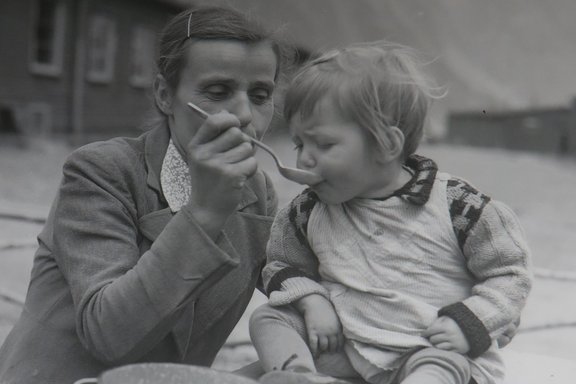
American Army photographs preserve unusually early views of the camp. An image dated 20 May 1945 shows civilian leaders gathered with American officers for a daily meeting about administration and everyday problems. A second photograph, taken on 5 June, shows a mother feeding her child. Together they record both collective organisation and ordinary family life.
The original American caption describes the mother as Russian. Landeck’s displaced population was multinational; these photographs show the wider camp in which Ukrainian life developed. They are not portraits of a specifically Ukrainian group.
Landeck also contained separate wartime prisoner-of-war sites. The municipal history places the largest of them east of the barracks stables, on the ground of today’s sports field in the Urichstraße, and notes that the hut still standing there is not of that date: it was put up by the Americans who provisioned the UNRRA camp. The Perfuchsberger Au site followed a different post-war history, including the detention of leading district Nazis.
Sources for this section
Teams and numbers
The International Tracing Service’s list of Austrian camps carries two Landeck entries, both under Area Team IV at Innsbruck. The first, a displaced persons camp under Team 107, is recorded for May 1945, for 1946 and again on 20 September 1949; the second, under Team 199, for May 1947. Neither carries a camp number.
The first of those entries is independent confirmation that a camp was running at Landeck from May 1945, and the last date shows it still in the record in the autumn of 1949, more than a year after the count of 1,161 Ukrainians.
Landeck in the ITS list of Austrian camps
| Entry | Camp number | Team | Area team | When mentioned |
|---|---|---|---|---|
| D.P.-Lager | — | T 107 | AT IV Innsbruck | May 1945; 1946; 20 September 1949 |
| — | — | T 199 | AT IV Innsbruck | May 1947 |
Children, education and mutual help
The Ukrainian Women’s Union organised a kindergarten with 35 children in 1945, later increasing to 45. Teaching used Ukrainian stories, songs and traditions. Women prepared materials for creative activities and made toys, turning limited resources into a setting in which young children could play and learn.
Landeck also had Ukrainian elementary, secondary and vocational schools. With roughly a thousand Ukrainians, it was the largest concentration identified in the French-zone account. Community organisations and both Catholic and Orthodox parishes supported different parts of Ukrainian life.
Women’s organisations also brought Ukrainian folk art to public exhibitions in Landeck and other Austrian towns. Their work joined the care of children with the preservation and public presentation of Ukrainian culture.
A theatre and a camp press
A Ukrainian theatre studio was established at Landeck in 1946. Its founders moved to Bavaria in 1947, and the company’s later touring connected displaced communities across western Germany. Landeck was an early stage in an artistic undertaking that continued after emigration to the United States.
The camp’s publishing activity was equally varied. Daily news, a weekly paper and a satirical weekly all appeared locally. Their different rhythms and purposes show a readership interested in information, community discussion and humour, even while living in temporary accommodation.
The surviving issue of the Ukrainian-language youth magazine Iunak is catalogued at Landeck and dated 1 May 1946. The catalogue describes an illustrated monthly that ran in Germany from 1946 to 1949 and then followed its readers abroad — to Canada in 1950, to the United States from 1951 to 1959, and back to Canada from 1963. The Landeck issue is the start of that emigrant history.
Periodicals published at Landeck
| Title | Type | Publication period |
|---|---|---|
| Taborovi visti | Daily camp news | 1945–1947 |
| Nedilni visti | Weekly newspaper | 1945–1947 |
| Proty shersty | Satirical weekly | 1946–1947 |
| Iunak | Youth publication | Issue dated 1 May 1946 |
Sources for this section
Keeping a crowded settlement healthy
A November 1946 camp health report records sanitation teams inspecting barracks, rooms, kitchens and latrines. People who were ill could be isolated, sometimes against their wishes. The camp’s routine therefore combined the provision of care with close supervision of living conditions.
Sources for this section
A community that became smaller
The Ukrainian population recorded at Landeck fell from 1,161 on 30 September 1948 to 339 on 30 June 1950. These are counts of Ukrainians in the camp, not the combined population of every nationality. They capture the contraction of the community during the wider period of resettlement from Austria.
The theatre’s move to Germany illustrates one form of onward movement before overseas emigration. The newspapers, photographs and accounts of schooling preserve another part of the story: the institutions people created while waiting, and the cultural work they carried with them.
Ukrainian residents in camp returns
| Date | Ukrainian residents |
|---|---|
| 30 September 1948 | 1,161 |
| 30 June 1950 | 339 |
Sources for this section
Sources
- French occupation authorities: displaced persons and refugees service
French Diplomatic Archives · 1945–1955 records
Institutional history identifies Landeck among four Tyrolean camps opened in May 1945 and explains occupation-zone administration.
- Landeck camp photographs, May–June 1945
University of Innsbruck / US National Archives · 1945 photographs
Army photographs 111-SC-328814 and 111-SC-328827, with original captions and university interpretation.
- Ukrainian Women in Austria and Attempts to Resume the Activities of the Union of Ukrainian Women (1945–1957)
Foreign Affairs; Iryna Rybachok · 2021
Full article, especially page 40: kindergarten enrolment, language, play materials and exhibitions; based on archival records and memoirs.
- Press
Internet Encyclopedia of Ukraine / Canadian Institute of Ukrainian Studies · Accessed 2026
Austria section identifies three Landeck newspapers and publication dates.
- The Refugee Experience: Ukrainian Displaced Persons after World War II
Canadian Institute of Ukrainian Studies Press · 1992
Ihor Stebelsky chapter; Table 5, “Ukrainians in the PCIRO or IRO Camps of Austria”, printed page 43 (PDF page 70), Ukrainian camp populations in Austria, with columns headed 30 September 1948 and 30 June 1950. Education discussed in the accompanying geographical account: printed page 27 (PDF page 54) identifies schools, vocational training, organisations and both Catholic and Orthodox parishes at Landeck.
- Die Kriegsgefangenenlager in Landeck
City of Landeck; Georg Zobl · Undated municipal PDF
Seven-page article by Georg Zobl, read in full. Landeck was made the seat of a branch camp of Stalag Markt Pongau in spring 1941; three camps stood in the town between 1941 and 1943; the largest lay east of the barracks stables on the site of today’s sports ground, with five larger accommodation huts and three outbuildings; the hut still standing there was built by the Americans who provisioned the UNRRA camp. Prisoner numbers are estimated at 800 to 1,200 from the number of huts. Deaths are counted from the Landeck register office death books. The town archive holds four folders on the camp, worked through by Roman Spiss for Landeck 1918–1945.
- Olimpiia Dobrovolska
Museum of Ukrainian Diaspora · 2023
Institutional biography establishes the Landeck theatre in 1946 and move to Bavaria in 1947.
- Iunak: Landeck issue of 1 May 1946
Libraria · 1946 issue
Catalogue record read: IUNAK, language Ukrainian, place of publication Landeck, one issue held, dated 1 May 1946. The catalogue note describes an illustrated monthly published in Germany in 1946 to 1949, in Canada in 1950, in the United States from 1951 to 1959 and again in Canada from 1963.
- Recivilising Refugees
S:I:M:O:N; Katarzyna Nowak · 2023
Printed page 12 cites Landeck Monthly Health Report, 30 November 1946, UN S-1494-0000-0094-00001.
- Alphabetisches Verzeichnis der DP-Lager in Österreich
International Tracing Service, Bad Arolsen · 1963
Open-access ITS list of 36 printed pages, read directly. The two Landeck entries stand on printed page 15: a D.P.-Lager under Team 107, Area Team IV Innsbruck, mentioned for May 1945, for 1946 and on 20 September 1949; and a second entry under Team 199, Area Team IV Innsbruck, for May 1947. No camp number is given for either.
- 20. Mai 1945: Tanz der Befreiung, Landeck
Institut für Zeitgeschichte, Universität Innsbruck · Accessed September 2026
Full published entry read: the 44th Infantry Division set up reception camps at Ehrwald, Haiming, Imst and Landeck for refugees stranded in Tyrol, and the military government ordered the mayors to provide for former forced labourers until repatriation. The photograph is captioned “Russians, recently liberated by the U.S. Seventh Army troops, celebrate their freedom with improvised dancing. They will be soon on their way back to Russia.” No catalogue number is given for it on the page.
Last researched 12 September 2026