Landstuhl
Displacement in Europe
Landstuhl · Germany · Documented 1945–1947
A Polish and Ukrainian camp in the French zone, run by UNRRA Team 2, where the politics of return, an independent newspaper and links beyond the camp shaped everyday life.
Introduction
Landstuhl’s displaced-persons camp brought together Polish residents and a substantial Ukrainian community in the French occupation zone. For Ukrainians who feared return to Soviet rule, the camp was more than temporary accommodation: the question of where they could safely live shaped encounters with relief officials, political representatives and the wider world.
Landstuhl lies on the north-western edge of the Palatinate Forest, about eighteen kilometres west of Kaiserslautern, in what the occupation authorities counted as the southern district of the French zone. The camp appears in the surviving administrative record as DP-Camp Landstuhl, under UNRRA Team 2.
A history in dates
- 17 July 1945UNRRA challenges Soviet officers seeking the return of Ukrainian residents; the French commander intervenes.
- November 1945UNRRA’s French-zone director reports that camp administration has always been a critical point in relations with the French PDR.
- 2 December 1945The camp weekly Nowiny Obozowe begins publication.
- Spring 1946UNRRA completes its takeover of the camps in the French zone.
- 30 April 1946Landstuhl is one of seven French-zone camps covered by UNRRA’s DP Monthly Report No. 9, together holding about half the zone’s displaced persons.
- July 1946A meeting at Landstuhl exposes competing claims over Polish liaison appointments.
- 1946–1947The Ukrainian community is estimated at approximately 610 people.
- 1–8 January 1947A published notice records the camp’s contribution to rebuilding a Warsaw orphanage.
- 31 August 1947The IRO counts 32,434 displaced persons in the whole French zone.
The camp in the occupation record
The Arolsen Archives inventory of displaced persons camps lists the centre in the French zone, southern district, at Landstuhl in the Kaiserslautern district, as DP-Camp Landstuhl. It gives the UNRRA teams as 2 and 17, names the team director as D. de Fos, and records Landstuhl as its own field-supervision point. The surviving strength and change reports are held as ITS documents 82006310 to 82006372.
The entry is thinner than the inventory’s American-zone rows. No capacity, no nationality list and no opening or closing dates are recorded for Landstuhl, and this is true of the French-zone entries generally: they carry a team number and an archive reference and little else. The camp’s size and composition therefore have to be built up from other sources rather than read off the register.
Arolsen Archives inventory entry for Landstuhl
| Field | Value |
|---|---|
| Region | DP French |
| District | Süd |
| Location | Landstuhl (Kreis Kaiserslautern) |
| Building | DP-Camp Landstuhl |
| UNRRA team | 2; 17 |
| Team director | D. de Fos |
| Field supervisor | Landstuhl |
| Opening, closing, capacity, nationality | Not recorded |
| Archive references | ITS Dok-ID 82006310-82006372 |
Sources for this section
A camp in the French zone
The French zone held far fewer displaced persons than the other two. At the end of August 1947 the IRO counted 32,434 in the French zone against 176,049 in the British and 328,180 in the American. Relief work there was correspondingly small and heavily weighted towards headquarters administration rather than field staff.
Responsibility was also divided differently. The French occupation authorities kept the camps under their own department for displaced persons, the PDR, and UNRRA’s takeover of the camps was only completed in the spring of 1946. A French instruction of January 1946 stated that the employment of displaced persons fell to the PDR and that the UNRRA teams were only to create favourable conditions for it in the camps. UNRRA’s zone director complained in November 1945 that camp administration had always been a sore point in relations with the PDR.
Landstuhl was one of the camps through which the zone was measured. UNRRA’s DP Monthly Report No. 9 of 30 April 1946 carried employment statistics for only seven centres — Landstuhl, Augusta, Niederlahnstein, Koblenz Gneisenau-Kaserne, Kandel, Kaiserslautern and Homburg — but those seven held about half of all the displaced persons living in the zone, which is why the figures were treated as representative of it.
Screening decided who counted as a displaced person at all, and in the French zone it came late and awkwardly. In early June 1946 UNRRA and the PDR agreed on camp-based commissions of three — one UNRRA representative, one from the PDR and one from the displaced persons themselves — with a regional commission for difficult cases. A UNRRA headquarters order of 24 June 1946, declaring eligibility decisions a matter for UNRRA alone, led the zone organisation to cancel those agreements. The screening finally began on 6 August 1946, and by the end of that month only 952 people in the whole zone had been examined.
Displaced persons in the three western zones, 31 August 1947
| Zone | Displaced persons |
|---|---|
| American | 328,180 |
| British | 176,049 |
| French | 32,434 |
| All three | 538,663 |
Sources for this section
Polish and Ukrainian residents
Ukrainian historical research places more than 600 Ukrainians at Landstuhl, with the encyclopedia giving approximately 610 for 1946–1947. Polish sources call it the Polish camp. Those descriptions can coexist: a camp described by its majority community could still include hundreds of Ukrainians. The figure of 610 should therefore not be read as the population of the whole institution.
The camp’s public life also appeared in the Polish-language press. It produced its own weekly, Nowiny Obozowe, whose title means Camp News, and participated in fundraising reported beyond Landstuhl. The surviving evidence connects residents both to local camp affairs and to people and institutions far away.
Dated evidence from the camp
| Date | Evidence | What it establishes |
|---|---|---|
| 17 July 1945 | UNRRA encounter with Soviet officers | Ukrainians present in the camp |
| 1946–1947 | Approximately 610 Ukrainians | Ukrainian community estimate |
| January 1947 | 1,381.42 RM donation | A specific Polish-camp fundraising contribution |
The struggle over return
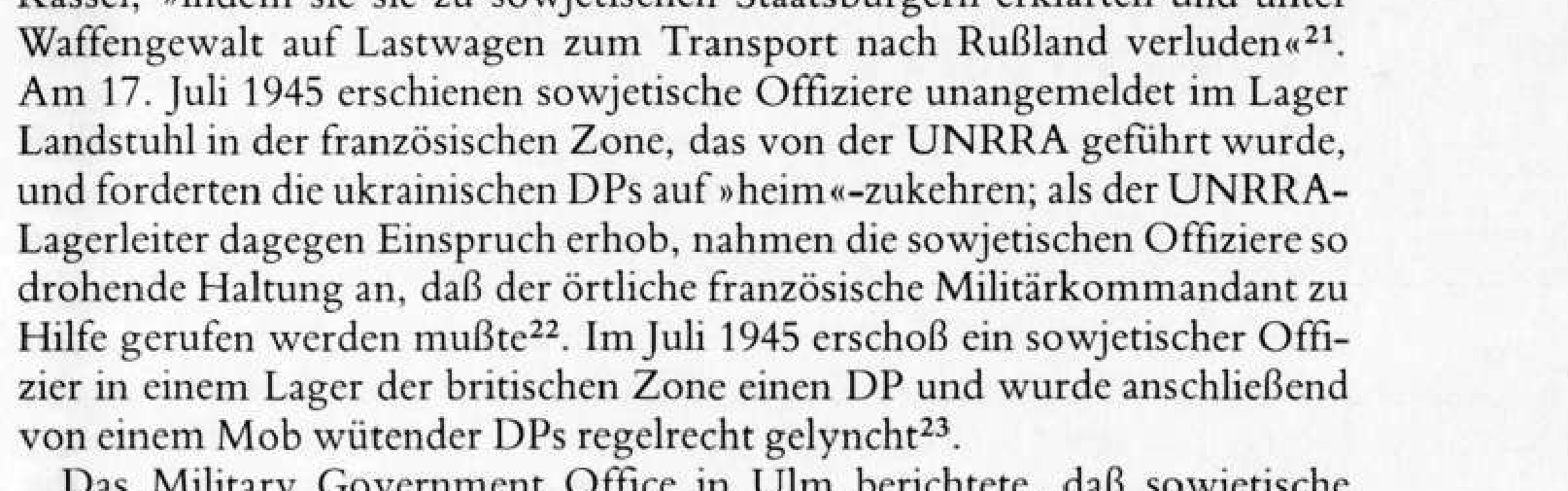
On 17 July 1945 Soviet officers entered the UNRRA-administered camp without warning and called on Ukrainian DPs to return home. The camp director objected. When the officers responded threateningly, the local French military commander had to be called. The episode, documented in research based on contemporary administrative records, shows that liberation had not settled who could decide a displaced person’s future.
Political authority remained contested the following year. In July 1946 a senior UNRRA official met Polish liaison officers at Landstuhl and asked them to make way for representatives associated with the Warsaw government. They replied that their appointments belonged to the French military authorities. Relief administration, national representation and the politics of return overlapped inside the same camp.
Both episodes turn on the same point. In the French zone the occupying power kept the last word on who represented the displaced and who administered them, and UNRRA’s camp staff at Landstuhl were left arguing for their residents inside a structure they did not control.
Sources for this section
A newspaper and competing accounts of censorship
Nowiny Obozowe began on 2 December 1945. A later account of Polish journalism describes an article being blacked out after printing and part of another report about emigration to Brazil being removed. The material concerned subjects central to camp life: international politics and the possibility of leaving Europe.
Another recollection gives a different picture. A former co-editor, interviewed for Mark Wyman’s history of displaced people, remembered having to explain the newspaper’s contents to UNRRA and French officials but experiencing no prior censorship. The accounts describe different experiences; together they show why the paper’s relationship with camp authorities cannot be reduced to a single unchanging rule.
The camp newspaper
| Title | Language | Beginning |
|---|---|---|
| Nowiny Obozowe (Camp News) | Polish | 2 December 1945 |
Sources for this section
Helping people beyond the camp
In January 1947 Repatriant published a donation from Landstuhl’s Polish camp: 1,381.42 Reichsmarks towards rebuilding an orphanage in Warsaw. The notice places camp residents among communities collecting money for reconstruction and children’s welfare. It identifies a specific contribution, rather than a total for all fundraising undertaken at Landstuhl.

Sources for this section
Medical care outside the camp
Landstuhl residents also appear in the history of Homburg’s state hospital. Recent research identifies the camp as one of the postwar centres from which displaced people came for treatment. Camp accommodation and hospital care were therefore connected through regional services; they were not the same institution.
The surviving record
The evidence follows several strands: the occupation inventory fixes the camp’s team and its archive references, international correspondence documents disputes over return, Ukrainian scholarship records the community’s size, and newspapers preserve residents’ public activities. Each illuminates a different part of life at Landstuhl.
The camp belongs to the history of displacement within Europe, before the separate journeys of repatriation or emigration that residents might later undertake. The town keeps its own archive at the Verbandsgemeinde offices, and the strength and change reports named in the inventory remain the fullest documentary trace of who was there.
Sources
- Vom Zwangsarbeiter zum Heimatlosen Ausländer
Wolfgang Jacobmeyer / Vandenhoeck & Ruprecht · 1985
Printed page 131 and notes: 17 July 1945 Soviet officers at Landstuhl and intervention by UNRRA and the French commander. Printed page 275 note 47, French-zone report for July 1946. Also read: note 27 on the French PDR instruction of January 1946; note 28, which names Landstuhl among the seven French-zone camps covered by UNRRA’s DP Monthly Report No. 9 of 30 April 1946, together about half the zone’s displaced persons; the zone comparison of IRO caseloads at 31 August 1947; and printed pages 112–113 on the French takeover of the camps and relations with the PDR.
- The Refugee Experience: Ukrainian Displaced Persons after World War II
Canadian Institute of Ukrainian Studies Press · 1992
Ihor Stebelsky, printed page 27: Landstuhl among substantial Ukrainian communities in the French zone, over 600 residents.
- Germany: Ukrainian displaced persons
Canadian Institute of Ukrainian Studies · Accessed September 2026
1946–1947 list gives approximately 610 Ukrainians at Landstuhl.
- Prasa polska w Niemczech
Antoni Stefan Koper / Zeszyty Historyczne 105, Instytut Literacki · 1993
Printed page 29: founding of Nowiny Obozowe on 2 December 1945 and retrospective censorship accounts.
- DPs: Europe’s Displaced Persons, 1945–1951
Mark Wyman / Cornell University Press · 1989; Cornell edition 1998
Printed page 120 and chapter notes: interview with a Landstuhl camp newspaper co-editor, describing absence of prior censorship during his experience. Full relevant passage read, not original interview.
- Rodacy z zagranicy dla kraju
Repatriant / Jagiellonian Digital Library · 1–8 January 1947
No.1–2 (52–53), printed page 13: Polish camp at Landstuhl contributes 1,381.42 RM to reconstruction of a Warsaw orphanage. Original notice visually inspected; OCR amount corrected from scan.
- The employment and treatment of civilian workers and prisoners of war at Homburg State Hospital, 1939–1947
Lisa-Marie Göppert / Saarland University · 2023
Indexed full-text passages, printed pages 38 and 77: Landstuhl DP centre records and referrals to Homburg hospital. Repository metadata read; downloadable PDF blocked, so no personal clinical cases used.
- DP camp inventory: Landstuhl (Kreis Kaiserslautern)
Arolsen Archives · 26 October 2023
Entry 603: region DP French, district Süd, location Landstuhl (Kreis Kaiserslautern), building “DP-Camp Landstuhl”, UNRRA team “2; 17”, team director D. de Fos, area-team date 1 June 1947, field supervisor Landstuhl, ITS Dok-ID 82006310-82006372. No opening, closing, capacity, headcount or nationality recorded, as is usual for the inventory’s French-zone rows. Neighbouring French-zone rows read for comparison.
Last researched 12 September 2026