Lehen Camp
Displacement in Europe
Salzburg, Austria · 1940s–1950s
Refugees made a community among the barracks beside the Salzach, in a camp built for the Wehrmacht and reused for several national groups. Ukrainians appear in the IRO returns for 1948 and 1950, and the camp was one of the stops on the Soviet repatriation mission’s circuit in 1949.
Introduction
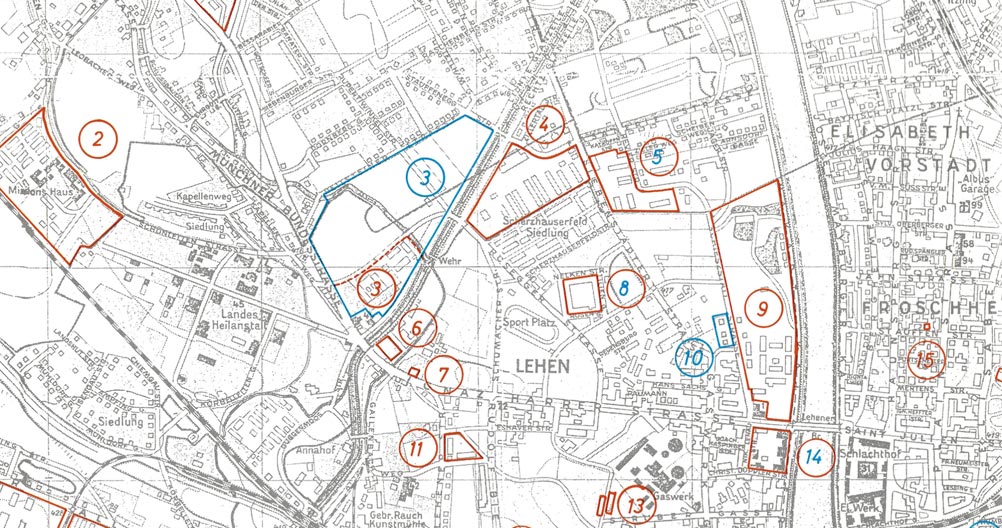
Lehen was a refugee camp in the Lehen district of Salzburg, in the American occupation zone. The Danube Swabian association’s history places its barracks beside the Salzach, in the area now occupied by Lehener Park and neighbouring educational buildings, across Ignaz-Harrer-Straße from the separate Lehener Kaserne. Salzburgwiki instead places the camp by the Glanbach in the area of the present Scherzhauserfeld settlement. Both describe the same district; no source consulted reconciles the two.
The camp became closely associated with Danube Swabian refugees, while Ukrainian residents also appear in contemporary population returns.
A history in dates
- Before 1945The Wehrmacht builds the camp, probably for Pioneer Battalion 85; it is then used as Heimatkraftfahrpark XVIII.
- 14 September 1945The Salzburger Nachrichten gives the Muslim religious community’s office as Lager Lehen 12.
- July 1948The camp football club receives formal approval.
- May 1948The first of the IRO documents on the camp at Lehen now held in the Archives nationales de France.
- 30 September 1948An IRO return records 189 Ukrainians at Lehen.
- 1949–1950Danubia competes outside the official championship standings.
- 26 December 1949The Soviet repatriation mission screens a repatriation film at Lehen.
- February 1950The last of the IRO documents on the camp at Lehen.
- 30 June 1950The Ukrainian population return records 16 people.
- 1957The refugee football club dissolves and joins FC Salzburg.
- 1962The last large barrack camp in the city of Salzburg, on the Alpenstraße, is cleared.
The buildings before 1945
Salzburgwiki records that the Lager Lehen was built by the German Wehrmacht, probably as a barracks for Pioneer Battalion 85, the unit for which the Glasenbach camp, later Camp Marcus W. Orr, was also put up. The site by the Glanbach was then used as Heimatkraftfahrpark XVIII, a home motor transport depot. The refugee camp was therefore an existing military installation rather than a purpose-built settlement.
Sources for this section
Salzburg’s housing emergency
Salzburg’s population rose from 68,000 in 1938 to 112,000 by 1945, and in September 1945 about 30,000 people were living in hotels and huts. Lehen was one of a series of camps in the city, alongside the Rositen barracks, Riedenburg, Glasenbach, Hagenau, Hellbrunn and Lexenfeld. Barrack housing outlasted the camps: 6,794 people were still in 666 huts across the province in 1959.
Sources for this section
A mixed refugee community
Many of the Danube Swabians had come from what is now Serbia. They were German-speaking people displaced from communities outside Germany and Austria. Their presence gave Lehen a strong community identity, but the camp was not exclusively theirs.
In September 1945 the Salzburger Nachrichten reported that the office of the Muslim religious community was at Lager Lehen 12 and called on Muslims in Salzburg and the surrounding area to register with it. The camp was thus in use as an address for organised religious life within weeks of the war ending.
Stebelsky’s Table 5 of Ukrainians in the PCIRO or IRO camps of Austria records 189 people at Lehen on 30 September 1948 and 16 on 30 June 1950, within an American zone total that fell from 2,869 to 1,171. These figures count Ukrainians, not everyone living in the camp. Their decline shows the changing size of this community without identifying each person’s destination.
Ukrainians recorded in the IRO returns for the American zone of Austria
| Camp or zone total | 30 September 1948 | 30 June 1950 |
|---|---|---|
| Lehen | 189 | 16 |
| Hellbrunn | 887 | 58 |
| Lexenfeld | 976 | no entry |
| Parsch | 104 | 288 |
| Glasenbach | 188 | 189 |
| American zone total | 2,869 | 1,171 |
The Soviet repatriation mission
On 16 December 1949 the Soviet repatriation mission in the American zone of Austria advertised in the Salzburger Tagblatt that a new Russian film, announced as “They are returning to their homeland”, would be shown in a circuit of camps. Lehen was on the list, with a screening on 26 December, alongside Asten, Wels, the DP hospital at Linz, Glasenbach, the mission’s own house at the Kasererhof in Salzburg and the Rositen barracks.
The advertisement was addressed to Soviet citizens. It shows that Lehen was still counted among the camps holding people the Soviet authorities claimed at the end of 1949, six months before the Ukrainian count there fell to sixteen. That claim was not the same as a resident’s own account of nationality, and the source does not say who attended.
Sources for this section
A football ground between the barracks
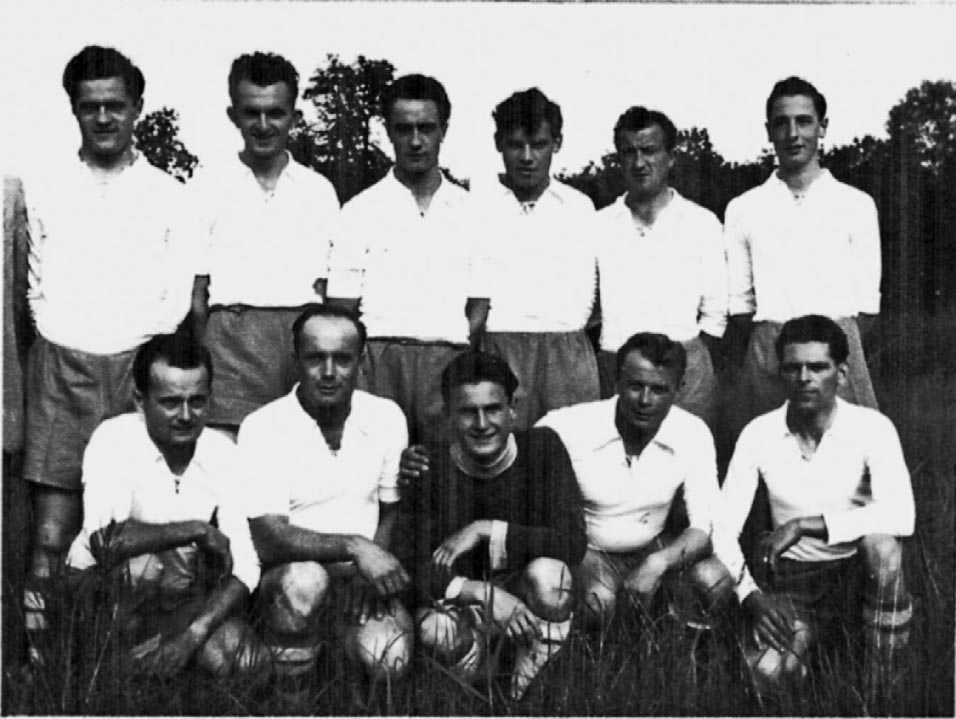
Camp residents established Danubia, a football club named after the Danube. Its formal approval came in July 1948, but refugee status complicated participation: Austrian citizens had to support the founding application, and the team’s 1949–50 results initially did not count in the official championship table. Full membership followed in 1950. In November 1949 the club played the ATSV Liefering at the camp itself.
Players remembered a rough gravel pitch crossed by a footpath. They marked its lines with sawdust and shared training days with ASV Blau-Weiß; American soldiers sometimes used it for baseball. Equipment was scarce. Each player took his kit home to wash, and the ground had a cold-water trough rather than showers. Simple benches were set out for spectators on match days.
Sources for this section
Worship and relief across the camp network
Lehen also formed part of the Croatian Catholic relief and pastoral network. The parish’s institutional history names it alongside Siezenheim, Puch and Hellbrunn among the camps served. Organised Croatian pastoral care in Salzburg took shape in 1948, and Caritas Croata began publishing a monthly religious periodical in 1949. These were shared institutions reaching several refugee communities rather than services confined to Lehen.
Salzburg was also the publishing centre of the Ukrainian emigration in Austria. The weekly Novi Dni and the daily Ostanni Novyny both began there in September 1945, the Ukrainian Central Relief Union in Austria issued its Visnyk from June 1946, and the Plast scouting journals Nash Shliakh and Skob appeared in the city. These are places of publication, and no title is recorded as produced inside Lehen camp.
One direct archival trace of the camp survives in the IRO records now in the Archives nationales de France, where a file of documents concerning the camp at Lehen covers May 1948 and February 1950, alongside files on Parsch, Glasenbach and Hellbrunn.
Leaving the barrack community
Emigration to Germany and overseas depleted Danubia’s playing numbers. By 1957 it could sometimes field only seven or eight players, and its old ground was no longer available. The club dissolved that July and joined FC Salzburg; the resulting Salzburg-Danubia name carried part of the camp community’s history into the city’s sporting life.
A motor vehicle firm later occupied the camp’s ground. A reunion in Salzburg in 1989 brought former players and supporters together again, and the association’s later publication preserved their recollections and a map distinguishing the camp from the nearby military barracks.
Sources for this section
Sources
- Die Danubia
Donauschwäbische Landsmannschaft Salzburg · 2021
Mitteilungen 2/2021, printed pages 30–33; community oral history, camp location map and photographs.
- Spiel der Woche: USK Danubia Salzburg
Salzburg 24 · 30 November 2008
Historical account of the camp club, official membership and ground.
- Ukrainian Population Migration after World War II, Table 5
Ihor Stebelsky, in The Refugee Experience: Ukrainian Displaced Persons after World War II (Edmonton: CIUS Press) · 1992
Appendix, Table 5, “Ukrainians in the PCIRO or IRO Camps of Austria”, printed page 43 (PDF page 70): Lehen 189 and 16, within an American zone total of 2,869 and 1,171. Page image rendered from the PDF and read directly. The two columns are headed 30 September 1948 and 30 June 1950; footnote a cites the IRO Field Service Office return for the end of September 1948, Archives nationales de France, AJ 43, box 1119.
- Geschichte der Pfarre
Croatian Catholic Parish Salzburg · Undated
Institutional history explicitly lists Lehen among camps served by Croatian pastoral care.
- Lager Lehen
SALZBURGWIKI, Salzburger Nachrichten · Retrieved 13 September 2026
Article read in full. Wehrmacht origin and Heimatkraftfahrpark XVIII, the Scherzhauserfeld localisation, the Muslim religious community notice of 14 September 1945, the Danubia fixture of 19 November 1949 and the Soviet repatriation mission advertisement of 16 December 1949, each cited by the wiki to ANNO newspaper pages. ANNO itself returned an automated security check to this session, so those newspaper pages were not inspected directly.
- Barackenlager
SALZBURGWIKI, Salzburger Nachrichten · Retrieved 13 September 2026
Article read in full. City population 1938–1945, September 1945 accommodation figures, the list of postwar camps in the city, 6,794 people in 666 huts in 1959 and the clearance of the Alpenstraße camp in 1962. City and province figures, not camp figures.
- Research Report No. 2: Political Refugees and “Displaced Persons”, 1945–1954
Yury Boshyk and Boris Balan, Canadian Institute of Ukrainian Studies · 1982
Printed page 41 for Archives nationales de France AJ 43 983, dossier 13, “Documents concernant le camp de Lehen, mai 1948 et février 1950”; printed pages 221–223 for Ukrainian periodicals published at Salzburg. Place-of-publication entries, not camp attributions.
Last researched 13 September 2026