Leipheim Airfield Camp
Displacement in Europe
Leipheim, Germany · 1945–1950
The former airfield housed Jewish survivors before receiving Ukrainian families and institutions from Augsburg. Its later community was recorded in photographs, refugee documents and a film about migration to Australia.
Introduction
Leipheim’s displaced-persons camp occupied the former military airfield. Its history includes distinct phases: a Jewish survivor community from December 1945, followed by Ukrainian families and institutions documented in 1949. Treating the earlier Jewish population totals as Ukrainian figures would erase that change.
The Ukrainian connection is documented beyond a general camp list. The Encyclopedia of Modern Ukraine records the transfer of Augsburg’s camp community in 1949, while surviving refugee documents identify Leipheim-Airport as the next stop before overseas departure. The airfield was both a new home for transferred communities and a stage in emigration.
A history in dates
- 1 April 1936Construction of the airfield begins on land taken from Leipheim, Bubesheim and Günzburg.
- 18 July 1942The Me 262 makes its maiden flight from Leipheim.
- Late April 1945American forces take the airfield.
- December 1945A Jewish DP camp opens on the former airfield.
- May 1946The Jewish camp records 3,150 residents.
- 1949Ukrainian families and organisations transfer from Augsburg.
- 12 May 1949A contemporary family chronology records the academy’s opening in Leipheim.
- 16 June 1949Refugee paperwork documents a family leaving Leipheim-Airport for Australia.
- Christmas 1949Australian filmmakers record camp and family celebrations.
- June 1950The camp is dissolved.
- October 1950The US Army reoccupies the airfield.
- 1987A former-resident bulletin connects Somme-Kaserne and Leipheim.
Sources for this section
The airfield before the camp
Work on the airfield began on 1 April 1936, on 132 hectares taken from Leipheim, 88 from Bubesheim and 30 from Günzburg. The town’s own account records that the project was presented as a demonstration of national strength rather than a preparation for war, which helped reconcile a population losing farmland to it.
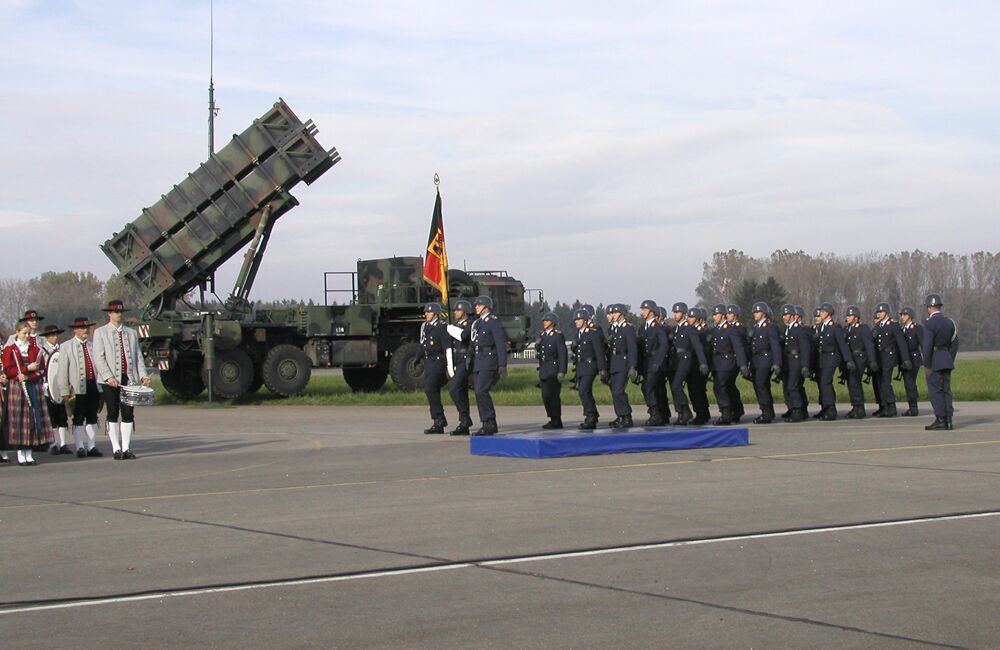
From 1940 the site carried a Messerschmitt works. The Me 321 transport glider first flew from Leipheim on 25 February 1941, and the Me 262, the first jet aircraft to enter series production, made its maiden flight there on 18 July 1942. On 19 March 1945 a raid by 84 B-24 bombers destroyed 28 Me 262s on the ground, and the last air attack came on 9 April. American forces took the airfield at the end of April 1945 and designated it Airfield R-59.
The airfield before and after the camp
| Date | Event |
|---|---|
| 1 April 1936 | Construction begins on 132 ha at Leipheim, 88 at Bubesheim and 30 at Günzburg |
| 25 February 1941 | First flight of the Me 321 transport glider |
| 18 July 1942 | First flight of the Me 262 |
| 19 March 1945 | 84 B-24 bombers destroy 28 Me 262s on the ground |
| 9 April 1945 | Last air attack on the airfield |
| Late April 1945 | American forces take the site, designated Airfield R-59 |
| October 1950 | The US Army returns |
| 31 December 2008 | Military use of the site ends |
Sources for this section
The earlier Jewish DP community
The Jewish camp opened in December 1945 under UNRRA and was the first Jewish camp in Bavarian Swabia. Its residents came mainly from Poland, Czechoslovakia, Hungary and Romania. They established schools, a library, religious education, a kosher kitchen and vocational training, together with a Talmud Torah, a ritual bath and a yeshiva, and the camp had a swimming pool. The newspaper A Heim and the Makabi sports club served the community, and a nearby training farm prepared residents for agricultural work.
Recorded population fell from 3,150 in May 1946 to 1,411 in January 1949. Many Jewish residents emigrated after Israel’s establishment in 1948; those remaining were transferred to other centres as this phase closed in 1949. Those figures describe the Jewish camp, not the later Ukrainian arrivals.
Population of the earlier Jewish DP camp
| Date | Residents |
|---|---|
| January 1946 | 2,900 |
| May 1946 | 3,150 |
| November 1946 | 3,099 |
| July 1947 | 2,923 |
| January 1948 | 2,790 |
| October 1948 | 1,817 |
| January 1949 | 1,411 |
Sources for this section
The Ukrainian community arrives
The Internet Encyclopedia of Ukraine names Leipheim among the Ukrainian camps of the American zone holding between 2,000 and 5,000 people, in the same group as Karlsfeld, Augsburg, Mittenwald, Regensburg, Aschaffenburg, Berchtesgaden, Bayreuth, Neu-Ulm and Dillingen. By 1948 the Ukrainian camps between them were running 102 elementary schools, 35 gymnasiums, twelve other secondary schools and 43 trade schools, and had published 232 periodicals and 818 books.
The 1949 move from Augsburg carried institutions as well as families. The Encyclopedia of Modern Ukraine records that Ukrainian organisations continued their work in Leipheim and Munich after leaving Augsburg. This was a relocation of an existing community rather than the creation of an entirely new one.
A family-held chronology records the opening of the Ukrainian Free Academy of Sciences in Leipheim on 12 May 1949 and a visit to its museum on 6 June. It also records journeys from Leipheim to Munich for resettlement discussions. Scholarship, church organisation and migration arrangements were taking place alongside one another.
At Leipheim’s first postwar children’s festival in 1949, Ukrainian girls from the airfield DP camp performed dances. The photograph is catalogued by Bavaria’s cultural-heritage portal with that explicit identification. It records camp residents taking part in the town’s public life.
Camp life recorded on film
The Australian film Mike and Stefani was made around a Ukrainian refugee family seeking resettlement. The national film archive identifies Leipheim scenes of laundry, kindergarten meals, a camp council meeting, carpentry, radio-engineering classes, shoemaking, sewing and English lessons. These scenes preserve an unusually broad visual record of daily work and preparation for departure.
The film was directed by R. Maslyn Williams and shot on location in Bavaria in 1949. It combines reconstructed episodes with events filmed as they happened: the Australian selection interview was recorded in Bavaria, while earlier wartime experiences were re-enacted. Its climax is that interview, in which the couple are confronted with a resettlement scheme that could direct them into two years of assigned labour and separate them.
It had been commissioned to support Australia’s immigration programme, so it is both evidence of camp surroundings and a shaped public account of refugee migration. In the event its picture of the selection procedure was thought too bleak, and the film received only a limited release.
Film footage of Christmas 1949 shows food collection, firewood, a decorated tree and a family celebration. Its date also demonstrates why the end of the earlier Jewish camp phase in spring 1949 cannot be treated as the end of all displaced-persons activity at Leipheim.
Work and learning in the archival footage
| Activity | Documented scene |
|---|---|
| Food and childcare | Kindergarten meals; food queues |
| Technical training | Carpentry; radio engineering |
| Clothing and footwear | Sewing; shoemaking |
| Language learning | English lessons and listening to a language record |
| Community administration | Camp council meeting |
From Leipheim to another country
An Augsburg exhibition reconstructs a family’s move from Somme-Kaserne to Leipheim-Airport and departure on 16 June 1949 for Australia. Their paperwork originally named Canada as their preferred destination. The example demonstrates that a transfer within Germany and a later journey overseas were separate events, and that the final destination could differ from the first plan.
The camp was dissolved in June 1950, and the United States Army returned to the airfield in October of that year. Flying units followed in 1957, the German air force took the station over in 1959, and flight operations ended in 1994; military use of the site ceased on 31 December 2008, and an intercommunal industrial park now occupies the ground.
Former residents maintained links long after leaving. The Shevchenko Scientific Society holds a 1987 bulletin issued by the committee of former residents of the Somme-Kaserne and Leipheim camps in Germany. The community’s memory crossed both camp and national boundaries.
Different stages of one documented journey
| Stage | Place or destination |
|---|---|
| Earlier accommodation | Somme-Kaserne, Augsburg |
| Transfer within Germany | Leipheim-Airport |
| Originally preferred destination | Canada |
| Departure 16 June 1949 | Australia |
Sources
- Leipheim: Jewish DP camp
Nuremberg Institute for Nazi Research and 20th Century Jewish History · Updated 16 January 2024
Original source read; scope retained.
- Leipheim: Jewish life in Bavaria
Haus der Bayerischen Geschichte · Accessed 12 September 2026
Original source read; scope retained.
- Augsburg
Encyclopedia of Modern Ukraine · 2001
Original source read; scope retained.
- Geboren 1946: Augsburg exhibition documentation
Reinhold Forster, geschichtsagentur augsburg · Accessed 12 September 2026
Camp transfer and 16 June 1949 departure on reproduced family records; names and personal scans not reproduced.
- Germany: archival family chronology
Harbuziuk family historical collection · Accessed 12 September 2026
12 May, 13 May and 6 June 1949 entries read. No resident names reproduced.
- Ukrainian girls at Leipheim children’s festival, 1949
Bavarikon / Bavarian cultural heritage · 1949 photograph
Catalogue description verified; image access challenge, image not acquired.
- Mike and Stefani: original footage descriptions
National Film and Sound Archive of Australia · Filmed 1949
Access numbers 41050–41053; scenes and Christmas 1949 date read.
- Mike and Stefani
National Film and Sound Archive of Australia · 1952 release
Original source read; scope retained.
- Fliegerhorst: history of Leipheim airfield
City of Leipheim · Accessed 12 September 2026
City’s compressed 1946–1949 DP period supplemented with actual 1949 film and 1950 military return. Its account of the airfield’s foundation, the Messerschmitt works, the Me 262 first flight, the 1950 American return and the site’s later use read in full.
- DP Camps: Augsburg Papers
Shevchenko Scientific Society · 2011 finding aid
Finding aid read; Box 1, Folder 12 is the 1987 bulletin of the committee of former residents of the Somme-Kaserne and Leipheim camps.
- Flugplatz Leipheim
German Wikipedia · Accessed 13 September 2026
Article read in full for the 1936 construction and the land taken from each parish, the Me 321 and Me 262 first flights, the March and April 1945 raids, the American capture, the displaced-persons camp and its closure in June 1950.
- Leipheim Displaced Persons Camp
United States Holocaust Memorial Museum, Holocaust Encyclopedia · Accessed 13 September 2026
Article read: opening in December 1945, the origins of the Jewish residents, the Talmud Torah, ritual bath, yeshiva and swimming pool, the newspaper A Heim, and the dissolution of the camp in June 1950.
- Displaced persons camps
Internet Encyclopedia of Ukraine · 1984; online edition
Read for the list of the larger Ukrainian camps of the American zone, which includes Leipheim, and for the 1948 totals of camp schools and publications.
- Mike and Stefani (R. Maslyn Williams, 1952)
Senses of Cinema · 2014
Article read for the director, the 1949 Bavarian location shooting, the selection-interview sequence, the terms of the resettlement scheme and the film’s restricted release.
Last researched 12 September 2026