Leoben Children’s Centre
Displacement in Europe
Franz-Josef-Strasse, Leoben, Styria, Austria · Documented 1946–1950
A children’s home in Austria’s British zone cared for young people separated from their families, including Ukrainian children, in a requisitioned parish building supplied from the camp at Trofaiach. Its records reveal daily care and difficult decisions about reunion and return.
Introduction
Leoben’s displaced-persons children’s centre cared for children separated from their families after the Second World War. Ukrainian children lived alongside children from other countries in an institution concerned with care, family tracing and return. A contemporary Polish visitor found a home in a large masonry building formerly used as an Austrian orphanage.
The compiled register of Austrian camps places the home on Franz-Josef-Strasse by the Mur, records that the building belonged to the parish of St Xaver until 1948, having been requisitioned for orphans after the end of the war, and gives UNRRA as the administering body from November 1945 under team 327, the same team number as the camp at Trofaiach. Gabriela Stieber’s study gives the team number for the children’s home as 334.
A history in dates
- November 1945UNRRA opens the children’s home in a building belonging to the parish of St Xaver, requisitioned after the war for orphans.
- July 1946The camp register records about 100 residents, mostly children.
- 1946The children’s home appears in Styrian camp accounts.
- January 1947An UNRRA memorandum by the officer in charge records a children’s committee examining repatriation to Yugoslavia.
- 20 February 1947A published visit describes Ukrainian children living in the home.
- June 1947The home returns to British administration with IRO participation and is run from the camp at Trofaiach.
- September 1947A British list of Styrian camps records 111 people at the Children’s Home in Leoben.
- 19 June 1950The home passes to Austrian administration with about fifty children, and staffing is reduced.
- From June 1950The remaining children are taken over by the IRO children’s homes at Bad Schallerbach and Ried im Innkreis.
- 1951The home is absent from the ministry’s camp list, supporting the historian’s conclusion that it had recently closed.
Who ran the home
Responsibility changed hands more than once. UNRRA opened the home in November 1945; from June 1947 it came back under British administration with IRO participation and was run from the camp at Trofaiach, which also supplied its food and fuel; the British handed it to Austria in stages in November 1949 and June 1950. The January 1947 memorandum used here was written by W. C. Collings, officer in charge of the children’s centre at Leoben.
Rooms for playing and learning
The February 1947 newspaper account describes bright rooms, separate dining and play spaces, and a kindergarten. Colourful paper decorations covered the walls. Staff included Austrian carers, and many residents were very young: most were between two and four years old. The reporter encountered children having an afternoon meal together around a large table.
The report explains that children reached the home from Austrian households after wartime separation. Some had been removed from their families under Germanisation policies; others were children of deported workers. Ukrainian and Yugoslav children were the largest groups in the home at the time of the visit.
A class was set up inside the home and was attended by fifteen children. Schools in camps under Allied administration were treated by the Austrian state as quasi-extraterritorial and handled as private schools without public status; from 1 January 1950 they were taken over by the federal authorities and soon dissolved, and the children went to the public schools of their district.
Sources for this section
Children taking part in decisions
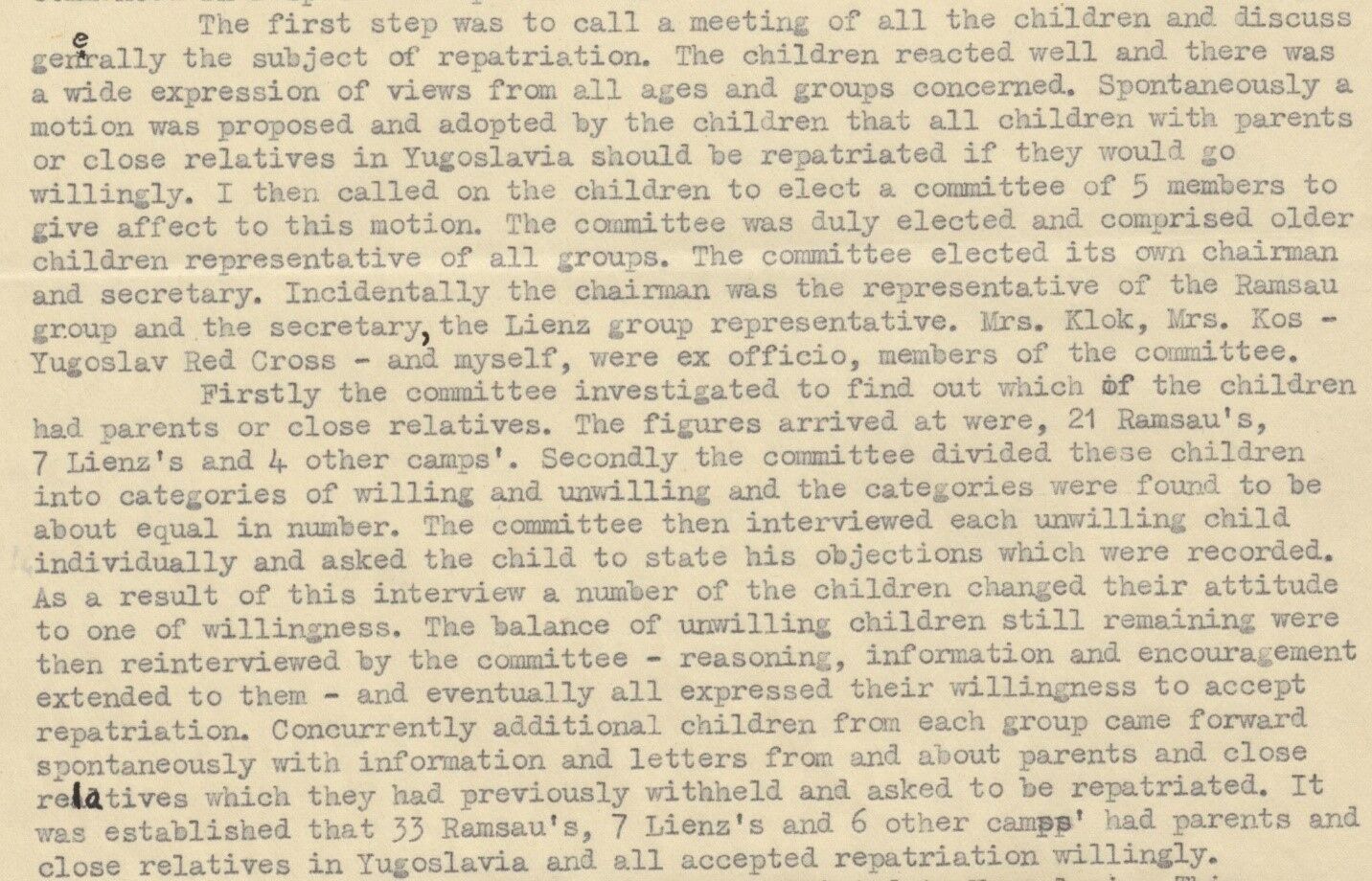
An UNRRA memorandum from January 1947 describes a meeting at which children discussed repatriation to Yugoslavia. They agreed that children with parents or close relatives there should return if willing, and elected a five-member committee of older children to examine the cases. Its chairman represented a group from Ramsau and its secretary a group from Lienz.
The committee first identified 32 children with family connections in Yugoslavia. About half initially wished to return and half did not. Interviews recorded the objections of reluctant children; repeated discussions followed. The officer’s report says that further family information emerged and eventually 46 children agreed to repatriation. This is the administrator’s account of a particular group’s decision-making, rather than a record of the wishes or destinations of every child in the home.
Family connections recorded by the committee
| Earlier group | Initial cases | Later cases |
|---|---|---|
| Ramsau | 21 | 33 |
| Lienz | 7 | 7 |
| Other camps | 4 | 6 |
| Total | 32 | 46 |
Sources for this section
A changing home
The figures preserved in different records describe different moments and purposes. The 1947 visitor counted approximately 60 children. The archival study gives accommodation capacity of 58 in its account of the home’s later administration. Neither figure is a count of Ukrainian children alone.
Other records give further moments. A British list of Styrian camps drawn up in November 1947 records 111 people at the Children’s Home in Leoben on the September count. The compiled camp register gives about 100 residents, mostly children, in July 1946, describes the home as an IRO orphanage for seventy, and notes that from February 1948 only IRO-eligible children were admitted. At the handover of June 1950 Stieber gives about fifty children. None of these is a count of Ukrainian children.
Children and accommodation
| Record | Figure | What it describes |
|---|---|---|
| July 1946 (camp register) | about 100 | Residents, mostly children |
| February 1947 report | About 60 | Children present, all nationalities |
| February 1947 report | 2–4 years | Most children’s ages |
| February 1947 report | 7 years | Oldest child reported |
| September 1947 (British list) | 111 | People recorded at the Children’s Home in Leoben |
| Camp register | 70 | Places as an IRO orphanage |
| Later administrative account | 58 | Accommodation capacity |
| 19 June 1950 (handover) | about 50 | Children at the transfer to Austrian administration |
Supplies and the final years
The home appears among the new facilities in the Styrian camp accounts for 1946. It depended on the larger camp at Trofaiach for food and fuel, connecting a small residential institution with the regional relief network. Its principal residents were children without parents.
On 19 June 1950 the home passed into Austrian administration and staffing was reduced. Historian Gabriela Stieber concludes that it probably closed soon afterwards because it is absent from the Interior Ministry’s 1951 list of Styrian camps. That sequence establishes a transfer of responsibility and a likely period of closure, without inventing a precise final day.
The compiled register resolves part of what happened next: from June 1950 the remaining children were taken over by the IRO children’s homes at Bad Schallerbach and at Ried im Innkreis, both in Upper Austria, and the entries for those two homes record the same transfer from Leoben. That gives the children a destination rather than leaving the closure as a blank.
Photographs and surviving records
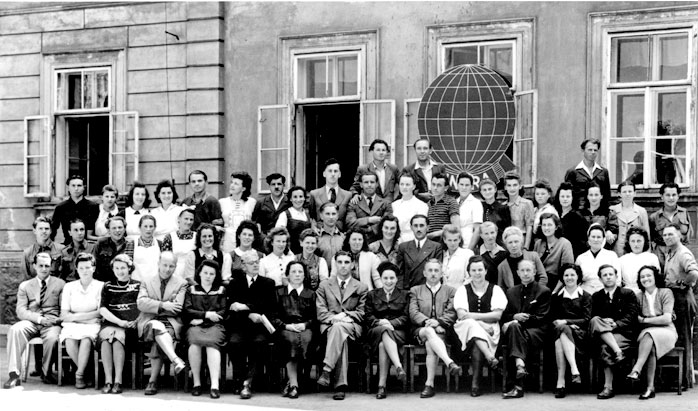
A photograph dated 1947 shows a large group assembled outside the children’s home beneath an UNRRA emblem. It preserves the institution’s public face, while the memorandum and newspaper report describe what happened inside: meals, play, attempts to recover family connections and decisions with lasting consequences for children’s lives.
Sources
- Biedny, mały Janku… Refleksje z podróży po Austrii
Gazeta Robotnicza, no.50 / Silesian Digital Library · 20 February 1947
Original p. 8 inspected visually. Contemporary visit explicitly identifies Ukrainian children, approximately 60 children, primarily ages 2–4; oldest 7. Individual children’s names omitted.
- Flüchtlingslager in der Steiermark 1945–1955
Gabriela Stieber, Zeitschrift des Historischen Vereines für Steiermark 83 · 1992
Original PDF read: printed pages 450–451 and 488, subsection 3.14 on Leoben, together with printed page 453 for the November 1947 camp list and its September occupancy of 111, page 455 for the June 1950 handover with about fifty children, and page 466 for the class of fifteen children and the status of camp schools. Capacity 58, supply from Trofaiach, transfer 19 June 1950; closure soon thereafter is the author’s inference from omission in the 1951 list.
- January 1947 memorandum from the Leoben Children’s Centre
UNRRA records, reproduced by University of Klagenfurt class exhibit · January 1947; exhibit 2019
Original memorandum image read visually; UNRRA records S-1503-0017, S-0527-0192. The memorandum was written by W. C. Collings, officer in charge of the children’s centre at Leoben. Five-member child committee; initial 32 and later 46 children with family ties in Yugoslavia. Figures describe the subgroup assessed for repatriation, not the total home population.
- Leoben Children’s Centre, 1947 photograph
DP camps.org; photograph supplied by Klaus Fohringer · Photograph dated 1947
Original page and image inspected. Source caption identifies the children’s home in 1947; exact roles and nationalities of the pictured people are not identified. The undated figure of 150 children is not used as a dated census.
- AustriaCampsV7.xls, compiled register of camps in Austria
Klaus Fohringer, published by DP Camps.org · Workbook last saved 24 July 2021
Workbook downloaded and read; the first sheet, the Leoben row and the corroborating rows for Bad Schallerbach and Ried im Innkreis. Gives the Franz-Josef-Strasse location, parish of St Xaver ownership to 1948, UNRRA from November 1945, team 327 (334 per Stieber), about 100 residents in July 1946, IRO orphanage for seventy, IRO-eligible children only from February 1948, administration from Trofaiach from June 1947, and the June 1950 transfer of the remaining children. A compiled secondary register with heavy abbreviation; the row cites Stieber.
Last researched 13 September 2026