Lintorf Camp
Displacement in Europe
Lintorf, now Ratingen, North Rhine-Westphalia, Germany · 1946–1960 as a displaced-persons camp
At a former Krupp labour camp on the Rehhecke, Ukrainians made up the second-largest national group in a camp that lasted until 1960. Its history runs from wartime forced labour through British administration, emigration and church life to the barracks being pulled down.
Introduction
Lintorf Camp stood on the Rehhecke, outside the old village centre. After the war it became a home for people who could not return to their countries. Ukrainian relief statistics recorded 1,321 Ukrainians there in 1946–47; the community remained present into the 1950s.
A history in dates
- 1943–44The Krupp forced-labour camp is built.
- Spring 1944The Krupp camp is first occupied; the intended 3,000 residents are reached within a short time.
- April 1945Allied liberation.
- June 1945British administration takes over the empty camp; about 3,000 Hungarian officers are accommodated.
- January–summer 1946The Hungarian residents are repatriated; Ukrainians and Belarusians arrive.
- Summer 1946The displaced-persons camp begins operating.
- Autumn 1947The British authorities declare Lintorf a transit camp for emigration overseas.
- 21 March 1950Administration passes to North Rhine-Westphalia.
- 15 January 1951The Ukrainian camp school is dissolved for want of pupils.
- 26 November 1951A German camp kindergarten opens with 45 children.
- 1 December 1952The Ukrainian church choir from Rheine and Lingen performs in the camp.
- 8 September 1955Archbishop Ivan Buchko visits the Ukrainian Catholic community.
- 1 February 1959A Caritas count records 173 Ukrainians among 648 residents.
- 1 April 1960The camp is cleared.
- 8 December 2023A memorial panel is unveiled.
A site with several different histories
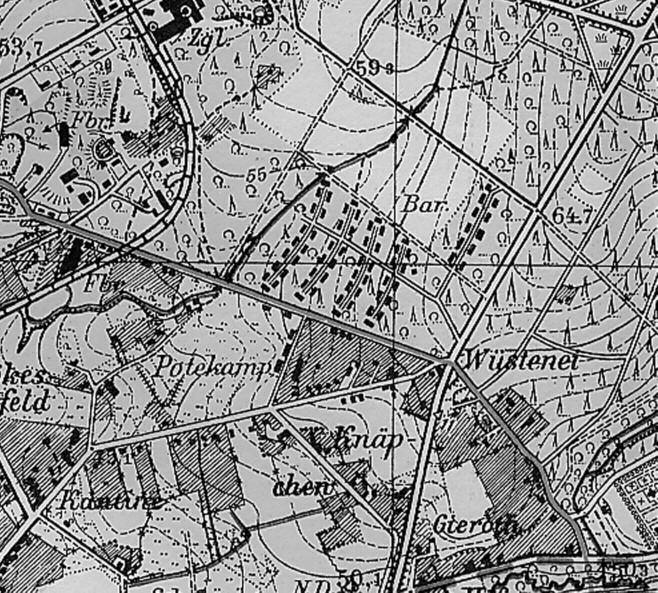
The camp was built by the Organisation Todt for prisoners of war and forced labourers, many of them working for Krupp in Essen. The memorial account gives its origins as 1943–44, while Braun records the founding date as disputed, preferring the Catholic school chronicle’s entry of 3 December 1943 to Kaminsky’s 1941. It stood outside the village on land called the Wüstenei; a main path and four streets named after trees ran through it, and each of the sixty-seven pumice-concrete huts was numbered. First occupation followed in spring 1944, and the intended figure of 3,000 was reached within a short time.
For part of 1945 the British used Lintorf to hold German and Hungarian prisoners of war. A German guard who arrived in June 1945 recalled finding the barracks empty under a British commandant who was also local commandant for Lintorf. Some 3,000 Hungarian officers were then accommodated and repatriated between January and summer 1946, not always willingly; Ukrainians and Belarusians followed, each newcomer questioned and recorded on a form.
From summer 1946 Lintorf operated as a displaced-persons camp. The wartime forced-labour population, the prisoners held by the British and the later civilian residents were successive groups, not one unchanging camp population.
Rations, work and transit
Lintorf lay in the British zone, where rations were cut hard after the first postwar winter: the daily allowance for displaced people fell to 2,170 calories in March 1946 and to 1,550 that summer, roughly what German civilians received. Bread came from a village bakery that had supplied the wartime camp under Krupp and kept the contract afterwards.
In autumn 1947 the British authorities declared Lintorf a transit camp for people awaiting emigration overseas, and occupancy then changed almost daily as residents left for the transit camps at Hamburg-Wentorf and Fallingbostel, most of them bound for the United States, Australia or Canada. Lintorf was also expressly designated a camp for people fit for work: a management return of 1951 shows most men in unskilled building work and the iron industry, and by 1954 the majority were laying track between Langenfeld and Düsseldorf.
Sources for this section
The Ukrainian community in numbers
The most detailed published series follows the Ukrainian population from 1946–47 to August 1951. It falls from 1,321 to 170, although the dates and collecting organisations vary. These figures count Ukrainians, not everyone living at Lintorf, and cannot by themselves distinguish emigration from transfers or moves into private housing. A staff memoir remembers about 3,000 foreign residents when its author arrived in October 1948, a retrospective estimate of the whole camp rather than a census.
A Caritas count of 1 February 1959 gives the fullest breakdown near the end: 410 Poles, 173 Ukrainians, 34 Yugoslavs, eleven Latvians, six Lithuanians, one Estonian, nine Hungarians and four people of undetermined nationality. Ukrainians were consistently the second-largest group, and church records point to a larger community earlier, with almost 400 Ukrainian Catholics recorded as living there. A compiled camp directory lists Lintorf under the British-zone numbers 3187 and 41/187 with the same three main nationalities.
Ukrainians recorded at Lintorf
| Date | Ukrainians |
|---|---|
| 1946–47 | 1,321 |
| May 1947 | 857 |
| December 1947 | 382 |
| July 1949 | 342 |
| December 1950 | 174 |
| August 1951 | 170 |
Nationalities recorded at Lintorf, 1 February 1959
| Nationality | Residents |
|---|---|
| Polish | 410 |
| Ukrainian | 173 |
| Yugoslav | 34 |
| Latvian | 11 |
| Lithuanian | 6 |
| Estonian | 1 |
| Hungarian | 9 |
| Undetermined | 4 |
Work, food and community life
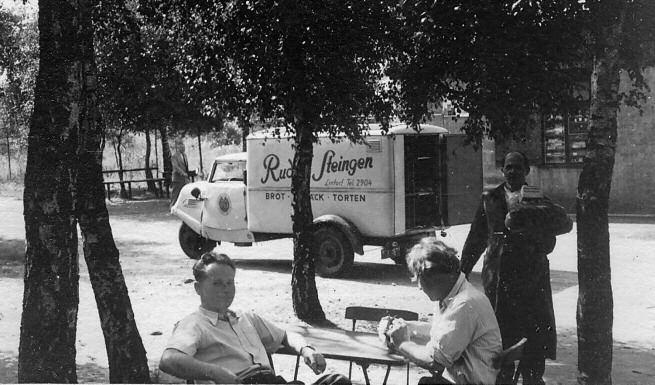
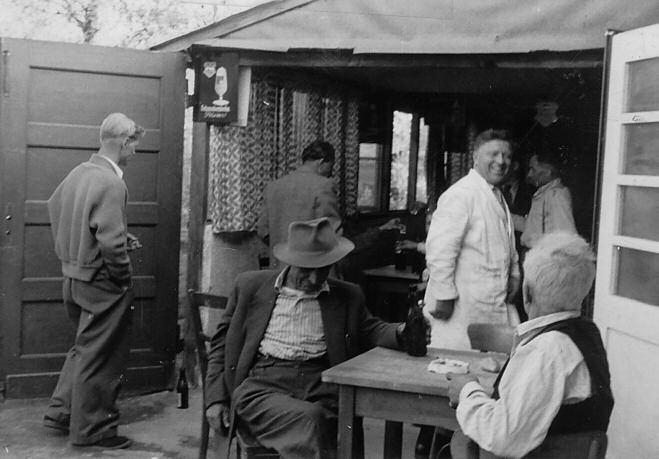
The camp had the shape of a small township. Two canteens with drink licences stood either side of the entrance road and a third shop lay in the third street; the camp church was in the first street, and the other public buildings were a multi-purpose hall, the school, the kindergarten, the sick bay and the kitchen left from the days of full catering. At the centre stood a cross whose arms carried a wreath of barbed wire, in memory of the dead of all nations.
Residents formed national committees whose representatives, trusted by their compatriots, relayed residents’ concerns and needs to the camp welfare workers; their material was posted for everyone on a wall newspaper, a printed Lintorfer Lagerzeitung having been discontinued after the British period. Unmarried residents ate from the communal kitchen while families received rations to prepare themselves. The hall had a stage: a Ukrainian folklore group appears in the photographic record, the Polish children’s folk-dance group performed there, and on 1 December 1952 the Ukrainian church choir from Rheine and Lingen gave a concert in the camp.
Sources for this section
Church and school
A single hut in the first street was fitted out for worship and shared in rotation between the denominations. The Ukrainian Catholic residents were looked after from Krefeld-Traar by a priest who had himself survived four years in Dachau, and their most notable occasion was the visit on 8 September 1955 of Archbishop Ivan Buchko, then in exile in Rome after the Ukrainian Catholic Church was banned in 1945. Polish Catholics were served by a priest from Essen; in 1952 the Orthodox archpriest responsible for Lintorf was covering twelve camps and settlements, and Protestants were served from Düsseldorf. Photographs in the published study show Ukrainian Catholic and Polish Catholic processions through the camp.
A Polish national school with 27 children ran until 28 February 1951, and the Ukrainian camp school was dissolved on 15 January 1951 because too few pupils remained. A Ukrainian kindergarten closed alongside the Polish one, and a German camp kindergarten opened on 26 November 1951 with 45 children. From Easter 1951 parents were directed to the German village school, where a separate foreign-children class was formed for 1952/53 with 43 pupils; its teacher later published his own account of those two years.
Leaving the camp
North Rhine-Westphalia took over on 21 March 1950, with 1,200 residents and 47 staff. Later, some families welcomed permanent housing; others regretted losing affordable accommodation, local employment and familiar neighbours. The site was cleared on 1 April 1960 and its barracks gradually demolished.
The staff memoir describes residents being rehoused in different towns. For employees, closure could mean a transfer elsewhere: the author was offered work at Unna-Massen but instead found employment in Lintorf.
Lintorf was the second-to-last home for homeless foreigners to be wound up in North Rhine-Westphalia, and the huts were pulled down one by one.
Remembering the site
A memorial panel was unveiled on 8 December 2023 near the former camp, at the roundabout joining Rehhecke and Am Kämpchen. It explains the successive wartime and postwar uses of a place whose buildings have disappeared.
Sources for this section
Sources
- Das wahre Leben war es nicht. Displaced Persons und das Lager Lintorf
Ruth Braun, Die Quecke 65 (1995), pp 34–63 · Accessed September 2026
Archival study using Ratingen municipal and NRW state records, school chronicles and interviews. Original PDF inspected.
- Wie Lintorf unsere neue Heimat wurde
Walter Kugler, Die Quecke 81 (2011), pp 69–73 · Accessed September 2026
First-person memoir of camp administration employment beginning November 1948; whole-camp estimate, not Ukrainian census.
- VLH: Gedenktafel erinnert an Lager Lintorf
Lintorfer, 9 December 2023 · Accessed September 2026
Report of memorial unveiling and historian Bastian Fleermann’s account; 1943/44 origins, successive uses, 1960 closure.
- Ukrainians in the Displaced Persons Camps of Austria and Germany, Table 7
Ihor Stebelsky, Ukrainian Historical Review (1986), pp 50–52 · Accessed September 2026
Original table and heading visually checked; six Ukrainian counts, distinct sources and dates.
- Meine Erinnerungen an das Kriegsgefangenenlager „Lintorf Camp“
Herbert Krug, Die Quecke 73 (2003) · Accessed September 2026
First-person account of the temporary German prisoner-of-war phase, October–December 1945, and later voluntary kitchen staff; distinct from DP residence.
- Displaced Persons Camps – Germany L (Lintorf entry)
dpcamps.org · Accessed September 2026
Compiled directory read in full: British-zone identifiers 3187 and 41/187, nationalities given as Ukrainians, Poles, Yugoslavs. Secondary compilation; not used for dates, capacities or population figures.
- Zwei Jahre als Lehrer in der Lagerschule
Karl Schaefer, Die Quecke 65 (1995), pp 63–66 · Accessed September 2026
Teacher’s account of the foreign-children class at the Catholic School I in Lintorf from 1952/53, quoting the school chronicle entry of 17 April 1952 and the figure of 43 registered camp children. Concerns the German village school, not the earlier Ukrainian camp school.
Last researched 13 September 2026