Luitpold-Kaserne
Displacement in Europe
Ludwigsburg · Germany · 1945–1949/1950
A former artillery barracks in Ludwigsburg housed one of four camps that the UNRRA team ran in and around the town, with a predominantly Polish population that also included Ukrainians. Ukrainian questionnaire returns counted 797 Ukrainians in Ludwigsburg in 1946 and 1947, and church records 723 Greek Catholics with 74 Orthodox at this barracks in 1947.
Introduction
Luitpold-Kaserne was one of several barracks used to accommodate displaced people in Ludwigsburg after the Second World War. Contemporary reports describe a predominantly Polish population; the archival camp inventory also records Ukrainians, and the Ukrainian Greek Catholic parish history gives a confessional count for the barracks in 1947. The camp was administered as Assembly Centre 644, with UNRRA Team 91 and the later code WG 212.
A history in dates
- 1892–1893The artillery barracks are built and named after Prince Regent Luitpold of Bavaria.
- 1939–1945The barracks serve as a military horse hospital.
- 2 May 1945The mayor lists Luitpold among the barracks holding liberated foreign workers.
- 30 July 1945A Polish occupancy return gives 1,218 people at Luitpold.
- 7 December 1946The first exact UNRRA statistic records 890 residents in camp 644.
- 2 April 1947An UNRRA letterhead lists Luitpold-Kaserne 644 among the camps of the Ludwigsburg assembly centre.
- 31 May 1947An UNRRA return counts 773 Ukrainians in Ludwigsburg as a whole.
- 29 May 1947The remaining 621 residents of Aldingen Camp 71 transfer to Luitpold.
- 1947Church records count 723 Greek Catholics and 74 Orthodox at the Luitpold camp.
- 24 August 1948The northern Württemberg resettlement centre moves from Stuttgart to the Flak-Kaserne at Ludwigsburg-Ossweil.
- 1949–1950The archival inventory places the camp’s closure within this interval.
- 31 January 1951The last homeless foreigners in Ludwigsburg are transferred to state hostels.
- 1956–1994The site serves the Bundeswehr before civilian redevelopment.
Sources for this section
- Luitpoldkaserne: from barracks to police headquarters
- Displaced persons (DPs) in Ludwigsburger Kasernen 1945–1951
- Ukrainians in the Displaced Persons Camps of Austria and Germany, Table 8
- Das DP-Camp 71 in Aldingen
- Under the protection of St Basil the Great: the Ukrainian church in Württemberg
- DP camp inventory: Ludwigsburg, Luitpold-Kaserne
From artillery barracks to temporary homes
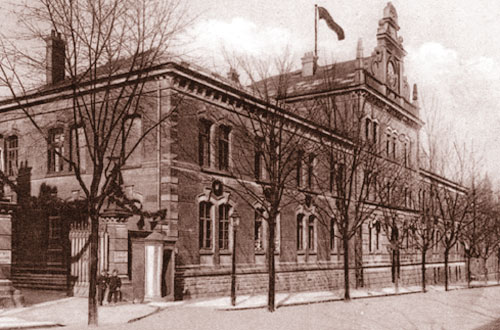
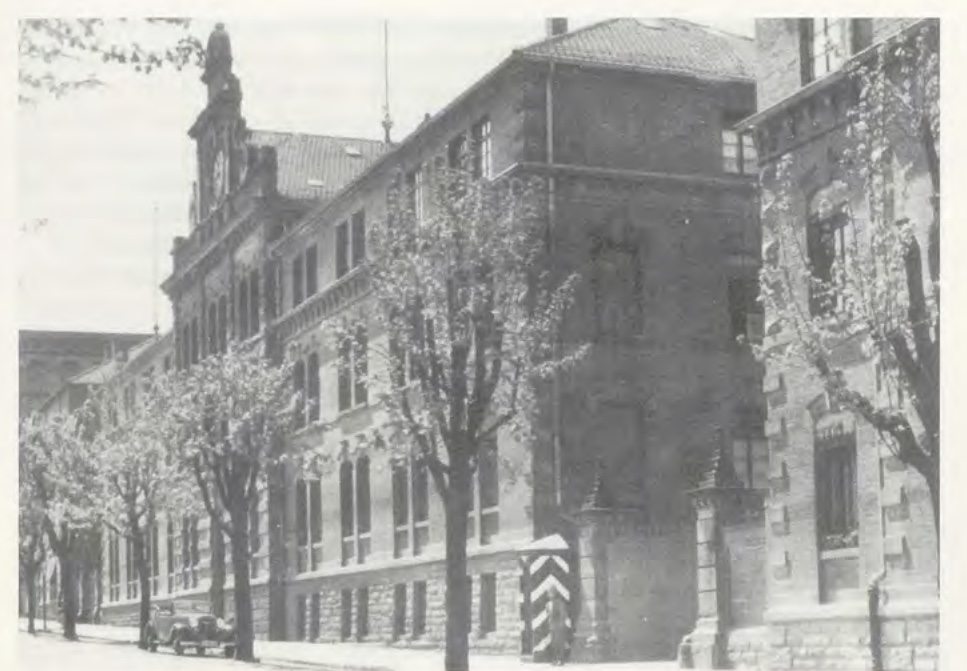
Built in 1892 and 1893 and named after Prince Regent Luitpold of Bavaria, the barracks stood at Alt-Württemberg-Allee 40 on a site of some 2.4 hectares, of which about 0.8 hectares were built over. Various field artillery regiments occupied it until 1938; from 1939 to 1945 it served as a military horse hospital. The barracks-conversion history states that in 1945 Luitpold and the neighbouring Jägerhof-Kaserne together formed a camp called the Kosciusko-Lager, whereas the archival inventory records Luitpold separately as Assembly Centre M. Kopernik and Jägerhof as Assembly Centre Sikorski. That difference in naming has not been resolved.
The first months
The city archivist Ulrich Müller found the barracks already in use in the first days of peace. In a letter of 2 May 1945 the mayor listed the Flak-Kaserne at Ossweil, Luitpold, Jägerhof, Fromann, Mathilden and Karls barracks as the places where liberated foreign workers were housed. By 8 May the town was delivering 7,500 meals a day to foreign civilian workers in its barracks. UNRRA then sought to keep national groups together, which is why Poles and Ukrainians came to be concentrated in Ludwigsburg.
On 30 July 1945 the chairman of the Polish central association in Ludwigsburg gave the occupancy of the barracks holding Poles. Luitpold appears with 1,218 people out of 9,353 across six barracks. Sixteen months later, on 7 December 1946, the first exact UNRRA statistic recorded four camps in Ludwigsburg and Aldingen with 3,094 residents in all, of whom 890 were at Luitpold as camp number 644.
Sources for this section
Camp 644 in the Ludwigsburg assembly centre
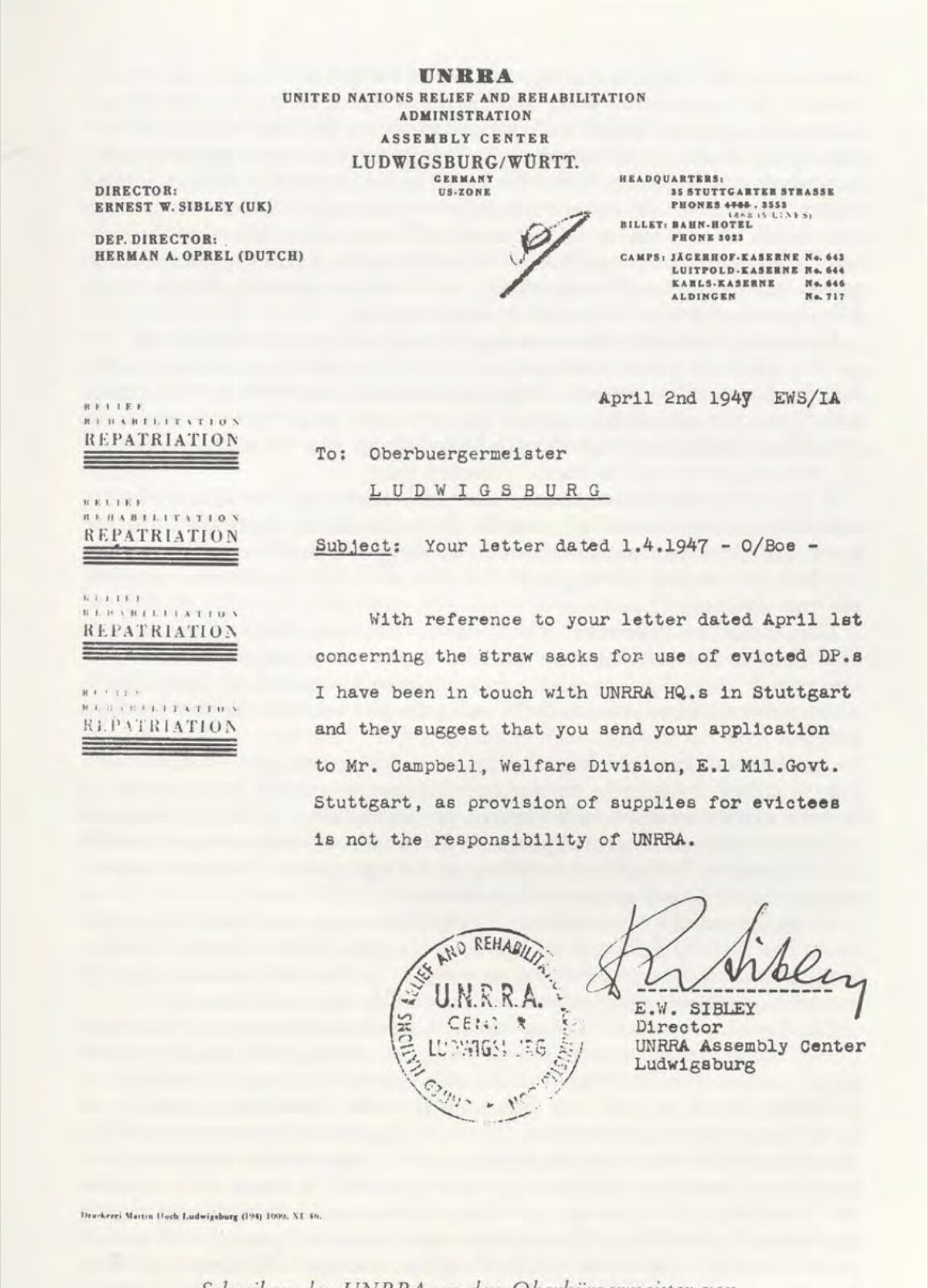
Luitpold was not run on its own but as one camp of the UNRRA Assembly Centre Ludwigsburg. A letterhead reproduced by Müller from a letter of 2 April 1947 names Ernest W. Sibley as director and Herman A. Oprel as deputy director, gives the headquarters as 35 Stuttgarter Strasse and the staff billet as the Bahn-Hotel, and lists the constituent camps, among them Jägerhof-Kaserne 643 and Luitpold-Kaserne 644. The same four camps, with Karls-Kaserne 646 and Aldingen 717, were still under UNRRA in spring 1947.
The inventory adds the administrative frame: Team 91 at Ludwigsburg under the director recorded as Cock, Area Team 1002 from November 1946, Area A 2 Ludwigsburg, and the field supervisors Metzger and Nutter. A recorded capacity of 800 on 31 October 1947 is an accommodation measure rather than a count of residents, and it is not a Ukrainian figure.
The four UNRRA camps of the Ludwigsburg assembly centre, 7 December 1946
| Camp number | Building | Residents |
|---|---|---|
| 643 | Jägerhof-Kaserne | 914 |
| 644 | Luitpold-Kaserne | 890 |
| 646 | Karls-Kaserne | 385 |
| 717 | Aldingen Camp | 905 |
| Total | All four camps | 3,094 |
A changing camp population
In May 1947 the camp received another substantial group when the remaining 621 residents of the Aldingen camp, DP-Camp 71 or UNRRA camp 717, were transferred here and that camp closed. The transfer figure does not establish how many people were living at Luitpold afterwards. During 1947 about 450 former displaced people in the Ludwigsburg district, mostly Poles and Ukrainians, had their displaced-person status withdrawn by UNRRA or IRO and passed to the German refugee administration.
Figures recorded for the Luitpold camp
| Date | Figure | Meaning |
|---|---|---|
| 30 July 1945 | 1,218 | People at Luitpold in the Polish occupancy return |
| 7 December 1946 | 890 | Residents in the UNRRA statistic for camp 644 |
| 29 May 1947 | 621 | Arrivals transferred from Aldingen, not total occupancy |
| 31 October 1947 | 800 | Recorded capacity in the archival inventory |
The Ukrainian community
The parish history of the Ukrainian Greek Catholic church in Württemberg, drawing on Dmytro Blazhejowskyj’s directory of Ukrainian Catholic clergy in the diaspora, records that in 1947 the camp at Ludwigsburg-Luitpoldkaserne held 723 Greek Catholics and 74 Orthodox. It describes Ukrainian pastoral care in the two camps of Ludwigsburg and Stuttgart-Zuffenhausen, naming Father Volodymyr Voznyak at Ludwigsburg in the earliest period and Father Yulian Mykytyn from 1951. The same account dates the ministries from 1944, which is before either camp existed, so only the 1947 figures are treated as evidence here.
Müller warns that Ukrainians were often recorded as Poles in 1945, because the only German authority that counted displaced people, the registry office, had no category for Ukrainians, and because people from what became Soviet western Ukraine were reclassified only after the Potsdam conference. Sixteen, seventeen and twenty births registered as Russian in 1945, 1946 and 1947 were, in his judgement, probably children of Ukrainian women. In February 1946 the mayor supported a working association called Ukrainian Folk Art, founded by about 1,000 Ukrainians living in Ludwigsburg to make craft goods, and wrote to eight firms producing lacquers and plywood asking them to supply materials. That association was a town-wide Ukrainian initiative and is not attributed to this barracks alone.
Stebelsky’s tabulation of Ukrainians in American-zone camps gives Ludwigsburg 797 for 1946 to 1947 and 773 on 31 May 1947, with no entry in the UNRRA return of 24 August 1946 or the return for December 1947. These are figures for the locality and cover all its camps. The Land civic-education portal records vocational courses for smiths, joiners and electricians at a Polish camp in Ludwigsburg it calls Kopernikus, the name the inventory attaches to Luitpold, although that account does not itself name a building.
Ukrainians recorded at the camp and in the town
| Source and date | Scope | Figure |
|---|---|---|
| Parish history after Blazhejowskyj, 1947 | Luitpoldkaserne camp, Greek Catholics | 723 |
| Parish history after Blazhejowskyj, 1947 | Luitpoldkaserne camp, Orthodox | 74 |
| Central Representation questionnaires, 1946–1947 | Ludwigsburg locality, all camps | 797 |
| UNRRA return, 31 May 1947 | Ludwigsburg locality, all camps | 773 |
| IRO resettlement centre statistic, 31 March 1950 | Northern Württemberg emigrants at Ludwigsburg-Ossweil | 517 |
Following the camp through its records
The inventory places the surviving records within the wider Ludwigsburg camp file, documents 82007923 to 82009434, which covers the whole town rather than this barracks. Müller worked from the city archive series L 3 and L 9, from United Nations records in New York for the December 1946 statistic, and from the IRO papers in the Archives Nationales in Paris. He closes by noting that the files allow the subject to be described only from the perspective of German and Anglo-American administrations, because the displaced people themselves left almost no written trace.
Departure and after
The inventory places the camp’s closure between September 1949 and September 1950. Emigration from northern Württemberg was handled by a resettlement centre that had first been at the Flandern-Kaserne in Stuttgart and moved on 24 August 1948 to the Flak-Kaserne at Ludwigsburg-Ossweil; an IRO statistic for 31 March 1950 counted 517 Ukrainians among those preparing to sail from it, alongside 638 Poles, 438 Latvians and other groups. On 31 January 1951 the last people still classed as homeless foreigners in Ludwigsburg were transferred to state hostels elsewhere in Germany.
The Bundeswehr used the barracks from 1956 until 1994. Redevelopment removed the northern accommodation block and several internal buildings in 1999, and a new tax office opened on that ground in 2001. The northern halls were demolished in 2000 and a police headquarters for Ludwigsburg opened in their place in 2004.
Sources
- Luitpoldkaserne: from barracks to police headquarters
Ludwigsburg barracks conversion history · Accessed 13 September 2026
Construction 1892–1893, site area, artillery and horse-hospital use, the Kosciusko-Lager name, Bundeswehr years and the 1999–2004 redevelopment. The page also carries the historical exterior photograph of the barracks reproduced here, published as luitpoldkaserne_hist_gross.jpg; the site is published by the City of Ludwigsburg and its imprint credits photographs collectively to Reiner Pfisterer, the Stadtarchiv Ludwigsburg and Michael Holzapfel, without attributing individual images.
- Displaced persons (DPs) in Ludwigsburger Kasernen 1945–1951
Ulrich Müller, Ludwigsburger Geschichtsblätter 43 · 1989
Printed pages 127–139. May 1945 barracks list, the 30 July 1945 occupancy return, the UNRRA statistic of 7 December 1946, the UNRRA assembly-centre letterhead of 2 April 1947, the Ukrainian Folk Art association, the resettlement centre and the closure of January 1951.
- Das DP-Camp 71 in Aldingen
Beth Shalom, Remseck municipal newsletter · May 2026
Archive-based research establishing the May 1947 transfer to Luitpold.
- DP camp inventory: Ludwigsburg, Luitpold-Kaserne
Arolsen Archives · 26 October 2023
Row 1189: Ukrainian and Polish nationalities, AC M. Kopernik and AC 644, WG 212, Team 91 Ludwigsburg, Area Team 1002, capacity 800 on 31 October 1947, closure between 20 September 1949 and 30 September 1950, ITS documents 82007923–82009434.
- Under the protection of St Basil the Great: the Ukrainian church in Württemberg
Parish of St Basil the Great, Stuttgart, Ukrainian Greek Catholic Church · Accessed 13 September 2026
Parish history citing Dmytro Blazhejowskyj, Ukrainian Catholic Clergy in the Diaspora 1751–1988 (Rome, 1988): 723 Greek Catholics and 74 Orthodox at Ludwigsburg-Luitpoldkaserne in 1947, and the priests who served the two camps.
- Ukrainians in the Displaced Persons Camps of Austria and Germany, Table 8
Ihor Stebelsky, Ukrainskyi Istoryk 3 · 1986
PDF page 56, printed page 54. Ludwigsburg 797 in the 1946–1947 questionnaire returns and 773 in the UNRRA return of 31 May 1947. A locality row covering all camps in the town.
- Displaced Persons im deutschen Südwesten
Paul Düring, Landeszentrale für politische Bildung Baden-Württemberg · Accessed 13 September 2026
Vocational courses for smiths, joiners and electricians at the Polish camp named Kopernikus in Ludwigsburg; the camp’s football team; the scale of camps in Württemberg-Baden.
- Die Interniertenlager in und um Ludwigsburg 1945–1949, with the 1947 town chronicle
Ulrich Müller, Ludwigsburger Geschichtsblätter 45 · 1991
Printed pages 174–177 and the 1947 chronicle: UNRRA’s four Ludwigsburg camps in spring 1947 and its headquarters at Stuttgarter Straße 35; about 450 former displaced people, mostly Poles and Ukrainians, who lost that status during 1947.
- Luitpold-Kaserne, Alt-Württemberg-Allee 40, um 1938
Stadtarchiv Ludwigsburg, reproduced in Ludwigsburger Geschichtsblätter 43 (1989), p. 131 · about 1938
Street view of the barracks from the Alt-Württemberg-Allee about seven years before it was requisitioned as a displaced-persons camp, showing the long brick ranges and the sentry post at the corner. The volume’s Bildnachweis credits the illustrations on pages 127 to 139 to the Stadtarchiv Ludwigsburg; the journal states all rights reserved and no reuse licence.
- Letter from the Director of the UNRRA Assembly Center Ludwigsburg to the Oberbürgermeister of Ludwigsburg, 2 April 1947
Stadtarchiv Ludwigsburg, reproduced in Ludwigsburger Geschichtsblätter 43 (1989), p. 135 · 1947
Typed letter on the assembly centre’s printed letterhead, signed by the director E. W. Sibley, declining responsibility for straw sacks for evicted DPs. The letterhead lists the centre’s four camps by number: Jägerhof-Kaserne No. 643, Luitpold-Kaserne No. 644, Karls-Kaserne No. 646 and Aldingen No. 717. The volume’s Bildnachweis credits the illustrations on pages 127 to 139 to the Stadtarchiv Ludwigsburg; the journal states all rights reserved and no reuse licence.
Last researched 13 September 2026