Ludwig-Kaserne
Displacement in Europe
Dillingen an der Donau · Germany · 1945–1951
A cavalry barracks of the 1840s in Dillingen an der Donau became a Lithuanian-led displaced-persons camp whose residents ran schools, a nursing school and a twice-weekly newspaper for the whole Lithuanian emigration. Estonians and people classified as Polish-Ukrainian were recorded here too, and the camp was still in use in 1949.
Introduction
The Ludwig-Kaserne housed a Lithuanian-led displaced-persons community in Dillingen an der Donau. Its recorded population also included Estonians and people classified as Polish-Ukrainian. Surviving camp currency, newspaper notices and relief records reveal an organised community with its own means of distributing supplies and maintaining links beyond the barracks.
A history in dates
- 1839–1844The Ludwigskaserne is built.
- 22 April 1945German soldiers remaining in the Ludwig-Kaserne are taken prisoner as Dillingen is captured.
- 6 May 1945The Dillingen barracks, among them the Ludwigs-Kaserne, are handed over to UNRRA and converted into a collective camp for displaced persons.
- 5 July 1945Some displaced people from Lauingen are transferred to the barracks.
- 24 January 1946The inventory registers the camp as Assembly Centre 94-273 under Team 308.
- May–June 1946UNRRA reports describe Dillingen’s points system for distributing amenities.
- 31 October 1946Mūsų kelias gives its address as the Lithuanian camp at Dillingen.
- 1947–1948A Lithuanian school for nurses operates at Dillingen.
- 31 October 1947The recorded accommodation capacity is 1,100.
- June 1947Newspaper notices document the student board and Lithuanian book distribution at Ludwig.
- 30 April 1949A notice in Mūsų kelias gives a sender’s address at the Ludwigskaserne DP Camp.
- March–September 1951The inventory places the camp’s closure within this interval.
Sources for this section
- Dillingen as a garrison town
- Dillingen, Atlas zum Wiederaufbau
- Alte–Neue Heimat Dillingen: Luitpold-Kaserne, 1945–48
- DP camp inventory, record 862
- Displaced Persons Camp Money
- Mūsų kelias, issues of 1946, 1947, 1948 and 1949
- The Lithuanian community in Germany, 1944–1951
- Vienybė, 6 June 1947
- Naujienos, 9 June 1947
The barracks and its neighbours
Built between 1839 and 1844, the Ludwigskaserne belonged to Dillingen’s long military history. The city escaped wartime bombing, and American troops entered on 22 April 1945. Former military accommodation subsequently sheltered displaced people. On 5 July 1945, some residents of the nearby Lauingen camp were transferred into the Ludwigskaserne.
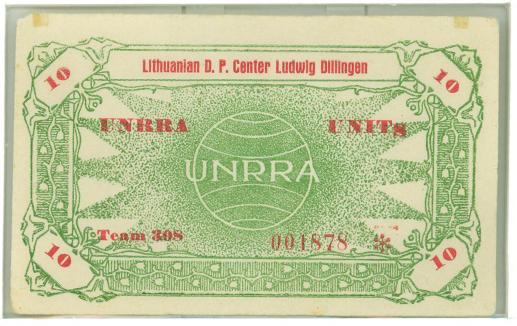
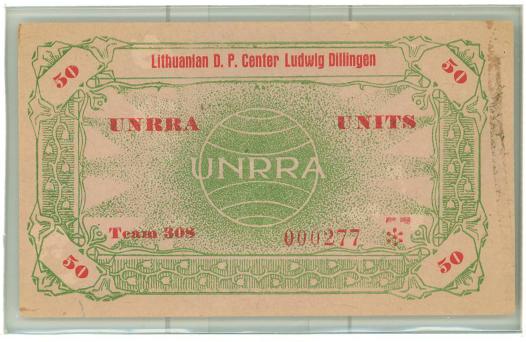
Dillingen also contained the Luitpold-Kaserne, a separate camp with its own Polish camp currency. The similar barracks names and shared UNRRA administration can obscure that distinction. The surviving Ludwig notes explicitly identify the Lithuanian centre.
The Haus der Bayerischen Geschichte records that on 22 April 1945 the German soldiers who had remained in the Ludwig-Kaserne were taken prisoner as Dillingen was captured. On 6 May 1945 the town’s barracks — named there as the Luitpold-, Ludwigs- and Alte Kaserne — were handed over to UNRRA and converted into a collective camp for displaced persons, and at the end of May 1945 the figure recorded for Dillingen was 6,318 displaced persons. That figure is for the town, and the source gives no breakdown by barracks.
The two Dillingen camps in the record
The inventory records this camp as the Lithuanian DP-Camp, Ludwig-Kaserne, Assembly Centre 94-273, later S 513, opened on 24 January 1946 under UNRRA Team 308 Dillingen and Team 165 Leipheim, with a capacity of 1,100 on 31 October 1947 and closure between 30 March and 30 September 1951. The nationalities listed are Lithuanian, Estonian and Polish-Ukrainian.
The neighbouring Luitpold camp in the same town is a separate entry: the Polish DP-Camp, Assembly Centre 94-272, later S 514, with a capacity of 1,900 and closure between 30 September 1950 and 31 March 1951, listing Polish-Ukrainian and stateless residents. The two share a town, a UNRRA team and an opening date, so the numbers, capacities and closing intervals have to be kept apart deliberately.
The two Dillingen camps side by side
| Record | Ludwig-Kaserne | Luitpold-Kaserne |
|---|---|---|
| Assembly Centre | 94-273 | 94-272 |
| Later camp number | S 513 | S 514 |
| Opening | 24 January 1946 | 24 January 1946 |
| Capacity, 31 October 1947 | 1,100 | 1,900 |
| Nationalities in the inventory | Lithuanian, Estonian, Polish-Ukrainian | Polish-Ukrainian, stateless |
| Closing interval | 30 March to 30 September 1951 | 30 September 1950 to 31 March 1951 |
| Ukrainian counts in Table 7 | no row | 1,656, 300, 1,655 and 1,362 |
Sources for this section
Education and connections
A June 1947 directory of Lithuanian student organisations listed a Dillingen student board with 44 students and an address at Ludwig DP Camp. This identifies an organised student network associated with the camp; the directory does not describe all 44 as pupils of a camp school.
Another contemporary notice offered Lithuanian books, journals and newspapers published in Germany through a contact at Ludwig. Such notices show how camp addresses supported cultural exchange and connected displaced readers to a wider publishing network.
Training as well as schooling was organised here. The Lithuanian community in Germany records a school for nurses at Dillingen operating in 1947 and 1948. Taken with the student board and the book distribution, it shows a town where the camps supported institutions serving Lithuanians well beyond Dillingen itself.
Sources for this section
A newspaper for the whole emigration
Dillingen was a publishing centre for the Lithuanian emigration. The UNRRA files in the United Nations Archives hold two Team 308 folders for 1946 of newspapers issued at Dillingen, Mūsų kelias and Latviešu Vēstnesis. In its issue of 31 October 1946 Mūsų kelias gave its address simply as the Litauisches Lager, the Lithuanian camp, at Dillingen, and was printed by Manz in the town.
The paper grew into an institution. By October 1947 it was working from Kapuzinerstraße 16 in the town, and the issue of 28 July 1948 carries the line that its readership to be served numbered 20,000. The issue of 30 April 1949 describes it as a Lithuanian newspaper appearing twice weekly, authorised by EUCOM headquarters, civil affairs division, under authorisation number UNDP 205, with a circulation of 4,000.
One private notice in that April 1949 issue gives its sender’s address as Dillingen, Ludwigskaserne, DP Camp. It is a small thing, but it is direct evidence that the Ludwig barracks were still a working camp with a working postal address at the end of April 1949, two years before the closing interval recorded in the inventory.
How camp money worked
Ludwig issued notes in 1, 2, 5, 10 and 50 units. White and light-violet versions circulated; the numismatic study describes white notes paid to men and violet notes to women. Their design combined floral ornament, the UNRRA emblem and the camp’s name.
Team 308 reports from May and June 1946 explain the wider Dillingen rationing system: residents received basic points, with additional allowances for work and for people with particular needs, including sick and older residents, students and nursing mothers. The points purchased scarce amenities through the camp supply system.
Sources for this section
Ukrainians in the Dillingen records
The inventory’s national category for this camp, Polish-Ukrainian, is an administrative label covering people from the interwar Polish state, and it records a presence rather than a count. No Ukrainian figure for the Ludwig camp exists in the published tables: Table 7 of Stebelsky’s survey has a Dillingen Luitpold Camp row, with 1,656 in the 1946–47 questionnaire series, 300 in August 1946, 1,655 in May 1947 and 1,362 in the column headed December 1947, taken from the PCIRO return of 2 January 1948, and a Dillingen DP Hospital row, but no row for a Ludwig camp. Those Luitpold figures belong to the other camp in the town and must not be carried across.
There was nonetheless Ukrainian publishing in the town. A bibliography of Ukrainian displaced-persons publications records the periodical Ukrainka na Chuzhyni as issued at Dillingen in 1948. The entry names the town and not a camp, so it cannot be assigned to either set of barracks.
The later camp
The inventory records a capacity of 1,100 in 1947 and a closing interval between 30 March and 30 September 1951. These figures describe the mixed camp as an institution. They do not supply a separate Ukrainian population total or establish where each group went after departure.
Recorded capacity and student organisation
Sources for this section
Sources
- DP camp inventory, record 862
Arolsen Archives
Ludwig-Kaserne, AC94-273; nationalities, capacity and administrative history.
- Dillingen as a garrison town
City of Dillingen
Official history distinguishes Ludwigskaserne (1839–1844) from Luitpoldkaserne (1898–1899).
- Displaced Persons Camp Money
Frank Passic and Steven A. Feller, The Numismatist, 1984
Ludwig section; original notes and UNRRA Team 308 reports of May 16 and June 17, 1946.
- Money and Scrip: Ludwig Dillingen
Florence and Laurence Spungen Family Foundation
Original Ludwig camp notes, white and violet issues.
- Vienybė, 6 June 1947
Lithuanian National Weekly
Contemporary book distribution advertisement gives Ludwig DP Camp address.
- Naujienos, 9 June 1947
Naujienos
Student organisations list gives Dillingen board at Ludwig DP Camp, 44 students.
- Alte–Neue Heimat Dillingen: Luitpold-Kaserne, 1945–48
Stadtarchiv Dillingen, 12 March 2026
Specific Ludwig transfer on 5 July 1945; wider article concerns distinct Luitpold camp.
- Mūsų kelias, issues of 1946, 1947, 1948 and 1949
Lithuanian displaced-persons newspaper, Dillingen an der Donau · 1946–1949
Imprints giving the Litauisches Lager and Kapuzinerstraße 16; EUCOM authorisation UNDP 205, circulation 4,000; a notice of 30 April 1949 with a Ludwigskaserne DP Camp address.
- UNRRA Germany Mission administrative history, box and folder list
United Nations Archives, AG-018-039, via dpcamps.org · 1945–1949
Team 308 folders of the newspapers Mūsų kelias and Latviešu Vēstnesis issued at Dillingen, 1946.
- The Lithuanian community in Germany, 1944–1951
Vokietijos lietuvių bendruomenė · retrieved 13 September 2026
A school for nurses at Dillingen operating 1947–1948; about 70,000 Lithuanians registered in 113 camps.
- Ukrainians in the camps of the American zone, Table 7
Ihor Stebelsky, The Refugee Experience, Canadian Institute of Ukrainian Studies Press · 1992
Table 7, printed pages 47–51. The Dillingen (Luitpold Camp) and Dillingen (DP Hospital) rows are in the Bavaria section on printed page 48; there is no row for a Ludwig camp.
- Research Report No. 2: Political Refugees and Displaced Persons, 1945–1954
Yury Boshyk and Boris Balan, Canadian Institute of Ukrainian Studies, University of Alberta · 1982
Entry for the periodical Ukrainka na Chuzhyni, Dillingen, 1948.
- Dillingen, Atlas zum Wiederaufbau
Haus der Bayerischen Geschichte (hdbg.eu) · Accessed 14 September 2026
Sections “Krieg und Zerstörung” → “Kriegsende” (entry for 22 April 1945: “Gefangennahme der in der Ludwig-Kaserne verbliebenen deutschen Soldaten”) and “Wiederaufbau” → “Ausgangslage” → “Flüchtlinge und Heimatvertriebene” (handover of the Luitpold-, Ludwigs- and Alte Kaserne to UNRRA on 6 May 1945 and their conversion into a Sammellager for displaced persons; 6,318 displaced persons in Dillingen at the end of May 1945; district figures for 1946 and 1949). No breakdown by barracks is given.
Last researched 13 September 2026