Luttensee Camp
Displacement in Europe
Luttenseekaserne, Mittenwald, Bavaria, Germany · 1945–1947 as a Ukrainian camp; barracks in use from 1936
Ukrainian and Russian families lived in the former mountain barracks by the lake above Mittenwald, each group under its own administration. Most of the Ukrainians moved down to the Pionier barracks at the end of January 1947, leaving behind an Orthodox chapel that still stands.
Introduction
Luttensee was one of Mittenwald’s displaced-persons camps, housed in a former military complex on the slopes of the Hoher Kranzberg. Ukrainians lived here alongside other displaced communities. It was a distinct residential site within a wider network that also used the Jäger and Pionier barracks and several hotels.
The camp stood about three kilometres from Mittenwald and from the other two Ukrainian camps. One resident described wooden buildings in a forest by the lake, and put the population at almost a thousand people, Ukrainians and a group of Russians, each group running its own administration.
A history in dates
- 1934–1936The barracks complex is constructed.
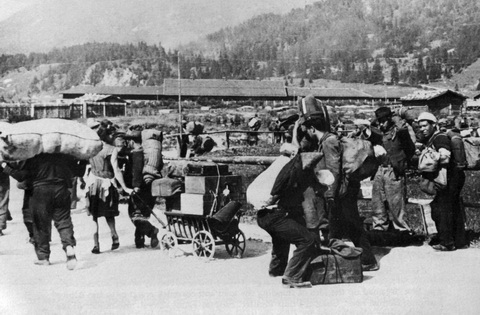
- 1945A surviving historical photograph records Ukrainian displaced people at Camp Luttensee.
- Spring 1946The Ukrainian families move into Camp Oberammergau after the winter at Kohlgrub; they are moved on to Luttensee soon afterwards.
- Summer 1946Russian residents take over the camp administration; several hundred Ukrainian families arrive from the liquidated camps at Oberdorf and Füssen.
- End of January to February 1947Most Ukrainian residents move to the Pionier barracks in the valley.
- May 1947A population return records 197 Ukrainian residents.
- December 1947The recorded Ukrainian population reaches 863; the camp school returns 16 pupils and 17 children in the kindergarten.
- 1948A Belarusian memorial is erected beside the barracks.
- December 1949Residents complete the Orthodox chapel, consecrated on St Nicholas’s Day.
- 1982 and 1984Restoration work takes place at the chapel.
Sources for this section
- Mittenwald listed monuments: Luttenseekaserne
- From forced labourers to displaced persons
- Yurij Kuzmycz, The Road to Camp Luttensee
- Wolodymyr Sijak, Camp Pionierkaserne in Mittenwald
- Ivan Rad, Cultural Activity in Camp Luttensee and Pionierkaserne
- Population migration after World War II, Table 7
- Pidsumky: informative report of the camp administration, 1 January to 31 December 1947
- The hidden church of Mittenwald
- Displaced-persons camps in Mittenwald
From barracks to a camp
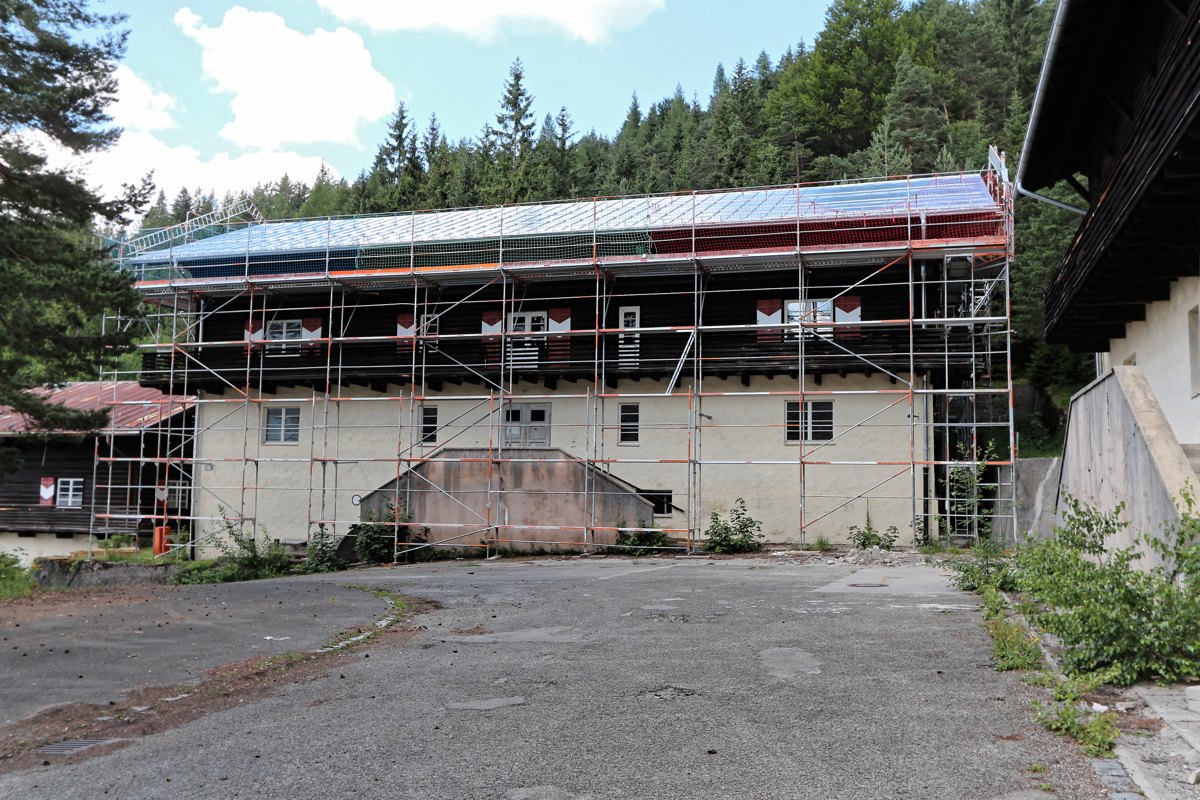
The buildings were designed by Hans Wagner and constructed in 1934–1936. Originally planned as an SA camp, the complex became a mountain-infantry barracks. Its administration building, six accommodation buildings and two officers’ buildings were arranged around a parade ground. Timber-clad upper storeys and shallow pitched roofs gave the military buildings an Alpine appearance.
A historical photograph captioned “Ukrainian DPs, 1945, Mittenwald, Camp Luttensee” records the site’s early postwar community. The camps gave people uprooted by war somewhere to live while their futures remained unsettled. The photograph documents Ukrainian presence at Luttensee without establishing a precise opening day.
The Luttensee barracks was treated as part of the same displaced-persons operation as the two barracks down in the valley, which the occupying administration called the Collective Camp Mittenwald. People were moved in from smaller camps that were being wound up. One group of Ukrainian families reached Luttensee by way of Sonthofen and Oberammergau after the camps they had been sent to were liquidated in turn.
A changing Ukrainian population
The population returns identify Luttensee separately from the other Mittenwald barracks. They record 372 Ukrainians in the 1946–1947 survey, 197 in May 1947 and 863 in December 1947. These are Ukrainian counts rather than the total number of residents of every nationality. The different dates show how sharply a camp’s population could change.
The rise in the December 1947 figure follows, rather than contradicts, the departure of most of the earlier Ukrainian residents. The Mittenwald labour department recorded the camp at about a thousand residents, Ukrainians and Russians together, and noted that the camp populations fluctuated continually as people emigrated and as residents of smaller liquidated camps were brought in.
Ukrainian residents at Luttensee
| Date | Ukrainian residents |
|---|---|
| 1946–1947 survey | 372 |
| May 1947 | 197 |
| December 1947 | 863 |
Camp life before the move
Residents rebuilt the institutions they had carried from camp to camp. A Ukrainian Catholic church, a Ukrainian Orthodox church, a kindergarten and an elementary school were established soon after arrival. Touring theatre companies and choirs visited, among them the Ukrainian Bandurist Capella under Wolodymyr Bozyk, and the camp held sports events and tournaments.
A male choir was formed to mark the execution of two members of the Ukrainian Military Organisation, then expanded to fifty mixed voices for the commemoration of the 1918 uprising on 1 November. A programme for Ukrainian Independence Day on 22 January included an exhibition of the original proclamations of independence and of the union of eastern and western Ukraine, assembled by a former officer who had taken part in those events. Lectures on Ukrainian history and culture were given in the camp every other week.
Schooling at Luttensee was modest. The Mittenwald camp administration’s report for 1947 records an elementary school with four classes and a kindergarten that shared its rooms with the Belarusian community, one teacher in the school and one in the kindergarten, and a December return of 16 pupils and 17 children. The sub-area labour department likewise described Luttensee as having only a few grades of elementary school, a few courses and a single workshop, which made celluloid goods.
Ukrainian school return at Luttensee, December 1947
| Institution | Boys | Girls | Total |
|---|---|---|---|
| Elementary school | 10 | 6 | 16 |
| Kindergarten | 6 | 11 | 17 |
The move to Pionierkaserne
Ukrainian families at Luttensee found the camp hard to live in because its administration was Russian and its signs and public announcements were in Russian. They petitioned UNRRA to be allowed to move into the almost empty Pionier barracks in the valley. In February 1947 the Ukrainian delegation was granted that right and the Ukrainians were moved; two eyewitness accounts place the transfer at the end of January and in February 1947 respectively.
The Luttensee choir went with them and continued at Pionierkaserne, reduced to fewer than twenty voices. The camp itself did not close with the move: the December 1947 return still counts 863 Ukrainians at Luttensee, and the Mittenwald supply department was still serving it at the end of that year.
Sources for this section
A chapel built by displaced people
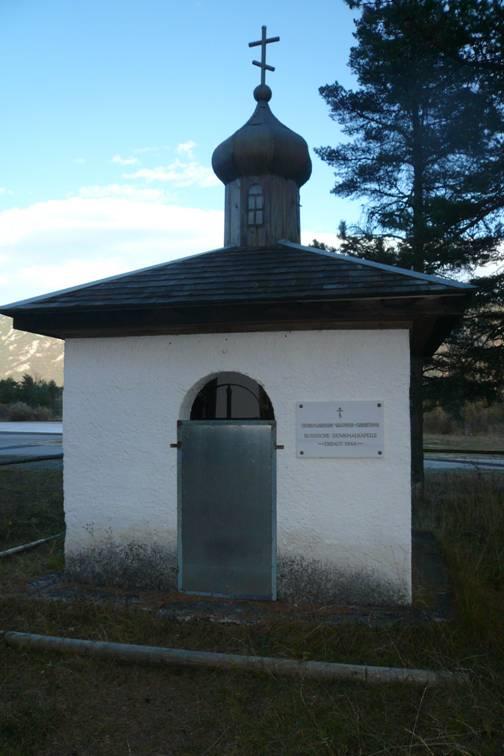
Ukrainian and Belarusian residents helped build the small Orthodox chapel that remains at the site. It was consecrated on St Nicholas’s Day in 1949, and the Mittenwald exhibition dates the consecration to December 1949. Its tent-shaped roof and small onion dome gave the camp a recognisable place of worship. The neighbouring Belarusian memorial, an obelisk erected in 1948 east of the barracks, is listed in the Bavarian monument register as a memorial to Belarusian prisoners of war, and belongs to another community’s history within the same landscape.
A family account preserved in the Mittenwald exhibition connects the chapel with everyday work and a new beginning. A Lithuanian engineer helped with its construction; he and a former forced labourer married there in 1950. The family received permission to emigrate to the United States the following year. This is one family’s route out of the camp, rather than a departure date for all residents.
Luttensee within Mittenwald
Mittenwald also served people travelling onward through a transit camp. Surviving registration cards record accommodation, clothing and food issues, medical examinations and travel arrangements. Most surviving arrivals date from April 1946 to October 1947. The archival account does not locate that transit operation precisely, so its short stays and journeys should not be treated as the experience of every Luttensee resident.
The camps were supplied as one system. At the end of 1947 the supply department of the Mittenwald assembly centre reported that it served Jägerkaserne, Pionierkaserne, Luttensee, Karwendel and two hospitals, together about 5,000 residents. The Hotel Karwendel in the town of Mittenwald was a separate camp for Jewish displaced people and should not be confused with the Karwendel-Kaserne barracks in the valley.
Distinct parts of the Mittenwald camp network
| Site | Identity |
|---|---|
| Luttensee | Residential camp in the Luttenseekaserne, about three kilometres from the town |
| Jägerkaserne | Separate residential camp, also called Nordkaserne; today the Edelweiß-Kaserne |
| Pionierkaserne | Separate residential camp, also called Südkaserne; today the Karwendel-Kaserne |
| Hotel Karwendel, Mittenwald town | Separate camp for Jewish displaced people, about 150 residents |
| Transit camp | Short-stay operation; precise location not established by the archival account |
What survives
The barracks, Orthodox chapel and Belarusian memorial are recorded in Bavaria’s monument register. The chapel underwent restoration in 1982 and 1984. A local historical visit in 2017 brought people onto the military site to see this surviving reminder of the displaced communities who had once lived there.
The site remains a Bundeswehr training area, and the accommodation buildings of the 1930s barracks still stand. In 1947 Mittenwald also hosted the first large postwar gathering of Ukrainian scouts, about 1,200 of them from the British and American zones; a jubilee meeting in 2017 retraced the route through the town and the cemetery where some camp residents are buried. That gathering belonged to the town as a whole and is not recorded as a Luttensee event.
Sources
- Mittenwald DP camp registration cards
Arolsen Archives
Institutional account distinguishing three residential camp areas and the separately documented transit operation.
- From forced labourers to displaced persons
Alois Schwarzmüller / Garmisch-Partenkirchen local history
2012 historical account with a photograph explicitly captioned Camp Luttensee, 1945.
- Mittenwald listed monuments: Luttenseekaserne
Bavarian State Office for Monument Protection
Monument D-1-80-123-146: barracks 1934–1936, Orthodox chapel 1949 and Belarusian memorial 1948.
- The hidden church of Mittenwald
Münchner Merkur
31 October 2017 report of a local historical visit; chapel builders, consecration and restoration.
- Displaced-persons camps in Mittenwald
Mittenwald historical exhibition
2019 exhibition. First panel: family recollection of chapel construction, marriage and emigration, with a photograph of the chapel captioned as consecrated in December 1949. Later panels describe the 1947 Ukrainian scout gathering in Mittenwald and the 2017 jubilee.
- Population migration after World War II, Table 7
Ihor Stebelsky, The Refugee Experience
1992, printed pages 47–51. Table 7 separates Luttensee from the Jäger and Pionier barracks and from the Mittenwald hospital. Rows re-read visually at 2.6x on 13 September 2026: Luitensee 372 (1946–7 questionnaire), 197 (31 May 1947), 863 (2 January 1948). The missing August 1946 return is not a zero.
- Yurij Kuzmycz, The Road to Camp Luttensee
Society of Former Residents of the Ukrainian Displaced Persons’ Camps in Mittenwald, Warren, Michigan · 2001
Mittenwald 1946–1951, printed page 419, read visually from the scanned volume. Eyewitness account of the journey to Luttensee, of the camp’s size and layout and of the move to Pionierkaserne.
- Ivan Rad, Cultural Activity in Camp Luttensee and Pionierkaserne
Society of Former Residents of the Ukrainian Displaced Persons’ Camps in Mittenwald, Warren, Michigan · 2001
Mittenwald 1946–1951, printed page 423, read visually. Eyewitness account of the choir, the commemorations, the lectures and the visits by the Ukrainian Bandurist Capella.
- Andrij Buk, Displaced Persons Camps: UNRRA and IRO
Society of Former Residents of the Ukrainian Displaced Persons’ Camps in Mittenwald, Warren, Michigan · 2001
Mittenwald 1946–1951, printed pages 387–388, read visually. Written by the labour director for Sub-Area Mittenwald; gives Luttensee at about 1,000 Ukrainian and Russian residents, describes its schooling and workshop, and states that all four camp figures fluctuated.
- Pidsumky: informative report of the camp administration, 1 January to 31 December 1947
Ukrainian camp Mittenwald-Jägerkaserne; digitised by the Ukrainian Museum-Archives, Cleveland, for the United States Holocaust Memorial Museum · 1948
Printed pages 19 and 30 read from the page images to correct the OCR: the Luttensee school and kindergarten returns, and the supply department’s list of the five Mittenwald sites it served, together about 5,000 residents.
- Luttenseekaserne, Am Luttensee 6
Wikimedia Commons, photograph by Pelz · 16 July 2019
Creative Commons Attribution-ShareAlike 4.0. Accommodation building of the barracks complex listed as monument D-1-80-123-146.
- Wolodymyr Sijak, Camp Pionierkaserne in Mittenwald
Society of Former Residents of the Ukrainian Displaced Persons’ Camps in Mittenwald, Warren, Michigan · 2001
Mittenwald 1946–1951, printed pages 420–422, read visually. Eyewitness account by the first elected administrator of the Ukrainian camp at Pionierkaserne; describes the Russian administration at Luttensee, the arrivals from Oberdorf and Füssen and the February 1947 transfer.
Last researched 13 September 2026