Lyssenko
Displacement in Europe
Hannover, Lower Saxony, Germany · Documented 1945–1950
In former military accommodation on Möckernstraße in Hannover, Ukrainian and Belarusian displaced people built a community of households, classrooms, a church and shared services; a scholarly account calls it the largest Ukrainian camp in the British zone. A daily camp bulletin and residents’ photographs preserve the practical details of everyday life.
Introduction
Lyssenko was a displaced persons camp on Möckernstraße in Hannover. A letter attributed to Hannover city archivist Dr Mechler, reproduced by the DP Camps research website, identifies the site as Möckernstraße 21–27. The letter describes wartime military accommodation followed by housing for former forced labourers after the war. This connects the displaced community to a particular site rather than to Hannover as a whole. Historian Jan-Hinnerk Antons connects the camp’s name with the Ukrainian composer Mykola Lysenko and describes it as the largest Ukrainian camp in the British zone and the only one with an Orthodox majority.
A history in dates
- Before October 1945The Arolsen inventory dates the camp’s opening.
- 1945The Internet Encyclopedia of Ukraine gives about 5,000 Ukrainian displaced persons in the camp.
- August or September 1945The camp bulletin begins publication; the two sources give different starting months.
- October 1945–June 1950Period covered by the resident list described by Hannover City Archives.
- 29–30 October 1946An overnight census required registered residents to remain in camp.
- December 1946Ukrainian residents appeal to UNRRA against the removal of Greek-Catholics from the camp.
- December 1946–June 1947The research page assigns DPAC number 2715 to the camp.
- January 1947Antons records the confiscation of a Ukrainian Insurgent Army donation receipt at the camp.
- Early 1947A UNRRA document records that a democratic camp election returned a Greek-Orthodox majority, settling the disputed election of 1945 to 1946.
- 12 February 1947A bulletin notice required medical certification for special rations.
- April 1947The last issue of the camp bulletin appears; a 1948 report attributes its closure to an order of the British authorities.
- April 1948–June 1949The camp carries the number 76/2716, with mostly Polish Ukrainians recorded as living there.
- 1948The Internet Encyclopedia of Ukraine gives 2,840 Ukrainian displaced persons in the camp.
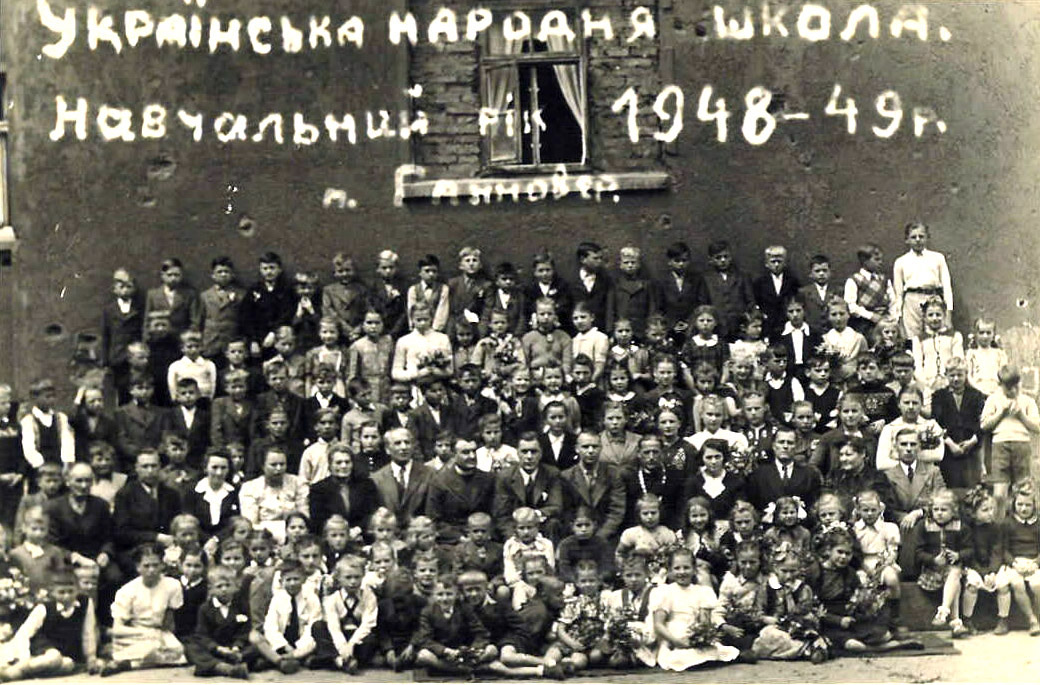
- 1948–49The Ukrainian primary school photograph records this academic year.
- June 1950German administration took over; the city archivist reports more than 3,100 residents, mostly from Ukraine and Belarus.
Sources for this section
- DP camp inventory: DP-Camp “Lyssenko”, Hannover
- Hannover
- Iryna Rybachok, The M. Lysenko camp bulletin as a source for studying displaced Ukrainians’ everyday conditions
- Yury Boshyk and Boris Balan, Political Refugees and ‘Displaced Persons’, 1945–1954: A Selected Bibliography and Guide to Research
- Lyssenko camp research collection
- Julia Lalande, Building a Home Abroad: a comparative study of Ukrainian migration, immigration policy and diaspora formation in Canada and Germany after the Second World War
- Jan-Hinnerk Antons, Ukrainian Displaced Persons in the British Zone: Nation Building in a Nutshell
Names and administrative numbers
The camp appears under several names and numbers, and the sources do not agree. The research page assigns it DPAC number 2715 from December 1946 to June 1947, DPACS number 14/76/96/2715 from May 1947 to March 1948, and 76/2716 from April 1948 to June 1949, and says that mostly Polish Ukrainians lived there in the last of those periods. The Hannover city archivist’s letter refers to the place as DP camp 36/4 Möckernstraße and notes that the building at number 27 was called Lyssenko Camp and, in another source, 76 D.P.A.C.S.; residents record 36/4 on a baptismal certificate and a garbled form of Möckernstraße on a birth certificate. The Arolsen Archives inventory records the camp under AC 2716, Teams 246 and 252, opening before October 1945, with Polish, Polish-Ukrainian, Russian, Ukrainian and stateless residents, and gives no capacity and no closing date. The same inventory assigns AC 2715 to Rittergut Burgweg, a different Hannover camp. These numbers should not be treated as a single sequence.
Names and administrative numbers recorded for the camp
| Designation | Period or context | Source |
|---|---|---|
| DPAC 2715 | December 1946 – June 1947 | dpcamps research page |
| DPACS 14/76/96/2715 | May 1947 – March 1948 | dpcamps research page |
| 76/2716 | April 1948 – June 1949 | dpcamps research page |
| AC 2716, Teams 246 and 252 | No period given | Arolsen inventory, record 245 |
| DP camp 36/4 Möckernstraße | Used in city-archive correspondence and on a resident’s baptismal certificate | Hannover City Archives letter, reproduced |
| 76 D.P.A.C.S. | Alternative name for Möckernstraße 27 | Hannover City Archives letter, reproduced |
Sources for this section
A community still present in 1950
The reproduced archive letter reports more than 3,100 residents in early June 1950, predominantly from Ukraine and Belarus. This is a figure for the camp’s population, not a Ukrainian-only count. The letter also describes a resident list covering October 1945 to June 1950 and states that all displaced-persons camps were under British military government until German administration took over in June 1950. The coverage of the list helps locate records; it does not by itself establish the camp’s exact opening or closing dates, and the June 1949 end of the 76/2716 numbering is an administrative date rather than a closure.
A reference-work entry supplies two earlier figures. The Internet Encyclopedia of Ukraine states that about 5,000 Ukrainian displaced persons were housed in the Mykola Lysenko camp in 1945 and 2,840 in 1948, and that Hannover and its vicinity held the largest concentration of Ukrainians in northern Germany between 1945 and 1949. Those are counts of Ukrainians, where the archive letter counts the whole camp; Lalande, writing of the same camp, calls it the biggest Ukrainian camp in the British zone, with more than 3,000 people.
Population evidence
| Date | Reported population | Scope |
|---|---|---|
| Early June 1950 | More than 3,100 | Whole camp; predominantly people from Ukraine and Belarus |
Population figures for the camp in different sources
| Date | Figure | What is counted | Source |
|---|---|---|---|
| 1945 | About 5,000 | Ukrainian displaced persons housed in the camp | Internet Encyclopedia of Ukraine |
| 1948 | 2,840 | Ukrainian displaced persons housed in the camp | Internet Encyclopedia of Ukraine |
| Undated | More than 3,000 | People in the camp, called the biggest Ukrainian camp in the British zone | Lalande |
| Early June 1950 | More than 3,100 | Residents, predominantly from Ukraine and Belarus | Letter attributed to Hannover City Archives |
The camp bulletin and the camp press
The camp administration circulated a daily, duplicated bulletin carrying orders, news and notices. Iryna Rybachok’s study of surviving issues describes it as published in Hannover from August 1945 to April 1947, produced by cyclostyle, intended to inform residents systematically about the camp administration’s work, and made up of documentary, chronological and personal material. The Boshyk and Balan bibliography dates the first issue to September 1945 and the last to April 1947, and records holdings at Oseredok in Winnipeg and at the Symon Petliura Library in Paris; the two accounts of the starting month have not been reconciled against the original issues.
Rybachok shows how the publication organised ordinary life: food distribution, medical appointments, registration and screening, cultural events and schooling. A standing announcements column carried notices of concerts, choirs, theatre and literary evenings, of courses and schools, of church services and visits by church hierarchs, of public organisations and political circles, and of practical matters such as the distribution of relief goods. She records that the camp also published a magazine, Ukraina i svit, edited by I. Sapiha, and that the newspaper Ukrainski visti reported in 1948 that the bulletin had been closed by order of the British authorities.
Food, work and medical care
Residents received separate food cards for children, working adults and non-working adults, and failure to turn up for work without good reason meant the loss of a food card; the sick could receive extra rations or items outside the ordinary ration, such as milk. A notice dated 12 February 1947 required a camp doctor’s certificate before the food department could issue rations. Cigarettes, coffee and chocolate counted as luxuries and were bartered: working men and women over 18 and students in higher schools received 20 American cigarettes, children under 18 a bar of chocolate, sick and disabled people and men over 60 twenty cigarettes, women unable to work ten, and men not working none. A camp doctor gave first aid, set hours were reserved for camp residents at a named Hannover hospital, and consultations with a gynaecologist or surgeon meant travelling to Stafford camp.
Registration, screening and emigration
For the overnight census of 29–30 October 1946, an order issued on the instruction of UNRRA Team 252 and the military government required all registered residents to remain in camp from six in the evening until the following morning, including those permitted to live outside it. Anyone absent lost displaced-person status and was struck off the ration list, and the bulletin noted that a census of the whole of Germany would follow on 30 October. Screening for displaced-person status was a recurring anxiety, since it could remove that status altogether.
Rybachok also records what emigration required: a work and accommodation certificate registered with the DP commission, two English-language copies of a birth certificate, originals and notarised English translations of a certificate of good conduct, a certificate of trade qualification, seven photographs, documents accounting for the applicant’s time in Germany, and a strict medical examination. Receiving countries wanted physically fit migrants, so older people, disabled people, women and children found permission harder to obtain, and families could be separated for years. Supplies followed a collective system: donated goods other than working clothes and boots were divided between residential blocks according to population, while 51 kilograms of leather went to the cobblers’ workshop, first of all for repairs.
School, home and church
A school photograph carries its own date: the academic year 1948–49. Children and adults pose outside a brick building beneath a handwritten Ukrainian inscription identifying the Ukrainian primary school. The former pupil who shared the photograph identified himself in the third row and recalled that his sister taught at the school. His recollection that teaching began around 1946 is approximate; the photograph directly documents the later school year.
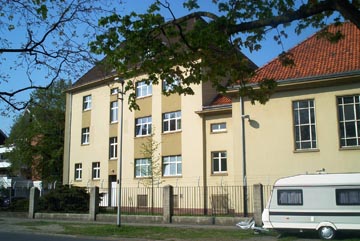
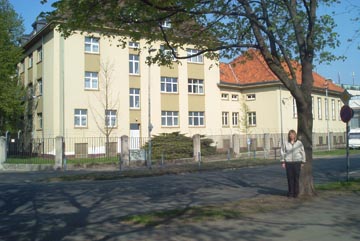
He remembered a large family household in the south-eastern corner of the camp, with orchards across the road and a small shop where he bought sweets and soft drinks, still standing today as a day-care centre. On a later visit he photographed the apartment building and the lower annex beside it, which he recalled had been a gymnasium before becoming a Ukrainian church around 1947, where his father served as a deacon. Another contributor records that St Joseph’s church on Isernhagener Straße was used after the war by the Ukrainian Greek Catholic Church, and that children of the camp were born at the provincial women’s hospital at 5 Herrenhäuser Kirchweg. These accounts place religious life and birth records close to the rooms where residents lived.
Recollections also reach beyond the camp boundary: walks beside the canal and swimming pools, and swimming at Silbersee lake, where many from the camp went. A maple tree and plaque were planted at the site in August 2007 in memory of a resident who disappeared in 1948.
The Internet Encyclopedia of Ukraine describes the camp as the centre of Ukrainian organisations in the British occupation zone and lists its institutions: a nursery, an elementary school, a gymnasium and a technical school, together with various cultural groups and civic organisations. The entry gives no dates for any of them.
Sources for this section
Politics and archives
Antons’s study places the camp in the politics of the British zone: he records that the Lysenko camp was almost split apart by internal quarrels, that a Ukrainian Insurgent Army donation receipt was confiscated there in January 1947, and that the UNRRA director reported activity by an underground Ukrainian movement in the camp. Records survive to test such accounts. The Boshyk and Balan guide notes that the original inventories of the Lysenko camp archive are held at Oseredok, the Ukrainian Cultural and Educational Centre in Winnipeg, together with camp papers containing records of cultural and educational work, minutes, correspondence, resettlement records and nominal rolls. The city archivist’s letter points to the Lower Saxony state archives and to British records.
Lalande’s dissertation adds documented episodes to the camp’s internal politics. She quotes an appeal made to UNRRA by Ukrainian residents in December 1946 against the removal of Greek-Catholics from the camp, which declared: “we Greek-Catholics and Orthodox, members of one nation, lived one with another in concord and peace and are doing the same now.” A UNRRA document she quotes records that “the election carried out in 1945-46 had been on a limited basis with the result that the Greek Catholics (Polish Galician element) had a disproportionate share of authority”, that the matter was settled in early 1947, and that a democratic election returned a Greek-Orthodox majority. She also quotes a relief worker who spent the best part of a year persuading the camp’s artists to put on lighter performances rather than always presenting the same national songs and dances.
Sources for this section
- Lyssenko camp research collection
- Jan-Hinnerk Antons, Ukrainian Displaced Persons in the British Zone: Nation Building in a Nutshell
- Yury Boshyk and Boris Balan, Political Refugees and ‘Displaced Persons’, 1945–1954: A Selected Bibliography and Guide to Research
- Julia Lalande, Building a Home Abroad: a comparative study of Ukrainian migration, immigration policy and diaspora formation in Canada and Germany after the Second World War
Sources
- Lyssenko camp research collection
dpcamps.org, Michigan Family History Network · Undated
Full page re-read 13 September 2026: camp numbering, the reproduced letter attributed to Dr Mechler of the Hannover City Archives dated 6 July 2003, and contributions from former residents on the school, the church annex, St Joseph’s church on Isernhagener Straße, the provincial women’s hospital and the 2007 memorial tree. The original archive letter has not been inspected and the residents’ dates are given by them as approximate.
- Jan-Hinnerk Antons, Ukrainian Displaced Persons in the British Zone: Nation Building in a Nutshell
Harvard Ukrainian Studies 37, nos 1-2 · Undated
Relevant scholarly passages previously read: camp named after the composer Mykola Lysenko; the largest Ukrainian camp in the British zone and the only one with an Orthodox majority; internal quarrels that almost split it; a UPA donation receipt confiscated there in January 1947 and an UNRRA report of underground activity.
- Iryna Rybachok, The M. Lysenko camp bulletin as a source for studying displaced Ukrainians’ everyday conditions
Ukrainian Diaspora: Problems of Research, international conference proceedings, Ostroh · 2016
Conference proceedings, printed pp. 295-300; all six pages read and re-read 13 September 2026. Bulletin published daily at Hannover from August 1945 to April 1947 by cyclostyle; food cards, cigarette allocations, medical arrangements, the October 1946 census order, emigration paperwork, distribution of relief goods and the announcements column; the camp magazine Ukraina i svit edited by I. Sapiha; closure of the bulletin by order of the British authorities as reported in Ukrainski visti no. 30 (182), 1948. The original bulletin issues have not been inspected.
- DP camp inventory: DP-Camp “Lyssenko”, Hannover
Arolsen Archives · 2023-10-26
Record 245: AC 2716, Teams 246 and 252, British zone, opening ‘before October 1945’, no closing date and no capacity; nationalities Polish, Polish-Ukrainian, Russian, Ukrainian and stateless. Archive reference: ITS strength and change reports for Hannover, document IDs 81989460-81989663. Record 238 in the same inventory assigns AC 2715 to Rittergut Burgweg, a different Hannover camp.
- Yury Boshyk and Boris Balan, Political Refugees and ‘Displaced Persons’, 1945–1954: A Selected Bibliography and Guide to Research
Canadian Institute of Ukrainian Studies, University of Alberta, Research Report No. 2 · 1982
Read 13 September 2026. Lists the Biuleten taboru imeny M. Lysenka, Hannover, daily, first issue September 1945 and last issue April 1947, with holdings at Oseredok and the Symon Petliura Library; records the original inventories of the Lysenko camp archive and camp papers at Oseredok, Winnipeg. Other Hannover imprints listed there are attributed to the city, not to this camp.
- Hannover
Internet Encyclopedia of Ukraine, Canadian Institute of Ukrainian Studies · 1988
Single-paragraph entry read in full. It gives about 5,000 Ukrainian displaced persons in the Mykola Lysenko camp in 1945 and 2,840 in 1948, describes Hannover and its vicinity as holding the largest concentration of Ukrainians in northern Germany between 1945 and 1949, and lists the camp's nursery, elementary school, gymnasium, technical school and cultural and civic organisations.
- Julia Lalande, Building a Home Abroad: a comparative study of Ukrainian migration, immigration policy and diaspora formation in Canada and Germany after the Second World War
Universität Hamburg dissertation · 2006
Printed pages 51 to 52, 65, 76 and 84 read. They describe Lyssenko as the largest Ukrainian camp in the British zone with more than 3,000 people, quote a December 1946 residents' appeal to UNRRA against the removal of Greek-Catholics, quote a UNRRA account of the disputed camp elections of 1945 to 1946 and their settlement in early 1947, and quote a relief worker on the camp's performers.
Last researched 13 September 2026