Maierhof-Kaserne
Displacement in Europe
Passau · Germany · 1945–1949
Barracks beside the Inn at Passau became a displaced-persons centre registered from January 1946 to April 1949, with Ukrainians among a mixed population of seven recorded nationalities. The buildings later housed a student community before their demolition in 1995.
Introduction
Maierhof-Kaserne stood on the Innstrasse in Passau, by the site of the present university sports centre. The camp inventory spells its name Meierhof and records Ukrainians among a mixed population that also included Latvian, Lithuanian, Polish, Yugoslav, Russian and Jewish residents. It was one of several separate accommodation centres in a city that the city archive describes as overwhelmed by movement in both directions.
Sources for this section
A history in dates
- 1893The first barracks accommodation and service buildings are completed.
- March 1919The troop barracks pass to Passau’s municipal administration.
- 25 April 1945About 200 to 300 Russian prisoners of war are held at the barracks.
- May 1945The university archive dates the beginning of postwar refugee accommodation.
- 27 August 1945The military government hands refugee affairs to the city administration.
- 24 January 1946Registered opening of the DP centre as AC 93-253 under UNRRA Team 143.
- 31 October 1947Recorded capacity of 600.
- 3 April 1949Registered closure of the DP centre.
- Late 1970sStudents begin living in the former barracks.
- 1995The former buildings are demolished after protests against clearance.
A barracks courtyard beside the river
The complex began in 1893 with two accommodation buildings, an exercise hall and kitchen and latrine buildings; by October that year it held two companies of 320 men, and further companies arrived in 1895. Bathing facilities were poor until improvements in 1894 and 1910, before which soldiers could wash at the Nikolakloster bath house only about every ten days.
In March 1919 the troop barracks passed to the municipal administration of Passau. By 1930 an officers’ housing block at Innstraße 51 to 55 closed off the courtyard, a vehicle store followed in 1934, and from 1935 the reintroduction of conscription brought Wehrmacht recruiting and district command offices onto the site. A separate machine-gun barracks, built west of the main complex from 1913 for 94 soldiers, is an adjoining site and not part of this centre.
Sources for this section
Accommodation after the war
On 25 April 1945 about 200 to 300 Russian prisoners of war were held at the barracks, and a shell strike killed the commanding officer, Colonel Georg Becher, and prevented a partial surrender. American forces requisitioned the site at the end of the war.
The city archive lists Maierhof among the several camps holding foreigners in Passau in the summer of 1945, alongside Bschütt, and names the Maierhofkaserne in its own list of the city’s foreigners’ camps together with the Waldwerke camp, the Loher und Söhne works camp and the Niedermayergarten. Responsibility for refugee affairs passed from the military government to the city administration on 27 August 1945, and at the end of September 1945 the number of refugees in the city and district rose from 17,000 to 28,000 within a fortnight.
The university archive dates the site’s use as refugee accommodation, chiefly for displaced people, from May 1945 to March 1949, and gives an average of approximately 1,500 people across that period. The administrative inventory records a capacity of 600 for the identified DP centre at 31 October 1947. The two measures are not comparable and the sources do not establish that they cover exactly the same premises.
Two differently defined accommodation figures
| Source | Figure | Measure |
|---|---|---|
| University archive, May 1945–March 1949 | Approximately 1,500 | Average number in its account of refugee accommodation |
| Camp inventory, 31 October 1947 | 600 | Recorded DP-centre capacity |
Sources for this section
The administrative record
The centre is registered as opening on 24 January 1946 and closing on 3 April 1949, under UNRRA Team 143 at Passau, with Hoguo recorded as team director from January 1946 and Cockroll as field supervisor. From November 1946 it fell under the Passau area team AT 1047 within the Amberg area A 4. Its assembly-centre number was AC 93-253, which became NBO 409 from September 1948.
The inventory’s archive note lists holdings and change reports for Passau in the Arolsen collection, reports on displaced persons from the district administration held at the Staatsarchiv Landshut, three refugee files at the Stadtarchiv Passau, and the existence of a photograph collection. Those Passau-wide holdings cover several centres and should not be read as records of this one.
Three other Passau centres held Ukrainians at the same time and are separately registered: the Bayrischer Löwe, closed in the winter of 1946 to 1947; the Donau camp, with a capacity of 445, closed on 17 March 1949; and the Innenstadt centre, with a capacity of 130, closed before 18 October 1948. Their figures belong to them and not to Maierhof.
Registration of the Passau centres holding Ukrainians
| Centre | Opened | Closed | Assembly centre | Capacity at 31 October 1947 |
|---|---|---|---|---|
| Meierhof-Kaserne | 24 January 1946 | 3 April 1949 | AC 93-253, later NBO 409 | 600 |
| Bayrischer Löwe | 24 January 1946 | Between 20 December 1946 and 20 February 1947 | AC 93-278 | not recorded |
| Donau camp | 24 January 1946 | 17 March 1949 | AC 93-359 and AC 93-357, later NBO 411 | 445 |
| Innenstadt | 24 January 1946 | Before 18 October 1948 | AC 93-354, later NBO 410 | 130 |
Sources for this section
Ukrainians at Passau
Stebelsky’s table of Ukrainians in the camps of the American zone enters Passau under the city name. It gives 600 from questionnaire returns collected during 1946 and 1947, 508 in the UNRRA summary of 24 August 1946, 217 in the UNRRA summary of 31 May 1947 and 121 in the summary compiled for the Preparatory Commission of the International Refugee Organisation on 2 January 1948. Because Passau had four registered centres holding Ukrainians, these are city totals and not counts for Maierhof.
The steep fall between August 1946 and December 1947 shows how quickly the Ukrainian population of the city thinned as centres closed and people moved on. It does not show when Ukrainians left this particular barracks.
The Munich almanac of the Ukrainian Council for Physical Culture records that a Ukrainian sports section existed in the mixed camp at Passau during 1945 and 1946, without formal organisation, and that it came last of ten at the zonal men’s volleyball tournament in 1946. A Ukrainian sports society at Passau is also listed among the clubs of the Regensburg area. The almanac does not say which of the city’s centres it means, and Maierhof was not the only mixed one.
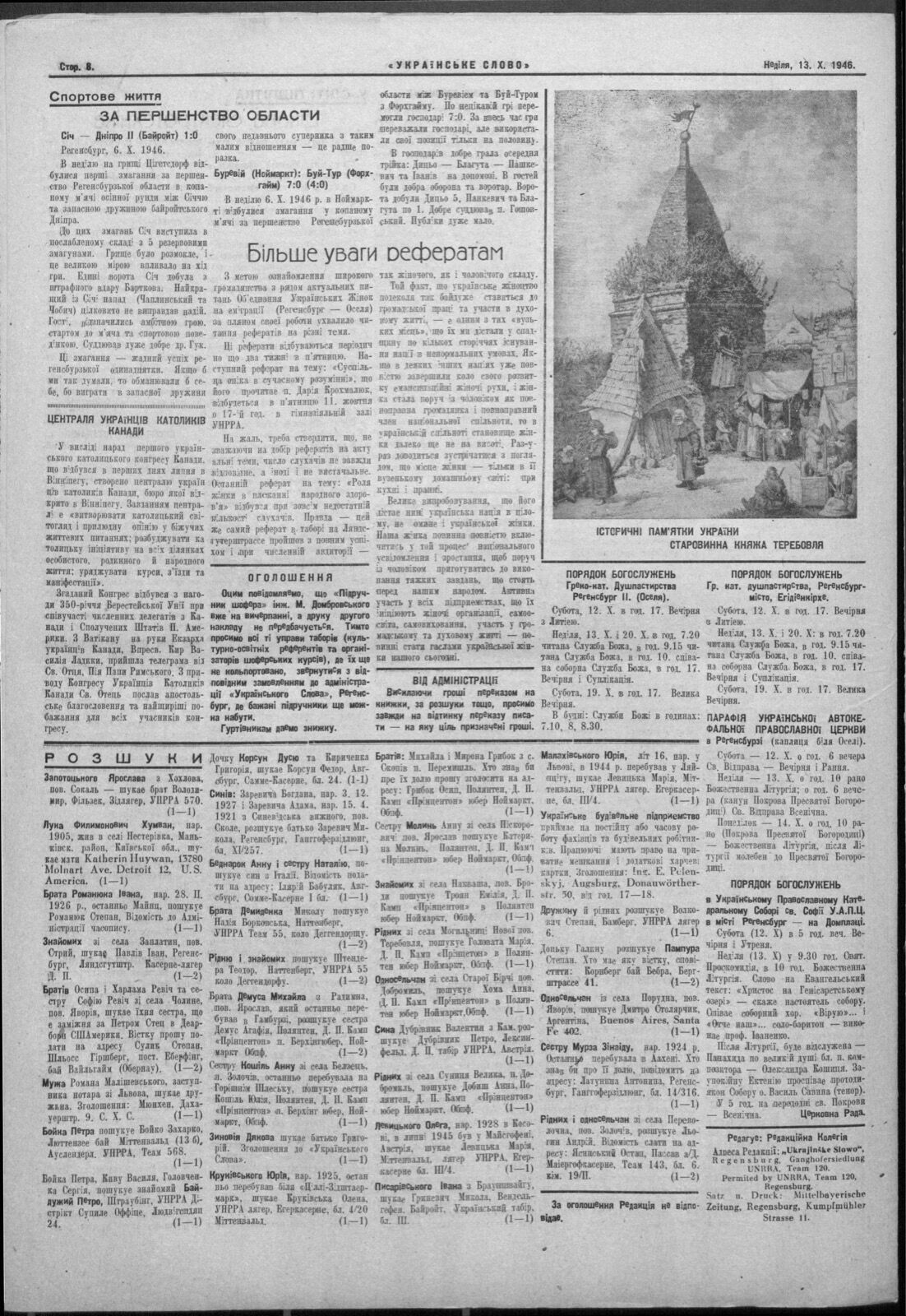
One contemporary notice puts a name and a room number to the barracks. In the searches column of the Regensburg weekly Ukrainske slovo for 13 October 1946, a man looking for relatives and fellow villagers from Perevolochna in the Zolochiv district asked that word be sent to a return address at Passau on the Danube, Maierhofkaserne, Team 143, block 6, room 19/II. The team number is the one the inventory records for this centre, so the notice ties a Ukrainian resident directly to these barracks rather than to Passau in general, and shows the block and room divisions in use there in the autumn of 1946.
Ukrainians counted at Passau, by return
| Return | Ukrainians |
|---|---|
| Questionnaires collected during 1946 and 1947 | 600 |
| UNRRA summary, 24 August 1946 | 508 |
| UNRRA summary, 31 May 1947 | 217 |
| PCIRO summary compiled 2 January 1948 | 121 |
A second Maierhof
The city archive also describes a barrack camp called Maierhof in the parish of Hacklberg, which the district refugee officer came upon in September 1948 and which had apparently been unknown to the responsible authorities. Its barracks held 82 people in roofs with holes and walls with finger-wide gaps, and after rebuilding they were occupied as 20 dwellings by 89 people. This was German refugee accommodation on a different site and should not be confused with the Maierhof barracks on the Inn.
Sources for this section
Student housing and demolition
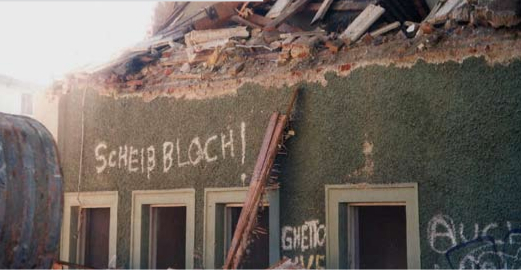
In the late 1970s students moved into the unrenovated buildings. Cheap accommodation developed into a small community also used by university employees. The university museum describes this as an interim use: the land had already been earmarked for sports facilities. Campaigners collected 2,000 signatures against demolition in 1985, but the buildings were demolished in 1995. Photographs of this later phase preserve part of the former camp’s physical setting.
Sources for this section
Sources
- Maierhofkaserne und MG-Kaserne
University of Passau Archive
University institutional history: barracks construction and DP accommodation from May 1945 to March 1949. On the requisition: “Die Teilkapitulation wurde verhindert und die Kaserne mit der Gesamtkapitulation Passaus von den US-Truppen beschlagnahmt.”
- Das Studenten-Ghetto
Digital University Museum Passau
Later student housing and demolition history, with original photographs reproduced from UniMagazin 04/2008.
- DP camp inventory: Meierhof-Kaserne
Arolsen Archives
Record 1361: mixed population including Ukrainians, AC 93-253, NBO 409, Team 143, capacity 600 and administrative closure 3 April 1949.
- Flüchtlingslager in Passau
Stadtarchiv Passau · Undated compilation
City archive compilation of the city’s refugee and foreigners’ camps, drawing on SAP C 321. Names Maierhof among the camps holding foreigners in summer 1945 and the Maierhofkaserne in its list of foreigners’ camps, and separately describes the Hacklberg-Maierhof barrack camp of 1948.
- Ihor Stebelsky, Table 8: Ukrainians in the UNRRA or IRO camps of the United States zone
Ukrainskyi Istoryk 3 · 1986
Printed pages 53 and 56: column definitions and the Passau row, read by word co-ordinates and confirmed against the rendered page image. The row is a city total.
- Dzerkalo sportovykh tovarystv, in Almanakh Rady Fizychnoi Kultury 1945-1948
Molode Zhyttia, Munich · 1951
Printed pages 22 and 84 read from the original scan with Ukrainian optical character recognition and checked against the page images. Entry 52 covers the sports section in the mixed camp at Passau.
- Rozshuky (Searches), Ukrainske slovo, Sunday 13 October 1946, page 8
Ukrainske slovo, Regensburg · 13 October 1946
Digitised by the Ukrainian Museum-Archives of Cleveland with the United States Holocaust Memorial Museum in the Displaced Persons Camp Periodicals Collection; marked public domain or an orphan work and offered under Creative Commons Attribution-NonCommercial-NoDerivatives 4.0. A column of notices from people searching for relatives, one of them giving a return address at the Maierhofkaserne in Passau under Team 143.
Last researched 12 September 2026