Mainleus
Displacement in Europe
Mainleus · Germany · 1946–1948
A mixed camp near Kulmbach connected refugee art, relief accommodation and the uncertain transition into civilian life. Its Ukrainian population fell from 461 in August 1946 to 22 in May 1947, and almost nothing of its local history has been published.
Introduction
Mainleus, near Kulmbach in northern Bavaria, accommodated a mixed displaced persons community after the war. Ukrainians lived alongside Polish, Jewish, Russian and Yugoslav residents. The surviving record reaches beyond registration: an original art catalogue preserves the work of a Ukrainian camp cultural organiser, while a contemporary Polish account describes the uneasy transition from military captivity into civilian relief accommodation.
A history in dates
- 24 January 1946The inventory begins its record of Mainleus DP camp under UNRRA Team 559.
- 1 August 1946A published account describes former Polish prisoners of war arriving at Mainleus.
- 24 August 1946An UNRRA summary credits Kulmbach (Mainleus) with 461 Ukrainians.
- November 1946The camp passes to Area Team 1044 at Bayreuth.
- 31 May 1947The next UNRRA summary records 22 Ukrainians.
- 1947Mainleus appears among contributors to a Belarusian student-support fund.
- 17 October 1947The separately listed Children Nutrition Center opens.
- 31 October 1947The camp’s recorded accommodation capacity is 970.
- September 1948The assembly-centre number changes from AC 92-296 A to OMF 317.
- 20 December 1948The main camp’s inventory record ends.
- 31 March 1949The children’s centre’s inventory record ends.
Arriving as civilians
A report published in August 1946 describes three companies leaving the closing Polish former-prisoner-of-war centre at Langwasser. They expected military quarters near Bayreuth, but after more than ten hours travelling reached Mainleus and were met by UNRRA. Being told that they were entering a civilian DP camp caused anxiety about their status and uniforms.
American officers and a Polish military mission became involved. Candidates for guard companies and transport columns were registered, but the men described weeks of waiting for decisions. The account records frustration with local relief officials and complaints about access to the telephone. It also says the men carried out work for the camp. Published amid arguments over repatriation, it gives the newcomers’ perspective on an uncertain transition.
Sources for this section
What the camp record holds
The inventory runs the camp from 24 January 1946 to 20 December 1948. It sat in District 3 of the American zone under UNRRA Team 559 at Kulmbach, with a team director recorded from the opening date, and from November 1946 under Area Team 1044 at Bayreuth within Area 3, Würzburg. Its assembly-centre number was AC 92-296 A, replaced by OMF 317 from September 1948. The recorded capacity on 31 October 1947 was 970, and the nationality field lists Polish, Ukrainian, Jewish, Russian and Yugoslav residents without giving proportions.
The published Ukrainian returns show how quickly that mixture changed. Kulmbach (Mainleus) is credited with 461 Ukrainians in the UNRRA summary of 24 August 1946 and 22 in the summary of 31 May 1947. The table gives no figure for the questionnaire returns of 1946 and 1947 and none for December 1947, so the two numbers describe two reporting dates rather than a continuous series. They do show the Ukrainian community leaving within a year, while the camp itself ran for another eighteen months.
Ukrainians recorded at Kulmbach (Mainleus)
| Reporting date | Source of the count | Ukrainians |
|---|---|---|
| 1946–7 questionnaire returns | Central Representation of the Ukrainian Emigration | Not recorded |
| 24 August 1946 | UNRRA summary of DP population, US zone | 461 |
| 31 May 1947 | UNRRA summary of DP population, US zone | 22 |
| 2 January 1948 | PCIRO summary of DP population, US zone | Not recorded |
Making art in displacement
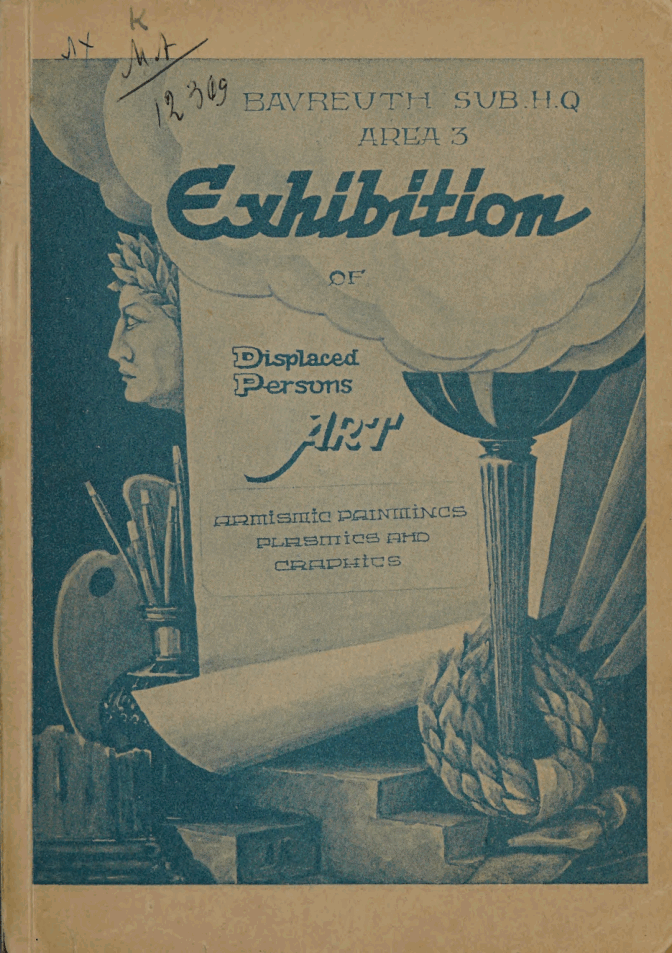
A Ukrainian artist served as Mainleus’s cultural leader and designed the cover of Art of Displaced Persons and Refugees. His work ranged across watercolour, oil, charcoal and sculpture. Among the exhibited subjects were a bandura player, Bavarian townscapes and the Mainleus Nutritional Center. The catalogue presents his ambition to rebuild a professional artistic life overseas.
The exhibition brought together displaced artists of different nationalities from the wider region. Its organisers described shortages of paper, canvas, brushes and colours; some artists improvised with sacks and other available materials. Watercolours predominated because they were easier to obtain. Mainleus’s contribution therefore belonged to a wider effort to make refugee creativity visible beyond the camps.
Mainleus in the original art catalogue
| Item | Connection |
|---|---|
| Catalogue cover | Designed by the camp’s Ukrainian cultural organiser |
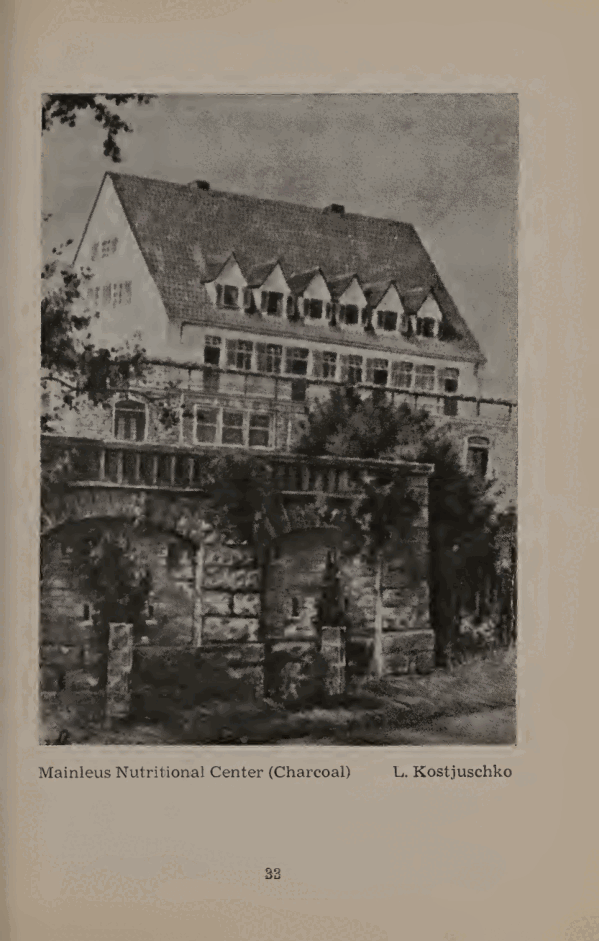
| Plate 33 | Charcoal drawing of Mainleus Nutritional Center |
| Artist biography | Identifies the Mainleus camp cultural role |
Sources for this section
Relief and community connections
The main camp was linked to Team 559 at Kulmbach and Area Team 1044 at Bayreuth. Its October 1947 recorded capacity was 970. A separate Mainleus Children Nutrition Center, opened on 17 October 1947 and closed on 31 March 1949, had a capacity of 90; those figures describe two inventory entries and should not be added into a supposed Ukrainian population total.
Mainleus also contributed to a wider Belarusian student-support network. A 1947 report names the community among donors helping displaced students remain at university. The published total combines many camps, organisations and private contributions; no separate Mainleus donation is given.
A wiki compilation on scouting in displaced-persons camps lists Mainleus among the American-zone camps that had Russian Boy Scout troops. The entry gives no date, unit name or troop size, and cites no source for the statement.
Two Mainleus relief institutions
| Institution | Inventory opening | Capacity, 31 October 1947 | Inventory closing | Assembly-centre numbers |
|---|---|---|---|---|
| Mainleus DP camp | 24 January 1946 | 970 | 20 December 1948 | AC 92-296 A, then OMF 317 |
| Children Nutrition Center | 17 October 1947 | 90 | 31 March 1949 | AC 92-296 A, then OMF 371 |
Two institutions, different dates
The general DP camp’s inventory record ends on 20 December 1948. The separately listed children’s centre continued in the inventory until 31 March 1949, and the two entries carry different later numbers, OMF 317 and OMF 371. The distinction matters: the drawing of the nutrition centre is an authentic local relief-site image, but it does not establish the location or appearance of every building used by the larger DP camp.
Beyond these records very little has been published about Mainleus itself. The market town’s own history, which covers the spinning mill established there in 1908 and the workers’ colony built beside it, says nothing about the years 1945 to 1949. No local chronicle, archive description or photograph has been found that identifies the buildings the camp used, names its Ukrainian institutions or explains where its residents went.
Sources
- Mainleus DP camp, inventory entry 1199
Arolsen Archives · 26 October 2023
Record 1199: 24 January 1946 to 20 December 1948; District 3; AC 92-296 A, later OMF 317 from September 1948; UNRRA Team 559 Kulmbach with a team director from the opening date; Area Team 1044 Bayreuth from November 1946 in Area 3 Würzburg; capacity 970 on 31 October 1947; nationalities Polish, Ukrainian, Jewish, Russian and Yugoslav. Record 1198, the Children Nutrition Center, is separate: 17 October 1947 to 31 March 1949, capacity 90, later number OMF 371. Archive reference: ITS running strength and change reports for Mainleus, Dok-ID 82012026-82012070.
- Art of Displaced Persons and Refugees
PCIRO Bayreuth exhibition catalogue · Postwar
Original catalogue: cover credited to Camp Mainleus; plate 33 depicts Mainleus Nutritional Center; biography XVIII identifies the Ukrainian cultural leader at Mainleus. The preface concerns the regional exhibition.
- UNRRA i wojsko w Mainleus
Repatriant, no. 27 (34), p. 3 · 1 August 1946
Contemporary reprint of a Polish military account from Pismo Żołnierza; original page and full indexed passage read. Newspaper promotes repatriation; complaints attributed rather than adopted as neutral administrative verdict.
- Belarusians in camps for displaced persons in West Germany in 1945–1952
Anastasiya Ilyina / Warsaw East European Review · 2022
Page 97 lists Mainleus among communities supporting a Belarusian student fund. No individual town amount is given.
- The Refugee Experience, Table 7: Ukrainians in UNRRA and IRO camps of the American zone of Germany
Ihor Stebelsky; Canadian Institute of Ukrainian Studies Press · 1992
Printed pages 47–51: headers p. 47, the Bavaria row on p. 49, source notes p. 51. Columns 1946–7, August 1946, May 1947 and December 1947, assigned by position in the scan. The row “Kulmbach (Mainleus)” carries 461 in the August 1946 column and 22 in the May 1947 column, with the other two columns blank. Column footnotes identify the UNRRA summaries of 24 August 1946 and 31 May 1947.
- Geschichte von Markt Mainleus
Markt Mainleus · Accessed 13 September 2026
The market town’s own published history, read in full. It covers the Kulmbach spinning mill’s branch from 1908 and the Hornschuchshausen workers’ colony, and carries nothing on 1945 to 1949 or on the displaced-persons camp.
- Scouting and Guiding in displaced persons camps
ScoutWiki, article imported from Wikipedia · Undated; read 14 September 2026
Tertiary wiki compilation. The list of American-zone camps under the ‘Germany’ heading carries a single entry for Mainleus recording Russian Boy Scout troops; the entry gives no date, unit name or size and cites no source.
Last researched 13 September 2026