Mainz-Kastel
Displacement in Europe
Wiesbaden · Germany · Documented 1945–1949
Schools, a cooperative and a camp newspaper sustained a large Ukrainian community in the Goltz barracks beside the Rhine, in an assembly centre the American zone numbered 579.
Introduction
Mainz-Kastel was one of the largest Ukrainian displaced-persons communities in Hesse. In the former Goltz barracks, residents sustained schools, two parishes and a camp newspaper while considering routes out of postwar Germany. Ukrainian population records place nearly 1,800 people here in the 1946–1947 survey period.
The barracks had a longer displaced-persons history than the Ukrainian community alone. Jewish survivors were quartered there in 1945; the American zone’s assembly-centre register carried the site until the autumn of 1948, with a recorded capacity of 1,750 and its own UNRRA team.
A history in dates
- 1860The Von-der-Goltz and Wilhelms barracks are built at Kastel.
- 1945DP Camp No. 712 in the Goltz barracks houses about 400 Jewish displaced persons.
- 1945The Rhine becomes a zone boundary: Mainz is French-administered while Kastel, on the east bank, falls in the American zone and is attached to Wiesbaden.
- 1946–1947Ukrainian questionnaires record a community of 1,797.
- October to December 1946The Gersdorff-Kaserne camp across the river, which had Polish, Baltic and Ukrainian residents, closes.
- 4 October 1946A “shock” collection for Ukrainian students in the camp raises 5,298 marks, part of 10,491 marks raised by the campaign in all.
- 2 January 1947The camp council forms a Resettlement Administration.
- May 1947The Ukrainian population return records 1,573.
- 30 June 1947After the takeover of the camp administration from UNRRA, the elected camp council adopts the camp’s first monthly budget, for July.
- July 1947Camp 579 takes part in a cleaning campaign and receives a commendation.
- 16 July 1947The Resettlement Administration resolves to dissolve and to hand its competences to the camp command.
- 25 August 1947The first issue of Taborovi visti appears.
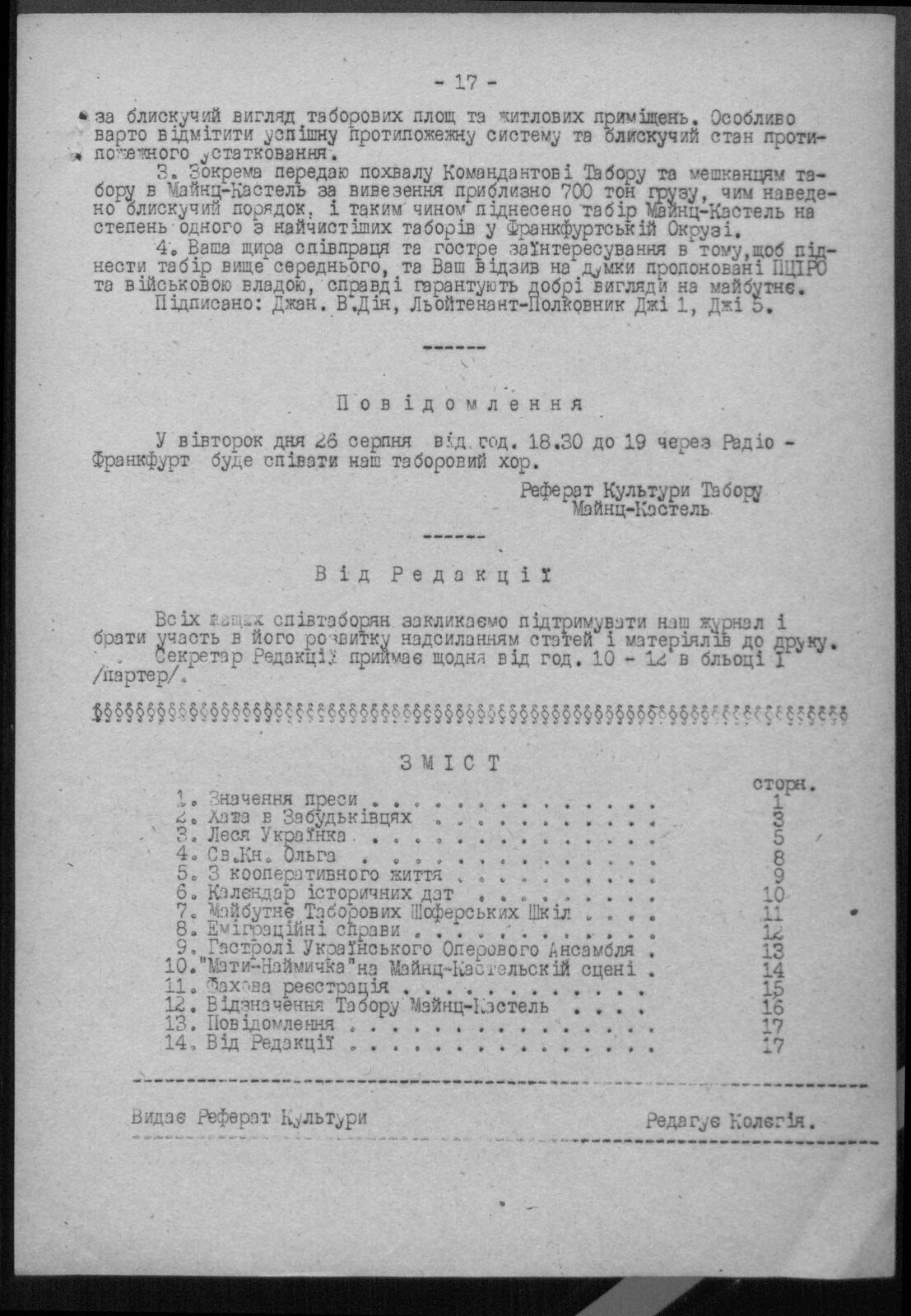
- 26 August 1947The camp choir sings on Radio Frankfurt from 18.30 to 19.00.
- December 1947The Ukrainian population return records 1,127.
- 30 June 1948The UUARC report lists the Ukrainian camp at Golzkaserne.
- September 1948The assembly-centre number changes from AC 579 to W 126 in the zone-wide renumbering.
- September to October 1948The inventory places the closing of the Kastel assembly centre in this window.
- 1949Memoir-based research documents continuing residence at Mainz-Kastel.
Sources for this section
- Barracks
- Providing for the DPs
- Integrated development and action concept: Wiesbadener Straße
- The Refugee Experience: Ukrainian Displaced Persons after World War II
- DP camp inventory: Wiesbaden, von-der-Goltz-Kaserne / Wiesbaden-Kastel
- Taborovi visti (Таборові Вісті), Mainz-Kastel camp journal, year I, issues 1–3
- Taborovi visti: Mainz-Kastel camp newspaper, issue 1
- Report of the United Ukrainian American Relief Committee, Inc.
- Daily life and working conditions of Ukrainian scholars in displaced persons camps (1945–1952)
Goltz-Kaserne on the Rhine
The Von-der-Goltz barracks and the neighbouring Wilhelms barracks were built at Kastel in 1860 and were occupied for most of their military life by pioneer troops. The United Ukrainian American Relief Committee’s June 1948 report explicitly identifies the Ukrainian camp at Wiesbaden-Kastel as Golzkaserne, and city research identifies the former Von-der-Goltz barracks with the later Kastel Housing site.
It was a different compound from Gersdorff-Kaserne, which the city’s own lexicon places in the Europaviertel on the other side of the Rhine, and from the nearby Mudra-Kaserne in Kastel itself. The Arolsen inventory keeps the two Wiesbaden camps apart as well, giving Gersdorff-Kaserne the assembly-centre number AC 563 under Team 28 Wiesbaden and a closing date between October and December 1946, and Kastel the number AC 579 under a team of its own.
The familiar name Mainz-Kastel reflects the area’s older connection with Mainz. After the war the Rhine divided the occupation zones: Mainz was French-administered, while Kastel lay in the American zone and became part of Wiesbaden. This explains why the Ukrainian camp appears under Wiesbaden in statistical lists without being a camp in the city centre.
Names in the sources
| Name | Meaning |
|---|---|
| Mainz-Kastel / Wiesbaden-Kastel | The camp’s locality on the east bank of the Rhine |
| Golzkaserne / Von-der-Goltz-Kaserne | Barracks identified in the 1948 relief report and city research |
| Conturino | A further name for the camp recorded in the Arolsen inventory |
| Camp 579 / AC 579 | Number printed in the camp newspaper’s August 1947 commendation and recorded as the assembly-centre number in the inventory |
| W 126 | The assembly-centre number after the renumbering of September 1948 |
| Gersdorff-Kaserne | Separate Wiesbaden barracks in the Europaviertel, AC 563; not an alias for this camp |
The barracks in 1945
The first displaced persons in the Goltz barracks were not Ukrainians. Wiesbaden’s Jewish local history records DP Camp No. 712 in the Goltz barracks at Mainz-Kastel, where about 400 Jewish displaced persons were housed; many of them were able to leave during the course of 1945 as rooms or flats were allocated to them in Wiesbaden across the river.
Ukrainians in Wiesbaden appear in the record first at the Gersdorff barracks, which the inventory lists with Polish, Baltic and Ukrainian residents and closes between 19 October and 20 December 1946. The Kastel camp was carried on in the register after that date.
Sources for this section
The camp in the assembly-centre register
The Arolsen Archives inventory of DP camps carries the site in District 2 of the American zone as “DP-Camp von-der-Goltz-Kaserne / Wiesbaden-Kastel / Conturino”. Its assembly-centre number is AC 579, changed to W 126 in the renumbering of September 1948. The recorded capacity is 1,750. The camp had its own UNRRA team, T 517 Wiesbaden-Kastel, under a director recorded as Gacras, within Area Team 1022 Frankfurt am Main and Area 1 Frankfurt am Main; the field supervisor is given as Westerman.
The number AC 579 matters for reading the camp’s own newspaper. The commendation reprinted in Taborovi visti in August 1947 identifies the site as Camp 579, and the register confirms that this was the assembly-centre number of the Kastel barracks. The two records, one printed inside the camp and one compiled from occupation paperwork, are describing the same place.
The inventory closes the camp between 30 September and 31 October 1948 and lists its residents as Polish, Latvian, Estonian and stateless. That list does not name Ukrainians, although Ukrainian statistical returns count more than a thousand of them here in the same years; nationality entries in the inventory record what a given return happened to note, and a Ukrainian resident might be entered as Polish or as stateless. The surviving paperwork is held as ITS documents 82040911 to 82041331, and the Stadtarchiv Wiesbaden holds documents and photographs of the Wiesbaden camps under WI/3 Nr. 2616.
Arolsen Archives inventory entry for the Kastel camp
| Field | Value |
|---|---|
| Region and district | DP US, District 2 |
| Location | Wiesbaden |
| Building | DP-Camp von-der-Goltz-Kaserne / Wiesbaden-Kastel / Conturino |
| Closing | Between 30 September and 31 October 1948 |
| Capacity | 1,750 |
| Assembly centre | AC 579; W 126 from September 1948 |
| UNRRA team | T 517 Wiesbaden-Kastel |
| Team director | Gacras |
| Area team and area | AT 1022 Frankfurt/Main; A 1 Frankfurt/Main |
| Field supervisor | Westerman |
| Nationalities recorded | polisch, lettisch, estnisch, staatenlos |
| Archive references | ITS Dok-ID 82040911-82041331; Stadtarchiv Wiesbaden WI/3 Nr. 2616 |
A community with schools and parishes
Alongside Cornberg, Mainz-Kastel stood out among the Ukrainian camps in Hesse for the range of institutions it sustained. It had an elementary school, a high school, vocational education, community organisations and two parishes. Their presence made it a centre for education and social life as well as accommodation.
Recent scholarship draws on a camp resident’s memoir to describe an unusually wide social spectrum: professional and political figures lived alongside agricultural and manual workers. The same study documents residence here from 1946 to 1949. Displacement had brought people with very different prewar lives into a shared community, rather than a settlement defined by one occupation.
A published obituary of a former resident records one marriage in the camp. It took place on 23 February 1946 in a church the internees had built themselves, and the bride wore a borrowed white dress that was “passed around to every small woman who was getting married”. The account is a single family recollection and cannot be checked against the camp’s own records.
The newspaper’s own account of the camp population gives about 90 per cent Ukrainians, with the great majority of institutions accordingly Ukrainian in character, and states that the camp’s minorities held posts and worked in the camp administration. Its report for the 1946/47 school year lists a kindergarten of 42 children, a primary school of five classes with 98 pupils, and a gymnasium of four classes with a matura group and 55 pupils. A drivers’ course was completed by 397 people, who then worked as drivers in the camp and for the Americans.
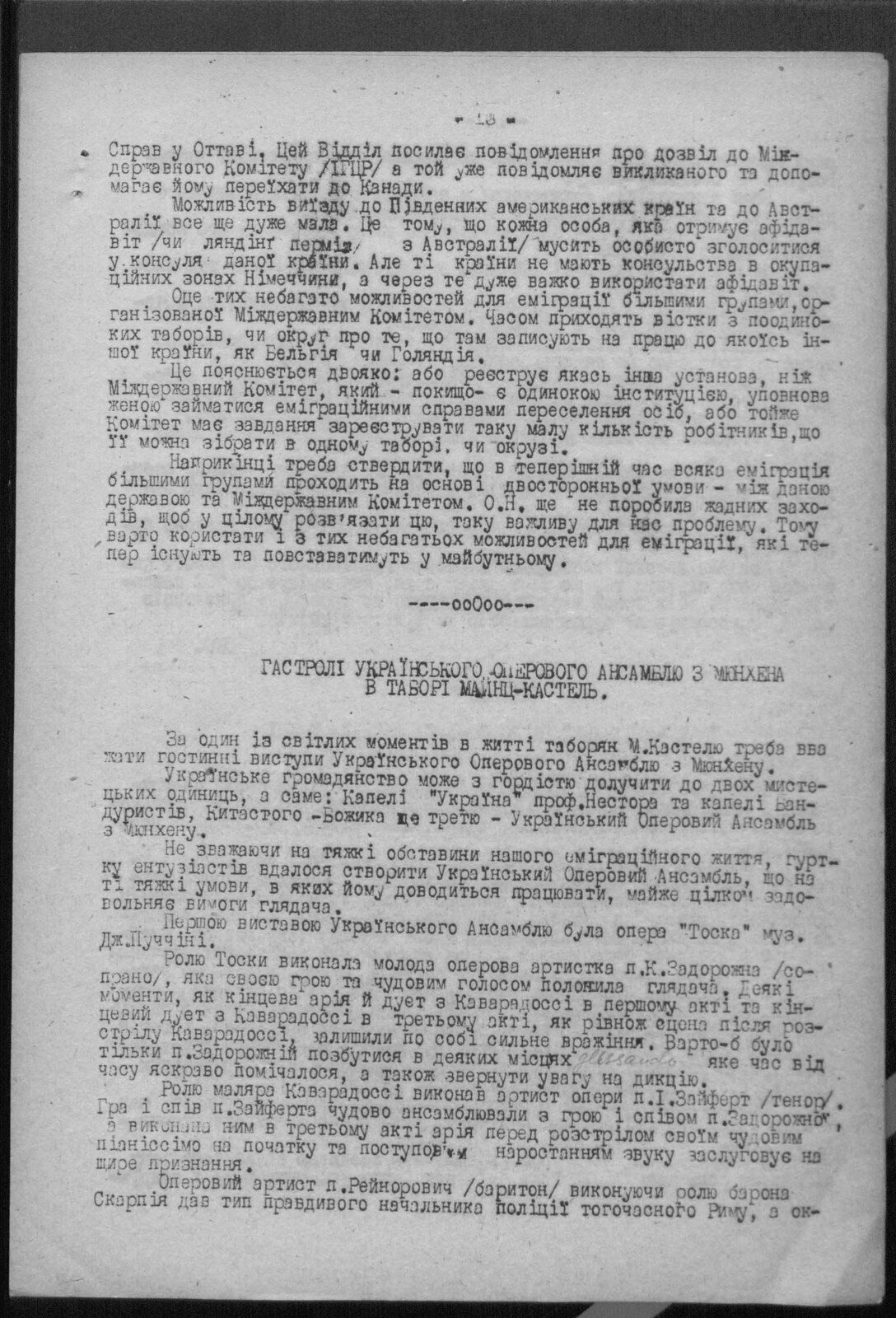
Performances came into the camp as well as out of it. The Ukrainian Opera Ensemble from Munich gave guest performances at Mainz-Kastel, and the paper reported that the theatre hall, which holds up to 700 spectators, was filled to the brim at all three of them. The theatre ensemble at Mainz-Kastel staged Maty-naimychka on the Mainz-Kastel stage. In the second half of October 1947 the Cultural Section and the YMCA planned a programme of events, and the camp choir prepared for a theatrical and artistic competition to be held in the IRO’s Frankfurt district at Hanau on the 25th of that month.
Residents also raised money for others. The KODUS representation at Wiesbaden-Kastel thanked all who had taken part in a collection campaign in the camp, and set out what earlier appeals had brought in: a “shock” collection held on 4 October 1946 raised 5,298 marks, and events and further collections added 5,193 marks, so that the intensified campaign in the camp yielded 10,491 marks.
Sources for this section
The camp in its own words
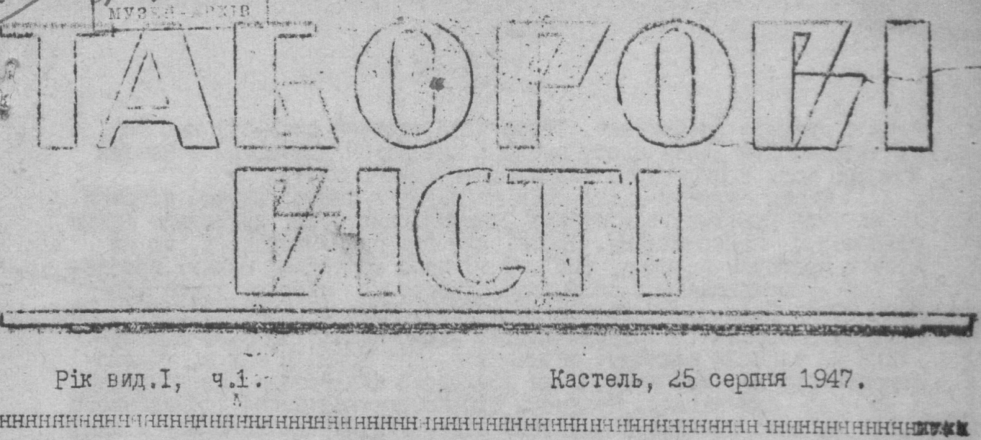
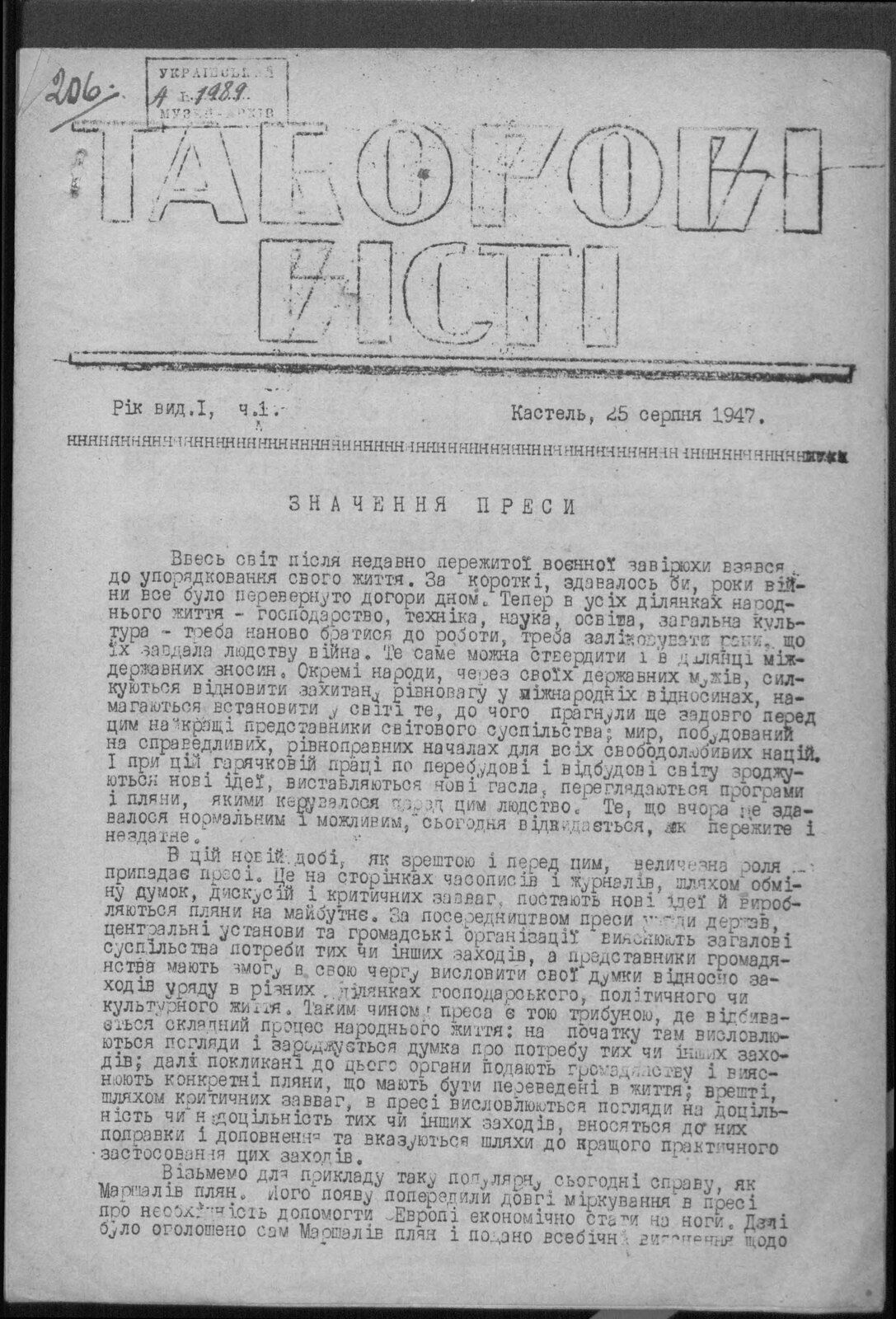
On 25 August 1947 the Culture Department issued the first Taborovi visti, or Camp News. Its pages linked Ukrainian literature and historical anniversaries with cooperative business, occupational registration and emigration. A notice invited residents to contribute articles, making the publication a forum for the camp itself.
The cooperative reported shop sales of 253,367 German marks for the first half-year. Its workshops also filled residents’ orders. Such accounts reveal an organised camp economy alongside externally supplied relief.
The first issue set out what the journal was for: it was to perform for the miniature “state” of the Mainz-Kastel camp the same role that the great world press performs for great states.
Later issues describe the camp governing itself. The paper wrote that Mainz-Kastel had by then been living for several months under a regime of democratic self-government. It also recorded that, after the camp administration was taken over from UNRRA, the administration that emerged from general elections faced immediate demands in every sphere of camp life, and that the camp council adopted the camp’s first monthly budget, for July, at its meeting of 30 June 1947.
The cooperative’s later accounts add to the picture. Forty-seven camp residents found work in its production centres, the soundness of its trading allowed it to spend on general national relief purposes, and the newspaper printed its business balance sheet as at 1 October 1947.
Making the barracks liveable
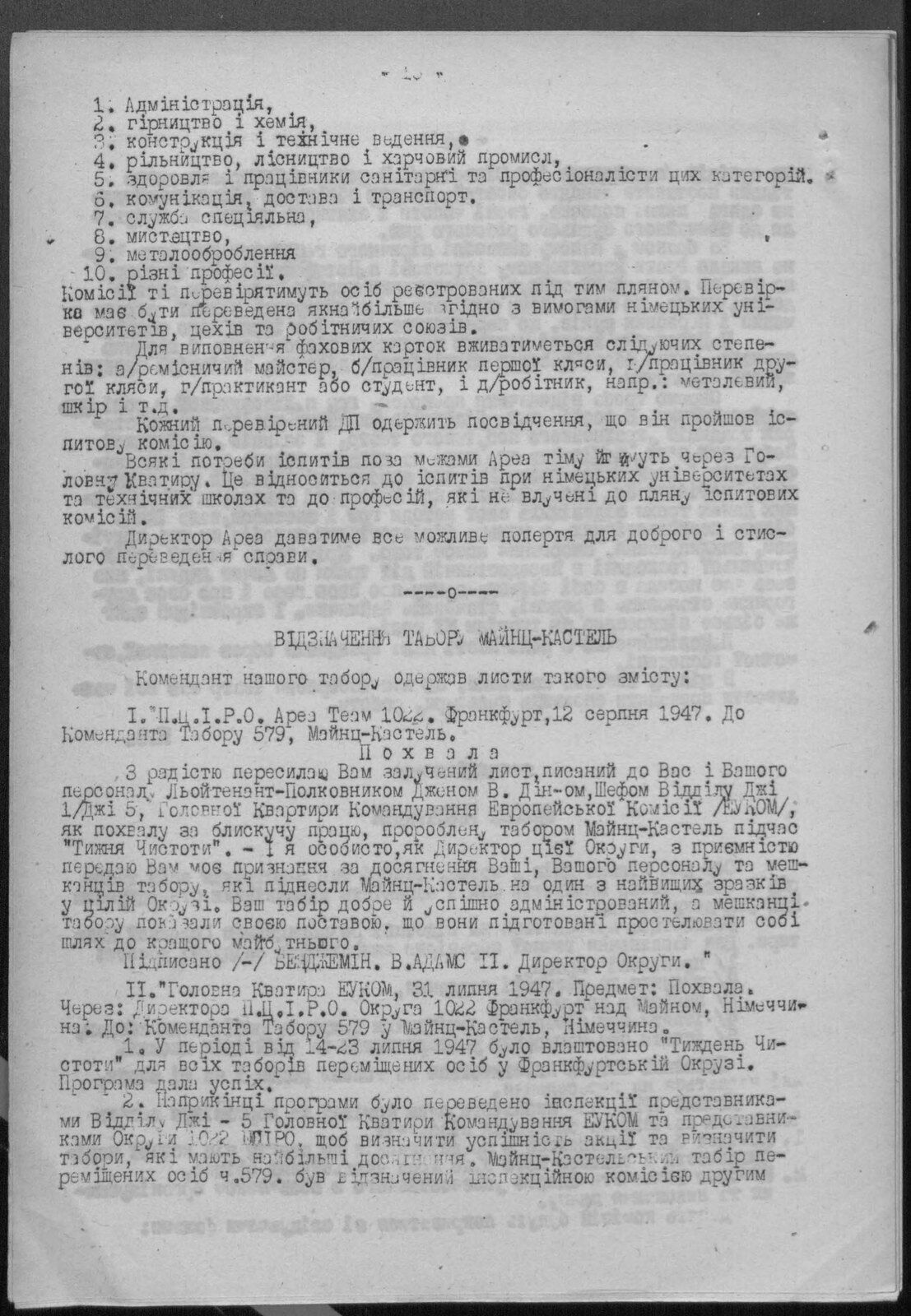
A commendation reproduced in the newspaper identifies the site as Camp 579. Following the July 1947 cleaning campaign, inspectors praised its grounds, accommodation and fire precautions, and the inspection commission singled out displaced persons camp no. 579 as second for the appearance of its camp squares and living quarters, raising Mainz-Kastel to the rank of one of the cleanest camps in the Frankfurt District. Residents had removed about 700 tons of rubble. The same issue announced that the camp choir would sing on Radio Frankfurt on Tuesday 26 August from 18.30 to 19.00.
The rubble is a reminder of what the buildings had been through. Kastel lay across the river from a heavily bombed city and the barracks were nineteenth-century military accommodation pressed into use for families; clearing the site was work the residents did themselves rather than work done for them.
Rations were cut in the camp’s second autumn. The newspaper reported that the contingent of rations for workers for October 1947 would amount, for the camp together with 55 rations for the Wiesbaden hospital, to 320 rations, and that the number of people receiving a ration had been reduced by approximately 50 per cent.

The population changed over time
The four surviving figures below come from different reporting dates or series. They should not be read as a cumulative total of everybody who passed through Mainz-Kastel. The encyclopedia’s rounded 1,800 is close to the 1,797 recorded in questionnaire material, while the December 1947 return records a smaller Ukrainian community.
None of these is a count of the whole camp. Against the inventory’s recorded capacity of 1,750 places for residents of every nationality, the Ukrainian figures suggest that for a period in 1946 and 1947 Ukrainians made up a large part, though not necessarily all, of a full barracks.
Ukrainians recorded at Mainz-Kastel
| Date / reporting series | Ukrainians |
|---|---|
| 1946–1947 questionnaires | 1,797 |
| August 1946 | 564 |
| May 1947 | 1,573 |
| December 1947 | 1,127 |
Occupational structure recorded by the camp's Resettlement Administration, 1947
| Category | Share or count |
|---|---|
| Counted as able to work, on the principle that all up to age 65 are able to work | 1,235 (720 men, 545 women) |
| Agricultural workers | 75 per cent |
| Ordinary labourers | 10 per cent |
| Skilled workers | 5 per cent |
| Intellectual professions | about 15 per cent |
Preparing for emigration
The August newspaper compared work-related migration to Belgium and the Netherlands, planned recruitment for France and individual arrangements for Canada. It treated emigration as a practical problem involving employment, documents and family eligibility—not simply a decision to board a ship.
These discussions took place while the camp still functioned. The June 1948 relief report continued to list it among the main Ukrainian centres, and memoir-based research documents residents remaining into 1949. The inventory’s closing window of September to October 1948 marks the end of the site as a registered assembly centre rather than the end of every residence there.
Emigration had its own camp institution. A Resettlement Administration was formed at the M. Kastel camp by the camp council on 2 January 1947; it resolved at its meeting of 16 July 1947 to dissolve itself and to hand its competences to the camp command. Its published statistics counted, on the principle that everyone up to the age of 65 was theoretically able to work, 720 men and 545 women, 1,235 people in all, of whom 75 per cent were agricultural workers, 10 per cent ordinary labourers, 5 per cent skilled workers and about 15 per cent members of the intellectual professions.
By the autumn the schemes had produced results. The newspaper reported that Canada had accepted the candidatures of forty camp residents, of whom 27 were accepted and had already left overseas; that France had offered very good working conditions in the mines; and that an emigration project to Australia had just been announced in the camp. It also printed a letter from the IRO director to the camp administration dated 2 October 1947.
Sources for this section
- Taborovi visti: Mainz-Kastel camp newspaper, issue 1
- Report of the United Ukrainian American Relief Committee, Inc.
- Daily life and working conditions of Ukrainian scholars in displaced persons camps (1945–1952)
- DP camp inventory: Wiesbaden, von-der-Goltz-Kaserne / Wiesbaden-Kastel
- Taborovi visti (Таборові Вісті), Mainz-Kastel camp journal, year I, issues 1–3
Sources
- Report of the United Ukrainian American Relief Committee, Inc.
United Ukrainian American Relief Committee · 30 June 1948
Printed page 18 names Wiesbaden-Kastel Ukrainian Camp Golzkaserne. Original page visually inspected; zone-wide school totals not attributed to camp.
- Taborovi visti: Mainz-Kastel camp newspaper, issue 1
Culture Department of Mainz-Kastel camp; digitised by Diasporiana · 25 August 1947
Original pages 1, 9, 12 and 16–17 inspected visually: cooperative accounts, emigration, Camp 579 commendation and choir announcement. English paraphrases from Ukrainian.
- The Refugee Experience: Ukrainian Displaced Persons after World War II
Canadian Institute of Ukrainian Studies Press · 1992
Ihor Stebelsky, printed pages 28 and 47: Mainz-Kastel education, parishes and four distinct population returns.
- Integrated development and action concept: Wiesbadener Straße
Landeshauptstadt Wiesbaden · 2018
Printed page 20, indexed full passage: Von-der-Goltz-Kaserne at Kastel Housing, postwar DP use, and occupation-zone geography. Direct download now returns 404; indexed passage remains available.
- Daily life and working conditions of Ukrainian scholars in displaced persons camps (1945–1952)
Halyna Klynova-Datsiuk and Alla Atamanenko, Echa Przeszłości XXVI/2 · 2025
Printed pages 168–169: memoir-based evidence of residence in Mainz-Kastel from 1946 to 1949 and the community’s social diversity. No resident names reproduced.
- Germany: postwar Ukrainian camps
Canadian Institute of Ukrainian Studies · Accessed September 2026
Rounded Ukrainian population of 1,800 in 1946–1947; not independent of the published Ukrainian statistical tradition.
- Barracks
Landeshauptstadt Wiesbaden, Stadtlexikon · Accessed September 2026
Separates Von-der-Goltz in Kastel from Gersdorff in the Europaviertel and from Mudra-Kaserne.
- Providing for the DPs
Aktives Museum Spiegelgasse für deutsch-jüdische Geschichte in Wiesbaden · Accessed 13 September 2026
Page read in full: “They came to DP Camp No. 712 in the Goltz Barracks in Mainz-Kastel. Many of the approximately 400 Jewish DPs housed there were able to leave the camp in the course of 1945, as they had been assigned a room or apartment in Wiesbaden.” No resident names taken.
- DP camp inventory: Wiesbaden, von-der-Goltz-Kaserne / Wiesbaden-Kastel
Arolsen Archives · 26 October 2023
Entry 1615: District 2, building “DP-Camp von-der-Goltz-Kaserne / Wiesbaden-Kastel / Conturino”, nationalities Polish, Latvian, Estonian and stateless, capacity 1,750, assembly centre AC 579 and from September 1948 W 126, UNRRA Team T 517 Wiesbaden-Kastel, team director Gacras, Area Team 1022 Frankfurt/Main, Area 1 Frankfurt/Main, field supervisor Westerman, closing between 30 September and 31 October 1948, ITS Dok-ID 82040911-82041331 and Stadtarchiv Wiesbaden WI/3 Nr. 2616. Entry 1611 read for comparison: Gersdorf-Kaserne, Polish, Baltic and Ukrainian, AC 563, Team 28 Wiesbaden, closing between 19 October and 20 December 1946. The recorded opening date of 24 January 1946 is the inventory’s general first-listing serial.
- Obituary of a former Mainz-Kastel resident
Winnipeg Free Press Passages; Korban Funeral Chapel · 28 January 2022
Obituary body text, paragraphs three to five, read in full: a Ukrainian forced labourer who reported to the Mainz-Kastel camp at the end of the war, her marriage there on 23 February 1946 in a church built by the internees, and the family’s emigration to Canada. The resident is not named on this page.
- Taborovi visti (Таборові Вісті), Mainz-Kastel camp journal, year I, issues 1–3
Referat Kultury (Cultural Section) of the Mainz-Kastel camp; Ukrainian Museum-Archives, Cleveland, DP Camp Periodicals Collection; digitised by the Internet Archive · 1947
Digitised run of the camp journal, 49 page images in the Internet Archive item linked here, read as page images. Pages used: issue 1 p. 1 masthead (image 3 of the item), p. 2 editorial statement, pp. 13–14 on the guest performances of the Ukrainian Opera Ensemble from Munich and on the camp theatre ensemble, pp. 16–17 on the commendation of Camp 579 and on the camp choir's Radio Frankfurt broadcast; issue 2 pp. 1–8 on democratic self-government, the composition of the camp population, the Resettlement Administration and its occupational statistics, emigration to Canada, France and Australia, the 1946/47 school report and the camp cooperative, and p. 14 on the October 1947 ration contingent; issue 3 pp. 1–3 on the first monthly camp budget, and its later pages on the KODUS collections and the cooperative's balance sheet of 1 October 1947. This is the same journal as source 2, read from the Internet Archive copy rather than the Diasporiana scan, and extends to issues 2 and 3. Licence: Creative Commons BY-NC-ND 4.0 per the item metadata.
Last researched 12 September 2026