Mattenberg Camp
Displacement in Europe
Kassel-Oberzwehren, Hesse, Germany · 1945–1949
A wartime workers’ settlement and barrack camp on Kassel’s southern edge became one of the largest assembly centres in northern Hesse. Ukrainians appear in the smaller transient unit linked to it rather than in the main camp’s recorded nationalities.
Introduction
Mattenberg’s postwar camp community occupied a landscape of workers’ housing and wooden barracks in Oberzwehren, southern Kassel. The camp catalogue records a main assembly centre here from December 1945 to June 1949 and, separately, a small transient unit in which Ukrainians are listed alongside Polish, Russian and Belarusian residents. The two records must be read apart, and the Ukrainian presence documented for Mattenberg is modest.
A history in dates
- 1937Construction of the planned workers’ settlement begins; the Dönche is expropriated for a training ground.
- From 1940The barrack camp holds forced labourers for the Henschel aero-engine works.
- 1 April 1945American troops reach Oberzwehren after heavy street fighting; Kassel capitulates on 4 April.
- 1945American authorities require German occupants to vacate the settlement.
- 14 December 1945The catalogue entry for the main Mattenberg camp begins.
- 31 May 1947The UNRRA return records 12 Ukrainians at Kassel (Mattenberg).
- 17 October 1947The catalogue entry for the linked transient camp begins.
- 31 October 1947The main camp records 2,965 people against a capacity of 3,600; the transient unit records 686 against 600.
- 1948A contemporary photograph documents collection of weekly firewood supplies; a second Protestant congregation is formed in the settlement.
- 27 June 1949The catalogue records the closure of the main camp; former German occupants are permitted to return.
- 1968The final wooden barracks are removed after their later emergency-housing use.
Sources for this section
- Mattenberg-Siedlung
- Geschichtliches: Oberzwehren chronicle
- Große Ausländerlager in Kassel (1940–1945)
- Heimatlos am Mattenberg
- Geschichtliches: Oberzwehren
- DP camp inventory: Mattenberg and the other Kassel camps
- The Refugee Experience, Table 7
- DP camp inventory: Transient-Camp Mattenberg
- Out of Darkness exhibition
A settlement built for industry
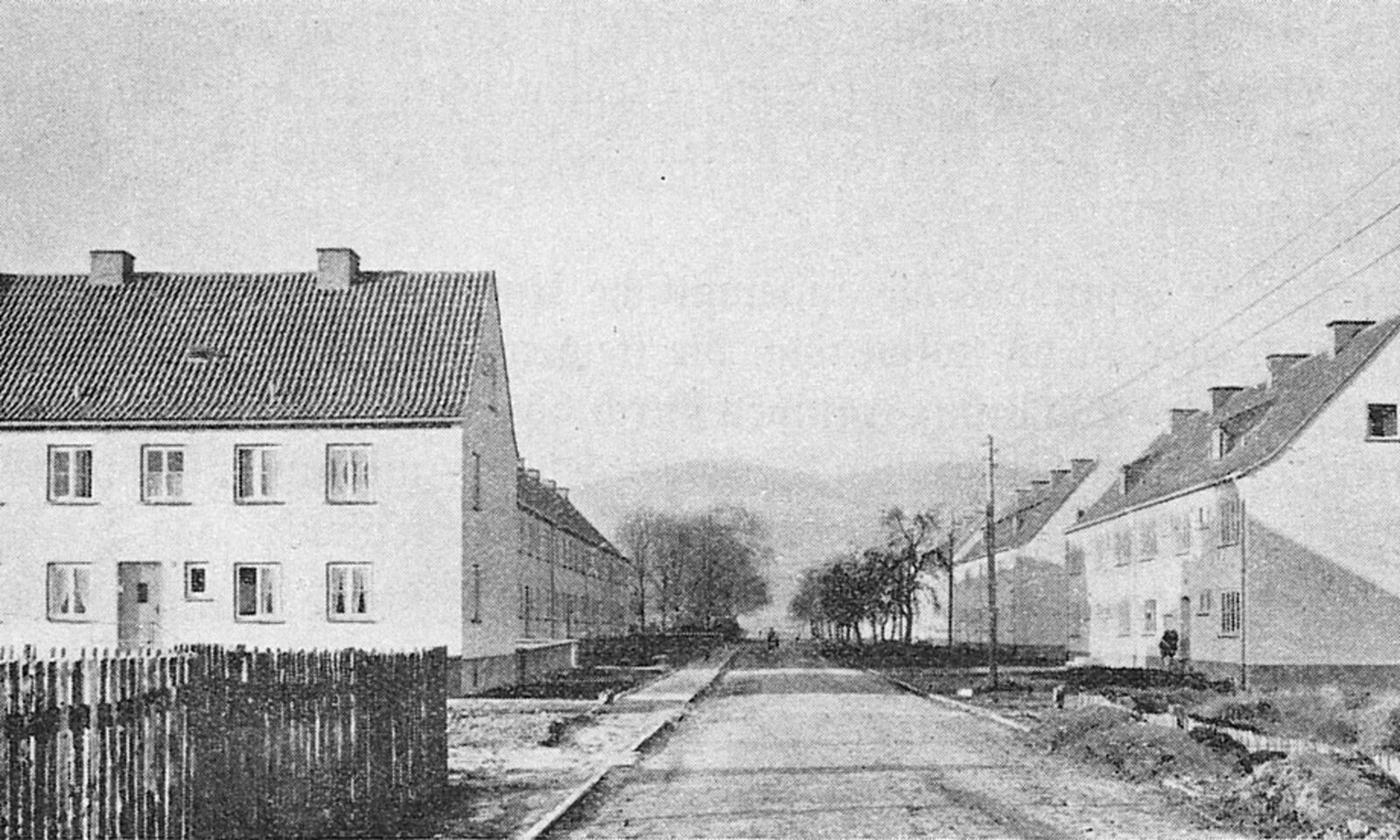
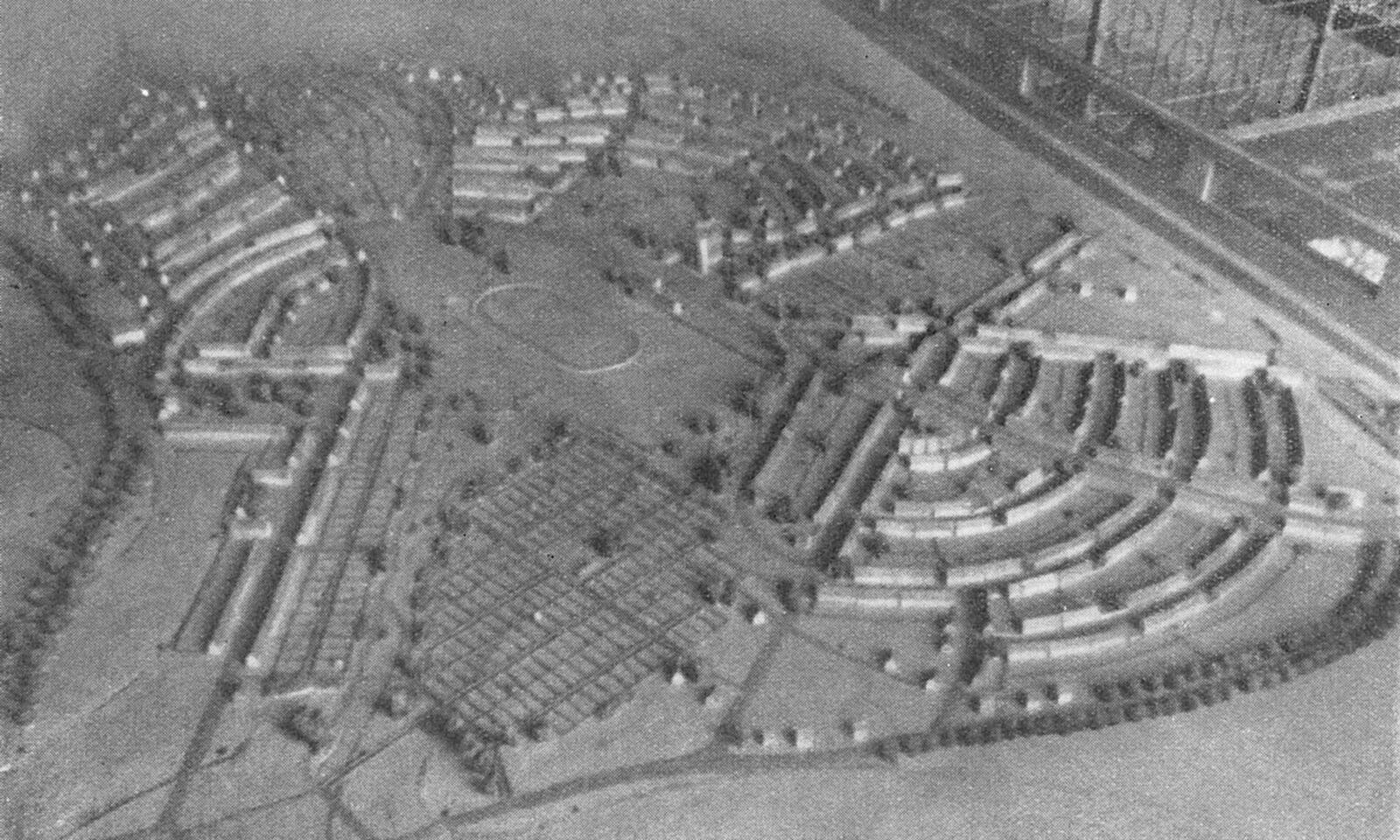
The Hessische Heimstätte and the city of Kassel planned Mattenberg for workers at the Henschel aircraft-engine factory. Construction of a first stage designed for 1,000 flats began in 1937, with mainly two-storey houses containing four dwellings each. Only about 600 of the planned 3,000 homes were completed. The local chronicle dates the expropriation of the Dönche for a troop training ground and the building of the settlement to the same year, and records that several farmers had to be resettled.
Sources for this section
The forced-labour camp
From 1940 the site also served forced labour, and the barrack camp beside the settlement became probably the second largest foreign workers’ camp in wartime Kassel. A study of the city’s large camps records more than 6,000 people housed at one time in 54 barracks, from the Soviet Union, Poland, France, Italy, Serbia, Czechoslovakia, Alsace and Lorraine, who had to work at the Henschel aero-engine works at Altenbauna on the site of today’s Volkswagen plant at Baunatal. The camp had its own kindergarten caring for more than 400 children, and Soviet prisoners of war were held separately in fenced green barracks. Despite bomb damage the camp was used until the end of the war.
American troops reached Oberzwehren on 1 April 1945 after heavy street fighting, and Kassel capitulated three days later. Local history records that German occupants were ordered to leave the Mattenberg settlement that year and were allowed back only in 1949.
The assembly centre
The catalogue entry for the main camp opens on 14 December 1945 and closes on 27 June 1949. It records a capacity of 3,600 and a headcount of 2,965 on 31 October 1947, the assembly-centre number AC 540, the later designation K 109, and UNRRA Team 77 Kassel-Oberzwehren under the Kassel area teams and the Frankfurt am Main area office. Its recorded nationalities are Polish, Latvian, Estonian, Lithuanian and Yugoslav, with no Ukrainian entry. A third Oberzwehren unit, a control centre, was recorded from July 1947.
Neither the capacity nor the headcount is a Ukrainian figure, and neither belongs to the transient unit described below. Other Kassel camps in the same catalogue, including the Jewish camp at Hasenhecke in Wolfsanger and the Baltic camp in the Junkers barracks at Bettenhausen, are separate records with their own numbers, and their figures should not be read across to Mattenberg.
The two Mattenberg records on 31 October 1947
| Record | Capacity | Headcount | Recorded nationalities |
|---|---|---|---|
| Main camp (AC 540, later K 109) | 3,600 | 2,965 | Polish, Latvian, Estonian, Lithuanian, Yugoslav |
| Linked transient camp (later K 172) | 600 | 686 | Polish, Russian, Belarusian, Ukrainian |
Sources for this section
School, worship and an evening at the cinema
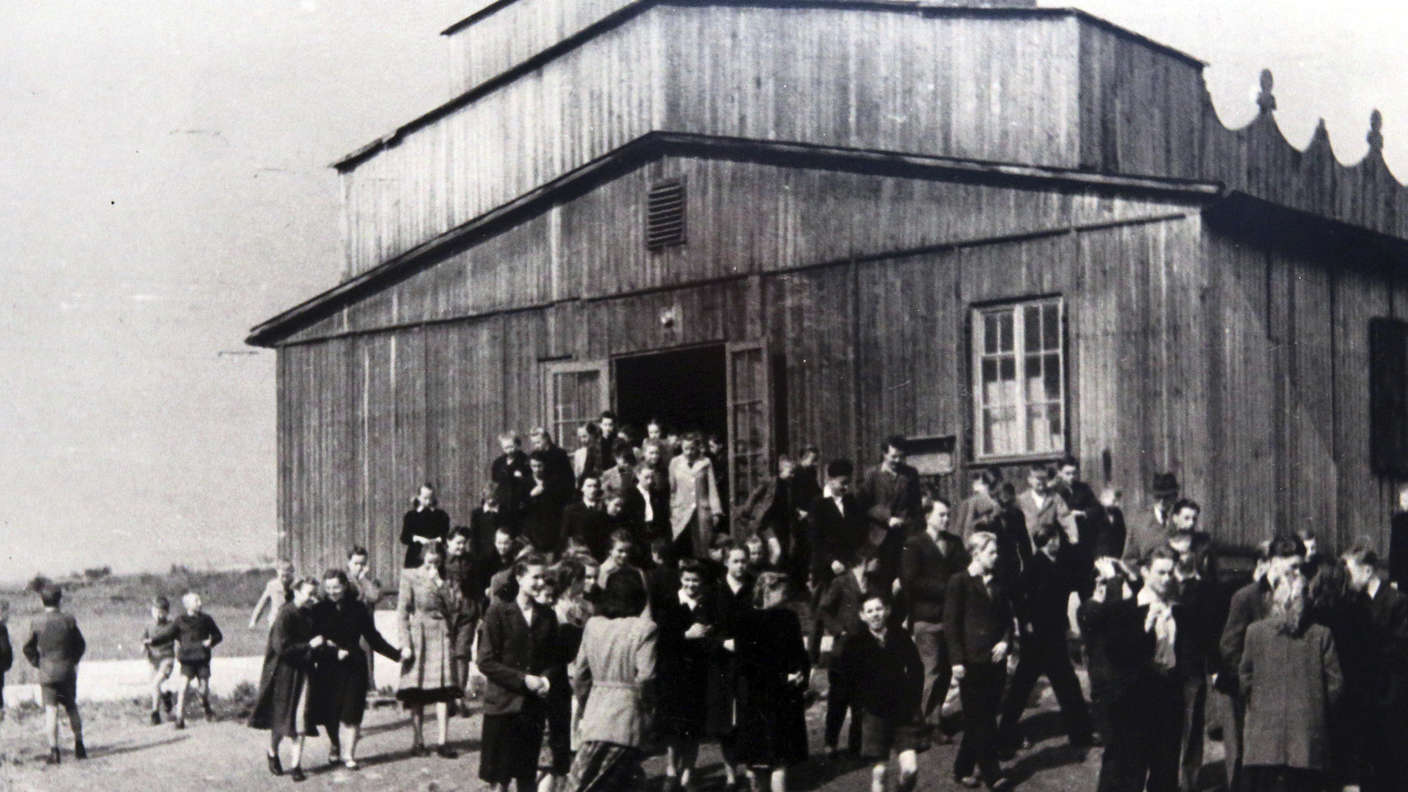
Contemporary photographs preserve a community making daily routines in provisional surroundings. One wooden communal building served as a school, a place of worship and a cinema, and a photograph shows people leaving after a film. Other images record informal gatherings and the ordinary work of obtaining supplies. A 1948 photograph, described by the institution that exhibited it, documents collection of the weekly firewood ration. The photographs also reflect a Lithuanian cultural community and a literary magazine produced in the barracks; these activities describe Mattenberg’s mixed social setting rather than an exclusively Ukrainian institution.
The photographer, a Lithuanian who lived at Mattenberg from 1947 to 1949 before emigrating to the United States, later became a well-known film-maker, and 36 of his photographs of the camp were shown in Kassel during documenta 14 in 2017. In 1948 a second Protestant congregation was formed in the settlement, which indicates how far the site had become a place of settled residence rather than a transit point.
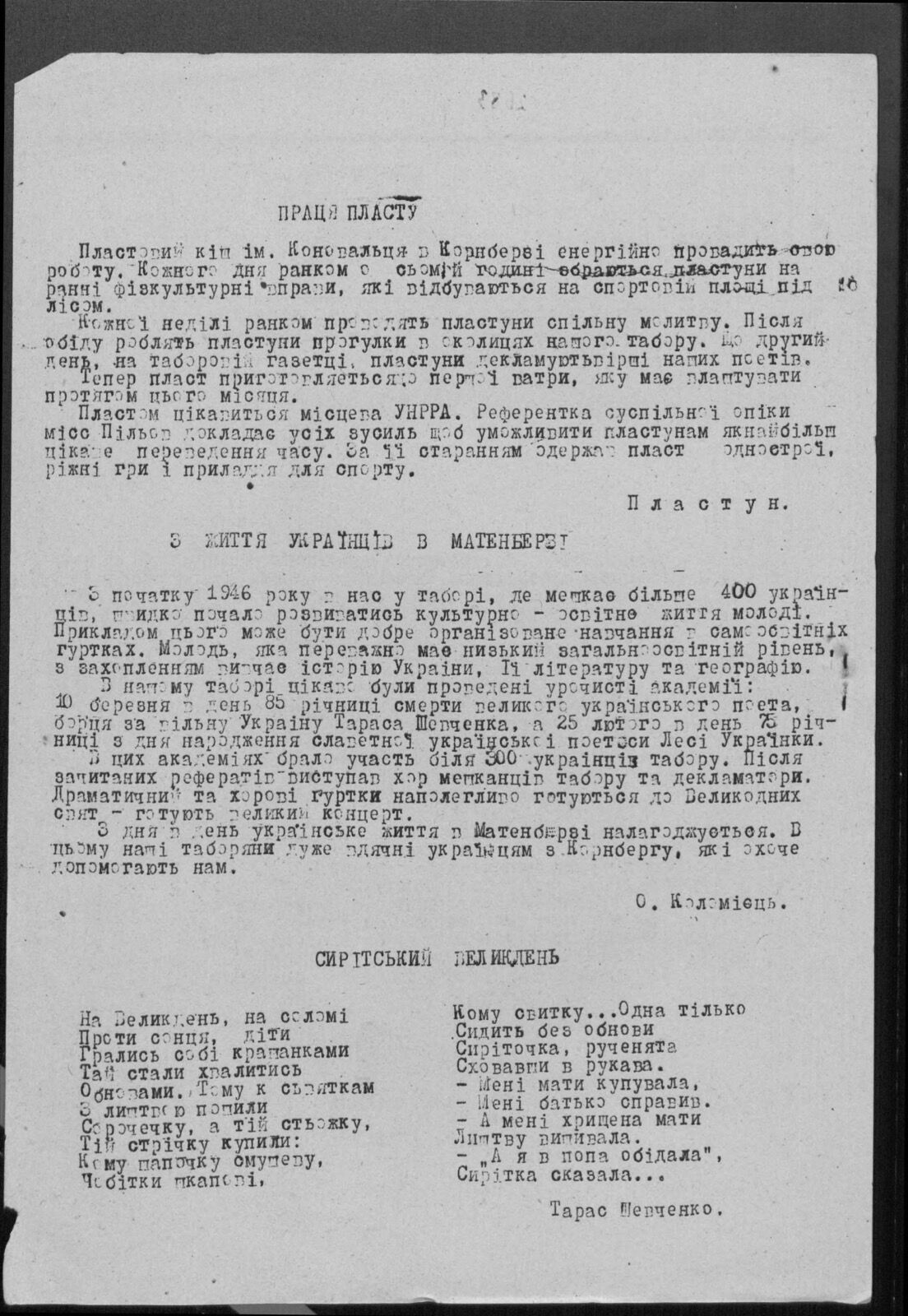
A correspondent writing from Mattenberg in 1946 for Chuzhynoiu, the paper of the educational department of the nearby Cornberg camp, described a camp of more than 400 Ukrainians in which cultural and educational work among the young had developed quickly from the beginning of that year. He gave as an example the well-organised teaching in self-education circles: young people whose general schooling was for the most part slight were studying the history, literature and geography of Ukraine with enthusiasm. Commemorative academies had been held on 10 March, the eighty-fifth anniversary of Taras Shevchenko’s death, and on 25 February, the seventy-fifth anniversary of Lesia Ukrainka’s birth, with about 500 Ukrainians of the camp taking part; after the papers were read a choir of camp residents sang and reciters performed, and the drama and choral circles were preparing a large concert for Easter. The writer, O. Kolomiiets, added that Ukrainian life at Mattenberg was settling down from day to day and that the camp’s residents were much indebted to the Ukrainians of Cornberg, who willingly helped them.
The linked transient camp
The transient unit’s catalogue entry begins on 17 October 1947 and lists Polish, Russian, Belarusian and Ukrainian residents. It records a capacity of 600 and a headcount of 686 on 31 October 1947, so at the end of that month its recorded population exceeded its stated capacity. The same entry places its closure between 31 October 1947 and 30 January 1948 and notes that it was linked to K 109 Mattenberg. That short interval cannot be treated as the closure of the whole settlement, which the main record carries into 1949.
For Ukrainians the only separate count traced is Stebelsky’s Table 7 for the American zone, where Kassel (Mattenberg) shows 12 in the UNRRA return of 31 May 1947 and nothing in the other three columns. That is a small figure beside the hundreds recorded at Korbach or Landau in the same table, and it predates the transient unit by five months.
Ukrainians recorded at Kassel (Mattenberg)
| Return | Ukrainians |
|---|---|
| 1946–1947 questionnaire collection | Not listed |
| UNRRA return, 24 August 1946 | Not listed |
| UNRRA return, 31 May 1947 | 12 |
| PCIRO return, 2 January 1948 | Not listed |
From temporary accommodation to a city neighbourhood
Local history records that former German occupants could return to their homes in 1949. In the 1950s the settlement housed resettlers and people without homes, and the study of the wartime camps records that displaced people, the homeless, refugees and expellees moved into the barracks used as emergency accommodation, while Sinti and Roma set up a caravan site on the upper part of the Mattenberg. The site passed into city ownership in the early 1950s.
The wooden barracks continued in emergency residential use. The remaining ten were removed in 1968, burned down in a controlled operation by the professional fire brigade after their residents had been allocated social housing. This later clearance belongs to the site’s housing history, well beyond the short-lived transient unit.
Sources
- Mattenberg-Siedlung
Nassauische Heimstätte | Wohnstadt, 2021
Housing institution’s history and archive photographs: planned settlement, construction and later housing.
- Heimatlos am Mattenberg
Hessische/Niedersächsische Allgemeine, 17 July 2017
Local reporting on documentary photographs: DP community building, school, worship, cinema and subsequent barracks clearance.
- Out of Darkness exhibition
Kunsttempel Kassel, 2013
Exhibiting institution describes original 1945–1949 photographs, including a 1948 weekly firewood collection at Mattenberg.
- Geschichtliches: Oberzwehren
Kassel-Oberzwehren local history
German residents vacated the settlement in 1945 and were permitted to return in 1949.
- DP camp inventory: Transient-Camp Mattenberg
Arolsen Archives
Record 1109: Ukrainian, Polish, Russian and Belarusian presence, capacity 600 and 686 people on 31 October 1947, later designation K 172, linked to K 109 Mattenberg.
- DP camp inventory: Mattenberg and the other Kassel camps
Arolsen Archives · 26 October 2023
Record 1108: opening 14 December 1945, closure 27 June 1949, capacity 3,600 and headcount 2,965 on 31 October 1947, AC 540, later K 109, UNRRA Team 77 Kassel-Oberzwehren. Records 1107, 1099, 1105, 1106 and 1112 are the separate Oberzwehren control centre, the Jewish camps and the Baltic and Polish camps in Kassel.
- Große Ausländerlager in Kassel (1940–1945)
Universität Kassel, Fachbereich 01 · Typescript dated 11 and 12 September 1993
Survey of the city’s large foreign workers’ camps. The Mattenberg section gives 54 barracks, more than 6,000 people at one time, the nationalities, the Henschel aero-engine works at Altenbauna, the kindergarten for 400 children, the separately guarded Soviet prisoners of war and the postwar use of the barracks.
- Geschichtliches: Oberzwehren chronicle
Kassel-Oberzwehren local history, after reports by Kurt Becker · Accessed 13 September 2026
Local chronicle: 1937 expropriation of the Dönche and construction of the settlement, the American arrival on 1 April 1945, the clearance of the settlement in 1945 and return in 1949, and the second Protestant congregation formed in 1948.
- The Refugee Experience, Table 7
Ihor Stebelsky, Canadian Institute of Ukrainian Studies Press · 1992
Table 7 “Ukrainians in UNRRA and IRO Camps of the American Zone of Germany”, printed pages 47–51. The Kassel (Mattenberg) row is in the Land Hessen section on printed page 47 and shows 12 in the column drawn from the UNRRA summary of 31 May 1947, with blanks elsewhere.
- Chuzhynoiu (Чужиною), the Cornberg camp paper: “З життя українців в Матенберзі”, 1946
Ukrainian Museum-Archives of Cleveland, DP Camp Periodicals Collection, via the Internet Archive · 1946
Marked in the collection as public domain or an orphan work and offered under CC BY-NC-ND 4.0. Chuzhynoiu (Чужиною) was published by the educational department of the Cornberg camp. The mimeographed page carries a correspondent’s report from Mattenberg signed O. Kolomiiets, a report on the Cornberg Plast troop and a Shevchenko poem.
Last researched 13 September 2026