Merxhausen Hospital
Displacement in Europe
Merxhausen, Kreis Wolfhagen, Hesse, Germany · 1945–1949
The American military government requisitioned part of the state institution at Merxhausen as a tuberculosis and general hospital for displaced people. Ukrainians were among the patients treated there between 1945 and 1949, and sixty-three who died were buried in a separate cemetery.
Introduction
Merxhausen Hospital was a place of treatment rather than a residential camp. Ukrainians were among the patients cared for in requisitioned parts of the former state psychiatric institution in northern Hesse. The camp catalogue records it as a tuberculosis and general hospital, opened on 12 August 1945 and served by its own relief team, and a separate cemetery still preserves the memory of people who did not survive their illnesses and exhaustion.
Sources for this section
A history in dates
- 1213An Augustinian double monastery is founded at Merxhausen.
- 26 August 1533A charter of Landgrave Philipp converts the secularised house into a territorial hospital.
- 1942The Wehrmacht takes nine of the thirteen ward buildings for a military hospital.
- 12 August 1945The camp catalogue records the opening of the hospital for displaced people.
- Early 1946The municipal history dates the start of UNRRA treatment of displaced patients.
- 31 May 1947The UNRRA return records 36 Ukrainians at Merxhausen Hospital.
- 31 October 1947A capacity of 460 places is recorded for the hospital.
- Mid-1949Treatment ends; the catalogue places closure between 31 March and 30 September 1949.
- 2011The separate UNRRA and IRO cemetery is redesigned.
From monastery to state institution
The buildings began as an Augustinian double monastery founded in 1213. Hesse adopted the Reformation after the Homberg synod of 1526, the house was secularised in 1527, and a charter of Landgrave Philipp dated 26 August 1533 turned it into one of the territorial hospitals for the rural poor. Merxhausen and its counterpart at Haina were founded in the same year, and the site remained a public institution of care for four centuries before the events described here.
By the twentieth century it was a state asylum whose patients were women. The medical site had already undergone violent changes before liberation. Under National Socialism, chronically ill patients were stripped of legal protection, and the institution’s own historical account records transfers towards the killing centre at Hadamar. The municipal trail records that 494 patients from Merxhausen became victims of the “Aktion T 4” murders.
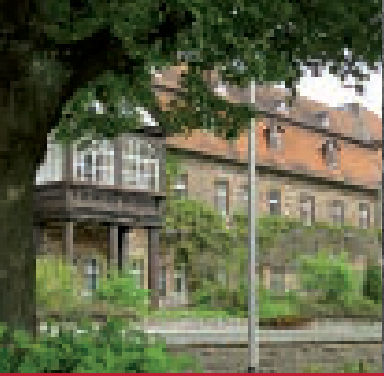
The wards under military occupation
From 1942 the Wehrmacht used nine of the institution’s thirteen ward buildings as a military hospital, which forced the remaining patients into severe overcrowding. The municipal account records two doctors for 400 patients and rations reduced to the point where physical decline was accepted. Local historians describe this as a silent form of killing, distinct from the transports to Hadamar but part of the same policy.
The displaced-persons hospital belonged to the subsequent Allied period. Its patients and administration must be distinguished from the earlier psychiatric institution and its victims, even though both histories occupied the same grounds.
Sources for this section
A relief hospital under UNRRA and IRO
The American military government requisitioned sections of the institution for sick displaced people. The camp catalogue lists the unit as “Merxhausen Hospital / TB- und General-Hospital”, with an opening date of 12 August 1945 and a closure recorded only as falling between 31 March and 30 September 1949. It carried the assembly-centre number AC 587, became K 161 in the renumbering of September 1948, and had a capacity of 460 places recorded on 31 October 1947. Its nationalities are given simply as various.
Relief work was organised through UNRRA Team 906 Merxhausen, under the Kassel area teams and the Frankfurt am Main area office. The same team number also covered a second hospital for displaced people at Steinatal near Ziegenhain, so the team’s scope was wider than this one site. UNRRA was absorbed into the International Refugee Organisation in Europe early in 1947, and the municipal history records that several hundred patients were treated between the beginning of 1946 and the middle of 1949, drawn from eastern and southern Europe.
Catalogue record for the hospital
| Record | Value |
|---|---|
| Catalogue name | Merxhausen Hospital / TB- und General-Hospital |
| Opening | 12 August 1945 |
| Closure | Between 31 March and 30 September 1949 |
| Assembly centre | AC 587 |
| From September 1948 | K 161 |
| UNRRA team | Team 906 Merxhausen |
| Area team and area | AT 1024 and AT 1025 Kassel; A 1 Frankfurt am Main |
| Nationalities recorded | Various |
Sources for this section
The Ukrainian return
A Ukrainian count taken from the UNRRA summary of 31 May 1947 records 36 Ukrainians at Merxhausen Hospital. The figure appears in Stebelsky’s Table 7 for the American zone, where the surrounding columns are blank, so no comparable Ukrainian figure exists for August 1946, December 1947 or the questionnaire returns collected during 1946 and 1947. This dated national count cannot be read as the hospital’s bed number, its cumulative admissions or its full international population.
Different measures of the hospital community
| Measure | Figure / period |
|---|---|
| Ukrainians recorded, 31 May 1947 | 36 |
| Recorded capacity, 31 October 1947 | 460 places |
| Patients treated across the relief period | Several hundred, early 1946 to mid-1949 |
| Displaced people buried in the separate cemetery | 63 |
Sources for this section
A place of remembrance
Sixty-three displaced people who died in the institution between 1946 and 1949, from fatal illness or from exhaustion, were buried in a cemetery of their own. The municipal trail records that they came from Estonia, Greece, Yugoslavia, Latvia, Lithuania, Poland, the USSR, Ukraine and Hungary. The cemetery was redesigned in 2011 and forms a stop on the local peace-education trail, maintained with the support of the German war graves commission.
Later guided commemorations have connected the surviving graves with the history of wartime uprooting and the struggle to recover after liberation. The trail places the displaced-persons cemetery beside the war cemetery at Bad Emstal-Sand, the memory of the workhouse inmates sent to Merxhausen as labourers, and the former synagogue at Riede, so that the site is read as one layer among several.
Sources for this section
Sources
- Eco Pfad Friedenspädagogik Bad Emstal
Gemeinde Bad Emstal · September 2020
Municipal historical interpretation identifies the requisitioned hospital, early 1946 to mid-1949 treatment period, multinational patients and separate DP cemetery. Cover photograph of the former monastery credited to B. Mietzner.
- The Refugee Experience: Ukrainian Displaced Persons after World War II, Table 7
Canadian Institute of Ukrainian Studies Press · 1992
Ihor Stebelsky, Table 7 “Ukrainians in UNRRA and IRO Camps of the American Zone of Germany”, printed pages 47–51. The Merxhausen (hospital) row is in the Land Hessen section on printed page 47 and gives 36 in the May 1947 column. Stebelsky’s earlier 1986 printing in Ukrainskyi Istoryk numbers these tables one higher and paginates them differently: the American zone is Table 8, printed pages 53–56.
- Die Jahre 1933 bis 1945 in Merxhausen
Vitos / Landeswohlfahrtsverband Hessen · Accessed September 2026
Institutional history documents the persecution of psychiatric patients, transfers for murder and military hospital use from September 1941. Pages 56–57: “Am 1. September 1941 wurde in einem Teil der Landesheilanstalt Merxhausen ein Lazarett für deutsche Soldaten eingerichtet. … Ab Januar 1942 waren neun der insgesamt 13 Häuser Reservelazarett.” The nine-of-thirteen arrangement therefore dates from January 1942, the smaller reserve hospital from September 1941.
- Wandern mit den NaturFreunden Hessen
NaturFreunde Hessen · Accessed September 2026
Firsthand account of a guided visit to the Merxhausen DP memorial and commemoration of 63 deaths.
- Inventory of displaced-persons camps, record 1230
Arolsen Archives · 26 October 2023
Merxhausen Hospital / TB- und General-Hospital, Kreis Wolfhagen: opening 12 August 1945, closure between 31 March and 30 September 1949, AC 587, later K 161, UNRRA Team 906, capacity 460 on 31 October 1947. Capacity is not a census. Row 1654 shows the same team covering the Steinatal hospital.
- Kloster Merxhausen
German Wikipedia · Accessed 13 September 2026
Foundation of the Augustinian double monastery in 1213, secularisation in 1527 and the charter of 26 August 1533 establishing the Hohes Hospital. The article carries nothing on the wartime or postwar hospital.
- Geschichte
Vitos Haina · Accessed 13 September 2026
Institutional history of the Hessian territorial hospitals founded in 1533 at Haina and Merxhausen, and their transfer to the Landeswohlfahrtsverband Hessen in 1953.
- Kloster Merxhausen, inner courtyard
Armin Schönewolf, via Wikimedia Commons · 26 March 2006
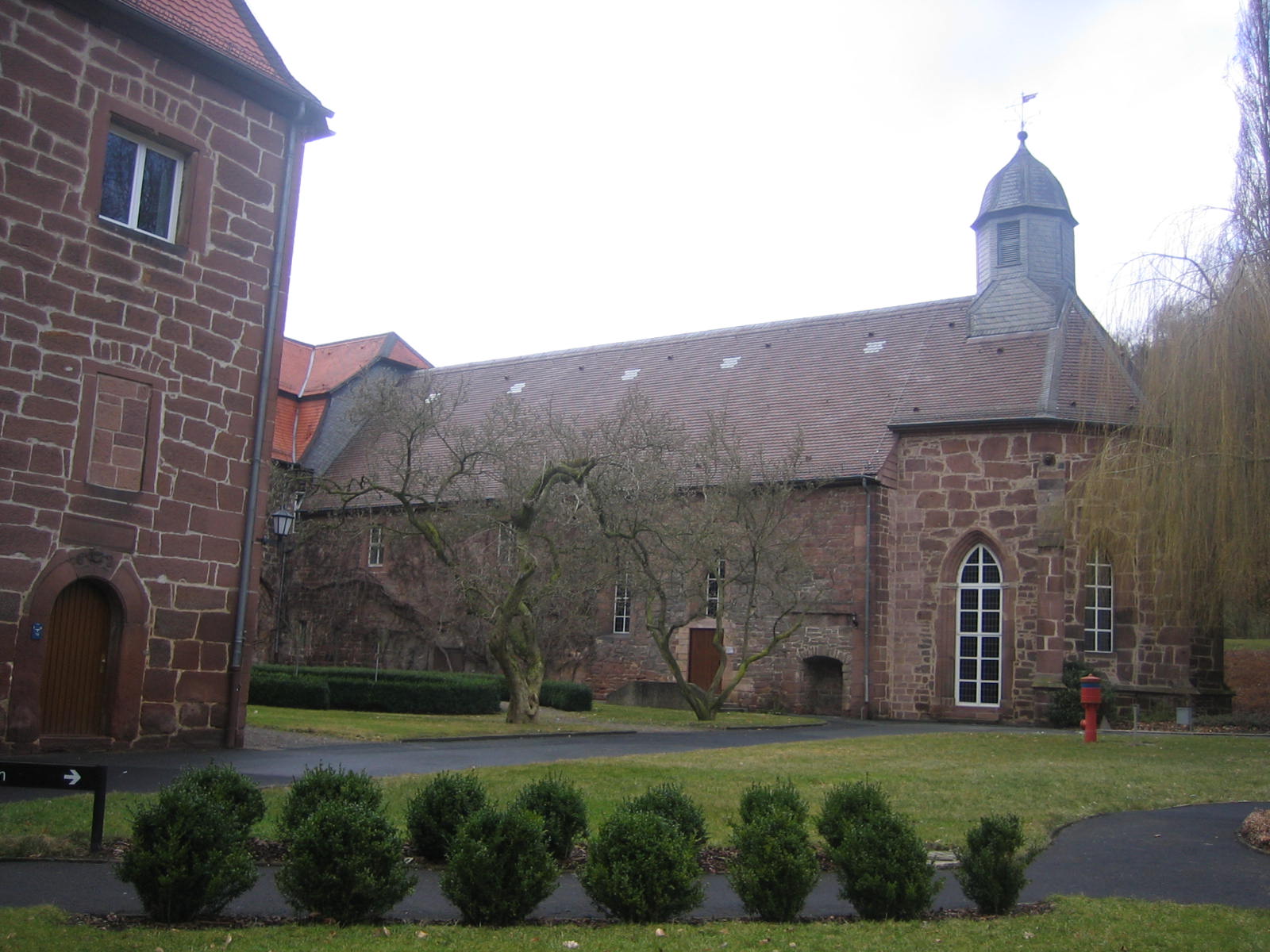
Photograph released into the public domain by the photographer. Shows the courtyard of the former monastery at Merxhausen, the buildings of the state institution part of which was requisitioned as a hospital for displaced people.
Last researched 13 September 2026