Michelsdorf
Displacement in Europe
Michelsdorf, Cham · Germany · 1946–1949
A hamlet outside Cham held a tent city for Jewish transit in the autumn of 1946 and then a small mixed camp of Russians, Belarusians and Ukrainians until May 1949. Its Belarusian gymnasium, scout troop and literary journal are the best documented parts of its life.
Introduction
Michelsdorf, a hamlet in the parish of Altenmarkt near Cham that was absorbed into the town of Cham in 1972, was a displaced persons camp with a particularly active Belarusian educational and literary community. Its inventory also records Russian and Polish-Ukrainian residents. A school, scouting activities and a literary journal helped people maintain a shared language and culture while living in temporary accommodation.
A history in dates
- August–October 1946A transit camp under canvas for up to 5,000 people operates at Michelsdorf; most adults go on to Wetzlar and the children to Rosenheim or Dornstadt.
- Summer 1946The Belarusian community and its school move from Regensburg to Michelsdorf.
- 17 August 1946The Belarusian gymnasium completes its first school year.
- 20 August 1946The camp’s administrative inventory record opens under the building name Tent City.
- 28 June 1947The gymnasium takes the name Janka Kupala.
- 1947The Bavaria unit of the Kastus Kalinouski scout troop is formed in the camp.
- 31 October 1947Recorded accommodation capacity is 550.
- 28 February 1948Residents protest against changing the school’s national designation.
- October 1948The school divides when teachers and pupils move to Windischbergerdorf.
- 19 May 1949The camp’s inventory record closes; the IRO camp file ends the same month.
- 1949–February 1950The gymnasium is resettled to Backnang, where it lasts until February 1950.
- 1950The Shypshyna literary society moves to the United States.
Sources for this section
- Cham: Jewish DP community, including the Michelsdorf tent city
- A life spanning history
- Michelsdorf (Cham): the DP camp
- Michelsdorf / Tent City, inventory entry 1231
- Belarusians in camps for displaced persons in West Germany in 1945–1952
- IRO camp files: Michelsdorf and Windischbergerdorf; Table 7 checked for Michelsdorf
- Shypshyna cover, collection pash per 00041
Two camps, one name
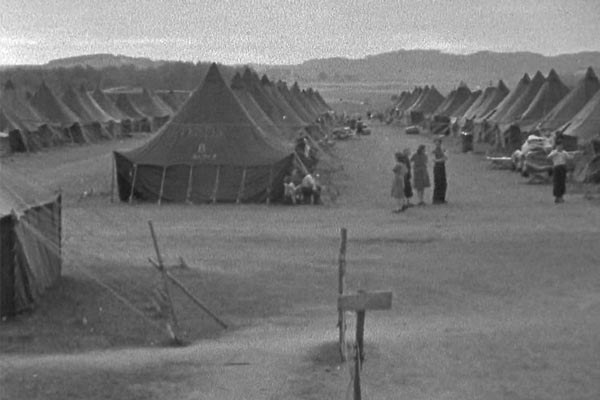
The inventory gives the building at Michelsdorf the name Tent City, and that name belongs to something the inventory does not otherwise describe. A register of Jewish displaced persons camps and communities in West Germany records that a transit camp under canvas for up to five thousand people existed at Michelsdorf from August to October 1946, and that most of its adults were then moved to the Jewish camp at Wetzlar and its children to Rosenheim or Dornstadt.
That figure of five thousand belongs to those two months of Jewish transit and to nothing else. Confusing the two would inflate the Belarusian and Ukrainian community by an order of magnitude.
Two successive camps on the same ground
| Period | Institution | Recorded size |
|---|---|---|
| August–October 1946 | Jewish transit camp under canvas; adults moved on to Wetzlar, children to Rosenheim or Dornstadt | Up to 5,000 places |
| 20 August 1946 – 19 May 1949 | Mixed camp of Russian, Polish-Belarusian and Polish-Ukrainian residents recorded in the inventory as Tent City | 550 on 31 October 1947 |
A community moves from Regensburg
In summer 1946, a Belarusian camp community moved from Regensburg to Michelsdorf, bringing its gymnasium with it. The school had begun in 1945, before the move, and completed its first school year on 17 August 1946. Michelsdorf’s administrative inventory opens on 20 August 1946. It belonged to the relief network of Team 187 at Cham and later Area Team 1046 at Regensburg, and its archive reference points to holdings and change reports under document identifiers 82013382 to 82013400 as well as scattered files in the Cham town archive; none of these have been read.
The inventory’s national classifications include Russian, Polish-Belarusian and Polish-Ukrainian residents. They describe a mixed institution, rather than a camp reserved exclusively for Ukrainians. A capacity of 550 was recorded in October 1947; this is an accommodation figure, not a count of the Ukrainian community. Michelsdorf does not appear at all in Ihor Stebelsky’s published table of Ukrainians in the camps of the American zone, so no Ukrainian headcount for the place is available.
The camp record
| Item | Recorded detail |
|---|---|
| Assembly centre | AC 93-402 |
| Later identifier | NBO 423 |
| Relief team | 187, Cham; Area Team 1046, Regensburg |
| Recorded nationalities | Russian, Polish-Belarusian, Polish-Ukrainian |
| Capacity | 550 on 31 October 1947 |
| Closing date | 19 May 1949 |
| IRO camp file | AJ 43 820, item 22, October 1947 – May 1949 |
Lessons without textbooks
The gymnasium offered Belarusian-language secondary education, with a roll that at times stood between 75 and 122 young people, and it built links with the German gymnasium in Cham. A former pupil recalled lessons with almost no textbooks: teachers prepared notes, which pupils copied quickly and passed to one another. Hunger remained a constant part of school life. On 28 June 1947 the institution took the name of the Belarusian poet Janka Kupala.
School also opened paths beyond the camp. A published biographical study records a March 1948 graduation followed by university study in Germany. Scouting ran alongside it: the Belarusian residents organised a troop named after Kastus Kalinouski, already founded at Regensburg, whose Bavaria unit was formed in 1947 under Vitaut Kipel, later active in the Belarusian community in the United States, and it even published scouting periodicals.
Education and cultural life
| Activity | Direct evidence |
|---|---|
| Secondary education | Belarusian-language gymnasium, at times 75 to 122 pupils, named for Janka Kupala on 28 June 1947 |
| Teaching materials | Hand-copied notes when textbooks were unavailable |
| Youth organisation | Kastus Kalinouski scout troop, Bavaria unit formed 1947, publishing scouting periodicals |
| Literary publishing | Shypshyna journal |
| Links beyond the camp | Contact with the German gymnasium in Cham |
Wild Rose and the printed word
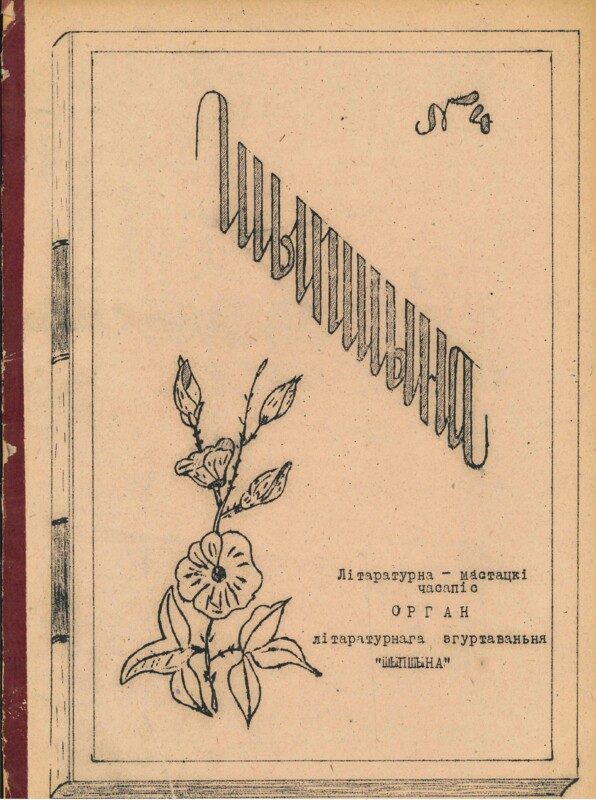
The literary journal Shypshyna, or Wild Rose, was published at Michelsdorf by a literary society of the same name. Copies survive in the University of Toronto’s Pashkievich collection. The original cover identifies it as a literary and artistic journal and uses a flowering rose as its central image.
Its survival adds a different dimension to the camp’s record. Alongside administrative forms and movement lists, the journal preserves a community’s cultural ambitions. The literary society had formed in Germany in 1945 and moved to the United States in 1950, carrying its work beyond the camp period.
Debating a national future
Cultural life was also contested. A proposal to identify the school as Kryvian, using a historical national designation, provoked disagreement within the Belarusian community. At a residents’ meeting on 28 February 1948, the camp council protested against changing the national name. The dispute shows that shared exile did not mean everyone agreed on how the community should define itself.
Michelsdorf and its gymnasium also appear among contributors to a fund supporting Belarusian students in higher education. Contributions were pooled across several camps and organisations; the published total cannot be assigned to Michelsdorf alone.
Sources for this section
After the camp
The camp began to break up before it closed. In October 1948 the school was divided when several teachers and pupils had to move to Windischbergerdorf, near Cham, where five hundred Belarusians were already living; Windischbergerdorf has its own IRO camp file running to June 1949. The gymnasium itself was resettled to Backnang in Württemberg in 1949 and lasted there until February 1950.
The inventory records the camp’s closure on 19 May 1949, and the IRO file for Michelsdorf, AJ 43 820 item 22 in the French national archives, ends in the same month. The literary society’s later American activity shows one way cultural connections continued after the German camp years. Nothing has been found about where the Ukrainian residents of Michelsdorf went; the departures that are documented are those of the Belarusian school.
Sources
- Michelsdorf / Tent City, inventory entry 1231
Arolsen Archives · 26 October 2023
20 August 1946 to 19 May 1949; Russian, Polish-Belarusian and Polish-Ukrainian residents. Capacity 550 on 31 October 1947; AC 93-402, NBO 423, Team 187 Cham, Area Team 1046 Regensburg. ITS documents 82013382-82013400 plus scattered files in the Cham town archive.
- Memories of education at Michelsdorf
Radio Svaboda, published participant recollection · 11 June 2010
First-person recollection: gymnasium transferred to camp, founded 1945, named for Kupala 1947; no textbooks, copied teacher notes, hunger. No resident name in article.
- Belarusian publications in Displaced Persons camps in Germany
University of Toronto Libraries · Current exhibition
Identifies Shypshyna as Michelsdorf literary journal; describes institutional collection.
- Shypshyna cover, collection pash per 00041
University of Toronto Libraries · 1946–1950 journal
The institutional record identifies Michelsdorf as publisher location. The society worked in Germany from 1945 and moved to the USA in 1950. The cover visibly shows number 6, despite the catalogue title identifying 4–5; the caption therefore omits the issue number.
- Belarusians in camps for displaced persons in West Germany in 1945–1952
Anastasiya Ilyina / Warsaw East European Review · 2022
Printed pp 95–97 directly read: school language/naming debate, camp meeting 28 February 1948, donor network. Unrelated workshops statistics on preceding page not assigned to Michelsdorf.
- A life spanning history
Belarusian Historical Review · 2022
The school moved with the community from Regensburg in summer 1946. The biography documents local scouting and a March 1948 school graduation. Only institutional events are used; no resident names are reproduced.
- Michelsdorf (Cham): the DP camp
Wikipedia, German · Revision of 5 September 2026, retrieved 13 September 2026
Raw article text read: hamlet of the former parish of Altenmarkt, incorporated into Cham on 1 January 1972; camp opened 20 August 1946 with 550 people on 31 October 1947 of various nationalities including Russians, Poles, Ukrainians and Belarusians; Kastus Kalinouski scout troop founded at Regensburg with a Bavaria unit formed in 1947 under Vitaut Kipel, publishing scouting periodicals; Belarusian-language gymnasium completing its first school year on 17 August 1946, with 75 to 122 pupils at times, links to the Cham gymnasium, named for Janka Kupala on 28 June 1947, divided in October 1948 when teachers and pupils moved to Windischbergerdorf where 500 Belarusians already lived, and resettled to Backnang in 1949 until February 1950; camp closed 19 May 1949. Tertiary account; the underlying PDF on Belarusian emigration formerly hosted by europe-direct-cham.de could not be retrieved.
- Cham: Jewish DP community, including the Michelsdorf tent city
after-the-shoah.org, Jewish DP camps and communities in West Germany · Retrieved 13 September 2026
German and English text read: a transit camp under canvas for up to 5,000 people existed at Michelsdorf from August to October 1946; most adult residents were transferred to Wetzlar and the children to Rosenheim or Dornstadt. This was a Jewish transit camp and its figure must not be applied to the later mixed camp.
- IRO camp files: Michelsdorf and Windischbergerdorf; Table 7 checked for Michelsdorf
Canadian Institute of Ukrainian Studies, Research Report No. 2 · 1982
Printed page 34 read directly: AJ 43 820, item 22, Michelsdorf, October 1947 to May 1949, and item 21, Camp Windischbergerdorf, October 1947 to June 1949. Separately, Ihor Stebelsky’s Table 7 in The Refugee Experience (1992), printed pages 47–51, was read in full and contains no row for Michelsdorf, so no Ukrainian headcount for the camp is published there.
- Die Zeltstadt am Rande von Cham / The tent city on the outskirts of Cham
after-the-shoah.org, Nürnberger Institut für NS-Forschung und jüdische Geschichte des 20. Jahrhunderts e.V. · 1946
Photograph of the rows of tents of the transit camp, which the same page describes as a reception camp for up to 5,000 people that stood from August to October 1946 in the Michelsdorf district of Cham. No reuse licence is stated for the image.
Last researched 13 September 2026