Miranda de Ebro
Displacement in Europe
Miranda de Ebro · Spain · 1937–1947
A Francoist concentration camp beside the Bayas river became the central holding place for foreigners who crossed into Spain during the Second World War. Ukrainian testimony and the army’s own index of admission files both record Ukrainians among them, arriving from Pamplona prison on New Year’s Day 1944.
Introduction
Miranda de Ebro was a Spanish military-run concentration and internment camp. During the Second World War, crossing into Spain could lead refugees and escaped prisoners into detention here. Ukrainian presence is directly documented in a survivor’s memoir and independently corroborated by an institutional biography. This was a guarded custodial site, rather than an UNRRA displaced-persons settlement.
A history in dates
- 5 July 1937An order of the Burgos war secretariat creates the Francoist concentration camps; one is sited at Miranda de Ebro, in operation from June 1937.
- Summer 1940A new phase begins with foreign refugees and prisoners escaping the European war.
- January 1943An eleven-day hunger strike led by the Polish internees wins releases and improvements; the camp population peaks at 3,770 on 14 January.
- October 1943Two Ukrainians cross the Pyrenees at Orbaizeta and are registered by the Spanish authorities as Russians.
- 1 January 1944A Ukrainian eyewitness records arrival from Pamplona prison with a group of thirty-six.
- December 1946The last admissions are recorded in the index of personal files.
- February 1947The depot is wound up.
- 1950sThe camp buildings are demolished for a factory complex.
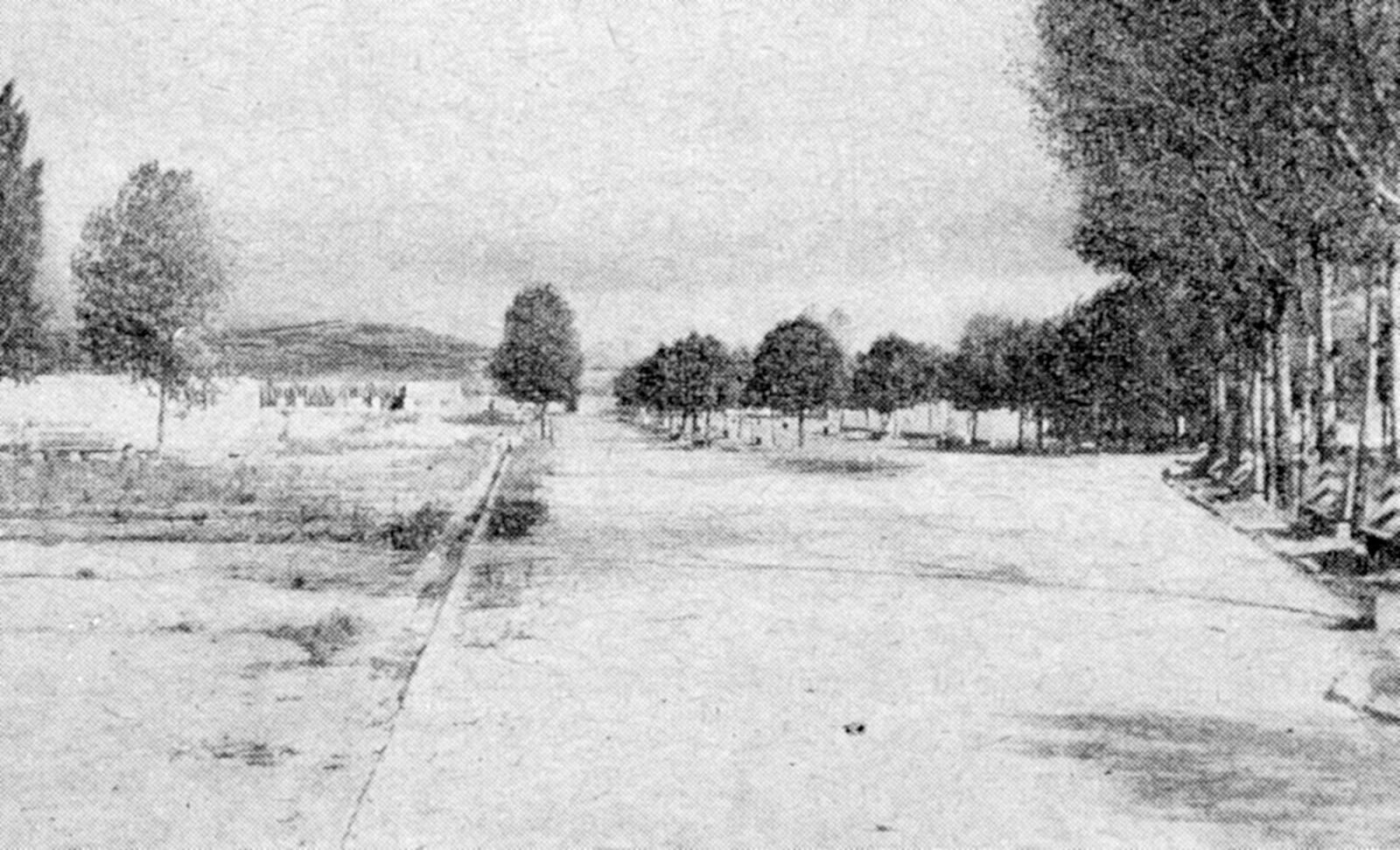
- September 1955A photograph records the camp’s main avenue and ruined buildings.
- 2006Surviving structures undergo conservation.
Sources for this section
- Refugiados extranjeros en España: el campo de concentración de Miranda de Ebro
- Campo de Concentración 1937–1947
- Archivo General Militar de Guadalajara: cuadro de clasificación e historia de fondos
- Ukrainian account of internment at Miranda
- Los expedientes personales de ingreso en el Depósito de Concentración y Clasificación de Personal Extranjero de Miranda de Ebro (Burgos). Índice nº 13
- Un camp pas comme les autres
- Centro de Interpretación sobre el Campo de Concentración de Miranda de Ebro
A camp beside the railway
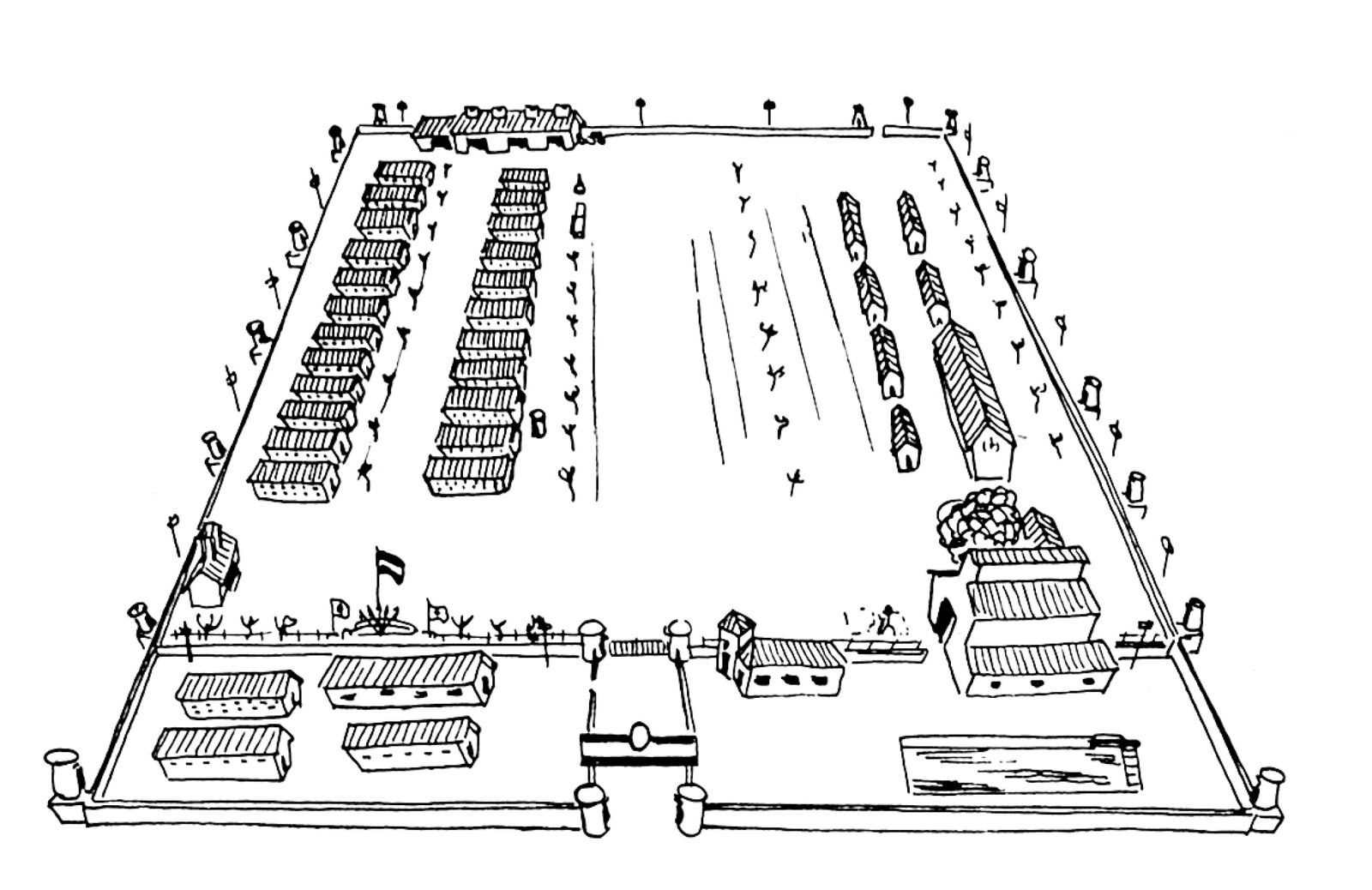
Established following an order of 5 July 1937, the camp stood at La Hoyada beside the Bayas River and the Castejón–Bilbao railway. The municipal history gives a site area of approximately 42,000 square metres. Initial barracks used materials from a circus stored in the town. Its first prisoners came from the Spanish Civil War.
The municipal memory project records that the camp was built on land belonging to the Sulfatos Españoles company and that the requisitioned circus materials came from the Circo Corzana, stored in the town since the start of the Civil War. It puts the camp in operation from June 1937, the longest lived in Spain, and gives its first-phase capacity as about 1,500. The town had served as the northern army’s rear area since the Third Carlist War.
Changing prisoner groups
From summer 1940, foreign refugees and prisoners escaping the European war were interned at Miranda. Its populations overlapped: Republican prisoners and International Brigaders, people fleeing German occupation, and later German officers and soldiers escaping the collapse of the Third Reich. The camp’s changing population cannot be described as one national community.
The municipal account notes that the German soldiers and collaborators who arrived from 1944 were treated far better than earlier prisoners, some being allowed to walk in the town. Until February 1947 the depot remained a disciplinary unit of the army ministry, which controlled custody, internal regime and the rules for admission and release.
Overlapping phases of detention
| Period | Principal groups described by the municipal history |
|---|---|
| 1937–1944 | Republican prisoners and International Brigaders |
| 1940–1945 | Foreign internees escaping German occupation |
| 1944–1947 | German officers and soldiers fleeing the defeated Reich |
Inside the depot
Matilde Eiroa’s study of the camp, drawn from the military archive at Guadalajara, describes a rectangular enclosure behind a two-metre wall and barbed wire, with sentries every fifty metres. Two rows of fifteen barracks faced a main avenue that served as the meeting place of what she calls a tower of Babel. Each barrack had an earth floor and a boarded upper level that doubled its capacity to about 100 to 120 men. The usual maximum for the whole camp was 2,000 to 2,500, a figure far exceeded by the mass arrivals of the first quarter of 1943, when two further barracks were built.
Administration ran through a command office, an information and investigation office, a foreigners’ office, a kitchen service, stores and a canteen. The information office registered each new arrival, interrogated him, confiscated his currency, censored correspondence and sat in on visits. Internees were grouped by nationality, and each nationality had a group chief, usually a military man chosen by the internees or by their legation, who acted as the link with the camp direction, handled relief funds and carried disciplinary authority. The Ukrainian memoir records instead a last barrack set aside for the stateless, men with no legation to speak for them.
The routine ran from a bugle call and flag raising through breakfast, walking, sport, the fascist salute and Sunday mass. There was a canteen, barracks given over to gambling, and ways of earning money by portraits, haircuts or making bunks, alongside a well established black market in which some of the guards took part. The Ukrainian account adds a cinema with a stage and a piano, an international library, a reading room, an infirmary, a chapel, a large square and a swimming pool, and constant tunnelling under the wall, none of it successful. In January 1943 an eleven-day hunger strike led by the Poles won the release of internees over forty and under eighteen, the transfer of officers to Jaraba and improvements to the buildings.
Recorded internees on selected dates
| Date | Internees | Largest national groups named |
|---|---|---|
| 3 July 1940 | 187 | Poles, Belgians, French |
| 1 March 1941 | 410 | Poles, British, French |
| 20 December 1941 | 920 | Poles, British, French |
| 1 January 1942 | 1,053 | Canadians, Belgians, Poles, French |
| 1 July 1942 | 1,161 | Canadians, Belgians, Poles, French |
| 29 December 1942 | 3,402 | French, Canadians, Poles |
| 14 January 1943 | 3,770 | French, Canadians, Poles, British |
| 30 June 1943 | 1,598 | French, Canadians, Poles, British |
| 5 September 1944 | 421 | Germans, French, stateless |
| 31 October 1945 | 421 | Germans, French, Italians |
| 1 October 1946 | 211 | Germans, French, Italians |
| 1 November 1946 | 294 | Germans, French, Belgians, Italians |
| 1 December 1946 | 356 | Germans, French, Belgians, Italians |
The Ukrainian route into detention
A Ukrainian memoir published in 1971 describes two men crossing the Pyrenees in October 1943, then spending several weeks in Pamplona provincial prison. On 1 January 1944, they were taken by train to Miranda. The account recalls officials repeatedly recording them as Russian despite their Ukrainian identification. It also records further Ukrainian arrivals. These observations establish Ukrainian presence without providing a complete Ukrainian population count.
The memoir sets out how the misclassification began. At the frontier post at Orbaizeta the commander answered their attempt to say they were Ukrainians by correcting them to Russians, and only with difficulty did they get the words ruso blanco written on their provisional papers. The same argument was repeated at the identification formalities in the camp. A Spanish official in Pamplona, they recalled, showed off his knowledge that Ukraine had a great deal of wheat and then wrote Russian.
Sources for this section
The Ukrainians in the stateless barrack
For several months the two men were the only Ukrainians in the camp. The memoir names the author, Antin Drahan, and the engineer Yurii Karmanin, who was living in Toronto when the account was published in 1971; a photograph on the same pages carries both names. In the spring three more arrived, remembered only by their first names as Mitka from the Kuban, Petia from Zhytomyr and Valentyn from Poltava. They had been conscripted into the Red Army, taken prisoner by the Germans, sent to a camp in France to look after army horses and had escaped from there without a guide. Two Georgians who had escaped German captivity in the same way followed later.
Their position was precarious in a way the western internees’ was not. As Soviet citizens they were the responsibility of the British legation, which represented Soviet interests in Spain, and its representative called from time to time to say that they would soon be taken home. Eiroa notes that the stateless, Jews and others with no diplomatic recognition, went unassisted for a long time until the International Red Cross supplied the papers that let them leave Spain. One of the three answered the camp clerk’s question about nationality by insisting that his nationality was sporting, having found that every other answer had gone badly for him.
Living behind the wire
Eyewitness accounts describe crowded sleeping quarters, vermin, inadequate food and the uncertainty of release. A French account explains how embassy assistance and Red Cross parcels could materially change a prisoner’s prospects. Inside the camp, there were kitchens, an infirmary, a chapel and spaces for reading or performance. The Ukrainian memoir recalls guards calling through the night and improvised attempts to keep bedbugs from climbing onto beds.
Sources for this section
Closure and remembrance
The detention camp closed in early 1947. Its grounds subsequently served military training before industrial development removed most buildings. Surviving traces include water installations, a guard structure and parts of the perimeter; conservation work took place in 2006. The municipal interpretation centre presents documents, photographs, drawings and reconstructions of the camp.
The municipal memory project records that all the camp buildings were destroyed in the 1950s to make way for a factory complex, and lists what survives: the water tank, the wash house, the base of a watchtower, sections of the perimeter wall and a small guard building, all now protected under the town plan. A memory garden was created alongside the interpretation centre.
The surviving records
The military archive at Guadalajara preserves 119 boxes relating to foreign internment, including admission and release papers, lists, financial matters and escapes. It also holds material on separate spa facilities used for foreign officers when Miranda was overcrowded. Those associated places require their own evidence of Ukrainian presence.
Within that fondo, the series of personal admission files fills 104 boxes covering 1938 to 1947, and its alphabetical index, compiled at Guadalajara by F. Javier López Jiménez, lists roughly 15,600 entries, each giving box, file number, name and nationality. Eighteen of them are recorded as Ukrainian. Another fifty-three are recorded as Russian and about 175 as stateless, so the eighteen are a minimum rather than a count of Ukrainians at Miranda. Two of the eighteen, entered as Anton Drajan and Georg Karmanin, correspond by name to the memoir’s author and to the engineer named in its photograph caption; the files themselves have not been read.
The index explains what each file contains: a personal record card, an interrogation, censored correspondence, personal documents confiscated on arrest and claims from legations or the Red Cross asking for release. It also states that foreigners detained in Navarre arrived at Miranda accompanied by the file and interrogation carried out at the Pamplona police station, which is the administrative counterpart of the journey described in the Ukrainian memoir. On admission men were classified by belligerent or neutral nationality, by age, and as escaped prisoners of war, doctors, clergy, undesirables, deserters or unfit.
Nationality recorded in the index of admission files
| Nationality as recorded | Entries |
|---|---|
| France | 6,597 |
| Canada | 2,051 |
| Germany | 2,014 |
| Belgium | 1,169 |
| Poland | 1,093 |
| United Kingdom | 781 |
| Netherlands | 278 |
| United States | 240 |
| Italy | 236 |
| Stateless | 175 |
| Czechoslovakia | 95 |
| Russia | 53 |
| Ukraine | 18 |
Sources for this section
Sources
- Centro de Interpretación sobre el Campo de Concentración de Miranda de Ebro
Ayuntamiento de Miranda de Ebro
Municipal archive-curated interpretation: July 1937 establishment, La Hoyada site, overlapping prisoner phases, 42,000 square metres, later military use and surviving remains.
- Ukrainian account of internment at Miranda
Almanac of the Ukrainian National Association, 1971
Original printed pages 134–139 read. Explicit Ukrainian self-identification, October 1943 escape, Pamplona imprisonment and arrival at Miranda on 1 January 1944. Inmate names and identifying photograph omitted.
- Biographical record corroborating Ukrainian internment at Miranda
Encyclopedia of Modern Ukraine, 2008
Institutional biographical source independently confirms Ukrainian internment at Miranda after the October 1943 journey and migration to the United States in 1946. Individual name omitted from article and source label.
- Un camp pas comme les autres
Fondation de la France Libre; original memoir published in 1960
Original eyewitness article republished by the foundation in 2017. Camp layout, harsh conditions, relief networks and the image explicitly dated September 1955 checked. Uncorroborated total-throughput and area estimates are not used.
- Archivo General Militar de Guadalajara: cuadro de clasificación e historia de fondos
Ministerio de Defensa, July 2022
Original printed pages 16–17: foreign-prisoner phase from summer 1940, early 1947 closure, 119 archival boxes, and separate spa detention sites for foreign officers in 1943–1945. Archive date span is not camp operating span.
- Los expedientes personales de ingreso en el Depósito de Concentración y Clasificación de Personal Extranjero de Miranda de Ebro (Burgos). Índice nº 13
F. Javier López Jiménez, Archivo General Militar de Guadalajara, Ministerio de Defensa · 2003, revised February 2018
Alphabetical index to the admission files, AGMG DCME cajas 305279 to 305382, 104 boxes, extreme dates 1938 to 1947. Read in full from the cached copy at research-workers/section-completion/spain-sources/dcme-agmg-indices.pdf. Machine count of the nationality field: about 15,600 entries, of which 18 are recorded as UCRANIA, 53 as RUSIA and 175 as APATRIDA. The introduction supplies the classification categories, the contents of each file, the Pamplona police route for detainees in Navarre, the annual admission pattern and the February 1947 closure.
- Refugiados extranjeros en España: el campo de concentración de Miranda de Ebro
Matilde Eiroa San Francisco, Ayer 57 (2005), pp. 125–152 · 2005
Scholarly study based on the Guadalajara military archive. Read in full. Supplies the camp layout, barrack capacity of 100 to 120 and overall maximum of 2,000 to 2,500, the administrative offices and group chiefs, the daily routine, the January 1943 hunger strike, the position of stateless internees, and Cuadro 1, the dated population counts drawn from AGMG DCME Relaciones de Internados cajas 140 to 142.
- Campo de Concentración 1937–1947
Memoria Histórica Miranda de Ebro, Concejalía de Memoria Histórica · retrieved 13 September 2026
Municipal memory project. Supplies the La Hoyada landowner, the Circo Corzana materials, June 1937 to January 1947 operation, the first-phase capacity of about 1,500, the treatment of German internees from 1944, the army ministry’s responsibility, the 1950s demolition for a factory complex and the list of protected remains. Its figure of more than 60,000 prisoners is not reconciled with other published estimates and is not used.
Last researched 13 September 2026