Jäger-Kaserne
Displacement in Europe
Mittenwald, Bavaria, Germany · 1946–1951
In barracks beside the Isar, Ukrainian displaced people built a community of schools, workshops, churches and elected representatives. Their annual report describes both the achievements and the daily shortages of a camp housing more than 3,000 people.
Introduction
Jäger-Kaserne, also known as Nordkaserne, became a Ukrainian displaced-persons camp in 1946. Thousands of residents made the barracks into a community with classrooms, clinics, workshops, churches and an elected council. The camp administration’s annual report, Pidsumky, preserves a detailed picture of life here: the meals prepared, rooms adapted, lessons taught and journeys planned.
Jäger was one of several separate camps at Mittenwald. It shared some administration and activities with Pionier and other sites, but had its own population and institutions. Its final clearance took place in two stages, ending in January 1951.
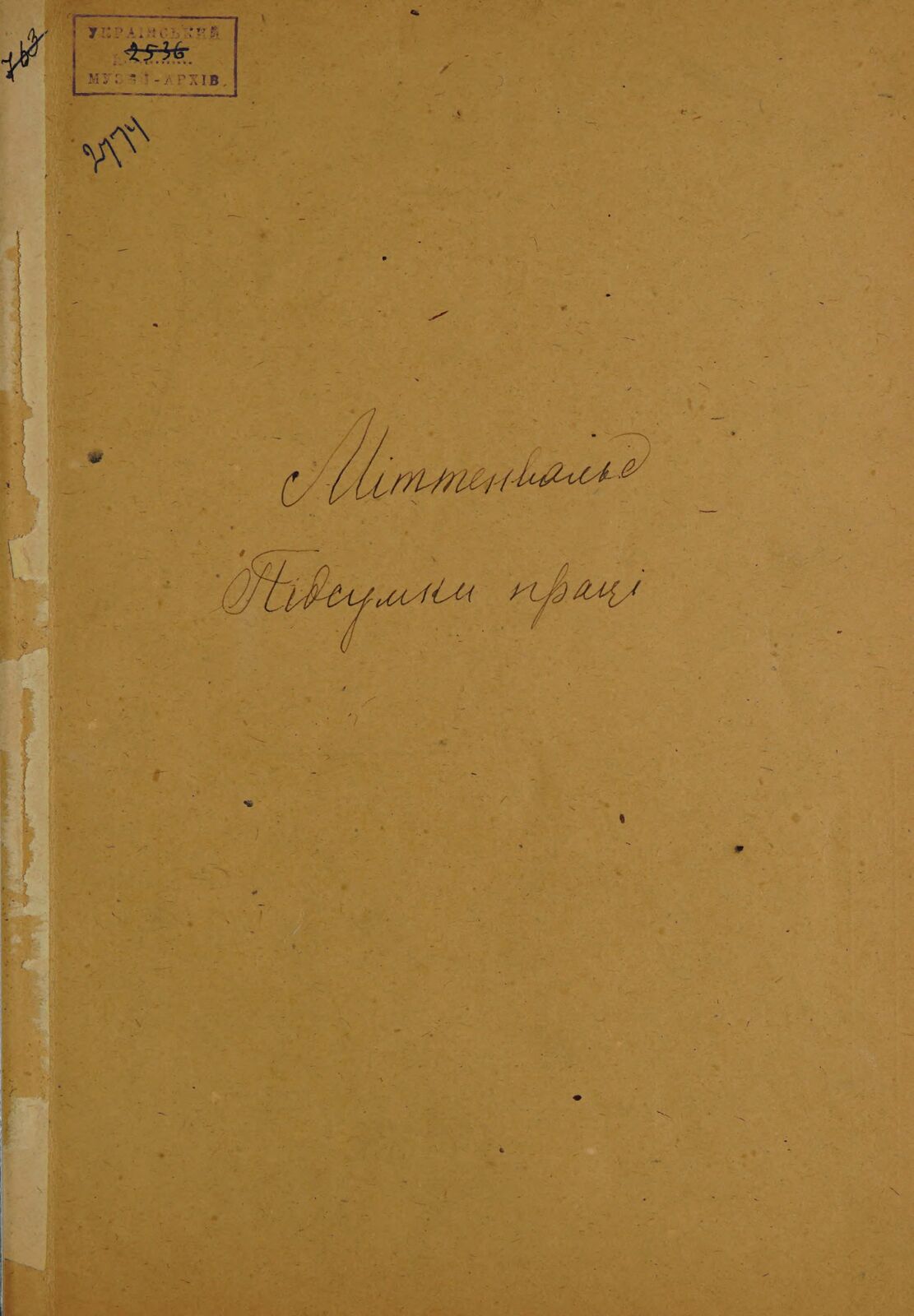
A history in dates
- 1937–1938The Jäger barracks are built and receive mountain troops.
- Early March 1946Jäger-Kaserne takes in its first displaced residents: Banat people, Lithuanians, Estonians, Latvians, Poles, Russians and Hungarians.
- April 1946The first group of Ukrainians, about 300 people, arrives.
- Late May–early June 1946Groups arrive from Karlsfeld and Füssen.
- June–July 1946Primary, music, teachers’ and gymnasium teaching develops at Mittenwald.
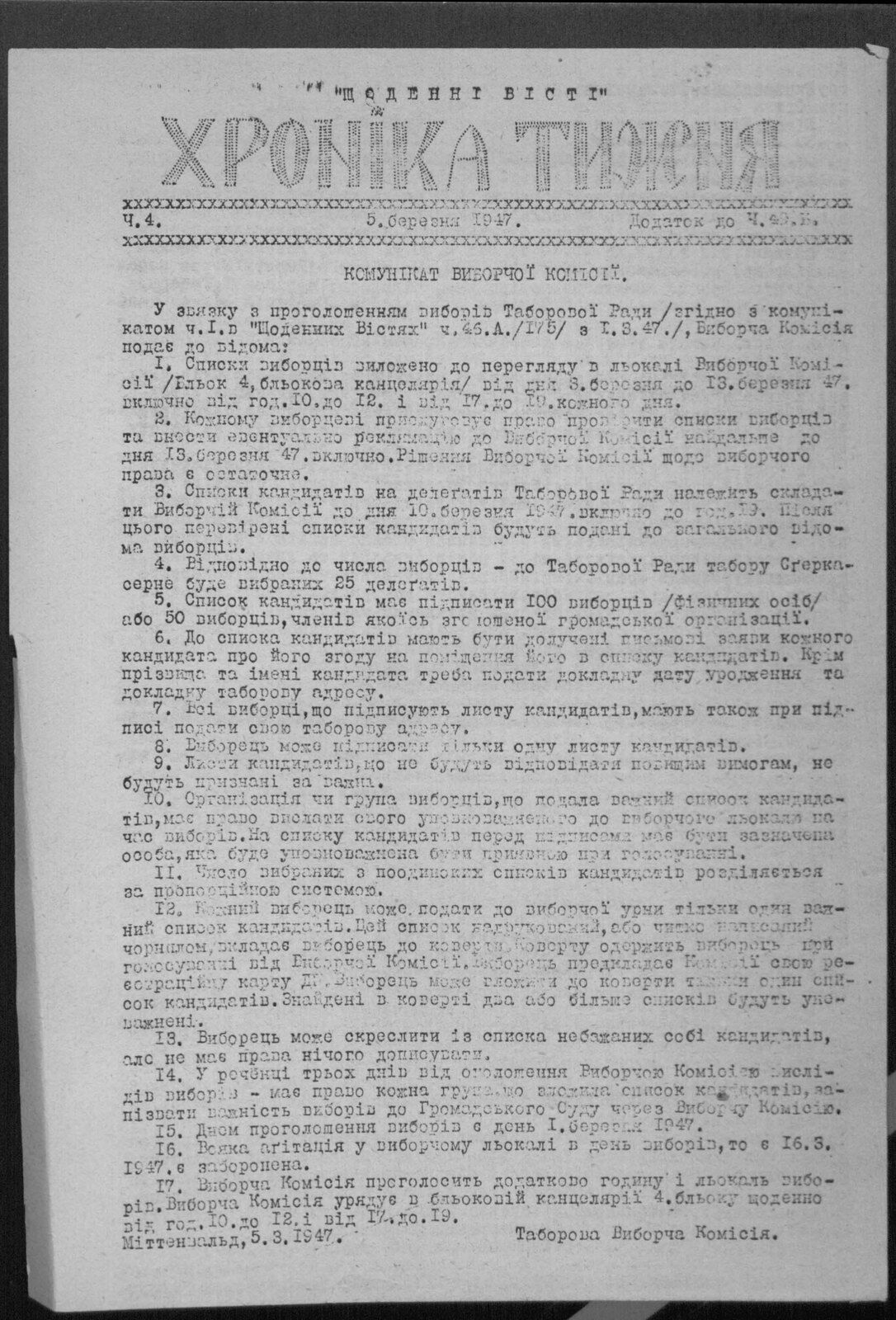
- 5 March 1947The Camp Election Commission announces that 25 delegates will be elected to the Jäger-Kaserne camp council.
- 15 March 1947Residents elect a 21-member camp council.
- Mid-June 1947A Combined Camp Mittenwald is formed from Jäger-Kaserne, Pionierkaserne, Lüttensee and the Karwendel hotel, with its administration in the Jäger-Kaserne.
- 10 June 1947M. Duzhyi takes responsibility for the wider assembly centre.
- 12 July 1947The camp bulletin records 3,024 residents in the Jäger-Kaserne camp itself, excluding Pionierkaserne.
- 31 July - 13 August 1947The Jäger- and Pionierkaserne camps may send 100 children aged 10 to 14 to the YMCA holiday camp at Grafenaschau.
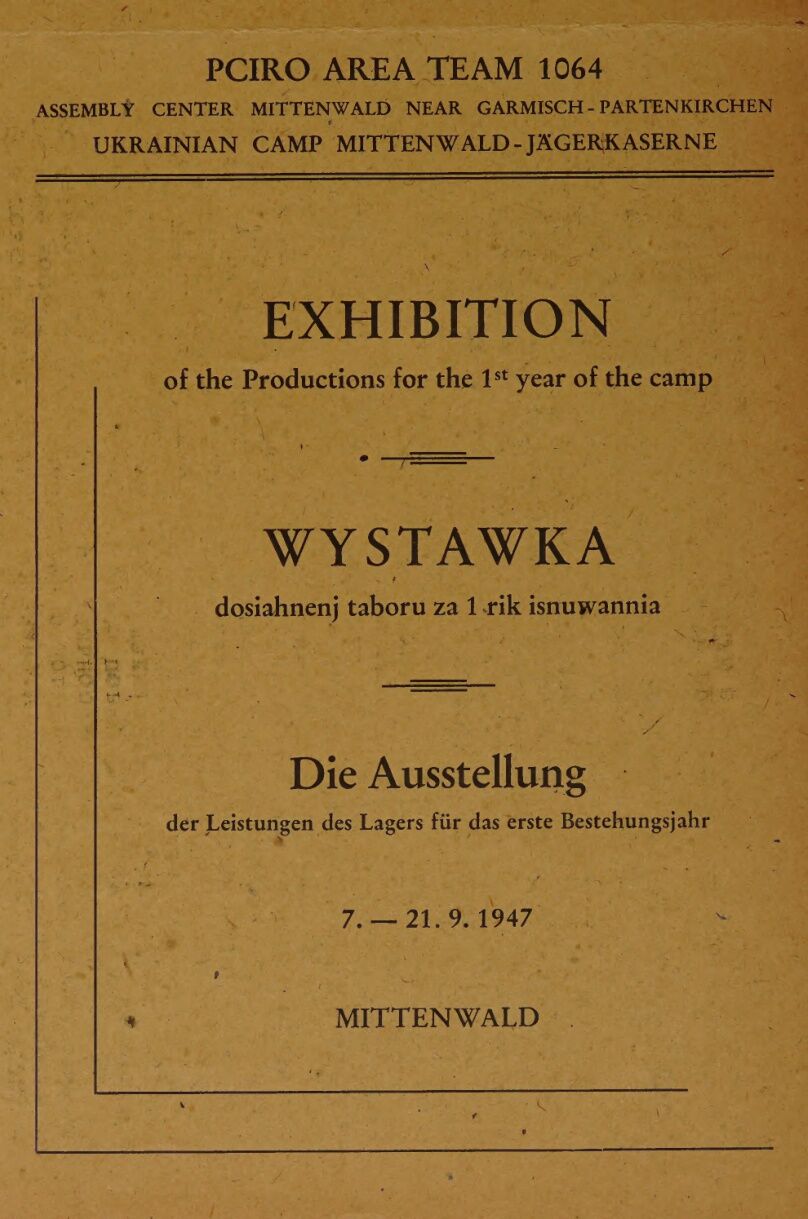
- 7–21 September 1947Exhibition of the camp’s first year of work.
- October–December 1947The assembly-centre office organises group departures to Belgium, Canada and England.
- 23 December 1947Registration office records 3,087 Jäger residents.
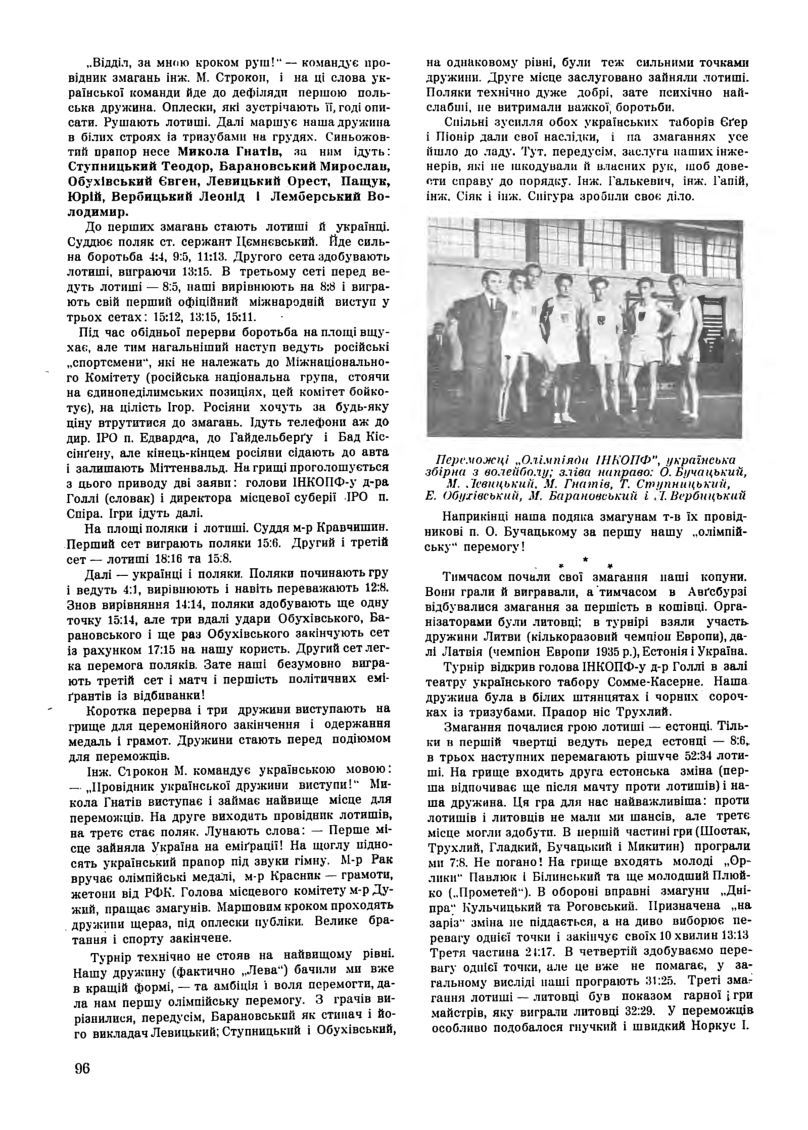
- 26 June 1948Jäger and Pionier jointly organise volleyball competition at Pionier’s hall.
- 6 December 1950Right-bank portion handed over.
- 24 January 1951Left-bank portion handed over, completing the two-stage clearance.
- 1964The former Jäger barracks take the name Edelweißkaserne.
Sources for this section
- Ortskameradschaft Mittenwald, 50-year anniversary booklet, 1956–2006
- Taborovi Budni (Camp Weekdays): weekly camp bulletin, Mittenwald, nos 1-8
- Pidsumky: camp administration report for 1 January–31 December 1947
- Shchodenni Visti (Daily News), no. 4, supplement to no. 43.B
- Oleh Lysiak, Sports games of INKOPF—The DP Olympics, in Almanac of the Ukrainian Council for Physical Culture (Munich, 1951)
- Bavarian cabinet minutes, 8 November 1950, item III, with editorial annotation 50
The barracks and the first arrivals
The former Jäger barracks are identifiable as the later Edelweißkaserne. A local garrison history dates construction in the Kofel area to 1937 and the arrival of Gebirgsjägerregiment 98 to November 1938. It records the name Edelweißkaserne from 1964. The camp’s final handover records describe accommodation on both banks of the Isar.
Groups of Ukrainians arrived from the camps at Karlsfeld and Füssen in late May and early June 1946. They brought organised educational work with them. The teachers’ seminary had begun at Karlsfeld in 1945 and moved to Mittenwald with almost its full body of students. Practical training initially depended on individual specialists, before a vocational education officer was appointed with UNRRA’s agreement on 15 July 1946.
A short history of the camp printed in the weekly bulletin Taborovi Budni records that the Jäger-Kaserne camp took in its first displaced residents at the beginning of March 1946. The first to arrive were about 60 Banat people, about 140 Lithuanians, Estonians and Latvians together, about 80 Poles, about 80 Russians and a group of Hungarians. The first group of Ukrainians, about 300 people, arrived in April 1946. The bulletin describes that group as the foundation of the Ukrainian camp at Mittenwald, which by the end of 1946 already numbered more than 3,000 Ukrainians.
Sources for this section
People and rooms
The registration office counted 3,593 residents at Jäger on 1 January 1947. Other nationalities left during January, after which the report gives 3,104 residents, including 17 Poles and two Turks. On 23 December it recorded 3,087 people. These are whole-camp counts. Arrivals, births and departures kept the community changing even while thousands continued to live there.
Space was a persistent concern. The housing department recorded 608 rooms considered suitable for accommodation, but some were used by the hospital, offices, schools and workshops. It listed 497 rooms remaining for residential use, with residents creating another 112 separate rooms in space not originally adapted for housing. The inspection commission reported strong demand for small private rooms.
A network of workers kept the buildings usable. The camp relied mainly on central steam heating. Repairs included boilers, electrical equipment, water pipes and drains. In November and December 1947, carpenters repaired windows and adapted five rooms for the gymnasium, the secondary school. Horse transport carried post, food and materials around the camp.
The bulletin’s population survey gives the barracks a count of its own. On 12 July 1947 it recorded 3,024 residents of the Jäger-Kaserne camp itself, of whom 2,997 were Ukrainians and 27 Poles, expressly excluding the attached Pionierkaserne.
Residents recorded by the camp office
| Date or period | Residents | Coverage |
|---|---|---|
| 1 January 1947 | 3,593 | All residents at Jäger-Kaserne |
| After the January 1947 departures | 3,104 | Includes 17 Poles and two Turks |
| 23 December 1947 | 3,087 | All residents at Jäger-Kaserne |
Accommodation and shared facilities, late 1947
| Facility | Reported provision |
|---|---|
| Rooms suitable for accommodation | 608 |
| Of these, remaining for residential use | 497 |
| Additional separate rooms created in other space | 112 |
| Bathing facilities | 9 bathing rooms; 83 showers; 18 baths |
An elected council and daily administration
Residents elected a 21-member camp council on 15 March 1947. It selected a five-member presidium, and its report records 22 presidium meetings and 15 council plenary meetings during the term ending in November. The council worked with the camp administration on housing, supplies, schooling and relations with relief officials.
M. Duzhyi became head of the administration in April and received responsibility for the wider Mittenwald assembly centre on 10 June 1947. Administrative work crossed camp boundaries: from August, the department issued travel permits for residents of all four camps. Jäger’s local community and the assembly centre were therefore connected, but were not interchangeable.
The camp had its own police and a camp court, with some cases referred to American military or German authorities. Police patrolled offices, the theatre, churches and other facilities, handled lost documents and issued character certificates for people seeking to emigrate. Their report noted that the camp lacked fencing on three sides and that unregistered visitors could enter.
These records also reveal disagreement within the community. Residents challenged food distribution, clothing supplies and accommodation decisions. A council-appointed inspection commission investigated services and tried to organise kitchen oversight, with limited participation. Its report recorded both shortages and the administration’s attempts to address them.
The camp daily Shchodenni Visti of 5 March 1947 printed the Camp Election Commission’s communiqué. It stated that, in proportion to the number of voters, 25 delegates would be elected to the camp council of the Jäger-Kaserne camp.
Taborovi Budni records that in mid-June 1947 a Combined Camp Mittenwald was created, made up of the camps at Jäger-Kaserne, Pionierkaserne and Lüttensee and the Karwendel hotel, which held a Jewish camp. The administration of the Combined Camp was placed in the Jäger-Kaserne, and the bulletin gives the Combined Camp a population of 5,009. It reports that the camp offices were relocated as part of the same reorganisation.
Meals and the work behind them
Two kitchens served ordinary meals and a separate kitchen fed children. The food department described an average of 2,250 people using the main kitchens and 350 children using the children’s kitchen; about 400 residents received dry rations, including students, sick people and those working outside camp.
The same report describes the shortcomings behind the totals. Supplies could be monotonous, sometimes dominated by oat flakes, and there was no regular allotment of onions or eggs. Staff shortages left vegetables unprocessed and kitchen work continued from early morning into the evening. The inspection commission found that the nominal calorie allocation was easier to meet on paper than in practice.
Meals prepared during the reporting year
| Kitchen | Breakfasts | Midday meals | Evening meals |
|---|---|---|---|
| Children’s kitchen | 108,341 | 107,835 | 110,986 |
| Kitchen 1 | 397,789 | 395,290 | 361,789 |
| Kitchen 2 | 411,600 | 408,369 | 375,717 |
| Total | 917,730 | 911,494 | 848,492 |
Sources for this section
Health and support
The outpatient clinic’s staff fell from nine doctors and six nurses in the first half of 1947 to five doctors and three nurses in the second half, with a registration clerk. Care included general medicine, children’s health, dentistry and sanitary inspection. Patients also travelled to hospitals outside the camp.
The school doctor’s examinations show how uneven children’s health remained. Many examined pupils were below the weight considered normal by the camp doctor. The report also records anaemia, undernutrition and infectious illnesses. An X-ray machine and equipment for a women’s clinic were available, but suitable rooms had not yet been found to put them into service.
The welfare office helped widows, orphans, older residents, disabled people and patients in hospitals. It distributed food parcels, bought medicines unavailable from hospital dispensaries and maintained contact with patients through visits, letters, books and newspapers. Its register included 96 widows, 77 children under 18 who had lost one parent, and ten children who had lost both parents. Three of the latter group left for America and three joined relatives in other camps.
Loss of DP status created a separate crisis. The office reported 95 residents deprived of that status. Local lawyers prepared appeals, which restored the status of 14 people. The administration helped those still excluded obtain German identity papers and private accommodation.
Children examined by the camp doctor in 1947
| Group | Examined | Recorded at normal weight |
|---|---|---|
| Kindergarten children | 77 | 29 |
| Primary-school pupils | 152 | 65 |
| Secondary-school pupils | 253 | 120 |
Sources for this section
Classrooms, teachers and school funds
The primary school began in June 1946, initially using recesses in corridors. By December 1947 it had warmer rooms, while younger classes used the gymnasium’s classrooms in the afternoons. The gymnasium itself began teaching in July 1946. Seventeen pupils passed its school-leaving examination in March 1947.
Parents helped equip schools and raise money. Camp workshops made furniture; the kindergarten received toys through UNRRA and YMCA as well as purchases from its own funds. The music school taught violin, piano and singing, hiring six pianos from German residents in Mittenwald and Garmisch. Its pupils also attended other local schools.
School fees alone did not support the teachers and classrooms. A school fund established in January 1947 combined parental payments, contributions from the administration, donations and earnings from camp activity. Theatre tickets carried a one-mark contribution to the fund. The camp hotel and workshops also contributed.
The fund’s statement for 1 February–10 December 1947 reports receipts of 169,024.42 German marks and expenditure of 157,482.50, leaving 11,541.92. This account describes a community pooling small payments and commercial income to keep education running.
A notice in the bulletin stated that between 31 July and 13 August 1947 the Jäger- and Pionierkaserne camps could still send 100 children aged 10 to 14 to Grafenaschau, and that only then was there an opportunity to make full use of the YMCA holiday camps.
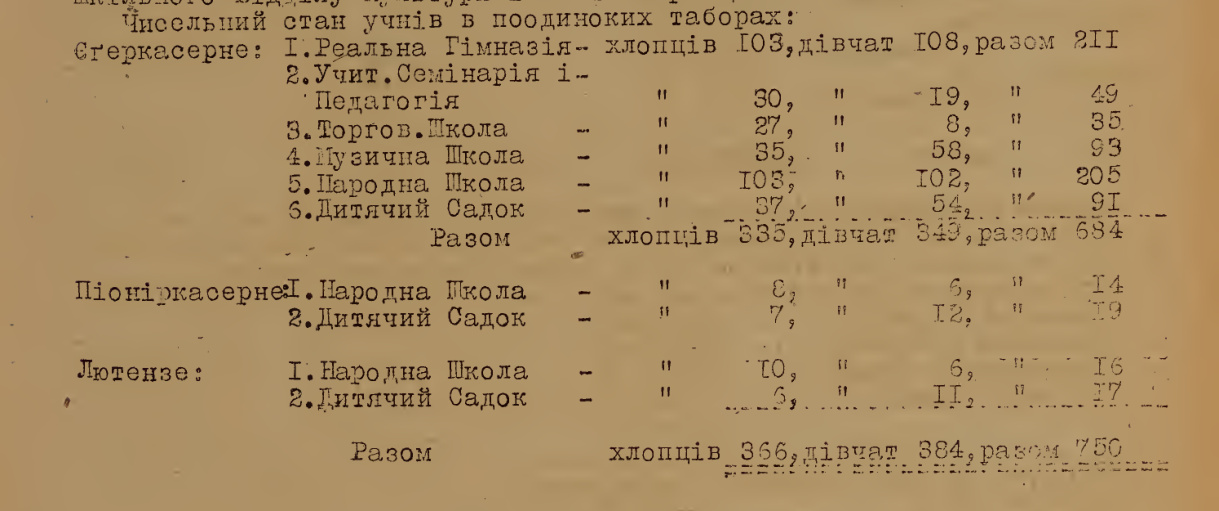
Enrolment at Jäger’s schools, late 1947
| Institution | Boys / men | Girls / women | Enrolments |
|---|---|---|---|
| Gymnasium | 103 | 108 | 211 |
| Teachers’ seminary and pedagogy | 30 | 19 | 49 |
| Commercial school | 27 | 8 | 35 |
| Music school | 35 | 58 | 93 |
| Primary school | 103 | 102 | 205 |
| Kindergarten | 37 | 54 | 91 |
Trades, workshops and a working economy
Vocational training was closely connected with rebuilding a working life. Courses covered tailoring, shoemaking, bookbinding, photography, mechanical and electrical work, driving, forestry, surveying, plumbing and bookkeeping. Icon painting and language teaching formed part of the same network. English, Spanish, French and German classes reflected the range of places residents might eventually reach.
Some courses were free and taught by specialists who also held other camp jobs. Others charged fees. Tailoring, shoemaking, mechanical work and driving had designated rooms, while other courses borrowed classrooms. The course register distinguishes entrants from those who completed their training; residents could take more than one course.
The camp supported a varied working economy. Its accounts list tailoring and shoemaking, ceramics, woodcarving, knitting, bookbinding, luggage making and mechanical work, alongside a laundry and barber. The Yednist cooperative and a camp shop sold goods; Zhinocha Pratsia, or Women’s Work, also appears among the cooperative enterprises.
The administration used its funds for schools, welfare, cultural work and loans to enterprises. Those accounts also show connections beyond a single workshop or building, including a loan to the Hirniak theatre studio. Residents’ wages, extra food allocations and cigarettes formed another part of the economy. The finance officer explicitly lacked the information needed to calculate all household earnings.
Selected vocational courses in the report
| Course | Entrants | Completed |
|---|---|---|
| One-year tailoring school | 64 | 31 |
| Evening tailoring course | 60 | 36 |
| One-year shoemaking school | 40 | 23 |
| Bookbinding course | 32 | 26 |
| Photography course | 33 | 11 |
| Driving course | 412 | 264 |
| Spanish course | 28 | 10 |
Sources for this section
Churches, theatre and youth organisations
Residents maintained Ukrainian Catholic and Ukrainian Orthodox churches. The primary school and gymnasium each had Catholic and Orthodox religious instruction. Cultural life included a local theatre group, a puppet theatre for children, visiting performers and public lectures. The report names visits by the Blavatsky and Hirniak theatrical companies, rather than establishing that both were permanently based inside Jäger.
Plast, the Ukrainian Youth Association (SUM) and the sports society Lev organised activities beyond the classroom. SUM had its own amateur theatre group and a sports section called Prometei. Excursions took members into the surrounding mountains. The report also describes scholarly gatherings involving the Ukrainian Free Academy of Sciences and the Shevchenko Scientific Society.
Sources for this section
Showing Ukrainian life to the outside world
An exhibition at Mittenwald presented a year of the camp’s work, including the output of workshops and individual residents. The surviving inside-cover programme gives 7–21 September 1947. A second exhibition followed in Garmisch. The organisers wanted visitors to encounter Ukrainian art, skills and collective life through things residents had made.
The report estimates about 10,000 visitors at Mittenwald, including about 700 people it described as foreigners, and 2,600 at Garmisch, including 2,000 foreigners. It reproduces visitors’ comments and a German newspaper’s response. These are the organisers’ attendance figures and selected reactions.
Sources for this section
News and connections beyond the barracks
Shchodenni Visti (Daily News) carried international news and camp information. The report also names a period when the weekly Khrystyianskyi Shliakh (Christian Way) appeared. A three-person radio service prepared news and announcements using broadcasts in several languages. Missing equipment limited its ability to include music.
The post office connected residents with people beyond the barracks. It handled domestic and overseas letters, registered mail, parcels and money transfers under German postal rules. Block representatives collected mail for delivery to residents. The information office, meanwhile, dealt with tracing enquiries, translations, passes and transfers between camps.
Sources for this section
Community life after 1947
Jäger remained connected with the wider Ukrainian community after 1947. An account of the 1948 DP sporting games credits both Jäger and Pionier with organising the volleyball competition held on 26 June in Pionier’s hall. The Ukrainian team won, and Duzhyi, identified as the local committee head, presented prizes. This was a shared undertaking across two separate camps.
Religious teaching also continued. Dmytro Blazejowskyj’s biographical directory records the Ukrainian Catholic priest Lev Dorosh as a catechist at Jäger in 1949–1950. His next listed appointment was Bradford, England, in 1951–1956. The entry follows one priest’s service rather than documenting the departure of the whole parish.
Preparing to leave
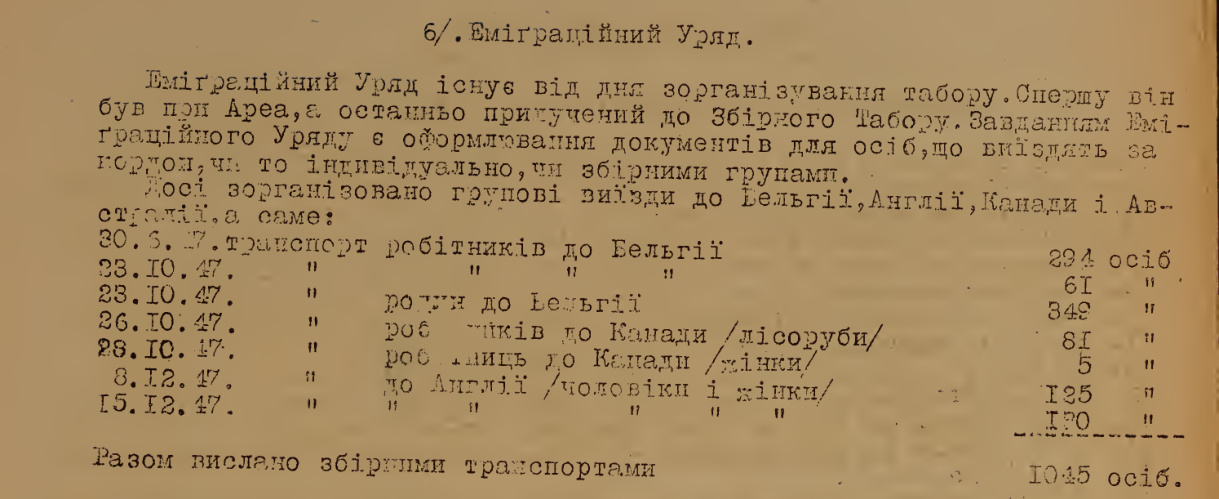
The assembly centre’s emigration office prepared documents for individual and organised departures. Its 1947 report lists group transports to Belgium, Canada and England, totalling 1,045 people. The entries distinguish workers from accompanying relatives and identify Canadian forestry workers. Because this office served the wider assembly centre, the transport total cannot be assigned entirely to Jäger.
Applications were not the same as departures. The office was still preparing papers for 290 people seeking group resettlement in Paraguay. It separately recorded individual departures of 13 people to Canada and seven to the United States. Within Jäger, the kindergarten and SUM reports describe membership changes as families and young adults left for Belgium and overseas.
Taborovi Budni reports the work of the Belgian recruitment commission. From the Combined Camp Mittenwald, 382 people aged up to 40 and 40 people aged over 40 registered for departure to Belgium, and from the Jäger-Kaserne camp the commission accepted 240 registrants.
Group departures organised by the Mittenwald office in 1947
| Date shown | Destination and group | People |
|---|---|---|
| 1947, first listed transport | Belgium: workers | 294 |
| 23 October 1947 | Belgium: workers | 61 |
| 23 October 1947 | Belgium: relatives | 349 |
| 26 October 1947 | Canada: forestry workers | 81 |
| 28 October 1947 | Canada: women workers | 5 |
| 8 December 1947 | England: men and women | 125 |
| 15 December 1947 | England: men and women | 130 |
| Total | Seven listed transports | 1,045 |
The final move, 1950–1951
By 8 November 1950, the Bavarian cabinet was discussing how to move 1,625 people from the Mittenwald barracks. Officials proposed sending 1,000 to Valka and considered temporary accommodation at Fischbach for the remainder. These were plans, rather than a completed passenger list.
The right-bank portion of the barracks was handed over on 6 December 1950. About 370 people remained over New Year; the left-bank portion followed on 24 January 1951. The ending was a staged relocation, extending beyond the December clearance deadline.
Sources for this section
Sources
- Encyclopedia of Ukraine: Mittenwald
Canadian Institute of Ukrainian Studies · 1993
Entry originally published 1993; full retrieved entry read.
- Registration card DP camp Mittenwald
Arolsen Archives · Undated
Full archival guide read; original individual cards not inspected.
- Pidsumky: camp administration report for 1 January–31 December 1947
Jäger-Kaserne camp administration; Ukrainian Museum-Archives of Cleveland / USHMM · Report covering 1947
Original 42-page scan, including all 36 numbered pages, read in full using OCR and visual inspection. All tables, institutional names and document captions checked visually. Detailed page-level ledger and unresolved readings accompany manuscript. Report title covers 1947; some departmental accounts use different periods. Catalogue publication year differs (1947/1948).
- Bavarian cabinet minutes, 8 November 1950, item III, with editorial annotation 50
Bavarian cabinet minutes, edition by Oliver Braun · 1950 minutes;2010 edition
Downloaded edition PDF, page 7 read. Contemporary discussion distinguishes planned relocations from actual events; editorial footnote cites December 1950 and January 1951 handover records, MArb-Landesflüchtlingsverwaltung 953. Original archival handover manuscripts not inspected. Edition: Oliver Braun, 2010.
- Ortskameradschaft Mittenwald, 50-year anniversary booklet, 1956–2006
Ortskameradschaft Mittenwald · 2006
Downloaded booklet; printed page 9 identifies Jägerkaserne in der Kofel as later Edelweißkaserne, construction starting 1937. Retrospective local garrison history, not contemporary construction documentation.
- Oleh Lysiak, Sports games of INKOPF—The DP Olympics, in Almanac of the Ukrainian Council for Physical Culture (Munich, 1951)
Ukrainian Council for Physical Culture · 1951
Original publication, printed pp. 95–97 (PDF 96–98), visually read. Describes 1948 games. Volleyball venue explicitly Pionier-Kaserne; Jäger and Pionier jointly organised. Team photograph is a Pionier event, not Jäger interior.
- Dmytro Blazejowskyj, Ukrainian Catholic Clergy in Diaspora (1751–1988), Rome 1988
Dmytro Blazejowskyj · 1988
Title and printed p. 53 (PDF 55) visually checked. Lev Dorosh entry specifically identifies Mittenwald Jägerkaserne, 1949–1950, catechist. Retrospective biographical reference; not a contemporary parish register.
- Shchodenni Visti (Daily News), no. 4, supplement to no. 43.B
Ukrainian camp administration, Mittenwald; Ukrainian Museum-Archives, Cleveland, DP Camp Periodicals Collection; digitised by the Internet Archive · 5 March 1947
Issue of the Mittenwald camp daily bulletin, digitised within the Internet Archive item linked here (catalogued there as Khronika tyzhnia, UNRRA Team 1064, Mittenwald; four images). Read as page images: image 3 of the item, page 1 of the issue, carrying the Camp Election Commission communiqué dated Mittenwald, 5 March 1947. Item licence Creative Commons BY-NC-ND 4.0.
- Taborovi Budni (Camp Weekdays): weekly camp bulletin, Mittenwald, nos 1-8
Tabor Mittenwald, Kolegiia; Ukrainian Museum-Archives, Cleveland, DP Camp Periodicals Collection; digitised by the Internet Archive · 15 June - 3 August 1947
Weekly bulletin of the Mittenwald camp, read as page images from the Internet Archive item (90 images). Pages read: the short history of the camp and the population survey in nos 5-6; chronicle entries and notices in nos 1-4; notices in no. 8. Item licence Creative Commons BY-NC-ND 4.0.
Last researched 12 September 2026