Pionierkaserne
Displacement in Europe
Mittenwald, Bavaria, Germany · 1946–1950
Pionierkaserne was the southern of Mittenwald’s two adjoining barracks, used first as a transit camp for people being repatriated and then, from February 1947, as the Ukrainian camp that took in the Ukrainians moved down from Luttensee. Its Ukrainian population fell from about 1,200 to a few dozen between 1947 and 1950, and the last residents transferred to the Jäger camp in January 1950.
Introduction
Pionierkaserne was one of several distinct displaced persons sites in Mittenwald. The registration-card guide identifies it as the Südkaserne, or southern barracks. Jägerkaserne, the northern barracks, and the Lüttensee camp were separate locations; displaced people also occupied at least two hotels. These distinctions matter when tracing a family through records labelled simply Mittenwald.
Sources for this section
A history in dates
- 1937The barracks is built at the foot of the Karwendel as the Ludendorff-Kaserne.
- 1 May 1945American troops take over the Mittenwald barracks without a fight.
- 1946Pionierkaserne operates as a transit camp for people being repatriated; by the end of the year only a few dozen residents remain.
- February 1947The Ukrainian delegation is granted the right to move all Ukrainians from Lüttensee to Pionierkaserne, which becomes the Ukrainian Camp Pionierkaserne.
- 31 May 1947The UNRRA return records 464 Ukrainians at Pionierkaserne.
- June 1947The Mittenwald clothing sub-department begins issuing clothing and footwear to Pionierkaserne residents as well as to Jägerkaserne.
- 13 June 1947A puppet theatre from the Pionierkaserne performs the fairy tale Bilosnizhka in the camp theatre hall.
- 30 June 1947A train leaves Mittenwald station at 7.30 a.m.; four lorries with trailers call at Pionierkaserne, two at Jägerkaserne and one at Lüttensee.
- 12 July 1947The camp bulletin records 1,100 people at Pionierkaserne, 858 of them Ukrainians.
- 31 July - 13 August 1947The Jäger- and Pionierkaserne camps may send 100 children aged 10 to 14 to the YMCA holiday camp at Grafenaschau.
- December 1947The camp school returns 14 pupils in the elementary school and 19 children in the kindergarten; the supply department serves five Mittenwald sites with about 5,000 residents.
- 2 January 1948The PCIRO return records 65 Ukrainians at Pionierkaserne.
- 6 June 1948The Soviet Repatriation Mission visits the camp and withdraws under escort; a two-week curfew follows.
- 26 June 1948Pionier’s hall hosts the INKOPF volleyball tournament; the Ukrainian team wins.
- 7–12 July 1949The Olympic Games of IRO Area 6 are staged at Pionierkaserne by the two Mittenwald camps together.
- End of 1949About 600 remaining Ukrainian residents vote to move to Jägerkaserne.
- Late January 1950The Camp Council holds its final meeting.
- 1951Lysiak’s account and the winning team photograph appear in the physical culture almanac.
- July 1956Bundeswehr mountain infantry battalions are raised in the Mittenwald barracks.
Sources for this section
- Karwendel-Kaserne and Edelweiß-Kaserne
- Wolodymyr Sijak, Camp Pionierkaserne in Mittenwald
- Ihor Stebelsky, Ukrainian Population Migration after World War II, Table 7
- Pidsumky: informative report of the camp administration, 1 January to 31 December 1947
- Taborovi Budni (Camp Weekdays): weekly camp bulletin, Mittenwald, nos 1-8
- Oleh Lysiak, Sports games of INKOPF: the DP Olympics, Almanac of the Ukrainian Council for Physical Culture, Munich 1951, pp 95–97
The barracks before 1945
The barracks that carried the name Pionierkaserne during the displaced persons years stands immediately south of the Jäger barracks and is today the Karwendel-Kaserne. Built in 1937 as the Ludendorff-Kaserne, it was renamed Pionier-Kaserne in 1945 and became the General-Kübler-Kaserne in the 1960s, so present-day signage cannot be used to locate the camp.
It was raised in the same building campaign as the neighbouring Jäger barracks, at the foot of the Karwendel. During the Second World War both were used mainly to house training units and convalescent companies. American soldiers took the site without a fight on 1 May 1945.
The barracks then became part of what the occupying administration called the Collective Camp Mittenwald, run by the United Nations Relief and Rehabilitation Administration. People displaced from Russia, Belarus, Lithuania, Poland and Ukraine were brought in from smaller camps that were being closed. When the large camp at Karlsfeld was liquidated in the spring of 1946, those sent to Mittenwald were directed to Jägerkaserne; Pionierkaserne and Lüttensee took in people of other nationalities from smaller camps.
Sources for this section
A transit camp becomes a Ukrainian camp
In 1946 the two Mittenwald barracks camps had different functions. Jägerkaserne held mostly Ukrainians who refused repatriation, while Pionierkaserne served as a transitional camp for people who were being repatriated. Its residents were chiefly former forced labourers, liberated concentration camp inmates and some liberated prisoners of war, who were fed and cared for in preparation for their return.
Because that population kept moving on, the camp emptied: by the end of 1946 Pionierkaserne held only a few dozen residents, among them Latvians, Lithuanians, Estonians, Poles, Hungarians, Arabs and a small number of Ukrainian families who could not be fitted into the overcrowded Jäger camp.
The change came from Lüttensee. Ukrainian families housed there found life difficult in a camp whose administration and public announcements were Russian, and they petitioned UNRRA to let them move. In February 1947 the Ukrainian delegation was granted the right to move all the Ukrainians from Lüttensee into the almost empty Pionierkaserne, and the camp became the Ukrainian Camp Pionierkaserne. A second eyewitness account dates the move to the end of January 1947.
Sources for this section
Administration and the Mittenwald network
Once the Ukrainians had moved in, the residents held elections and rebuilt the camp administration. Under IRO rules elections were held annually and had to be approved by the IRO director of Area 6 at Gauting. The first elected administrator was Wolodymyr Sijak, a hydraulic engineer, and the first chairman of the Camp Council was Petro Postoliuk, a former Ukrainian Sich Rifleman. The camp police worked under the supervision of the American military police at Garmisch-Partenkirchen.
The four Mittenwald camps formed Sub-Area Mittenwald within IRO Area 6. Its labour director recorded Jägerkaserne at about 3,500 residents, 98 per cent of them Ukrainian, Pionierkaserne at about 1,500 residents, 65 per cent Ukrainian, Lüttensee at about 1,000 Ukrainians and Russians, and the Hotel Karwendel in the town as a camp of about 150 Jewish residents, adding that these figures fluctuated continually. Some IRO staff were housed in the casino at Pionierkaserne, and the camp held the UNRRA garages where the administration’s vehicles were kept and repaired.
The camps were supplied together. At the end of 1947 the supply department of the Mittenwald assembly centre reported that it served Jägerkaserne, Pionierkaserne, Lüttensee, Karwendel and two hospitals, about 5,000 people in all, and the clothing sub-department recorded that from June 1947 it also issued clothing and footwear to Pionierkaserne. Shared supply did not mean shared administration: the two barracks camps remained separate and independently run.
The four camps of Sub-Area Mittenwald
| Camp | Residents recorded | Composition |
|---|---|---|
| Jägerkaserne | about 3,500 | 98 per cent Ukrainian |
| Pionierkaserne | about 1,500 | 65 per cent Ukrainian |
| Lüttensee | about 1,000 | Ukrainians and Russians |
| Hotel Karwendel, Mittenwald town | about 150 | Jewish residents |
A changing Ukrainian population
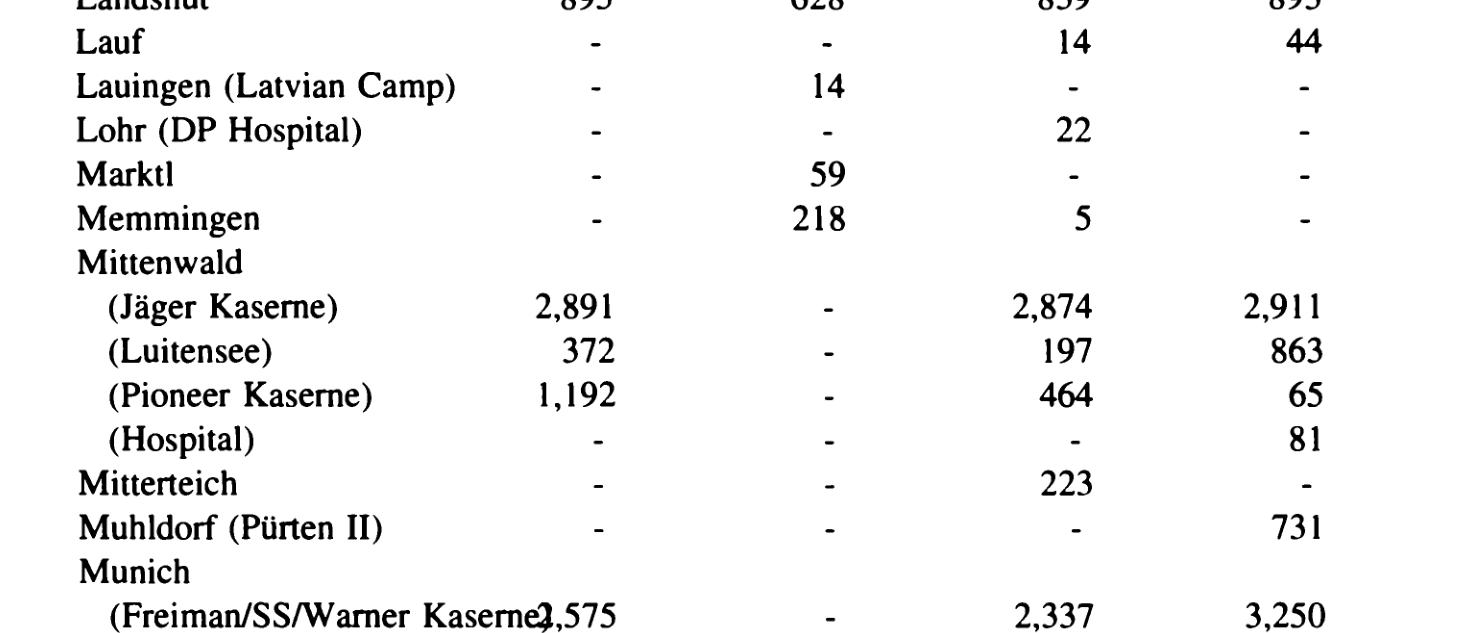
The published population tables give Pionierkaserne its own row. Stebelsky’s Table 7 records 1,192 Ukrainians in the questionnaire returns of 1946 to 1947, 464 in the UNRRA return of 31 May 1947 and 65 in the PCIRO return of 2 January 1948. These are counts of Ukrainians, not of every resident, and the fall between them is a real movement of people rather than a change of definition.
The Encyclopedia of Ukraine records a Ukrainian camp at Pionierkaserne during 1947 to 1950 and gives an undated population of 1,200. That figure has no census date, and the camp’s own labour department put the whole camp at about 1,500 residents of all nationalities. The three sources measure different things and should be read side by side rather than added together.
The Mittenwald camp bulletin gives another count. Taborovi Budni recorded that the small camp of Pionierkaserne, which it described as recently attached to the Jäger camp, then held 1,100 people, 858 of them Ukrainians. It listed the other nationalities as 23 Estonians, 75 Latvians, 24 Lithuanians, 17 Yugoslavs and Banat people and 26 Turks, with the remainder stateless Nansen refugees. The same survey put the Jäger-Kaserne camp itself at 3,024 residents on 12 July 1947, of whom 2,997 were Ukrainians.
Pionierkaserne in the published record
| Item | Recorded information |
|---|---|
| Alternative name | Südkaserne |
| Barracks name sequence | Ludendorff-Kaserne 1937–1945; Pionier-Kaserne from 1945; General-Kübler-Kaserne from the 1960s; Karwendel-Kaserne today |
| Ukrainian camp period | 1947–1950 |
| Reported Ukrainian population | 1,200; no census date stated |
Ukrainians recorded at Pionierkaserne
| Return | Ukrainians |
|---|---|
| Questionnaire returns, 1946–7 | 1,192 |
| UNRRA, 31 May 1947 | 464 |
| PCIRO, 2 January 1948 | 65 |
Church, school and community life
A Ukrainian Catholic church was fitted out in one of the camp barracks. Its first pastor was the Reverend Antin Lukomskyj, followed by the Reverend Pawlo Szymanskyj and two priests named Atamaniuk. There was also a Ukrainian Orthodox church at Pionierkaserne, which in time joined the larger Orthodox congregation at Jägerkaserne.
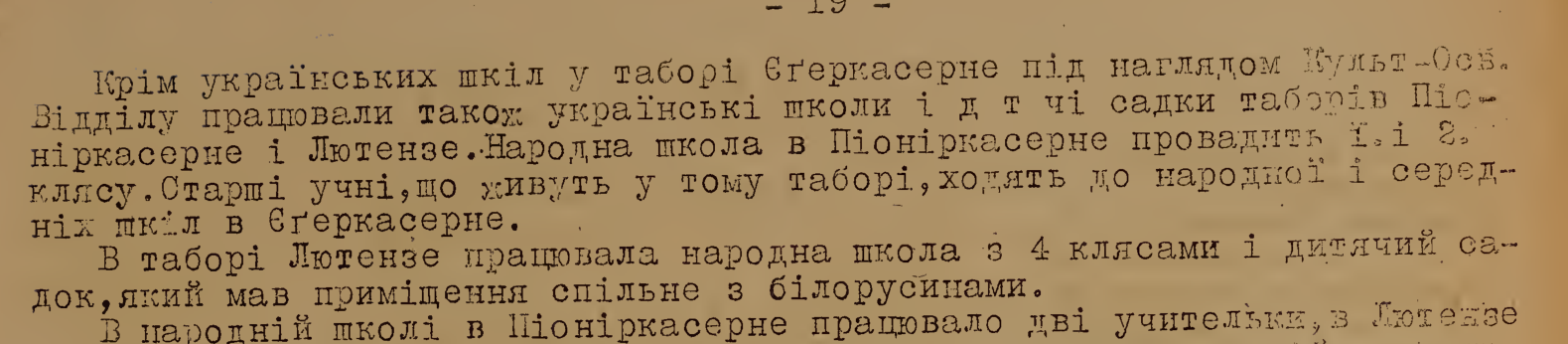
The camp ran an elementary school and a kindergarten. The December 1947 report of the Mittenwald camp administration records that the school taught the first and second classes only, with two women teachers and 14 pupils, that the kindergarten had one teacher and 19 children, and that older pupils living in the camp attended the elementary and secondary schools at Jägerkaserne. Teaching followed the syllabuses of the school department of the Central Representation of the Ukrainian Emigration.
At the centre of the camp lay an open ground with a football pitch, a large sports building adapted for volleyball and basketball that served both camps, and an auditorium with a stage for visiting choirs and theatre companies. There was a Plast scout group, a dance group and a choir that sang the liturgy each Sunday and joined the three Jägerkaserne choirs for a combined performance of Kyrylo Stetsenko’s Shevchenko cantata. Residents nevertheless often went to the larger Jäger camp for concerts, lectures and sport.
The bulletin also records smaller details of camp life. A puppet theatre from the Pionierkaserne staged the fairy tale Bilosnizhka, or Snow White, in the hall of the camp theatre on 13 June 1947. A notice stated that between 31 July and 13 August 1947 the Jäger- and Pionierkaserne camps could still send 100 children aged 10 to 14 to Grafenaschau, where children were able to receive 300 additional calories of food a day. An advertisement sought a distributor for the papers Shchodenni Visti and Taborovi Budni at Pionierkaserne, with pay depending on the number of periodicals sold.
Ukrainian school return, December 1947
| Institution | Boys | Girls | Total |
|---|---|---|---|
| Pionierkaserne elementary school | 8 | 6 | 14 |
| Pionierkaserne kindergarten | 7 | 12 | 19 |
A hall prepared for international sport
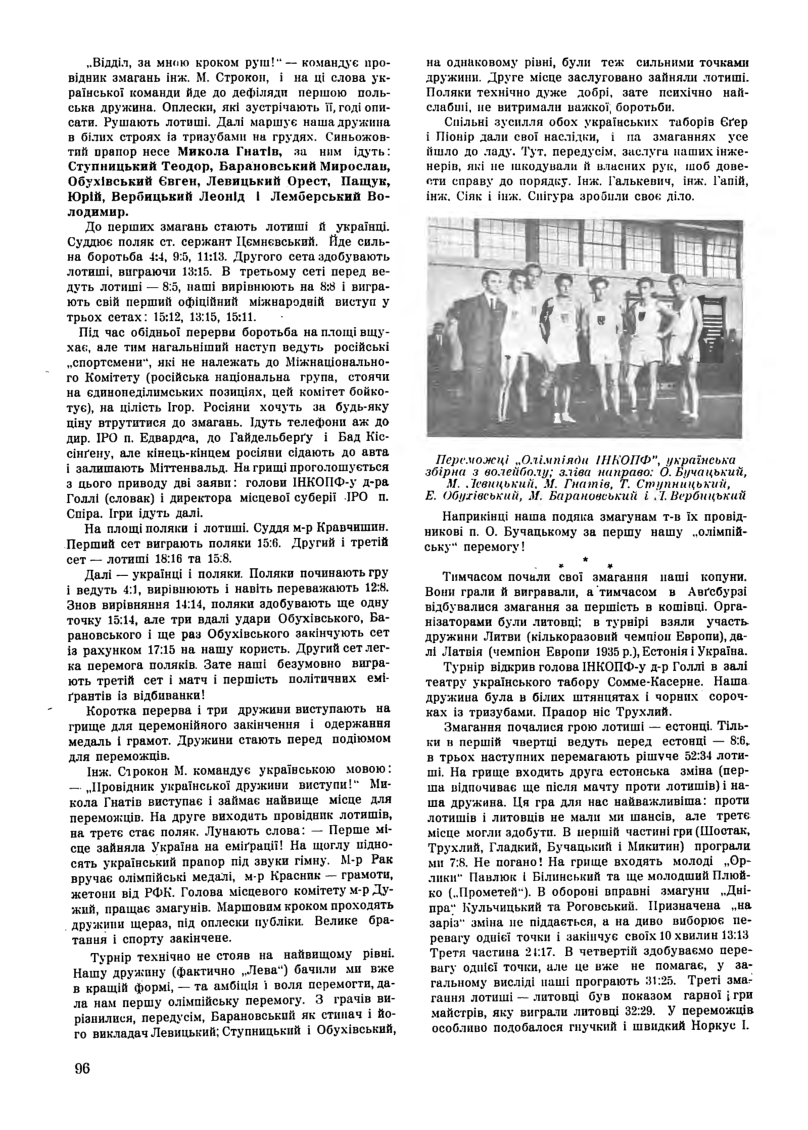
On 26 June 1948 Pionier’s hall hosted a volleyball tournament as part of the INKOPF sports games for displaced people. The journalist Oleh Lysiak described tiered spectator seating on three sides, flags and a large golden Ukrainian trident, and credited the Jäger and Pionier camps with organising the event together. Polish, Latvian and Ukrainian teams competed; the Ukrainian team won, with Latvia second and Poland third, and Lysiak describes the medals, the raising of the flag and the anthem. A photograph published with his report shows the winning team, a view of the sporting community that used the hall rather than a portrait of the camp.
A second and larger meeting followed at Pionierkaserne from 7 to 12 July 1949, the Olympic Games of IRO Area 6, known in the camps as the DP Olympics. IRO headquarters arranged transport and equipment while the two camp administrations requisitioned extra rations and organised housing. This was a distinct event from the tournament of June 1948 and the two should not be merged.
The Soviet Repatriation Mission, June 1948
On 5 June 1948 the camp administrator received notice from the American military police at Garmisch-Partenkirchen that the Soviet Repatriation Mission would visit Pionierkaserne the next day to urge residents to return home. The announcement was posted on the Sunday morning as people went to church. The delegation found the administration building empty because the crowd, put by the administrator at about a thousand residents together with five hundred sportsmen from the sports ground and five hundred visitors from Jägerkaserne, had gathered in front of the theatre. Stones and bricks were thrown, the delegation withdrew under escort, and the camp was punished with a two-week curfew between five in the evening and five in the morning. The camp bulletin Shchodenni Visti of 7 June 1948 carried a radio dispatch about the affair from London. This is the camp administrator’s own account and the only detailed narrative of the day located here.
Sources for this section
Emigration and closure
From 1948 residents began to leave in larger groups for Australia and South America, and from 1949 for the United States and Canada. By the end of 1949 the roughly 600 Ukrainians still at Pionierkaserne had voted to move to Jägerkaserne, and the Camp Council decided that whatever remained in the camp treasury would be divided between the nationality groups in proportion to their numbers and spent on the neediest. The final meeting of the Camp Council was held in late January 1950.
German soldiers returned to the Mittenwald barracks in July 1956, when the first Bundeswehr mountain infantry battalions were raised there. The Pionier barracks was renamed later and is now the Karwendel-Kaserne. No document setting out the last day of camp operation at Pionierkaserne was located; the January 1950 council meeting is the closest fixed point.
Merging the two barracks camps was discussed well before the final move. The bulletin reports that the Camp Council considered the liquidation of the sanatorium at Kollgrub and the question of merging the Pionierkaserne camp with the Jäger-Kaserne camp, and that it resolved to take steps to delay the decision on the Kollgrub liquidation.
Tracing a stay in Mittenwald
Surviving registration cards are a starting point for researching people who passed through Mittenwald. The archival guide distinguishes longer-term accommodation from transient arrangements, whose precise location remains unresolved. A Mittenwald card therefore needs to be read alongside its dates and other addresses before assigning a person to Pionierkaserne.
Two further distinctions matter. The Hotel Karwendel in the town was a separate camp for Jewish displaced people and is not the Karwendel-Kaserne barracks. And because Pionierkaserne was a repatriation transit camp through 1946 and a settled Ukrainian camp from February 1947, a record naming it means very different things depending on its date.
A United Nations photograph of displaced-person students at a language training institute near Nürnberg shows how loosely the name could be used. Its caption describes a 24-year-old Ukrainian, taken to Germany in 1942 as a prisoner of war, as then living in the Mittenwald DP camp, where his father was an Orthodox priest. It does not say which of the Mittenwald camps was meant.
Sources
- Encyclopedia of Ukraine: Mittenwald
Canadian Institute of Ukrainian Studies · Article first published in volume 3, 1993
Independent reviewer read entry; population of 1,200 for Pionier-Kaserne is undated.
- Registration card: DP camp Mittenwald
Arolsen Archives e-Guide · Accessed September 2026
Facility distinctions and transient-record scope independently reviewed; identifies Pionierkaserne as the Südkaserne and Jägerkaserne as the Nordkaserne.
- Oleh Lysiak, Sports games of INKOPF: the DP Olympics, Almanac of the Ukrainian Council for Physical Culture, Munich 1951, pp 95–97
Molode Zhyttia, Munich · 1951
Agent visually read original pages 95–97; parent inspected photograph and caption on page 96 and extracted the venue and date paragraph on page 95.
- Ihor Stebelsky, Ukrainian Population Migration after World War II, Table 7
Canadian Institute of Ukrainian Studies Press · 1992
The Refugee Experience, printed page 49. Mittenwald block read visually at 2.6x magnification so that each figure could be matched to its column: Pioneer Kaserne 1,192 (1946–7 questionnaire), 464 (31 May 1947), 65 (2 January 1948). Ukrainians only.
- Wolodymyr Sijak, Camp Pionierkaserne in Mittenwald
Society of Former Residents of the Ukrainian Displaced Persons’ Camps in Mittenwald, Warren, Michigan · 2001
Mittenwald 1946–1951, printed pages 420–422, read visually from the scanned volume. Eyewitness account by the camp’s first elected administrator.
- Andrij Buk, Displaced Persons Camps: UNRRA and IRO
Society of Former Residents of the Ukrainian Displaced Persons’ Camps in Mittenwald, Warren, Michigan · 2001
Mittenwald 1946–1951, printed pages 387–388, read visually. Written by the director of the labour department for Sub-Area Mittenwald; gives the four camps and their populations and states that the figures fluctuated.
- Pidsumky: informative report of the camp administration, 1 January to 31 December 1947
Ukrainian camp Mittenwald-Jägerkaserne; digitised by the Ukrainian Museum-Archives, Cleveland, for the United States Holocaust Memorial Museum · 1948
Printed pages 13, 19 and 30 read from the page images to correct the OCR. Clothing issues to Pionierkaserne from June 1947, the Ukrainian school returns for both subsidiary camps, and the supply department’s list of the five sites it served.
- Karwendel-Kaserne and Edelweiß-Kaserne
German Wikipedia · Accessed September 2026
Tertiary source used only for the sequence of barracks names, the 1937 construction, the wartime use for training and convalescent units, the American takeover on 1 May 1945 and the return of the Bundeswehr in 1956. Its underlying citations are Münchner Merkur reports, the Arolsen e-Guide and the 2001 Mittenwald volume.
- Yurij Kuzmycz, The Road to Camp Luttensee
Society of Former Residents of the Ukrainian Displaced Persons’ Camps in Mittenwald, Warren, Michigan · 2001
Mittenwald 1946–1951, printed page 419, read visually. Eyewitness account of the move from Lüttensee and of the two Ukrainian churches at Pionierkaserne.
- DP students at the Lauf Language Training Institute near Nürnberg
United Nations Photo Library, asset UN7761491, photo no. 36221 · Undated; catalogued 1946, caption range 1946 to 1952
Photograph caption read in full. It describes a 24-year-old Ukrainian student, taken to Germany in 1942 as a prisoner of war, as living in the Mittenwald DP camp, where his father was an Orthodox priest. The caption names no particular Mittenwald camp. Reuse of the image is restricted by the library's terms.
- Taborovi Budni (Camp Weekdays): weekly camp bulletin, Mittenwald, nos 1-8
Tabor Mittenwald, Kolegiia; Ukrainian Museum-Archives, Cleveland, DP Camp Periodicals Collection; digitised by the Internet Archive · 15 June - 3 August 1947
Weekly bulletin of the Mittenwald camp, read as page images from the Internet Archive item (90 images). Pages read for this camp: the chronicle entry for 13 June 1947 in no. 1; the Camp Council report in no. 2; the transport notice in no. 3; the population survey in nos 5-6; and the holiday-camp notice and small advertisements on a printed page 8. Item licence Creative Commons BY-NC-ND 4.0.
Last researched 13 September 2026