Mortonhall Hostel
Arrival and settlement
Edinburgh, Scotland · Ukrainian hostel in the postwar years
Ukrainians lived in a hutted camp in the wooded edge of an Edinburgh estate, and a visitor remembered their choir singing between the huts. Excavation has since recovered the camp’s foundations and dated its dismantling to about 1950.
Introduction
At Mortonhall, Ukrainian residents lived in a hutted camp within an Edinburgh estate. One visitor remembered a choir performing between the huts, with neighbours from the manor house invited to listen. Kormylo lists Mortonhall among the Scottish and northern English hostels which held significant numbers of ethnic Ukrainians, and archaeological work has recovered the camp’s foundations, placing this small community within a much longer history of military occupation and postwar resettlement.
A history in dates
- 1939The Trotter family left Mortonhall House and the estate passed to military use.
- July 1940The 16th Battalion, Durham Light Infantry occupied tents on the estate.
- From mid-1942Permanent camp buildings replaced the tented accommodation.
- 25 December 1942The Durham Light Infantry left; the excavation summary records later use by the Royal Signal Corps.
- Immediate postwar yearsThe camp became a displaced persons centre, its residents including Ukrainians and Poles.
- April 1948A contemporary return recorded nine POWs at Mortonhall within the Deer Park administration.
- About 1950The camp was dismantled, having already been reduced in size.
- 1988Balinsky’s memoir preserved a recollection of the Ukrainian camp and its choir.
- February to March 2010Excavation opened three hut bases, two building complexes, part of the camp road and its drains.
- 15 September 2023Richard Webb photographed the field at the former camp.
Sources for this section
- Roy Thompson, Mortonhall Stroll Notes and Mortonhall: notes
- Magnus Kirby, Alasdair Ross and Sue Anderson, The Excavation of a World War II Army Camp at Mortonhall, Edinburgh
- Excavation, Mortonhall Army Camp, February to March 2010 (event 993027)
- Kate Bowell, Morton Hall, Curious Edinburgh Second World War tour
- Edinburgh, Mortonhall, Army Camp: NRHE121757
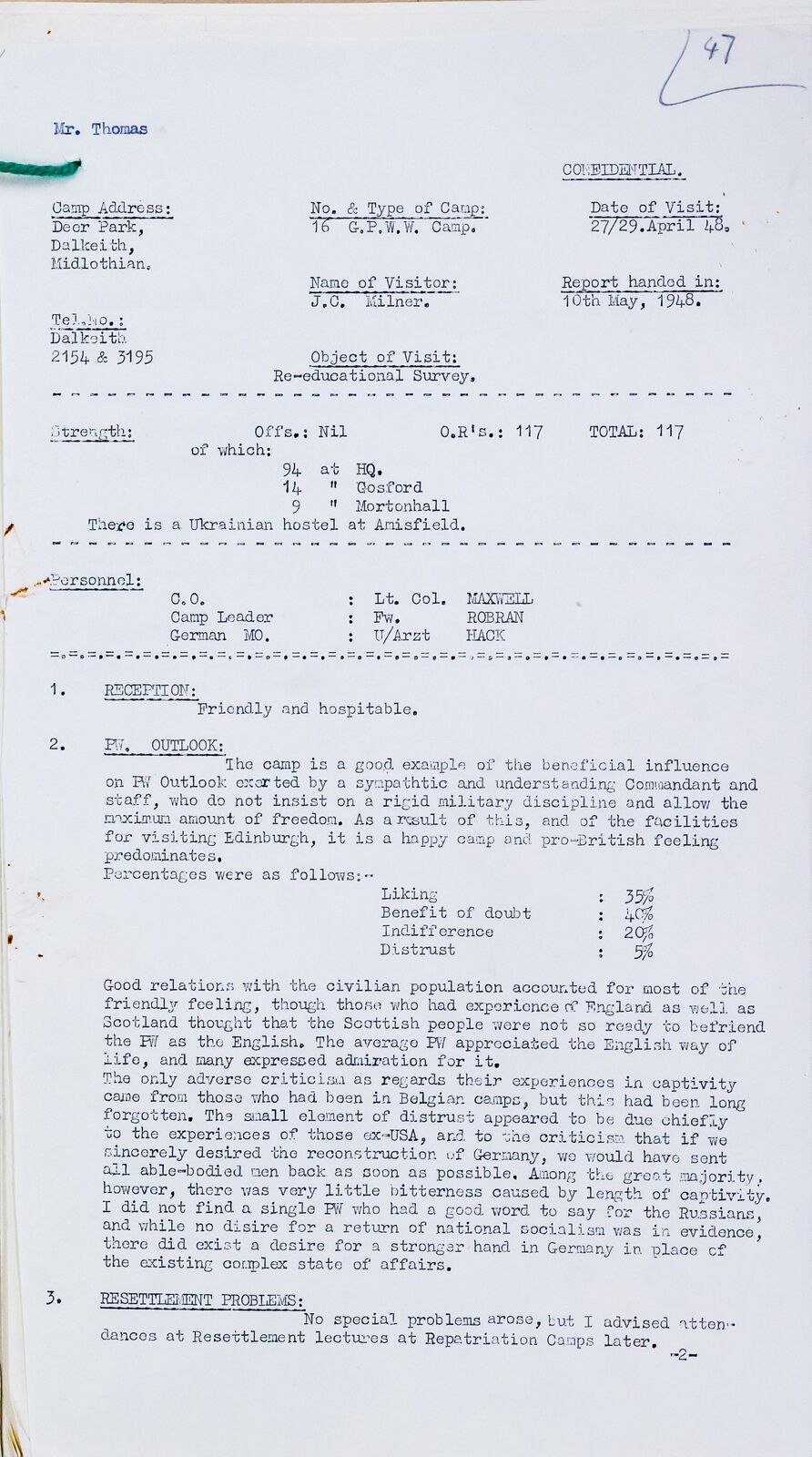
- J. C. Milner, Deer Park re-educational survey, 27–29 April 1948
- Boris Balinsky, My Life: Scotland section
- Richard Webb, Ungrazed field, Mortonhall
The estate before the camp
The Trotter family left Mortonhall House in 1939 and the estate was taken over for military use. A local history compilation records an earlier army camp in the grounds during the First World War, occupied by the Argyll and Sutherland Highlanders, and notes the family’s long association with the army as a likely reason for the estate being made available. The same notes estimate roughly two hundred structures in the Second World War camp, accommodating some sixteen officers, forty warrant officers and sergeants and 460 other ranks. These are the compiler’s figures rather than a surviving return, and no comparable count exists for the later Ukrainian occupation.
The camp’s siting followed a wartime convention: woodland cover was used to disguise camps from the air, and the shelter belt that hid the huts is where their remains were later found. Mortonhall House itself took a separate course after the war, leased to Edinburgh University in 1949 for scientists of the Agricultural Research Council’s Unit of Animal Genetics and their families. The manor and the camp were two distinct communities on one estate.
From tents to permanent huts
The excavators of Mortonhall distinguish an earlier First World War army camp from the remains of its Second World War successor. Their research places the 16th Battalion of the Durham Light Infantry in tents here from July 1940, with permanent accommodation built from the middle of 1942. The battalion left on Christmas Day 1942 and the published excavation summary records later use by the Royal Signal Corps. Excavation found concrete bases consistent with standard Nissen huts, alongside evidence for buildings made with brick and asbestos, so the estate contained more than a single uniform type of temporary shelter.
The 2010 excavation, carried out ahead of the Edinburgh drinking water pipeline, opened three hut bases and two building complexes and traced part of the camp road and several drainage systems. A metal detector survey on the pipeline route recovered a large quantity of cartridge casings in one stretch, taken to suggest a live firing range associated with the camp. Finds included ink, milk and sauce bottles and a stainless steel knife blade, the ordinary debris of people living in huts.
Sources for this section
- Magnus Kirby, Alasdair Ross and Sue Anderson, The Excavation of a World War II Army Camp at Mortonhall, Edinburgh
- Excavation, Mortonhall Army Camp, February to March 2010 (event 993027)
- Kate Bowell, Morton Hall, Curious Edinburgh Second World War tour
- Roy Thompson, Mortonhall Stroll Notes and Mortonhall: notes
The Ukrainian camp in the wooded valley
Boris Balinsky’s 1988 memoir describes a camp about a kilometre from the Mortonhall manor house, in a wooded valley on the estate. He identifies its inhabitants as Ukrainians and describes numerous semicylindrical corrugated-iron huts. His distinction between the manor residents and the camp is central to understanding the place: this was a separate settlement of huts within the grounds. Kormylo’s directory independently lists Mortonhall as number four among the hostels which held significant numbers of ethnic Ukrainians, while cautioning that his list may not be complete.
Two independent records agree on who lived there. The archaeological record compiled from John Guy’s 1997 survey states that in the immediate postwar period the camp became a displaced persons centre, and the local notes describe remnants of a postwar camp for displaced people from Eastern Europe, including Ukrainians and Poles. Neither gives a population, an operator or a date of arrival.
Mortonhall across its different phases
| Period or source | People or buildings documented |
|---|---|
| 1939 | Trotter family left the house; estate taken for military use |
| First World War | Army camp in the grounds occupied by the Argyll and Sutherland Highlanders |
| July 1940 | 16th Battalion, Durham Light Infantry, in tents |
| From mid-1942 | Permanent camp buildings; battalion left on 25 December 1942 |
| Immediate postwar years | Displaced persons centre; residents included Ukrainians and Poles |
| 27 to 29 April 1948 | Nine POWs at Mortonhall in the Deer Park administrative return |
| Balinsky’s retrospective memoir | Ukrainian residents, corrugated huts and a choir performance |
| About 1950 | Camp dismantled after a period of contraction |
| 1997 survey | Broken hut bases recorded along a field wall |
| February to March 2010 | Excavation of three hut bases, two building complexes, camp road and drains |
A choir and an invitation
Balinsky recalled the manor residents being invited to a celebration at the Ukrainian camp. They went together and found a stage and seating in an open space between the huts. Choral singing formed the part of the event he described. The recollection preserves an encounter between two groups living on the same estate and gives the camp a social life beyond the bare outline of its buildings.
Sources for this section
Mortonhall in the 1948 records
The estate’s wartime and postwar uses overlapped in the surviving paperwork. In his survey of 27–29 April 1948, J. C. Milner listed nine prisoners of war at Mortonhall as part of the Deer Park administration. The report names the place but does not plot their accommodation within the estate. Later archaeologists questioned earlier claims that the excavated camp had been a POW camp. These sources describe different levels of detail: the contemporary record establishes POWs at Mortonhall, while the excavated structures and Ukrainian memoir concern the physical settlement.
What remains of the camp
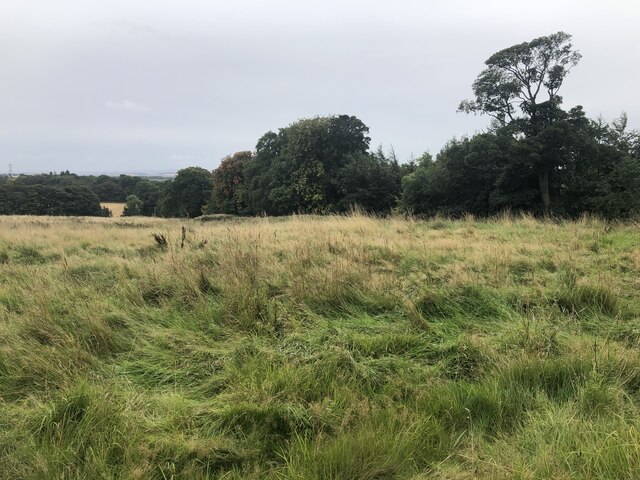
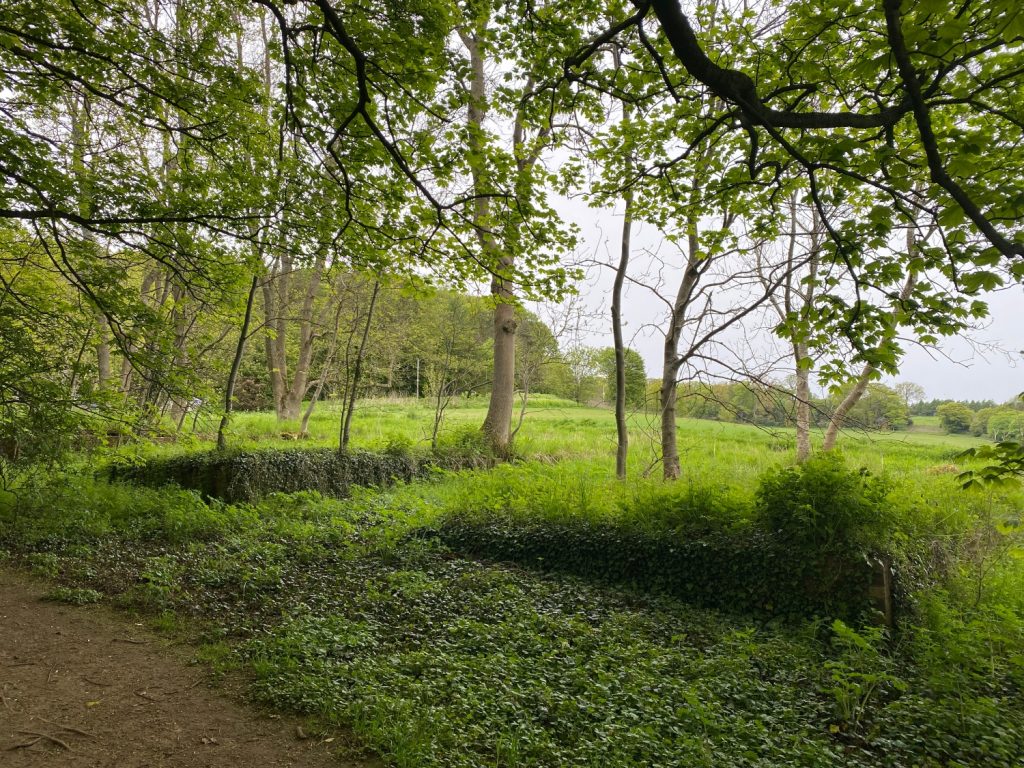
The 2013 archaeological study found that the camp was being reduced in size by the 1950s, and the excavation summary dates its final dismantling to about 1950; the exact closure of the Ukrainian accommodation is not established. A 1997 survey recorded broken concrete hut bases along a field wall east of the former Princess Margaret Rose Hospital. The field lies off Mounthooly Loan, and a 2023 walking tour entry directs visitors through a gate opposite King Malcolm Close to the low remains along the tree line.
Richard Webb’s 2023 photograph shows the grassy field and wooded margin at the recorded site. The standing huts have disappeared from this view, leaving the landscape, the buried foundations and the overgrown hut bases to carry the camp’s history.
Sources for this section
- Magnus Kirby, Alasdair Ross and Sue Anderson, The Excavation of a World War II Army Camp at Mortonhall, Edinburgh
- Edinburgh, Mortonhall, Army Camp: NRHE121757
- Excavation, Mortonhall Army Camp, February to March 2010 (event 993027)
- Kate Bowell, Morton Hall, Curious Edinburgh Second World War tour
- Richard Webb, Ungrazed field, Mortonhall
Sources
- Boris Balinsky, My Life: Scotland section
1988
Original library viewer text reviewed on printed pages 326–327, PDF 11–12. Retrospective eyewitness, manor party kept separate from camp performance.
- Magnus Kirby, Alasdair Ross and Sue Anderson, The Excavation of a World War II Army Camp at Mortonhall, Edinburgh
2013
Institutional abstract read. Journal of Conflict Archaeology 8(2), 106–135. Construction 1942, mixed hut building materials, contraction 1950s; exact closure unknown.
- Peter David Kormylo, In which ways is the Ukrainian community in Scotland a diaspora?, PhD thesis
University of Glasgow · 2021
Printed 100 map and 322 directory entry 4 inspected.
- Edinburgh, Mortonhall, Army Camp: NRHE121757
Historic Environment Scotland
Institutional archaeological record read. John Guy 1997 note; earlier POW interpretation challenged in 2013 publication.
- J. C. Milner, Deer Park re-educational survey, 27–29 April 1948
Original complete photographed report visually read: 117 POWs comprise 94 HQ, 14 Gosford, 9 Mortonhall. Does not locate nine men within estate.
- Richard Webb, Ungrazed field, Mortonhall
15 September 2023
Original photo and caption inspected; credit Richard Webb, CC BY-SA 2.0. Modern field photograph, not historical hut photograph.
- Roy Thompson, Mortonhall Stroll Notes and Mortonhall: notes
Roy Thompson, University of Edinburgh blogs · December 2023
Full text read. Retrospective local compilation: First World War camp of the Argyll and Sutherland Highlanders; Durham Light Infantry huts c.1940 with the compiler’s estimate of about 200 structures and a garrison of 16 officers, 40 warrant officers and sergeants and 460 other ranks; postwar camp in the shelter belt for displaced people including Ukrainians and Poles; house leased to Edinburgh University in 1949. Figures are the compiler’s, not an administrative return.
- Excavation, Mortonhall Army Camp, February to March 2010 (event 993027)
Historic Environment Scotland, National Record of the Historic Environment · Reported 2012 by Magnus Kirby and Mike Cressey, CFA Archaeology
Full activity record read in browser (direct requests return 403). Three hut bases and two building complexes excavated, camp road and drainage identified, camp dismantled around 1950. Associated metal detector survey (event 959902) reports cartridge casings suggesting a live firing range.
- Kate Bowell, Morton Hall, Curious Edinburgh Second World War tour
Curious Edinburgh, a University of Edinburgh STIS project; site licensed CC BY 4.0 · 5 June 2023
Full entry and photographs read. Chronology of the Durham Light Infantry and Royal Signal Corps, excavation finds, postwar displaced persons including Ukrainians and Poles, and access to the remains off Mounthooly Loan. A reader comment adding POW claims is unverified user content and is not relied on.
Last researched 13 September 2026