Schleißheim
Displacement in Europe
Munich · Germany · Postwar camp · to 1953
Ukrainian and Russian communities lived on opposite sides of a road in a wooded barrack camp north of Munich.
Introduction
At the edge of the woods north of Munich, Schleißheim was a community of wooden barracks, schools, churches and shared kitchens. Ukrainians lived in its eastern section, while Russians occupied the western side of Schleißheimer Straße. The camp was also known as Schleißheim-Feldmoching or Frauenholz. It was a separate site from Munich’s Luitpold-Kaserne.
A history in dates
- 1937Barracks are built for the aviation technical school’s trainees.
- August 1946The Russian camp is established for transfers from Kempten and Füssen.
- May 1947A population return records 1,472 Ukrainians at Schleißheim.
- December 1947The recorded Ukrainian population has fallen to 333.
- June 1950A documented family leaves via Munich and Bremen for Venezuela.
- November 1951Bavaria takes over the remaining camp accommodation.
- 1953Municipal purchase and conversion create housing for homeless families.
A camp on both sides of the road
The barracks had been built in 1937 for trainees at the Schleißheim aviation technical school. After the war, the accommodation became part of the displaced-persons system. Its location beside Schleißheimer Straße is important: the camp community was not simply another name for every postwar use of the nearby airfield.
Research into the Russian section dates its establishment to August 1946, when about 2,000 people were brought by lorry from Kempten and Füssen. The study follows their attempts to retain DP status after the main repatriation phase. This arrival history concerns that Russian community; it does not establish an identical founding date for the Ukrainian section.
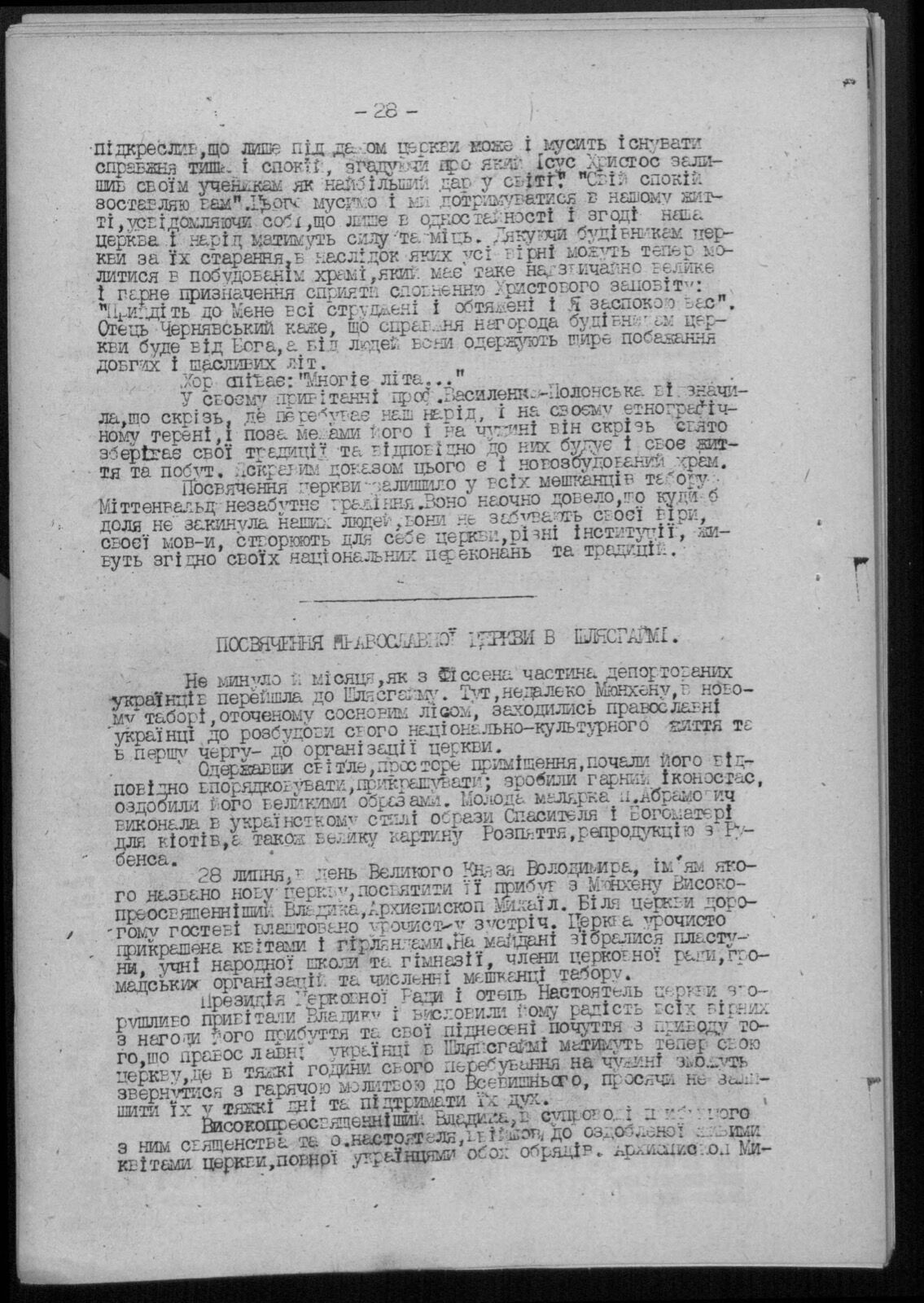
The Ukrainian church paper Tserkovnyi visnyk describes the arrival from the Ukrainian side. Less than a month after part of the Ukrainians deported from Füssen had moved to Schleißheim, the Orthodox among them set about rebuilding their national and cultural life in the new camp — which the paper describes as lying not far from Munich and surrounded by pine woods — and first of all about organising a church. Given a light, spacious room, they fitted it out and decorated it, made a fine iconostasis and hung it with large images; the young painter Abramovych executed figures of the Saviour and the Mother of God in the Ukrainian style for the icon cases, and a large Crucifixion after Rubens.
The church was named after Grand Prince Volodymyr, and on 28 July, his feast day, Archbishop Mykhail came from Munich to consecrate it. The church was decorated with flowers and garlands; Plast scouts, pupils of the elementary school and of the gymnasium, members of the church council, civic organisations and a large number of camp residents assembled in the square outside. The presidium of the church council and the rector told the archbishop what it meant that the Orthodox Ukrainians of Schleißheim would now have a church of their own for the hard years abroad.
Understanding the site
| Area or phase | Community / use |
|---|---|
| East of Schleißheimer Straße | Ukrainian DP section |
| West of Schleißheimer Straße | Russian DP section |
| Whole compound, historical exhibition estimate | 145 barracks; capacity up to 4,500 |
| From 1953 | Municipal housing for homeless families |
Life among the barracks
The local historical exhibition describes a compound of 145 barracks designed for up to 4,500 people. That is a capacity figure for the wider camp. Buildings contained around eighteen to twenty rooms; families could find themselves sharing rooms as accommodation grew tighter. Washing facilities and toilets stood outside, while poorly insulated walls and windows made winter heating difficult.
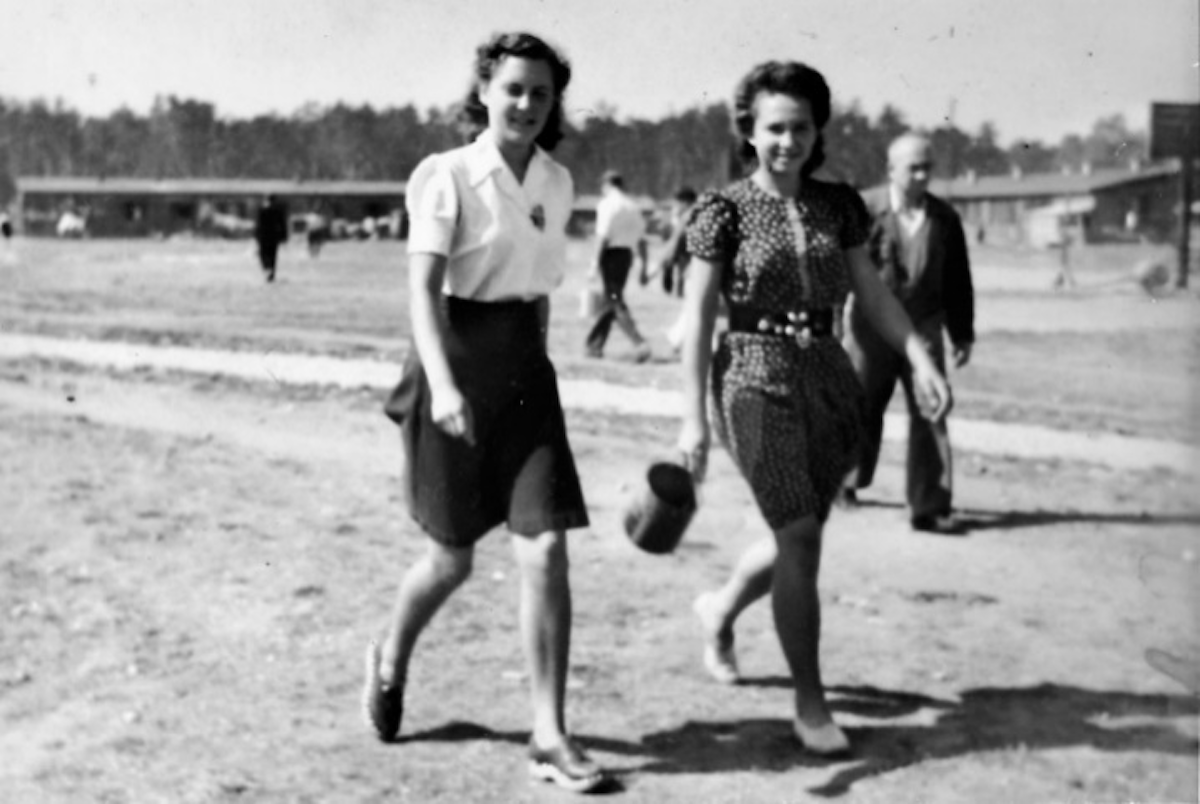
A published family account from the Russian section describes the path to the communal kitchen as a meeting place where residents exchanged news while collecting food. Meals were carried home in containers. Its accompanying photograph shows people crossing open ground with low barrack buildings behind them. These recollections illuminate everyday surroundings shared within the larger camp, without turning one family’s experience into a census.
Sources for this section
Education and cultural life
Ukrainian recollections describe a busy programme beyond ordinary lessons: theatre, a church choir, gymnastics and nursing courses held during two successive summer holidays. Historian Kateryna Kobchenko uses this evidence to show how young people remembered the DP years as a period of recovered opportunities after wartime disruption.
The Russian section’s Mendeleev Gymnasium occupied converted barrack rooms. A family account describes small classes, scarce writing paper and students sharing lecture notes. Music, dancing and vocational instruction offered further ways to learn and prepare for life elsewhere. These Russian school details belong alongside, rather than in place of, the distinct evidence for Ukrainian educational life.
Sources for this section
A varied religious and social community
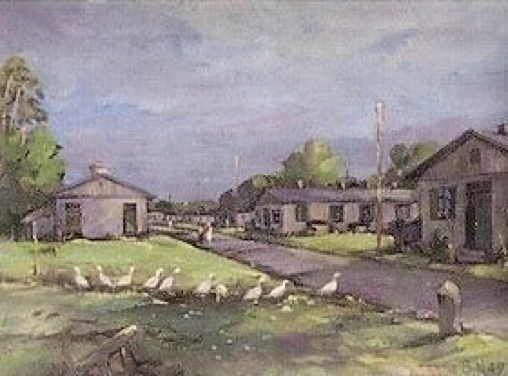
The wider compound included Russian Orthodox and Greek Catholic churches and a Buddhist temple used by Kalmyks. A library, cinema, theatre and Friday exchange market were among its shared facilities. Contemporary paintings preserve another side of this landscape: barrack lanes, gardens, poultry and the trees around the camp.
The surviving paintings are historical views made by people who knew the camp, rather than later reconstructions. Alongside photographs and written recollections they convey how the utilitarian buildings became a lived-in neighbourhood. Their subjects include ordinary work and efforts to supplement the necessities provided through organised relief.
Sources for this section
The Ukrainian community in numbers
Ukrainian population returns list 2,023 people in the 1946–47 questionnaire series, 1,472 in May 1947 and 333 in December 1947. These figures describe the Ukrainian community, not all residents of the Russian, Kalmyk and other groups. The table therefore measures a different population from estimates for the entire barrack compound.
Ukrainians recorded at Schleißheim
| Date / series | Ukrainians |
|---|---|
| 1946–1947 questionnaires | 2,023 |
| May 1947 | 1,472 |
| December 1947 | 333 |
Sources for this section
Emigration and a new use for the site
Residents left through several routes. One published family history documents a journey from Munich in June 1950, onward through Bremen and by ship to Venezuela. Others in the same account left for Australia, Belgium, Morocco and the United States. These are examples of actual destinations, not a complete breakdown of departures from the camp.
In November 1951 Bavaria took over the remaining accommodation as a government camp for homeless foreigners. The City of Munich’s history places its dissolution and municipal purchase in 1953. From August that year the city housed homeless families in the repaired barracks. This later municipal settlement continued into the 1960s, when residents moved into new housing and the barracks were gradually removed.
Sources for this section
Sources
- Frauenholz: history of Munich districts
City of Munich · Accessed September 2026
Frauenholz entry: 1937 training-school accommodation, DP use, Bavarian takeover November 1951 and conversion to municipal housing in 1953.
- Das Lager Frauenholz
Lokal-Anzeiger, reporting a local historical exhibition · 25 March 2011
Exhibition based on archival research, paintings and interviews: east Ukrainian/west Russian sections, barracks, infrastructure and artwork.
- Schleißheim camp and resettlement: a family history
Project Ancestry; public family collection · Accessed September 2026
Detailed recollections and photographs of the Russian section, schooling, meals and emigration; residents are not named in this article.
- The Refugee Experience: Ukrainian Displaced Persons after World War II
Canadian Institute of Ukrainian Studies Press · 1992
Ihor Stebelsky table 7, printed page 49: Schleißheim distinguished from Luitpold-Kaserne and other Munich facilities.
- Die DP-Zeit als Erinnerungsort
Kateryna Kobchenko, in Displaced Persons-Forschung in Deutschland und Österreich, Frank & Timme · 2022
Printed page 143, footnote 79: Ukrainian Schleißheim memoir describes theatre, church choir, gymnastics and nursing courses.
- Das Lager Schleißheim 1946–1953: conference research abstract
LMU Munich; Elena Kuhlen · Accessed September 2026
Research on the Russian camp traces August 1946 establishment and transfers from Kempten and Füssen, using administrative files, photographs, documents and oral history.
- Posviachennia pravoslavnoi tserkvy v Shliasshaimi (Consecration of the Orthodox church at Schleissheim), Tserkovnyi visnyk, page 28
Church Administration of the Ukrainian Autocephalous Orthodox Church, Munich · 1946
Digitised by the Ukrainian Museum-Archives of Cleveland with the United States Holocaust Memorial Museum in the Displaced Persons Camp Periodicals Collection; marked public domain or an orphan work and offered under Creative Commons Attribution-NonCommercial-NoDerivatives 4.0. A report of the fitting out and consecration of the Ukrainian Orthodox church in the camp. The same issue carries a circular of the Church Administration dated 31 July 1946.
Last researched 12 September 2026