Laim Camp
Displacement in Europe
Laim, Munich, Bavaria, Germany · Postwar displaced-persons camp; documented 1946–1949
A workers’ camp in Munich-Laim became an UNRRA assembly centre with a substantial Ukrainian population, its own schools and a block administration drawn from the residents. Population returns, a resident’s memoir and surviving school records trace life here from 1946 until the last families left for overseas.
Introduction
Laim was a displaced-persons camp in Munich with a substantial Ukrainian population. It was recorded separately from Freimann, Funkkaserne, Luitpoldkaserne and Schleissheim. A resident’s memoir describes Laim as a worker camp under UNRRA care, while school archives preserve a parallel history of children continuing their education.
A history in dates
- By 1944Deported Ukrainians are housed in a forced-labour barracks camp in the Laim district.
- 1945UNRRA Team 125 files for Munich-Laim and Fürstenfeldbruck begin.
- June 1946A resident’s memoir records admission to Laim under UNRRA care.
- August 1946The Ukrainian population return records 1,280 residents.
- 20 August 1946The inventory registers the camp as Assembly Centre 95-278.
- 1947A memoir describes questionnaires, interviews and the issuing of DP cards during screening.
- 31 October 1947The recorded accommodation capacity is 1,300.
- 1947–1950Surviving primary and secondary school records document continued Ukrainian education.
- 1949One documented Ukrainian family leaves for the United States.
- November 1949The memoir’s author is at the Warner-Kaserne in Munich, and reaches the United States in May 1950.
- 1949–1950The inventory places the camp’s closure within this interval.
Sources for this section
- KulturGeschichtsPfad 25: Laim
- UNRRA Germany Mission administrative history, box and folder list
- A difficult road: a Ukrainian resident’s memoir
- Population migration after World War II, Table 7
- DP camp inventory, record 1287: DP-Camp Laim
- Inventory of the Central Representation of Ukrainian Emigration archive
- A family remembrance, May 2025
What the records call it
The camp inventory lists DP-Camp Laim at München-Laim as Assembly Centre 95-278, later OB 704, under UNRRA Team 125 München-Laim, with an opening date of 20 August 1946, a capacity of 1,300 recorded on 31 October 1947 and closure between 30 September 1949 and 30 September 1950. The nationalities given are Ukrainian, Lithuanian and Polish.
The UNRRA files in the United Nations Archives carry the same assembly-centre number under a clerk’s uncertain spelling, as Lain or Laum Displaced Persons Camp, and there are Team 125 files for Munich-Laim and Fürstenfeldbruck running from 1945. Since the memoir describes admission in June 1946 and the team files begin in 1945, the inventory’s August 1946 date is best read as a registration date rather than the first day the camp existed.
Administrative identifiers
| Record | Detail |
|---|---|
| Assembly Centre | 95-278 |
| Later camp number | OB 704 |
| UNRRA team | T 125 München-Laim |
| Opening date in the inventory | 20 August 1946 |
| Capacity, 31 October 1947 | 1,300 |
| Closing interval | 30 September 1949 to 30 September 1950 |
| Nationalities in the inventory | Ukrainian, Lithuanian, Polish |
Laim before the camp
Laim was a railway and industry district, and several of its firms produced for the armaments industry during the war using foreign forced labour. The city’s cultural history trail for the district records a forced-labour camp of twenty barracks on Aindorferstraße in which deported Ukrainians were housed while they worked for Munich’s armaments industry, and states that the site continued in use for refugees and expellees until 1957 before a housing association built over it. It also records 133 Soviet prisoners of war counted in 1944 at one Landsberger Straße factory.
The trail does not name or locate the UNRRA camp, so it cannot be said that the assembly centre occupied the Aindorferstraße barracks. What it does establish is that Ukrainians had already been brought to this district under compulsion, and that Laim held the kind of barracks accommodation an assembly centre needed.
Sources for this section
Finding a place at Laim
The memoir that describes this camp begins outside it. Its author reached Munich on the second day after Christmas 1945 with twelve other families and found the half-ruined barracks of a former Polish camp on Hannoverstraße, where each family fitted out a room as best it could. By the spring of 1946 the place was falling apart and filling with people of every nationality, theft was constant and the police were never away from it. That is what he was leaving when he applied to an UNRRA camp.
One Ukrainian resident recalled entering Laim in June 1946 after struggling to find a vacancy. Illness prevented him from taking ordinary work, and he was given responsibility for a residential block. His account shows the camp as both a place of accommodation and an organised community with work and administrative responsibilities.
He was admitted only with difficulty, for want of places. Laim, he wrote, counted as a workers’ camp, and because he was ill he was made a block leader instead of being sent out to work. The block system put day-to-day order in the hands of residents while UNRRA held the administration, which is how camps of this size were generally run.
Sources for this section
The changing community
The 1946–1947 Ukrainian survey recorded 717 people at Laim. Separate returns counted 1,280 in August 1946, 1,149 in May 1947 and 945 in December 1947. These figures describe the Ukrainian population of the named camp, rather than the total population of Munich or everyone housed at Laim.
A later Ukrainian encyclopedia article on Munich gives about 250 Ukrainians at Laim, without a date, alongside about 3,000 each at Karlsfeld and the Warner-Kaserne. That figure is far below the dated returns and probably describes a different moment, most likely near the end. Both are recorded here and neither is treated as the population of the camp as a whole.
Ukrainian residents
| Reporting date | Ukrainian residents |
|---|---|
| 1946–1947 survey | 717 |
| August 1946 | 1,280 |
| May 1947 | 1,149 |
| December 1947 | 945 |

Sources for this section
Schools and community organisation
The Ukrainian Free University’s archive lists records for both a Ukrainian primary school and a gymnasium in Munich-Laim. The primary-school holdings include a report for 1947–1948, class records for 1947–1949 and pupil assessment material for 1949–1950. The gymnasium holdings include entrance examinations, school reports and a conference journal. Together these records establish sustained educational activity; they do not supply a verified enrolment total.
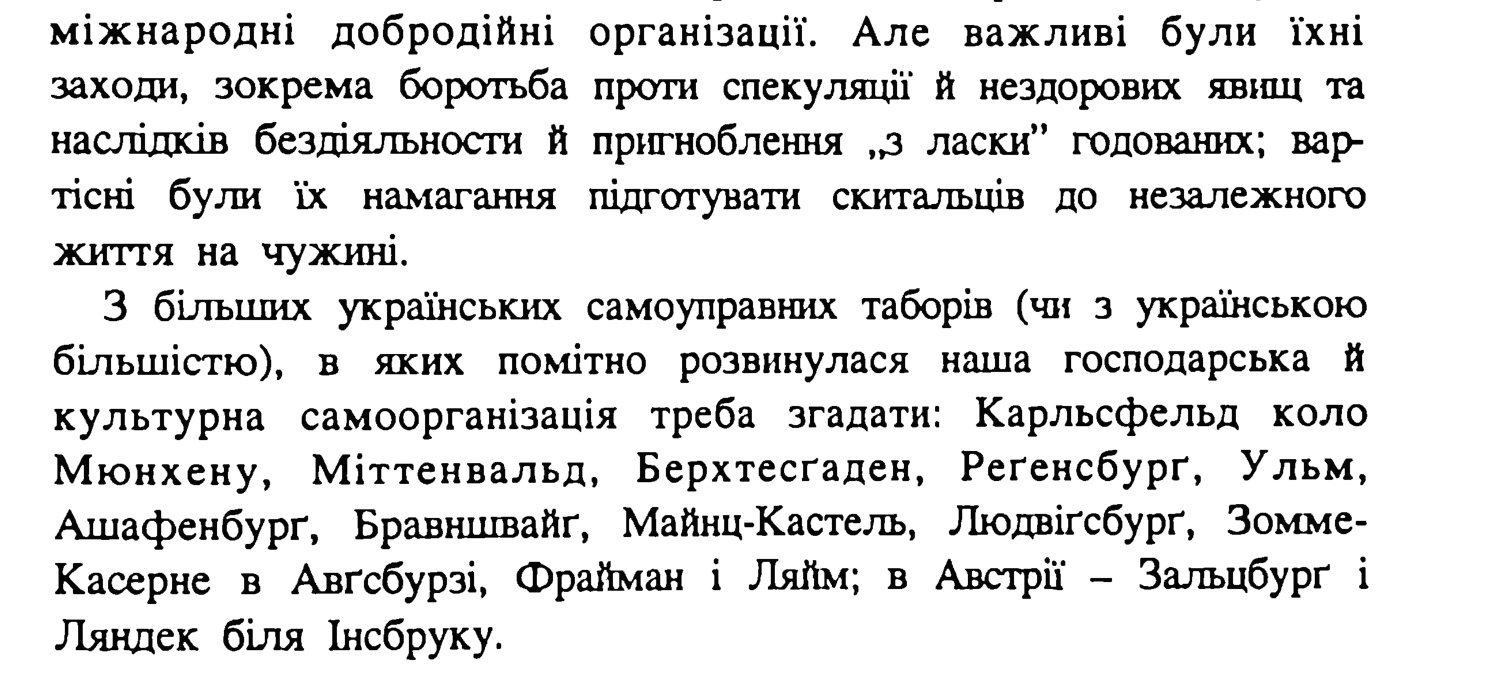
A history of Ukrainian cooperation also includes Laim among the camps where economic and cultural self-organisation developed. Such organisations gave displaced communities responsibilities beyond receiving relief. The source places Laim within this wider movement without supplying a separate membership count or a detailed balance sheet for its cooperative.
Recognition and uncertainty
Registration had already required a compromise. The memoir records that its author wrote on his admission form that he came from Poltava, and that the American camp commandant replied that he had not a single person from the Soviet side and that the form would have to be rewritten. He was entered instead as coming from Kolomyia, in former Polish territory. The same pressure shaped the answers people gave two years later.
The memoir describes the strain of the 1947 screening process. Residents completed questionnaires and waited for interviews and decisions about DP status. For a family from Soviet Ukraine, stating their place of origin raised fears of return. The author recalled eventually receiving DP cards. His account is evidence of one household’s experience, rather than proof that every resident faced an identical decision.
Sources for this section
Leaving the camp
The memoir follows one route out. Its author was living in the Warner-Kaserne camp in Munich by the end of November 1949, and after a medical commission and a consular interview he landed in the United States on 4 May 1950. A move to a transit and emigration barracks was the normal last stage, which means a family’s departure from Laim and its departure from Germany can be a year apart.
A family obituary published in 2025 records that a Ukrainian family remained at Laim until admission to the United States in 1949. School documents continued into the 1949–1950 academic year. These overlapping traces show why a family’s departure and the disappearance of a camp community cannot be treated as the same event.
Sources
- Population migration after World War II, Table 7
Ihor Stebelsky, The Refugee Experience
Original table header and camp row visually checked: separate American-zone camp populations, pp. 47–51.
- A difficult road: a Ukrainian resident’s memoir
Poltava history of political repression
Full memoir read. Laim admission June 1946, worker-camp description, block responsibility and 1947 screening. Personal names omitted.
- Inventory of the Central Representation of Ukrainian Emigration archive
Ukrainian Free University
2025 published inventory p. 19: Laim primary and secondary school holdings. Descriptions establish records and activity, not enrolment or unseen report contents.
- Ukrainian world cooperation: historical account
Ukrainian cooperative movement history / Diasporiana
Printed p. 13 lists Laim among camps with economic and cultural self-organisation. No camp-specific cooperative figures inferred.
- A family remembrance, May 2025
Tribute Archive
Family-authored obituary documents Laim residence and US admission in 1949; no personal names reproduced.
- DP camp inventory, record 1287: DP-Camp Laim
Arolsen Archives · inventory of 26 October 2023
AC 95-278, later OB 704; Team 125 München-Laim; opened 20 August 1946; capacity 1,300 on 31 October 1947; Ukrainian, Lithuanian and Polish.
- UNRRA Germany Mission administrative history, box and folder list
United Nations Archives, AG-018-039, via dpcamps.org · 1945–1949
Assembly Centre 95-278 recorded as Lain or Laum Displaced Persons Camp; Team 125 files for Munich-Laim from 1945.
- KulturGeschichtsPfad 25: Laim
Landeshauptstadt München · district history trail
Forced-labour barracks in the district, including twenty barracks on Aindorferstraße housing deported Ukrainians, in use for refugees and expellees until 1957.
- Munich
Encyclopedia of Modern Ukraine · retrieved 13 September 2026
Gives about 250 Ukrainians at Laim, undated, against about 3,000 each at Karlsfeld and the Warner-Kaserne.
Last researched 13 September 2026