Luitpold-Kaserne
Displacement in Europe
Munich · Germany · Recorded 1945–1950
An imperial airship barracks on the Oberwiesenfeld became an assembly centre and then the transit and control centre through which refugees passed on their way into and out of the German camp network. Polish, Ukrainian and Yugoslav groups were recorded here, and the barracks were still occupied when the American army reclaimed them in 1950.
Introduction
Luitpold-Kaserne in Munich served as an international transit and control centre: a place where refugees arrived, underwent screening and moved on to other accommodation. Ukrainians formed part of a mixed population. Photographs preserve both its prominently signed entrance and a crowded room beneath the barracks roof.
A history in dates
- From 1896The Luftschifferkaserne is built at Infanteriestraße 19 on the Oberwiesenfeld.
- 1945An UNRRA team file is opened for Luitpold Kaserne, Munich.
- February 1946American troops arrest former royal Yugoslav soldiers living here as displaced persons.
- 24 June 1946The centre appears in the camp inventory as Assembly Centre 95-465 A.
- 31 May 1947The Ukrainian return records 91 people; a further return records 27 on 2 January 1948.
- 31 October 1947The recorded accommodation capacity is 1,550.
- 1 August 1948A Warsaw Uprising commemoration is held in the Polish theatre in Block 5.
- February 1949A local study reports the camp dissolved and 457 residents moved to Rothschwaige.
- 1949Documented arrivals undergo screening and transfer onward to other German camps.
- 9 October 1950Bavaria approves replacement accommodation in Munich.
- 16 October 1950An American directive sets 1 November as the deadline to vacate Luitpold.
- From 1950The refurbished barracks pass to the United States Army, and to the Bundeswehr in 1955.
Sources for this section
- Luitpold-Kaserne (München)
- UNRRA Germany Mission administrative history, box and folder list
- DP-Lager: Munich, the camp in the Luitpoldkaserne
- DP camp inventory: Munich Luitpold-Kaserne
- Ukrainians in the camps of the American zone, Table 7
- Mūsų kelias, 28 July 1948: notice of the Warsaw Uprising commemoration
- Archival study of Czechoslovak refugees: Munich transit centre
- Bavarian cabinet meeting of 9 October 1950
The barracks before 1945
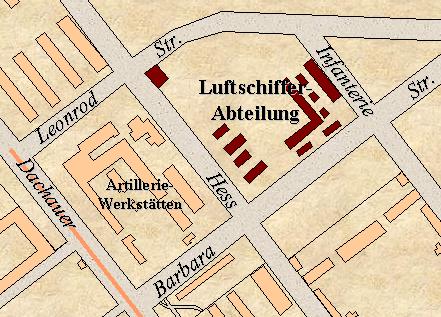
Building began in 1896 at Infanteriestraße 19, on the Oberwiesenfeld in the north of Munich, as the Luftschifferkaserne for the Bavarian army’s airship detachment, a unit formed in 1890. The compound was enlarged by about 5.5 hectares in 1931 and 1932 and later carried the Luitpold name. A ground plan of about 1922 shows the yard and the ranges of accommodation blocks that displaced people would occupy after the war.
The buildings came through the war in a condition that allowed reuse. That is why a barracks of this kind became camp accommodation: it offered heated blocks, a kitchen, a yard and a gate that could be controlled, all of which suited an occupying army looking for places to put several hundred people at short notice.
Numbers, dates and administration
The camp inventory records the centre as Assembly Centre 95-465 A, later carried as OB 783 and OB 797, opened on 24 June 1946 and closing between 30 September 1949 and 30 September 1950. It lists Polish, Ukrainian and Yugoslav groups and a capacity of 1,550 recorded on 31 October 1947.
The UNRRA files in the United Nations Archives show that the barracks were in relief use before that registration. There is a 1945 file for Team 540, Luitpold Kaserne, Munich, and a 1946 file for Assembly Centre 95-465 under Area Team 1066, the same area team that handled the Schleissheim base labour camp. The catalogue titles establish the administrative chain rather than the contents of the files.
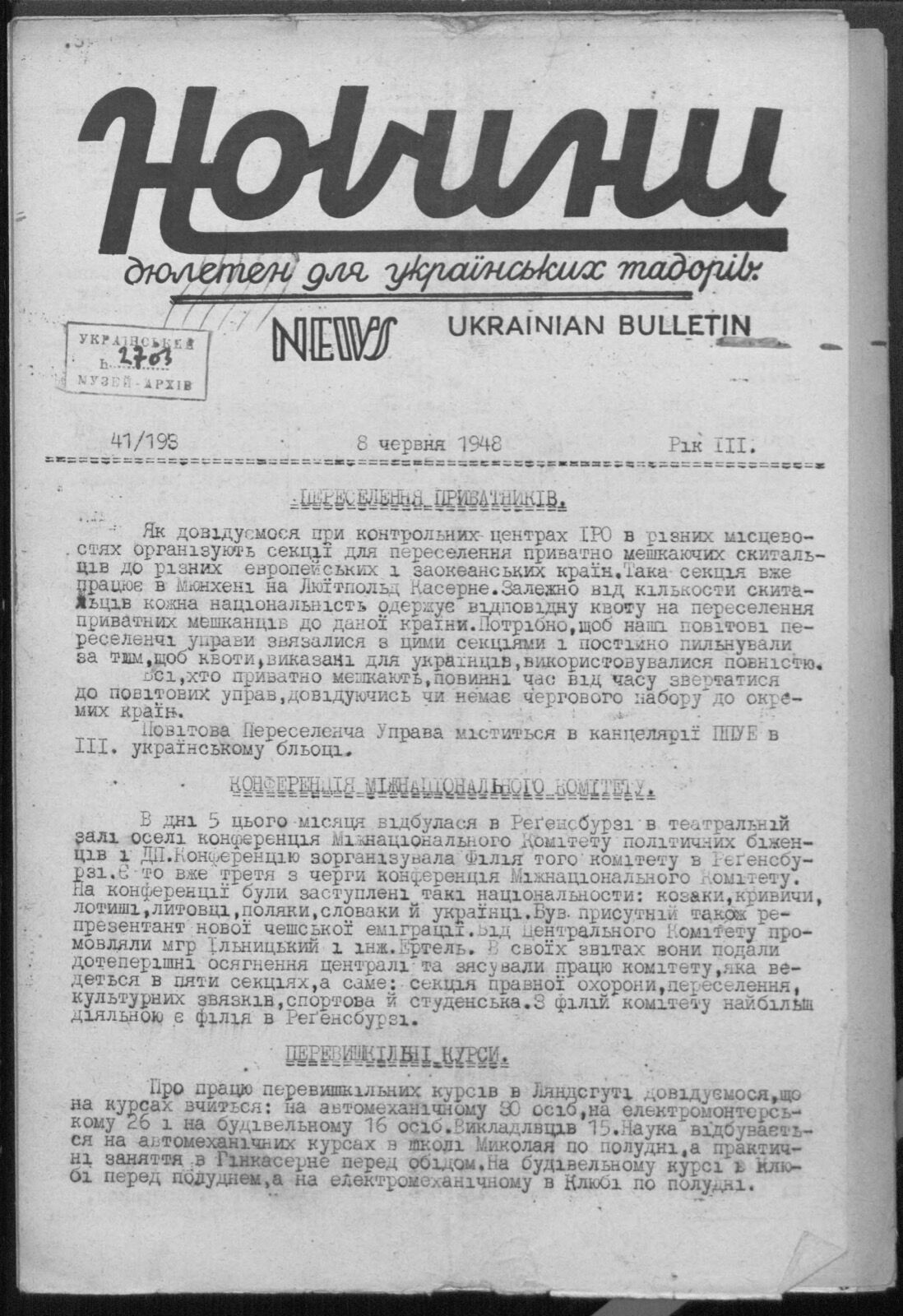
The barracks also served refugees who were not living in camps at all. The Ukrainian camp bulletin Novyny reported on 8 June 1948 that resettlement sections for privately accommodated refugees were being set up at the IRO control centres in various places, and that such a section was already working in Munich at the Luitpold-Kaserne. Each nationality received a quota for private residents in proportion to its numbers, and the paper pressed district resettlement offices to keep in touch with these sections and to see that the quotas allotted to Ukrainians were taken up in full.
Sources for this section
Arrival and onward movement
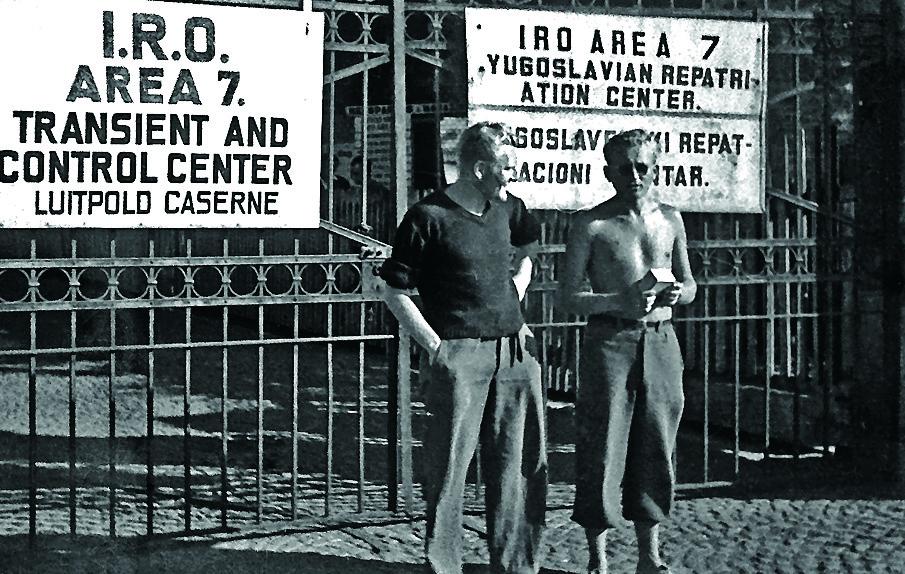
An archival study traces refugees arriving from Czechoslovakia in 1949 through border checks to the IRO Area 7 Transient and Control Center at Luitpold. Screening assessed their circumstances and eligibility for refugee status. The barracks therefore stood at an administrative gateway between flight across a border and placement in the camp network.
One documented group spent about a month here before transfer with 150 compatriots to Eichstätt. Another route continued from Luitpold to Arsenalkaserne in Ludwigsburg. These were movements within Germany, not overseas resettlement. They illustrate the centre’s transit role without suggesting that every nationality followed the same itinerary.
Documented stages of movement
| Stage | Place or process |
|---|---|
| Arrival | Border checks followed by transfer to Munich |
| Reception | IRO Area 7 transit and control centre, Luitpold-Kaserne |
| Onward accommodation | Eichstätt in one documented group; Ludwigsburg in another |
Sources for this section
Inside the barracks
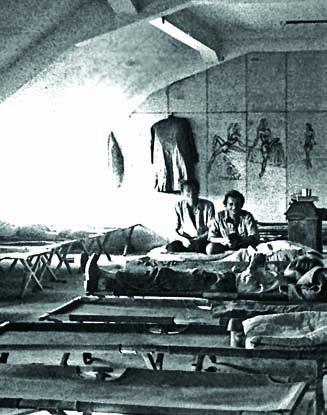
The entrance photograph identifies the IRO centre by name and also shows signage for a Yugoslav repatriation centre. A second photograph records beds beneath a sloping attic ceiling, bringing the accommodation into view. Both survive in an archival study based on contemporary records and later interviews.
The 1947 inventory gives a capacity of 1,550 and lists Polish, Ukrainian and Yugoslav groups. Capacity describes the number the premises could accommodate; it does not establish how many people were present on any particular day. The later OB 797 identifier is especially useful because it also appears in the 1950 evacuation order.
Administrative identifiers
| Record | Detail |
|---|---|
| Assembly Centre | 95-465A |
| Later camp number | OB 797 |
| Capacity, 31 October 1947 | 1,550 |
| National groups in inventory | Polish, Ukrainian and Yugoslav |
Communities inside the barracks
A notice in the Lithuanian displaced-persons newspaper Mūsų kelias for 28 July 1948 announced a requiem for the fallen of the Warsaw Uprising on 1 August at the Polish parish church in Infanteriestraße 15, immediately outside the gate, and a commemorative session the same afternoon in the premises of the Polish theatre in Luitpoldkaserne Block 5. A theatre with its own rooms inside a numbered block, and a parish church at the gate, describe a settled community rather than a waiting room.
The Ukrainian returns collected for the American zone are much smaller. Table 7 of Stebelsky’s survey records 91 Ukrainians at the Munich Luitpold Kaserne on 31 May 1947 and 27 on 2 January 1948, with no entry in the two earlier columns. Those counts describe one national group at two moments, in a centre whose purpose was movement, and they cannot be read as the number of people living in the barracks.
In February 1946 American troops arrested numerous former soldiers of the royal Yugoslav army who were living here as displaced persons, in an operation the authorities said had broken up an attempt to form a royalist Yugoslav force in Bavaria. Hundreds of the former Allied prisoners of war who had been housed in the barracks were moved to Bad Aibling in the autumn of 1946. The episode explains the Yugoslav signage on the gate photograph and shows how closely the barracks were policed.
Ukrainians recorded at the Munich Luitpold Kaserne
| Return | Ukrainians |
|---|---|
| 1946–1947 questionnaire series | no entry |
| 24 August 1946 | no entry |
| 31 May 1947 | 91 |
| 2 January 1948 | 27 |
Dissolution, and a conflict in the record
In October 1950, additional American troops required barracks then housing displaced people. The Bavarian cabinet discussed replacement accommodation, noting that many residents worked locally and needed to remain near their jobs. On 16 October, the American land commissioner specified that OB 797 Luitpold-Kaserne should be vacated by 1 November.
Bavaria approved 300,000 DM for new accommodation at Munich’s Oberwiesenfeld as part of a wider programme. These records establish that displaced people still occupied Luitpold in autumn 1950. They record an evacuation deadline, rather than proof that every resident left on that date.
The sources do not agree about when the camp ended. A local study by Petra Röhrle, cited in the German survey of displaced-persons camps, states that the Luitpoldkaserne camp was dissolved in February 1949 and that 457 displaced people from 18 European countries were transferred to the Rothschwaige transit camp near Dachau. The inventory places closure between September 1949 and September 1950, and the Bavarian cabinet papers show people still living here in October 1950. The likeliest reading is that the residential camp was wound up in stages while the transit and control function continued, but no single record establishes that, and the conflict is left open here rather than settled by choosing a date.
The site afterwards
The buildings were refurbished and taken over by the United States Army from 1950, which is the change the Bavarian cabinet was preparing for. The newly formed Bundeswehr moved in during 1955, the army medical school followed in 1957 and grew into the Bundeswehr medical academy, which left in 1980. Military use ended in 1999, the city of Munich bought the site in 2004, and the area has since been planned for mixed housing and commerce.
Sources for this section
Sources
- DP camp inventory: Munich Luitpold-Kaserne
Arolsen Archives · 2023
Entry 1279: control and transient centre; AC 95-465A; OB 783 and subsequently OB 797. Capacity 1,550 on 31 October 1947.
- Archival study of Czechoslovak refugees: Munich transit centre
Institute for the Study of Totalitarian Regimes, Paměť a dějiny · 2009, number 1
Printed pages 76–78: arrival, screening and onward transfers in 1949. Page 76 reproduces photographs of the signed Luitpold entrance and attic room from a private historical archive. The institute checked archival testimony against later interviews.
- Bavarian cabinet meeting of 9 October 1950
Bavarian cabinet protocols, scholarly edition · 9 October 1950; editorial documents dated October 1950
Item I and note 3: proposed replacement accommodation and the 16 October order requiring OB 797 Luitpold-Kaserne to be vacated by 1 November. Distinguishes decisions from confirmed implementation.
- Ukrainians in the camps of the American zone, Table 7
Ihor Stebelsky, The Refugee Experience, Canadian Institute of Ukrainian Studies Press · 1992
Printed pages 47–51. Munich Luitpold Kaserne: 91 on 31 May 1947 and 27 on 2 January 1948. Ukrainians only.
- UNRRA Germany Mission administrative history, box and folder list
United Nations Archives, AG-018-039, via dpcamps.org · 1945–1949
Team 540 Luitpold Kaserne Munich 1945; Area Team 1066, Assembly Centre 95-465, Munich Luitpold Kaserne 1946.
- DP-Lager: Munich, the camp in the Luitpoldkaserne
German Wikipedia, citing Christian Höschler and Petra Röhrle · retrieved 13 September 2026
February 1946 arrests of former royal Yugoslav soldiers; transfer of 457 residents to Rothschwaige in February 1949.
- Luitpold-Kaserne (München)
German Wikipedia · retrieved 13 September 2026
Built from 1896 as the Luftschifferkaserne; enlarged 1931/32; United States Army from 1950; Bundeswehr from 1955.
- Mūsų kelias, 28 July 1948: notice of the Warsaw Uprising commemoration
Lithuanian displaced-persons newspaper, Dillingen an der Donau · 28 July 1948
Polish parish church at Infanteriestraße 15 and the Polish theatre in Luitpoldkaserne Block 5.
- Ground plan of the Luftschifferkaserne, later the Luitpoldkaserne, Munich
Wikimedia Commons, public domain · about 1922
Extract from a Munich city plan showing the barracks layout.
- Pereselennia pryvatnykiv (Resettlement of those living privately), Novyny: biuleten dlia ukrainskykh taboriv / News: Ukrainian Bulletin, number 41, year III, 8 June 1948, page 1
Novyny: biuleten dlia ukrainskykh taboriv · 8 June 1948
Digitised by the Ukrainian Museum-Archives of Cleveland with the United States Holocaust Memorial Museum in the Displaced Persons Camp Periodicals Collection; marked public domain or an orphan work and offered under Creative Commons Attribution-NonCommercial-NoDerivatives 3.0. Front-page notice that a resettlement section for privately accommodated refugees was already working at the Luitpold-Kaserne in Munich.
Last researched 13 September 2026