Munster-Lager
Displacement in Europe
Munster, Lower Saxony, Germany · 1945–1949
A Ukrainian camp of roughly 1,600 people occupied part of a barracks landscape that had housed soldiers since 1893, while the British ran Germany’s largest prisoner-of-war discharge centre on the same heath. Its Orthodox parish kept registers from 1945 to 1949 and the camp appears in relief records as DP Camp 252 in the Soltau district.
Introduction
Munster-Lager was a Ukrainian displaced-persons camp at Munster in Lower Saxony, in the British occupation zone. It lay about 40 kilometres northeast of Fallingbostel. Contemporary relief records identify it as DP Camp 252 in the Soltau district.
The place is Munster on the Lueneburg Heath, rather than Muenster in Westphalia. That distinction matters: the two towns had different camps, administrative histories and migration routes. The Ukrainian parish at Munster-Lager is directly documented from 1945 to 1949.
A history in dates
- June 1893The troop camp beside the railway is first occupied, by an Oldenburg infantry regiment.
- 1914–1918About 21,000 prisoners of war are held at Munsterlager.
- 1945The Ukrainian camp and Orthodox parish begin their documented postwar period; the British open the largest German prisoner-of-war discharge centre on the same heath.
- 1946–1947A survey records 1,529 Ukrainians.
- May 1947The Ukrainian population return records 1,682 residents.
- 30 June 1948The relief directory lists Munster-Lager as DP Camp 252 and counts 1,809 Ukrainians in the district.
- July 1949The recorded Ukrainian population is 988.
- 1949The parish register and local history reach the end of the Ukrainian camp period.
- 1956Munster becomes a Bundeswehr garrison town; the remaining barrack camps are cleared during the 1960s.
The barracks before 1945
Munster was a village of 470 people on the Lueneburg Heath in 1891. A troop camp was then laid out about 1.5 kilometres from the village centre, beside the railway running from Bremen through Soltau to Uelzen, and was first occupied in June 1893 by an Oldenburg infantry regiment. The place grew around the camp, and the name Munster-Lager attached itself to the whole settlement.
Detention was part of the site’s history long before 1945. In the First World War about 21,000 prisoners of war were held there, the first 1,200 of them British soldiers brought from northern France in September 1914. In the 1930s the neighbouring Breloh ground was rebuilt as an army chemical-weapons testing station, and the Army Weapons Office moved part of its work there from Berlin in March 1945.
Sources for this section
Refuge in a military landscape
After 1945 the extensive military sites served several purposes at once. The British set up the largest discharge camp for captured Wehrmacht soldiers in Germany here; about 1.7 million prisoners of war are said to have been processed home through Munster and Breloh, and in July 1946 the first 2,000 prisoners returned under the Seagull scheme arrived at what was then the central transit and distribution camp of the British zone. The displaced-persons camp sheltered Ukrainians in the same locality. These populations had entirely different status and reasons for being there.
The barrack camps were named by the British with letters of the alphabet. Some of them stood until the 1960s, when they were pulled down, by which time the town no longer wished to be called Munster-Lager. The local military history describes a Ukrainian camp of about 1,600 people during 1945 to 1949, and independently compiled Ukrainian returns are of the same order while showing that numbers changed.
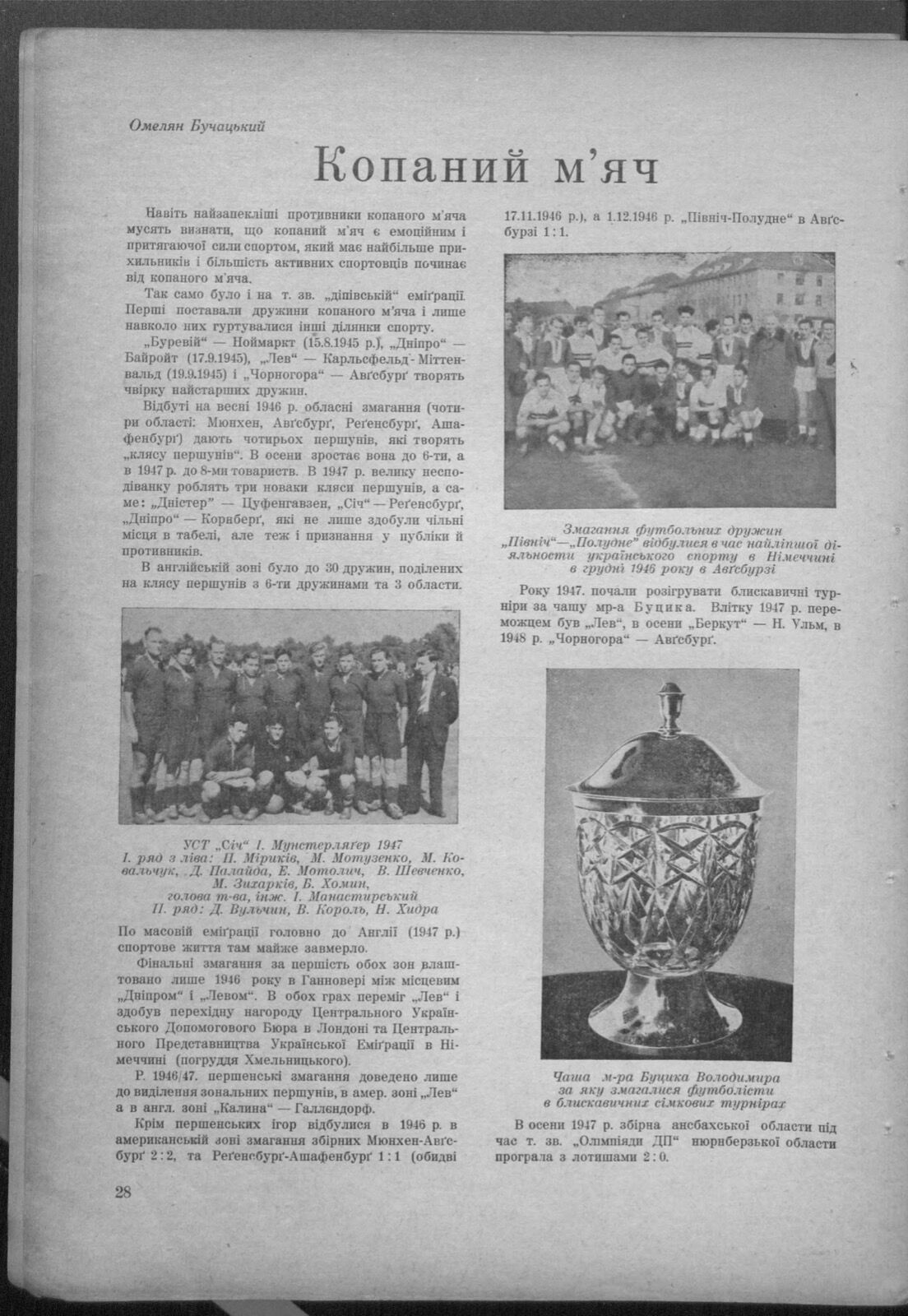
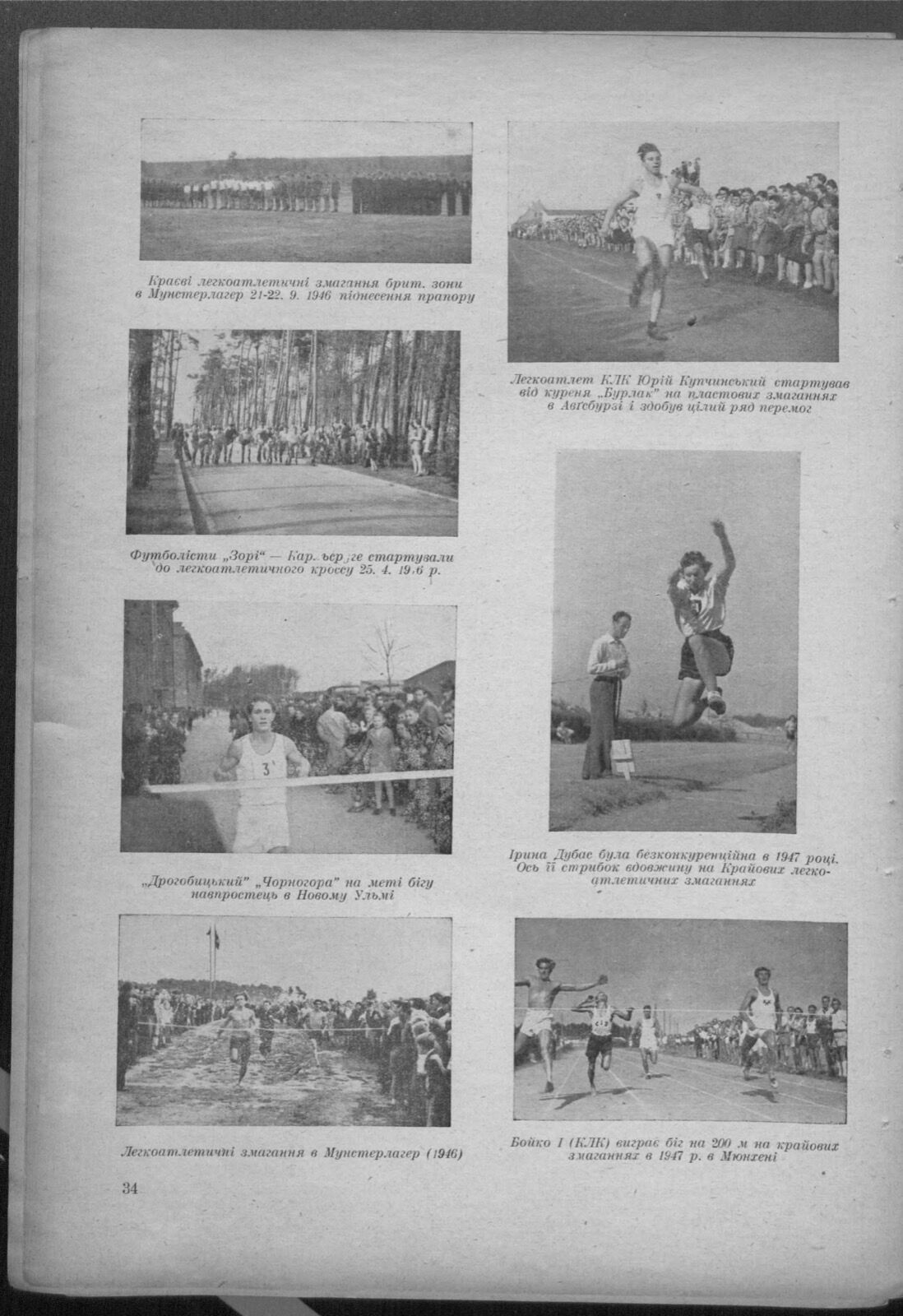
The barracks landscape gave the camp ground enough for meetings that drew competitors from across the zone. The Almanac of the Ukrainian Council for Physical Culture, published at Munich in 1951, reproduces a photograph of the flag being raised at the British zone athletics championships held at Munsterlager on 21 and 22 September 1946, and a second photograph, captioned simply “Athletics meeting at Munsterlager (1946)”, of runners finishing on a churned track in front of a crowd held back by a rope.
Uses of the Munster military landscape
| Period | Use | Population counted |
|---|---|---|
| From June 1893 | Imperial German troop camp | Garrison units |
| 1914–1918 | Prisoner-of-war camp | About 21,000 prisoners |
| 1935–1945 | Army chemical-weapons testing station at Breloh | Military staff |
| From 1945 | British discharge centre for German prisoners of war | About 1.7 million processed at Munster and Breloh |
| 1945–1949 | Ukrainian displaced-persons camp, DP Camp 252 | About 1,600, and see the returns above |
A changing Ukrainian population
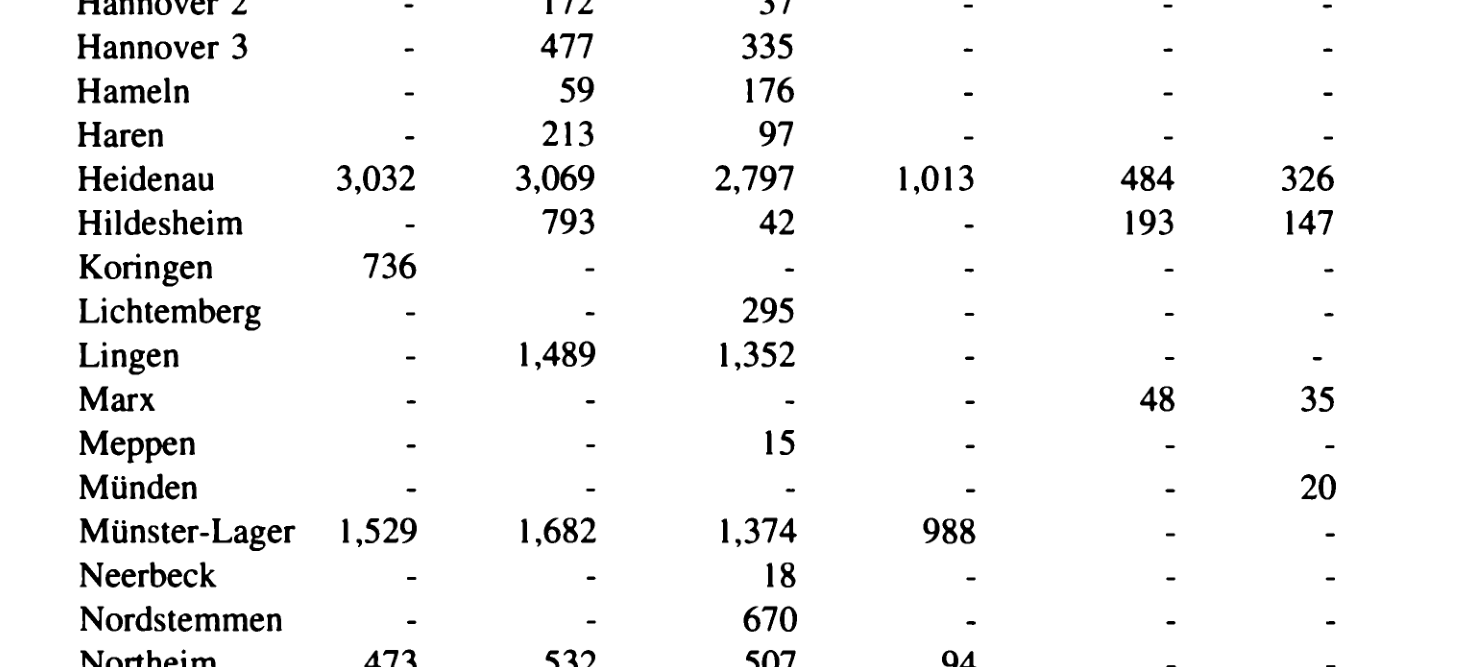
The 1946 and 1947 questionnaire survey recorded 1,529 Ukrainians. The dated returns then show 1,682 in May 1947, 1,374 in December 1947 and 988 in July 1949, after which the table’s columns for December 1950 and August 1951 are blank, meaning no return rather than nobody left. Each figure is a snapshot; they do not measure all the people who passed through the camp.
A separate count made by the United Ukrainian American Relief Committee gives 1,809 Ukrainians in the Munster district on 30 June 1948, all of them in camps. The two compilations used different sources and different reporting units, so they sit alongside one another rather than correcting one another.
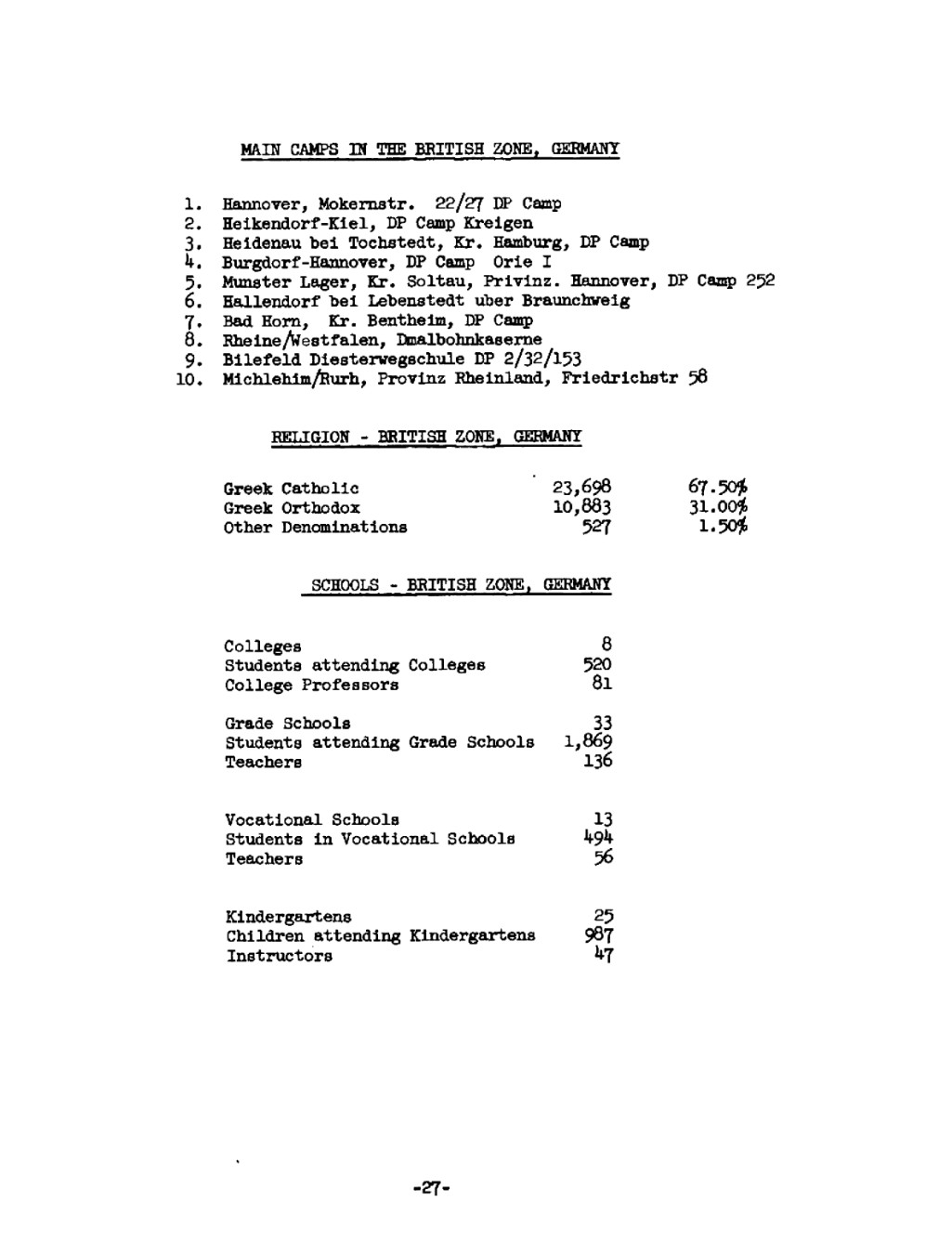
Munster-Lager remained important enough to appear in the same committee’s list of the ten main British-zone camps on 30 June 1948. The original directory gives the camp number and district, providing a contemporary link between the community and its administrative location.
Sport at the camp was organised in a society of its own. The same almanac’s chapter on football reproduces a photograph of the first eleven of the Ukrainian sports society Sich of Munsterlager in 1947 and names them: in the first row, from the left, P. Mirykiv, M. Motuzenko, M. Kovalchuk, D. Palaida, E. Motolych, V. Shevchenko, M. Zykharkiv and B. Khomyn, with the society’s chairman, the engineer I. Manastyrsky; in the second row, D. Vulchyn, V. Korol and N. Khydra.
Ukrainian population returns
| Date or survey | Ukrainians | Source and scope |
|---|---|---|
| 1946–1947 survey | 1,529 | Stebelsky Table 6, from questionnaire returns of the Central Representation of the Ukrainian Emigration |
| May 1947 | 1,682 | Stebelsky Table 6, from UNRRA assembly centre reports, British zone |
| December 1947 | 1,374 | Stebelsky Table 6, from the IRO monthly assembly centre report |
| 30 June 1948 | 1,809 | Relief committee district table, Ukrainians in DP camps in the Munster district |
| July 1949 | 988 | Stebelsky Table 6, from the IRO monthly statistical report for the British zone |
| December 1950 and August 1951 | no return | Stebelsky Table 6 cells blank, which is not a zero |
A parish through the postwar years
The Ukrainian Autocephalous Orthodox congregation recorded baptisms, marriages and funerals during 1945 to 1949. Its register also retained affidavits about earlier ceremonies and government-issued certificates. Documents that families carried or reconstructed before emigration became part of the parish record.
The surviving papers are arranged in five series: church correspondence and records, financial records, relief aid distribution records, the combined register book, and census records. They are written in Ukrainian, German, English, Serbo-Croatian and Polish, which is itself a measure of how many administrations a parish had to deal with. The relief distribution records show the congregation acting as a channel for aid as well as for sacraments.
The same surviving volume contains entries from the separate Fallingbostel Emigration Centre for 1948 to 1950, and the collection’s census record of 14 July 1950 belongs to Fallingbostel. The collection’s finding aid suggests that the two parishes may have shared clergy. The volume connects their surviving paperwork without demonstrating that the camps were one institution or that every resident followed the same route.
Children’s education and onward journeys
Primary schooling continued amid displacement. The University of Manitoba’s archival biography of a former pupil records education at Munster-Lager and Fallingbostel between 1946 and 1950, before settlement in Canada. This supplies a concrete example of schooling continuing through more than one camp.
The 1948 relief report also records a wider British-zone network of schools, colleges, kindergartens and vocational teaching, together with a breakdown of the Ukrainian workforce in which farmers and labourers far outnumbered every profession. Munster-Lager belonged to the network of communities served by this relief organisation; the zone-wide totals should not be read as figures for this camp alone.
Sources for this section
The end of the camp period
The local history dates the Ukrainian DP camp to 1945 and 1949, consistent with the parish entries ending in 1949 and the July 1949 population return.
Munster’s later military installations followed a separate chronology. The town became a Bundeswehr garrison in 1956 and grew into the largest in the country, while British stationed forces kept their own garrison there until 1993. The wooden barrack camps of the displaced-persons years had gone by then.
Sources
- Fallingbostel and Munster-Lager DP Camp Church Records
Ukrainian History and Education Center · 2012
Location identity and uncertainty about shared volume.
- Report: history, accomplishments, statistics and plans
United Ukrainian American Relief Committee · 30 June 1948
Original scan PDF 31, printed 27; Camp 252 and Soltau district visually verified.
- Fallingbostel and Munster-Lager church register
Ukrainian History and Education Center · 1943–1950
Detailed contents give Munster parish dates of 1945–1949; the earliest inserted certificates do not establish the camp opening.
- Der Truppenübungsplatz Munster blickt auf eine lange Tradition zurück
Matthias Blazek · 18 July 2015
Historian’s revised military site history; Ukrainian DP camp separately identified.
- Ukrainians in British-zone camps, Table 6
The Refugee Experience · 1992
Printed 44-46, heads and source footnotes visually checked.
- Fallingbostel and Munster-Lager DP Camp Church Records, finding aid
Ukrainian History and Education Center archives · Accessed 13 September 2026
Finding aid read 13 September 2026: 1943–1950, majority 1948–1950; 0.25 linear feet, four folders and one bound volume; five series including relief aid distribution records and census records; census record dated 14 July 1950 for Fallingbostel; languages Ukrainian, German, English, Serbo-Croatian and Polish; archivists note the two camps may have shared clergy. No names reproduced.
- Truppenuebungsplatz Munster
Wikipedia DE · Accessed 13 September 2026
Wikitext read in full. Section ‘Munsterlager’: village of 470 in 1891; troop camp laid out 1.5 km from the centre on the Bremen-Soltau-Uelzen line, first occupied June 1893 by Oldenburg Infantry Regiment 91; about 21,000 prisoners of war in the First World War; in 1945 the British set up the largest Wehrmacht discharge camp, some 1.7 million prisoners processed at Munster and Breloh; barrack camps lettered by the British and partly demolished only in the 1960s; Bundeswehr garrison from 1956; British garrison until 1993. The article does not mention the DP camp.
- Oleh Gerus fonds
University of Manitoba Archives · 2021 finding aid
Original PDF 3 biographical entry; no individual names published.
- Almanac of the Ukrainian Council for Physical Culture, page 28: the first eleven of UST Sich, Munsterlager, 1947
Ukrainian Museum-Archives of Cleveland, DP Camp Periodicals Collection, via the Internet Archive · 1951
Marked in the collection as public domain or an orphan work and offered under CC BY-NC-ND 3.0. Omelian Buchatsky’s chapter on football reproduces a team photograph captioned “УСТ «Січ» І. Мунстерлягер 1947” and names the players and the society’s chairman.
- Almanac of the Ukrainian Council for Physical Culture, page 34: athletics at Munsterlager, 1946
Ukrainian Museum-Archives of Cleveland, DP Camp Periodicals Collection, via the Internet Archive · 1951
Marked in the collection as public domain or an orphan work and offered under CC BY-NC-ND 3.0. Two of the six photographs on the page are captioned as Munsterlager: the raising of the flag at the British zone athletics championships of 21 and 22 September 1946, and a race at the same meeting.
Last researched 13 September 2026