Nelson Bay
Arrival and settlement
Port Stephens · New South Wales · Australia · 1948–1955
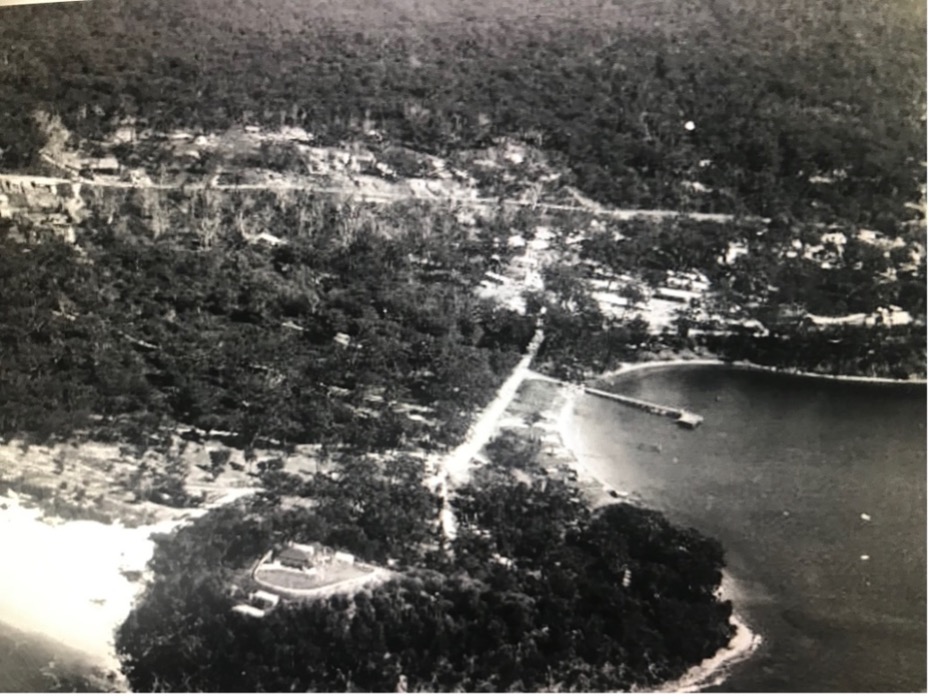
A wartime naval depot at Fly Point was converted into a workers’ hostel for displaced people employed at the Newcastle steelworks, and then into a family hostel. Ukrainians were among its residents from 1949 until its buildings were sold off in the mid 1950s.
Introduction
Nelson Bay’s migrant hostel reused the buildings of HMAS Assault at Fly Point. Former naval accommodation became a temporary home for European newcomers, including Ukrainians. Its history links shift work at the Broken Hill Proprietary steelworks in Newcastle with the effort to bring separated families back together.
Sources for this section
A history in dates
- 1942–1943Naval training buildings are constructed for HMAS Assault.
- January 1949Newspapers report that the naval depot may be taken over to house European migrant workers.
- April 1949A Commonwealth contract worth £7,099 is let to convert the site; 49 migrants help prepare it.
- August 1949The first marriage of hostel residents, a Ukrainian couple, is celebrated at Nelson Bay.
- September 1949Ninety-four displaced-person workers start at the Newcastle steelworks, followed by 74 more.
- October 1949Medical facilities are prepared so that families can join the men; residents stage a one-day food boycott.
- July 1950A Polish resident dies of benzol poisoning in an accident at the steelworks.
- January 1951–December 1954The state record lists operation of the Nelson Bay Holding Centre school.
- June 1951A further contract worth £20,972 is let for additional prefabricated buildings.
- 27 November 1954About 50 timber buildings and 10 Nissen huts are auctioned for removal from the site.
- 27 August 1955A parliamentary return gives this as the hostel’s closing date.
- April 1956The former sick bay begins operating as a local hospital.
- August 1981The hospital buildings pass into community arts use.
From naval base to migrant accommodation
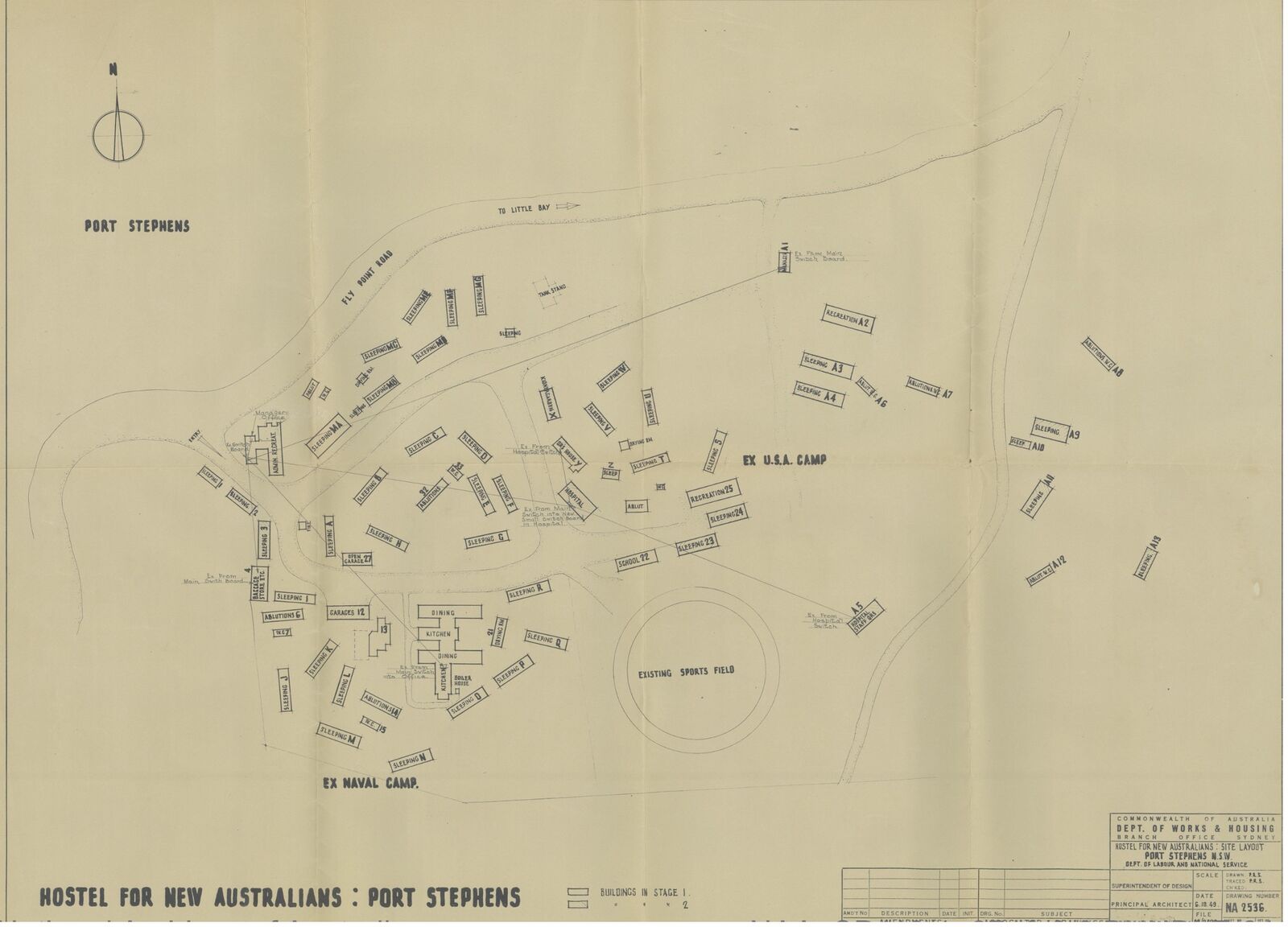
HMAS Assault was developed during 1942–1943 as a naval training centre. Its sick bay and other buildings later formed part of the migrant settlement. After the war the facilities were maintained in a caretaker mode until the Commonwealth took the site over for migrant accommodation; a plan of the site at that takeover shows the former naval camp and an adjacent United States camp.
In January 1949 the Newcastle Morning Herald reported that the naval depot might be taken over to house European migrant workers. It described hut accommodation for a large number of people, mainly of galvanised iron, on a site running along the waterfront about half a mile east of the township and already equipped with water and sewerage. In April 1949 a Newcastle firm, J. D. Judd Bros of New Lambton, was awarded a Commonwealth contract worth £7,099 to convert the site. An initial intake of 49 migrants helped to prepare the hostel.
The accommodation was then enlarged. Prefabricated Nissen huts bought in Britain were shipped out and re-erected at places such as Newcastle and Port Stephens, and in June 1951 a further contract worth £20,972 was let for additional prefabricated buildings. A 1950 account of hostel design in the journal Construction lists Port Stephens among twelve New South Wales hostels built or building since 1948, designed and built by the Commonwealth Department of Works and Housing and then transferred to the Department of Labour and National Service. By the time the site was sold it comprised about 50 timber buildings and 10 Nissen style huts.
From military buildings to civilian services
| Facility | Migrant or later use |
|---|---|
| Nissen huts | Small-room accommodation |
| Larger former depot buildings | Family accommodation |
| Sick bay | Migrant medical care; later local hospital |
| Hospital building after 1981 | Community arts centre |
Steelwork, family reunion and camp life
The hostel was created for the steel industry. In May 1949 the Minister for Immigration said that up to 800 displaced people would be accommodated at Port Stephens for steel production, 300 of them almost immediately. A November 1949 report described 94 men starting work at the Newcastle steelworks on 12 September and 74 more on 20 September, naming them as Poles, Ukrainians, Lithuanians, Yugoslavs and Latvians, all married men who would be joined by their wives and children at a hostel with accommodation for 600. They were paid about £7 a week, from which they paid for their keep.
Until October 1949 the hostel held only single and married men, whose families remained at Greta or Bathurst. One report of that month described 300 residents waiting for the camp hospital to be finished so that the place could become a family hostel; work in progress included a new kitchen, a kindergarten, recreation rooms and further living quarters converted from naval dormitories. Long bus journeys to the steelworks made for long days, and the separation from families was a recurring grievance. The hostel was run by the Department of Labour and National Service; its commandant in 1950 was Wing Commander Littlejohn, and the manager of the family hostel at Christmas 1953 was named as Mr Travis.
Contemporary reports also record community life. In August 1949 the first marriage of migrants at the hostel was celebrated at the Nelson Bay Roman Catholic church between Iryna Matlock and Mykola Kowalsky, both Ukrainians, who had met in a displaced persons camp in Germany four years earlier. Residents ran table tennis tournaments and a cabaret dance, floor shows were given by two Latvian professional tap dancers, and a Yugoslav footballer tried to raise a soccer team. In December 1949 the Legion of Catholic Women gave a Christmas party for about 170 children, and the first baby born to hostel residents was recorded that same month.
Life there was not uniformly settled. In October 1949 about 200 residents boycotted the dining room for a day in protest at the cut lunches supplied for work at the steelworks; two men were assaulted on the works bus, one man was charged, and the protest ended that evening. In November 1949 the shire council complained that it had no authority to enter what it regarded as Commonwealth territory while investigating a scarlet fever case. In July 1950 a Polish resident, Zygmund Wroblewski, died with an Australian workmate after benzol fumes overcame them in a storage tank at the steelworks; the inquest returned accidental death by benzol poisoning.
Numbers recorded in contemporary reports
| Date and source | Figure | What it describes |
|---|---|---|
| Newcastle Morning Herald, 28 May 1949 | 300, with 500 more being prepared for | Places being readied at Port Stephens for displaced-person ironworkers |
| Centralian Advocate, 4 November 1949 | 600 | Stated accommodation of the workers’ hostel once families joined the men |
| Newcastle Morning Herald, 28 October 1949 | 300 residents, rising to more than 700 | Men then in residence, and the expected population after family reunion |
| Newcastle Sun, 24 December 1953 | 70 children | Children present for the hostel Christmas tree |
| Raymond Terrace Examiner, 11 November 1954 | About 50 timber buildings and 10 Nissen huts | Structures advertised for sale and removal |
Sources for this section
Children and education
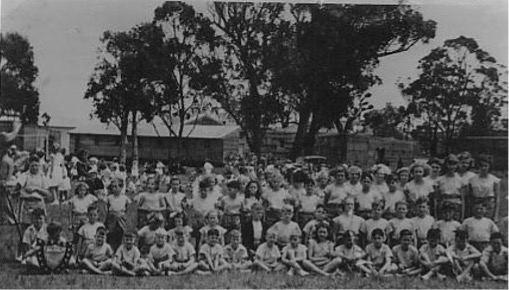
The state education record lists the Nelson Bay Holding Centre school from January 1951 to December 1954, and a departmental file covering the establishment of the school, the appointment of teachers and its floor plan survives for 1951–1952. Camp schools formed part of a programme in which the Commonwealth supplied buildings and New South Wales provided teaching. The intention was to introduce the Australian school routine before pupils moved into local schools.
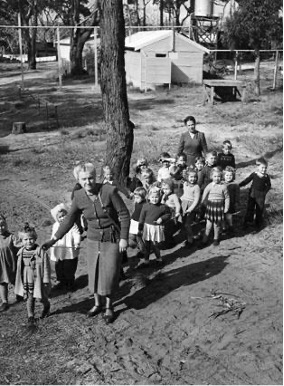
A set of official photographs captioned Commonwealth Migrant Workers’ Hostels, 1951 shows what that meant day to day: kindergarten children of nine nationalities walking around the grounds holding a guide rope, meals served cafeteria style from bain-maries, communal laundries and ablution blocks, and subdivided Nissen huts furnished with standard beds, chairs and a wardrobe. Peter Toedter, who arrived from Germany in June 1954 and stayed two weeks, remembered being seated at the back of the class because the teacher knew most camp children were transient, and his father leaving and returning in the dark after an hour’s bus journey each way to the steelworks.
A workers’ hostel in a wider system
Commonwealth planning distinguished migrant workers’ hostels from reception and holding centres. A programme table reproduced by the Migration Heritage Project identifies Nelson Bay and Shoal Bay as accommodation for displaced-person workers and families, with construction in hand and completion estimated for December 1950. This regional programme expanded as demand for housing grew.
The hostel served people already in Australia and moving towards employment and independent housing. It was a different stage of migration from the displaced persons camps they had left in Europe.
Sources for this section
Closure and the buildings afterwards
Accounts of the ending differ. A parliamentary return tabulated by the Migration Heritage Project gives the closing date of the Nelson Bay hostel as 27 August 1955. The buildings were offered for sale and removal by auction at the site on 27 November 1954, the advertisement listing dormitories, a hall with a stage, offices, storerooms, kitchens and dining rooms, three Quonset huts, seven Nissen huts, ablution blocks and latrines. The memorial on the boundary of the site records the years 1949 to 1956. A local history account of the naval base dates the hostel's establishment to 1948 and its closure to 1953.
The former sick bay operated as a local hospital from April 1956 until 1981. That August its buildings passed into community arts use. The surviving hospital building remains the core of the Port Stephens Community Arts Centre, and apart from it little survives beyond concrete floor slabs, path remains and brick foundation piers.
Sources
- Our History
Port Stephens Community Arts Centre · Undated
Institution occupying former sick-bay building; wartime construction, migrant conversion, hospital and arts reuse. Its mid-1953 hostel closure date conflicts with the school record, the 1954 auction and the 1955 parliamentary return, so not adopted.
- Nelson Bay Migrant Hostel: contemporary reports and photographs
Port Stephens — a history exploration, compiled by Kevin McGuinness · 2024, subsequently updated
Compilation read in full. Reproduces transcripts of reports in the Newcastle Morning Herald and Miners’ Advocate (8 January, 17 May, 28 May, 16 August, 7 October, 24 October, 28 October, 15 November, 20 December and 22 December 1949; 23 June and 31 August 1950; 12 January 1951; 1 March 1952), the Sydney Morning Herald (12 July, 24 October and 25 October 1949; 26 July 1950), the Daily Examiner (4 August 1948), the Daily Telegraph (28 April 1949), the Raymond Terrace Examiner (26 May 1949; 11 November 1954), the Centralian Advocate (4 November 1949), the Newcastle Sun (15 February 1952; 24 December 1953) and the journal Construction (5 April 1950). Original Trove pages were not independently reviewed for this revision because trove.nla.gov.au is behind a bot-detection wall.
- Teaching English to post-WWII migrants
Museums of History NSW · Undated
Institutional education guide lists the Nelson Bay Holding Centre school January 1951–December 1954, cites school file [14/7740] for 1951–52, and explains the Commonwealth and state division of responsibilities.
- Commonwealth Government Hostels
Migration Heritage Project · 12 April 2022
Original archival research compilation. Programme table of hostels under construction (Nelson Bay and Shoal Bay, displaced-person workers and families, completion estimated December 1950) and Table 7, Commonwealth Migrant Hostels in NSW 1949–1971, derived from House of Representatives Hansard 12 November 1957 and 27 September 1967, giving Nelson Bay commencing between 1 July 1945 and 19 December 1949 and closing 27 August 1955.
- Commonwealth Migrant Workers’ Hostels, 1951: photographs and captions
National Archives of Australia, reproduced by Port Stephens — a history exploration · 1951
Official photographic series with departmental captions describing huts, laundries, dining room, bathrooms, the kindergarten and new arrivals from Bathurst. Read as reproduced; the archival item numbers were not verified against RecordSearch.
- Peter Toedter, recollections of the Nelson Bay Holding Centre, 1954
In Sabine Nielson, Memories in my Luggage (2014), reproduced by Port Stephens — a history exploration · 2014
First-person memoir extract, read as reproduced; the original book was not consulted. German assisted-passage family, distinct from the displaced-person intake of 1949.
- HMAS Assault and JOOTS, 1942 to 1943
Port Stephens, a history exploration, compiled by Kevin McGuinness · 2024
Companion article read in full. Its concluding comments record the site held in caretaker mode until the Commonwealth established the migrant hostel, and date the hostel 1948 to 1953. An image caption describes a plan of the site at the takeover showing the former naval camp and an adjacent United States camp. Its dates differ from the newspaper, school, auction and parliamentary records also cited here.
Last researched 13 September 2026