Reinhardt-Kaserne
Displacement in Europe
Neu-Ulm, Germany · 1945–1951
Neu-Ulm’s Reinhardt barracks held one of the largest Ukrainian displaced-persons populations in Bavaria, and became the home of a newspaper, a publishing house and a theatre whose reach went far beyond the camp.
Introduction
Reinhardt-Kaserne was a Ukrainian displaced-persons camp in Neu-Ulm, on the Bavarian side of the Danube opposite Ulm. A contemporary Ukrainian relief report names the facility explicitly. The city had other accommodation centres, notably Ludendorff-Kaserne; references to Neu-Ulm alone do not always identify the same camp.
The Arolsen Archives inventory makes the distinction precise. Reinhardt-Kaserne is entered with Polish and other nationalities, a capacity of 2,000 and the assembly centre number AC 94-294; Ludendorff-Kaserne is entered as a Jewish camp with a capacity of 1,800 and a number of its own. The same UNRRA team ran both from Leipheim, but they were two camps holding two communities.
A history in dates
- 1934Construction of Reinhardt-Kaserne at the corner of Reuttier Straße and Finninger Straße.
- 1945Ukrainski visti begins publication in the Neu-Ulm Ukrainian camp.
- Autumn 1945The Rozvaha theatre begins its activity at Neu-Ulm.
- Christmas 1945A theatre with an auditorium for up to 1,000 is built from a ruined military sports hall with UNRRA support; the camp Theatre Studio gives three performances over the holidays.
- November 1945A memorial service in the camp commemorates the 359 Ukrainian soldiers killed at Bazar in 1921.
- 5 December 1945Lieutenant-General Guaite inspects the camp with UNRRA representatives and concludes that it is in good condition and well organised.
- 12 December 1945The camp’s literary circle holds an author’s evening of the poet Yuriy Klen.
- 23 December 1945An assembly of farmers in the camp founds a professional union of Ukrainian farmers.
- 27 December 1945The camp holds an author’s evening of the poet Ivan Bahrianyi, a member of MUR.
- 30 December 1945A general assembly of the camp’s women founds a women’s organisation.
- 21 January 1946More than a thousand residents take part in elections to the camp court; UNRRA appoints its president.
- 24 January 1946First listing of Reinhardt-Kaserne in the Arolsen inventory, under UNRRA Team 165 Leipheim.
- 9 March 1946Fifteen people attend the founding meeting of a professional union of journalists and writers of Novyi Ulm and Ulm.
- 11 March 1946The camp radio station begins operating.
- 14 March 1946An artistic society is founded in the camp.
- 3 June 1946MUR, the Artistic Ukrainian Movement, holds its fifth executive meeting at Neu-Ulm.
- 1946Correspondence identifies the newspaper office at Reinhardt-Kaserne.
- August 1946A UNRRA summary counts 2,051 Ukrainians at Neu Ulm.
- 19 October 1946The Jewish camp opens in the Ludendorff barracks across the town.
- 15–16 March 1947MUR holds its second congress at Neu-Ulm, with its seventh executive meeting the following day.
- May 1947A UNRRA summary counts 1,985 Ukrainians at Neu Ulm.
- 31 October 1947The inventory records a capacity of 2,000 at Reinhardt-Kaserne.
- February 1948The newspaper’s imprint gives Ludwigstraße 10 as its editorial and administrative address.
- 30 June 1948The Ukrainian relief committee lists Reinhardtkaserne among its main camps.
- September 1948The assembly centre number AC 94-294 is replaced by the IRO designation S 503.
- 1950A Ukrainian newspaper reports a substantial Ukrainian camp still at Reinhardt-Kaserne.
- June 1950The Neu Ulm camp-post stamps, overprinted from the Bayreuth issue, are used for the last time.
- 1951The US Army takes over the former refugee accommodation; 250 new dwellings are built in the town to rehouse foreigners from the barracks.
- 1963Ivan Bahriany dies at Neu-Ulm, where he had settled.
Sources for this section
- Ukrainische Gemeinde Ulm/Neu-Ulm: Geschichte
- Publications by Ukrainian Displaced Persons and Political Refugees in 1945–1954
- Almanac of the Ukrainian National Association for the Year 1985
- Ukrainski visti (Українські Вісті), Neu-Ulm, issues 1–11/18
- DP camp inventory: Reinhardt-Kaserne and Ludendorff-Kaserne, Neu-Ulm
- Organizational Aspects of DP Literary Activity
- Letters from 1946: Ukrainian newspaper editorial office
- Ukrainians in UNRRA and IRO Camps of the American Zone of Germany, Table 7
- Neu-Ulm – Jüdisches DP-Lager
- Ukrainski visti, no.11(163), imprint
- Report of the United Ukrainian American Relief Committee
A camp in a damaged city
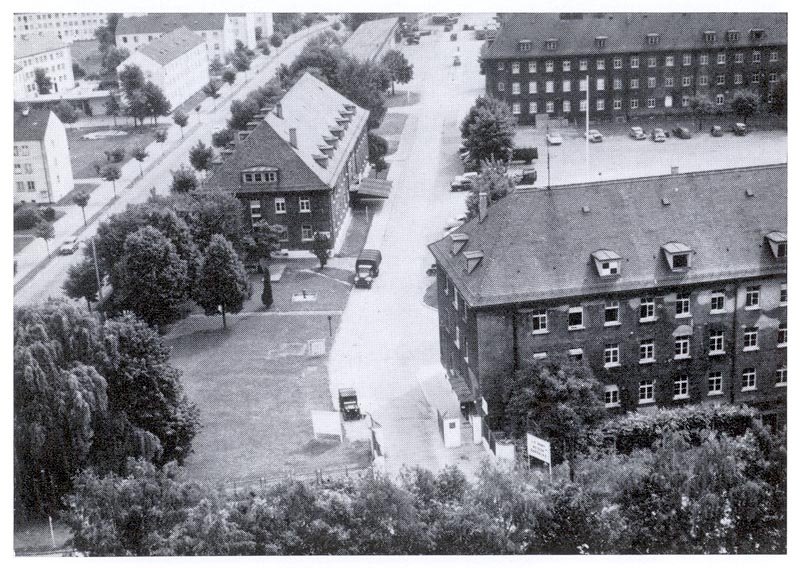
The former military buildings stood at the junction of Reuttier Straße and Finninger Straße. They were built in 1934 and later became known as Nelson Barracks. Neu-Ulm’s Ukrainian parish history records the accommodation of refugees after the war and the transfer of the installation to the US Army in 1951.
The surrounding city had suffered six air raids between March 1944 and March 1945. The Haus der Bayerischen Geschichte reconstruction atlas estimates 70 per cent destruction overall and records temporary accommodation in barracks and camps. Its figure of 4,000 people concerns the wider accommodation system, not the Ukrainian population of Reinhardt-Kaserne alone.
Ludendorff-Kaserne, built two years later on open ground at Memminger Straße, took a different path: it served first as a discharge and transit camp for German prisoners of war and then, from October 1946, as the town’s Jewish camp. The two installations went to the Americans together in 1951 and became Nelson Barracks, named for Sergeant William L. Nelson of the 60th Infantry Regiment, and Wiley Barracks.
The names distinguish different locations
The camp in the inventory
The inventory gives the camp its administrative outline. Reinhardt-Kaserne appears from its first listing on 24 January 1946, with a capacity of 2,000 entered against 31 October 1947, the assembly centre number AC 94-294 replaced in September 1948 by the IRO designation S 503, and a closing date between 31 March and 30 September 1951. It was served by UNRRA Team 165 Leipheim, with a team director recorded as Robertson and a field supervisor recorded as Brooke, under Area Teams 1061 Leipheim and 1062 Augsburg in Area 5, Augsburg.
The same team ran a compact group of camps along the upper Danube: the airfield camp at Leipheim, the Latvian camp at Kleinkötz, another at Lauingen, the Lithuanian camp in the Ludwig barracks and the Polish camp in the Luitpold barracks at Dillingen, the hospital at Günzburg, and the Jewish camp in the Ludendorff barracks across the town. At 2,000 places, Reinhardt-Kaserne was the second largest of them after Dillingen’s Luitpold barracks.
Its papers were dispersed at the time and remain so. The Arolsen Archives hold lists and change reports for Neu-Ulm; the Staatsarchiv Augsburg holds an OMGUS file on displaced persons in the Neu-Ulm district for 1946 and 1947; and the Stadtarchiv Neu-Ulm holds copies of camp papers taken from the Archives nationales in Paris and from the United Nations Archives.
Arolsen Archives inventory: the two Neu-Ulm camps
| Field | Reinhardt-Kaserne | Ludendorff-Kaserne |
|---|---|---|
| Opening (first listing) | 24 January 1946 | 19 October 1946 |
| Closing | Between 31 March and 30 September 1951 | Between 30 September 1950 and 30 September 1951 |
| Capacity | 2,000 | 1,800 |
| Capacity date | 31 October 1947 | 31 October 1947 |
| Assembly centre | AC 94-294; from September 1948 S 503 | AC 95-457 and AC 94-294 A; from September 1948 S 502 |
| Nationalities recorded | polnisch, verschiedene | jüdisch |
| UNRRA team | T 165 Leipheim | T 165 Leipheim |
| Team director | Robertson | — |
| Area team | AT 1061 Leipheim; AT 1062 Augsburg | AT 1061 Leipheim; AT 1062 Augsburg |
| Area | A 5 Augsburg | A 5 Augsburg |
| Field supervisor | Brooke | — |
Sources for this section
How many Ukrainians
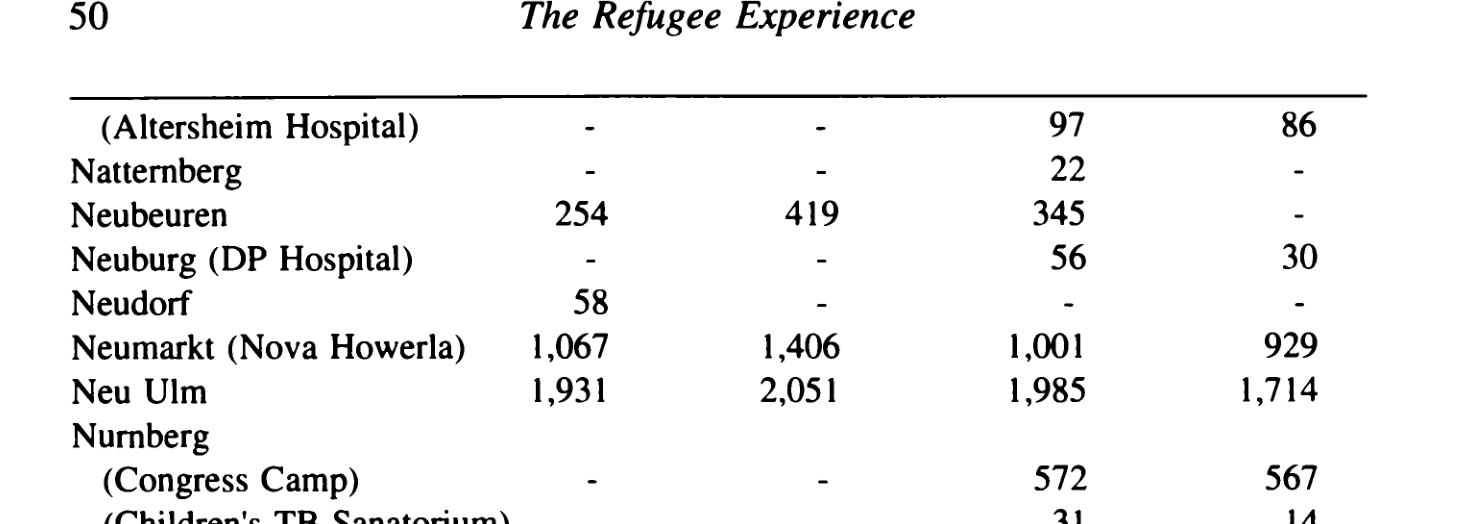
Stebelsky’s table of Ukrainians in the camps of the American zone records Neu Ulm at town level rather than barracks by barracks. Its four columns give 1,931 in the questionnaire returns collected during 1946 and 1947, 2,051 in August 1946, 1,985 in May 1947 and 1,714 in December 1947: a large and remarkably steady Ukrainian population, and one of the biggest in Bavaria.
The Jewish camp on the other side of the town is separately documented, and its figures do not overlap: 1,699 in September 1946, 1,762 in November, 1,766 in February 1947, 1,747 in July, 1,654 in September, 1,672 in January 1948, 1,322 in May and 1,391 in March 1949, under a camp leader named Josef Schachter, with a camp hospital and a training camp for Haganah soldiers. The Ukrainians counted at Neu Ulm therefore belong overwhelmingly to Reinhardt-Kaserne, whose 2,000 places they came close to filling.
The community outlasted the camp’s peak. A Ukrainian newspaper reported in 1950 that about 800 Ukrainians were living in the Sedan barracks in Ulm and another 900 in private accommodation nearby, and that Reinhardt-Kaserne in Neu-Ulm held a substantial Ukrainian camp. A notice of 1951 recorded 250 new dwellings under construction in the town to move foreigners out of barracks and into permanent housing.
Ukrainians recorded at Neu Ulm
| Return | Ukrainians |
|---|---|
| 1946–47 questionnaire | 1,931 |
| August 1946 | 2,051 |
| May 1947 | 1,985 |
| December 1947 | 1,714 |
The Jewish camp in the Ludendorff barracks
| Date | Residents |
|---|---|
| September 1946 | 1,699 |
| November 1946 | 1,762 |
| February 1947 | 1,766 |
| July 1947 | 1,747 |
| September 1947 | 1,654 |
| January 1948 | 1,672 |
| May 1948 | 1,322 |
| March 1949 | 1,391 |
A newspaper begins inside the camp
The newspaper Ukrainski visti began in Neu-Ulm in 1945. A library bibliography identifies the initial publisher as Ukrainian Camp and records surviving copies of the first five numbers. The modest camp imprint became the beginning of a much longer émigré publishing history.
A letter written in 1946 gives an editorial address directly in the Ukrainian DP camp at Reinhardt-Kaserne. That correspondence connects the publication to this particular barracks, rather than merely to the town. It also shows how a newspaper office could function as a contact address for displaced people whose location might change again.
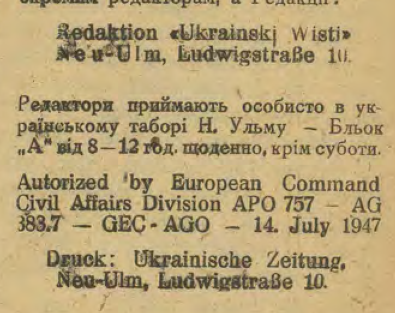
By February 1948 the newspaper’s imprint directed subscriptions and editorial correspondence to Ludwigstraße 10 in Neu-Ulm. It advertised group subscriptions and a 20 per cent discount for distributors. The printed authorisation referred to the European Command’s Civil Affairs Division and 14 July 1947. These details show a publication operating through subscriptions, distribution and formal licensing beyond the original camp address.
The paper’s own imprint, repeated at the foot of the last page of each issue, reads “В-во й редакція: Н. Ульм, український табір. РЕДАГУЄ КОЛЕГІЯ.” — publisher and editorial office at the Ukrainian camp in Neu-Ulm, edited by a collective rather than by a named editor.
A publishing house, a theatre and a literary movement
The newspaper brought a literary world with it. Ivan Bahriany, who set the political direction of Ukrainski visti, settled in Neu-Ulm and lived there until his death in 1963. The town’s Prometei press issued his Tyhrolovy in 1946–47 and his children’s books in 1948, alongside work by Iurii Kosach, Semen Pidhainy, Todos Osmachka and others, and the Ukrainian Revolutionary Democratic Party used Neu-Ulm as its publishing address.
MUR, the Artistic Ukrainian Movement, met in the town three times. Its fifth executive meeting was held at Neu-Ulm on 3 June 1946; its second congress there on 15 and 16 March 1947, at which Ulas Samchuk and Yurii Sherekh kept their positions and Iurii Kosach was re-elected to the executive; and its seventh executive meeting the following day.
Neu-Ulm also had the most notable of the conservative Ukrainian camp theatres. Rozvaha, founded by Iosyp Mandzenko-Siry, was among the first Ukrainian theatres in post-war western Germany; a participant’s later account dates the start of its activity to autumn 1945. It put on more than 200 performances, counting those given outside the camp. Beyond the standard repertory of everyday life it staged Lesia Ukrainka’s Boiarynia and Lisova pisnia, Mykola Kulish’s Myna Mazailo, Max Halbe’s The River and two plays by Iurii Kosach, Obloha and Zozulyna dacha — difficult pieces, put on by amateurs. The emigration of its leading members ended it.
The camp newspaper records an earlier hall. For the Christmas holidays of 1945 a theatre was built out of a ruined former military sports hall, by joint effort and with UNRRA support, with an auditorium for up to 1,000 spectators. The paper reported three performances there by the camp’s own Theatre Studio during the Christmas days.
Sources for this section
- Ukrainische Gemeinde Ulm/Neu-Ulm: Geschichte
- A Survey of Ukrainian Camp Periodicals, 1945–50
- Political Refugees and Displaced Persons: Reinhardt-Kaserne archive guide
- Organizational Aspects of DP Literary Activity
- Theatre in the Camps
- Almanac of the Ukrainian National Association for the Year 1985
- Ukrainski visti (Українські Вісті), Neu-Ulm, issues 1–11/18
Part of a wider Ukrainian network
In June 1948 the Ukrainian American relief committee placed Reinhardtkaserne first in its selective list of main American-zone camps. Its inclusion locates the camp within organised transatlantic relief work. The same report lists other major centres in Augsburg, Dillingen, Mittenwald, Regensburg and Bayreuth.
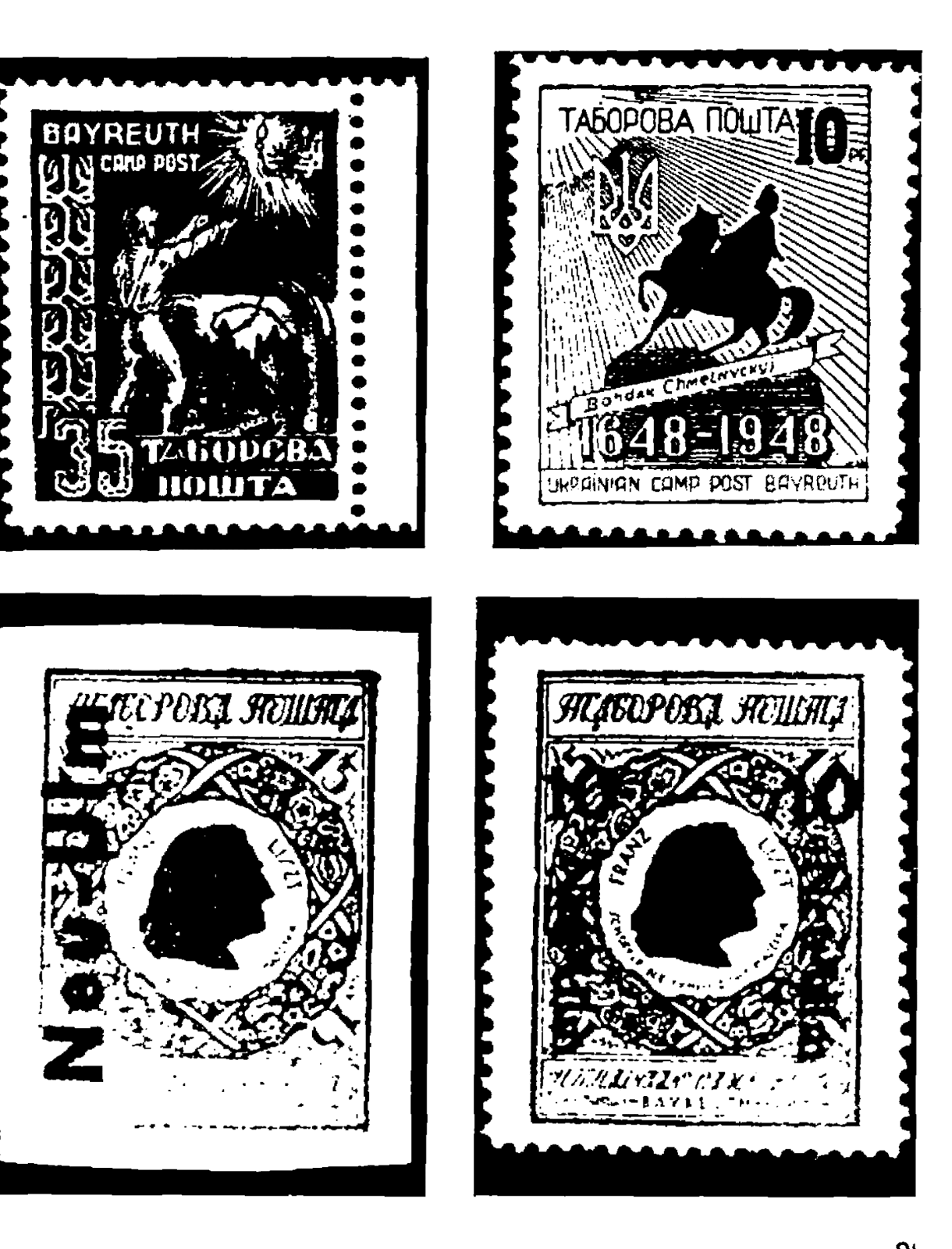
The history of Neu-Ulm also includes a camp postal service established in autumn 1949 after transfers from other Ukrainian settlements. That postal account names Neu-Ulm at town level; it does not justify assigning every later postal item or arriving family to Reinhardt-Kaserne.
A later philatelic account describes the stamps themselves. The group that had organised the camp post at Bayreuth took up the work at the new Neu Ulm settlement, and had the Bayreuth set of stamps and its souvenir sheet overprinted for it; the stamps were used for the last time in June 1950. That account also names the settlement at town level.
The camp’s surviving records
A substantial administrative archive survived the camp. The 1982 research guide identifies Reinhardt-Kaserne files for 1947–1951 in the International Refugee Organisation holdings of the French National Archives. Its contents cover army inspections, administration, refugee employment, health, family matters, movements, resettlement and transport. The listed subjects demonstrate the breadth of the surviving record, without revealing the decisions in individual files.
The guide sets the arrangement out carton by carton. One carton holds descriptions of typical refugee installations for 1947 to 1950, Reinhardt-Kaserne among them; the next opens the camp’s own archive for 1947 to 1951; a third carries the subject headings — army inspection reports, camp administration, refugee employment, camp police, legal questions such as marriages and divorces, medical questions, movements of refugees, resettlement and repatriation, supply and transport, and the Ukrainian emblem from the camp director’s office; and a fourth continues under the heading Welfare, a very general rubric taking in eligibility, transfer to the German economy, the organisation of sports and leisure, social work and the care of children. A separate file on Reinhardt-Kaserne runs from November 1947 to April 1951.
The guide even records a Ukrainian emblem from the camp director’s office. Alongside the newspaper’s changing addresses, this surviving object connects the official machinery of the camp with the national identity of the community it housed.
Sources for this section
From refugee accommodation to a new garrison
The Ukrainian parish’s building history places the US Army takeover of Reinhardt-Kaserne in 1951 and the end of its American military use in 1991. Later conversion brought offices and public services into the former accommodation buildings. This reuse should be distinguished from nearby Ludendorff-Kaserne, whose later American name was Wiley.
The camp and the press followed different timelines. A 1951 end to refugee accommodation in the barracks did not end Ukrainian publishing in Neu-Ulm. Later bibliographies continue to record the newspaper under Neu-Ulm addresses. A camp institution could move into the town and outlive the housing arrangements in which it had begun.
The buildings are still in use. The Americans left in the middle of 1991, and the converted accommodation blocks at Reuttier Straße now hold the tax office, the police, the fire service, the technical inspection authority, businesses and clubs. On the Wiley site, eighty hectares of it, there is now a housing district and the Neu-Ulm university of applied sciences.
Ukrainian life in Neu-Ulm outlasted the camps themselves. A comparative study of Ukrainian migration and diaspora formation records that after the camps were dissolved and Ukrainians were dispersed across Germany, community life remained possible only in settlements such as Munich and Neu-Ulm. The study does not say how large the Neu-Ulm community then was.
Sources for this section
The camp in the newspaper's own chronicle
The weekly carried a chronicle of the camp. It reported the feast of St Michael the Archangel celebrated with particular solemnity by the Ukrainians of the camp, and on the evening of the same day a solemn memorial service for the 359 Ukrainian soldiers killed at Bazar on 22 November 1921. On Sunday 25 November an academy was held in the camp to honour the memory of the heroes of Bazar. On 23 December an assembly of farmers in the camp founded a professional union of Ukrainian farmers. On 30 December 1945 a general assembly of the camp’s women founded a women’s organisation and elected its leadership.
A committee for the care of the disabled in the Novyi Ulm camp announced a voluntary collection taken on the third day of the Christmas holidays, for the purchase of prostheses and aid to the disabled, which raised 3,007 Reichsmarks and 80 pfennigs. A People’s University was opened in the camp, its stated aim to reach all who wished to advance their learning in one or another branch of knowledge. On the initiative of farmers and agricultural specialists a farmers’ association was founded at the camp; it ran beekeeping courses regularly attended by 49 people and agriculture courses attended on average by 18.
On Wednesday 12 December 1945 the literary circle of the camp held an author’s evening of the poet Yuriy Klen, and on 27 December an author’s evening of the poet Ivan Bahrianyi, a member of the MUR writers’ association. Readings by the poet Yar Slavutych and the fabulist Ivan Manylo followed at the camp’s traditional literary Wednesday on 16 January 1946. On 21 and 22 November 1945 residents had their first opportunity to hear the ’Ukraina’ choir, and during the Epiphany days a chapel of bandura players gave three concerts in the overcrowded camp theatre, which the paper says held over 1,000 spectators. An artistic society was founded in the camp on 14 March 1946.
The paper reported the camp’s official machinery as well. After an inspection on 5 December 1945, Lieutenant-General Guaite concluded that the Neu-Ulm camp was in good condition and well organised; the inspection took place in the presence of the local UNRRA administrator Ritfeld, Lieutenants Stott and Stewart, and the camp’s deputy director. Elections to the camp court were held on 21 January 1946, more than a thousand people took part, and UNRRA appointed the court’s president. A camp radio station began operating on 11 March 1946, a chess section had existed at the camp club since February and numbered up to sixty members, and fifteen people attended the founding meeting of a professional union of journalists and writers of Novyi Ulm and Ulm on 9 March. The paper urged readers to prepare to elect a camp council, and asserted that the camp had been held to be the most united and disciplined, free of regional and political enmity.
The camp converted to steam heating although the German engineers who surveyed the system had declared that it would not work; the paper reported that all the blocks were then heated. A letter from Canada was printed, whose writer asked that her sincere greetings be conveyed to all the Ukrainians of the camp, and wrote of trying to help them reach a country of true democracy.
Organised activity in the camp, November 1945 – March 1946, as reported by Ukrainski visti
| Date | Activity | Detail reported |
|---|---|---|
| 21–22 November 1945 | First concerts by the 'Ukraina' choir | Residents' first opportunity to hear the choir |
| 25 November 1945 | Academy honouring the heroes of Bazar | Held in the camp on the Sunday |
| December 1945 | People's University opened | Open to all who wished to advance their learning |
| 23 December 1945 | Farmers' union founded | Founded at an assembly of farmers in the camp |
| 30 December 1945 | Women's organisation founded | Founded at a general assembly of the camp's women, which elected its leadership |
| Christmas 1945 | Collection by the disabled-care committee | 3,007 Rm 80 pf raised for prostheses and aid |
| 21 January 1946 | Camp court elected | Over a thousand took part; president appointed by UNRRA |
| Early 1946 | Agricultural courses | Beekeeping attended regularly by 49, agriculture by an average of 18 |
| February–March 1946 | Camp club activities | Chess section of up to 60 members from February; radio station from 11 March |
| 9–14 March 1946 | Professional and artistic foundations | Journalists' and writers' union, 15 present, 9 March; artistic society, 14 March |
Sources for this section
Sources
- Report of the United Ukrainian American Relief Committee
United Ukrainian American Relief Committee · 30 June 1948
Original source read; scope retained.
- Ukrainische Gemeinde Ulm/Neu-Ulm: Geschichte
Ukrainian Catholic community of Ulm/Neu-Ulm · 2018; accessed 2026
Community history page read in full: Reinhardt-Kaserne built in 1934 at the corner of Reuttier Straße and Finninger Straße, used after the war for displaced persons and emigrants, taken over by the US Army in 1951 and held until mid-1991, the converted accommodation buildings now holding the tax office, police, fire service, TÜV, businesses and clubs; a Ukrainian newspaper report of 1950 giving about 800 Ukrainians in the Sedan-Kaserne at Ulm and 900 more in private accommodation nearby, with a substantial Ukrainian camp at Reinhardt-Kaserne in Neu-Ulm; a notice of 1951 on 250 new dwellings under construction to move foreigners out of the barracks; and Ivan Bahriany settling in Neu-Ulm and living there until his death in 1963.
- Neu-Ulm: Wiederaufbauatlas
Haus der Bayerischen Geschichte · Accessed 12 September 2026
Wartime damage and wider housing context only. Its inaccurate IRO 1946 label not repeated.
- Publications by Ukrainian Displaced Persons and Political Refugees in 1945–1954
Yury Boshyk and Włodzimierz Kiebalo, Canadian Institute of Ukrainian Studies · 1988
Ukrainski visti entry and holdings; source PDF acquired.
- Letters from 1946: Ukrainian newspaper editorial office
Nadiia Zhakhalova, local historian · 2023
Published original letter transcription; personal names omitted.
- Ukrainski visti, no.11(163), imprint
Ukrainski visti · February 1948
Original printed p 6 acquired and inspected; imprint excerpt supplied.
- Ukrainian camp postal services
Ukrainian Philatelist no.84 · 2001
Original source read; scope retained.
- Ukrainian periodicals bibliography: Ukrainski visti
Ukrainian bibliographic record · 1968–1969
Indexed entry 387 retains later Neu-Ulm addresses.
- Political Refugees and Displaced Persons: Reinhardt-Kaserne archive guide
Yury Boshyk and Boris Balan, Canadian Institute of Ukrainian Studies · 1982
Printed pages 35–36 read in full. AJ 43/820, item 34, lists Reinhardt Kaserne, Neu Ulm among descriptions of typical refugee installations, 1947–1950; AJ 43/821, item 37, is “Archives de la Reinhardt Kaserne à Neu Ulm, 1947–1951”; AJ 43/822 sets out the subject headings 1–10, ending with the Ukrainian emblem from the camp director’s office; AJ 43/823 continues under heading 11, “Welfare”; AJ 43/824, item 41, carries a further Reinhardt Kaserne file for November 1947 to April 1951. The Neu-Ulm imprints of the Prometei press are listed in the bibliographic sections of the same volume. The underlying camp files were not inspected.
- DP camp inventory: Reinhardt-Kaserne and Ludendorff-Kaserne, Neu-Ulm
Arolsen Archives · 26 October 2023
Both Neu-Ulm entries read in full. Reinhardt-Kaserne: first listing 24 January 1946, closing between 31 March and 30 September 1951, nationalities polnisch and verschiedene, capacity 2,000 at 31 October 1947, AC 94-294 and from 09.1948 S 503, UNRRA Team T 165 Leipheim, team director Robertson, Area Teams AT 1061 Leipheim and AT 1062 Augsburg, Area A 5 Augsburg, field supervisor Brooke; archive status naming the ITS lists and change reports for Neu-Ulm, Staatsarchiv Augsburg OMGUS 10/66-1/31 “DPs im Landkreis Neu-Ulm, 1946-1947”, and Stadtarchiv Neu-Ulm copies from the Archives Nationales Paris and the UN Archive. Ludendorff-Kaserne: opened 19 October 1946, closing between 30 September 1950 and 30 September 1951, jüdisch, capacity 1,800, AC 95-457 and AC 94-294 A, from 09.1948 S 502. The other camps of Team 165 Leipheim were listed from the same spreadsheet. Serial dates converted from the Excel epoch.
- Neu-Ulm – Jüdisches DP-Lager
Jüdische DP-Lager und Gemeinden in Westdeutschland · Accessed 14 September 2026
Entry for the Ludendorffkaserne camp read in full: open summer 1946 to autumn 1949; populations 1,699 (September 1946), 1,762 (November 1946), 1,766 (February 1947), 1,747 (July 1947), 1,654 (September 1947), 1,672 (January 1948), 1,322 (May 1948), 1,391 (March 1949); camp leader Josef Schachter; camp hospital; training camp for Haganah soldiers. The page carries nothing on Reinhardt-Kaserne.
- US-Garnison Neu-Ulm: Nelson Barracks und Wiley Barracks
bundeswehrstandort.de · Accessed 14 September 2026
Read for the two barracks: Reinhardt-Kaserne built in 1934 at the corner of Reuttier Straße and Finninger Straße, used after 1945 for displaced persons and refugees, taken over in 1951 and held until mid-1991 as Nelson Barracks; Ludendorff-Kaserne built in 1936, used first as a discharge and transit camp for German prisoners of war and then for displaced persons, and held from 1951 to 1991 as Wiley Barracks, whose roughly eighty hectares now carry a housing district and the Hochschule Neu-Ulm. The naming of Nelson Barracks for Sergeant William L. Nelson of the 60th Infantry Regiment is recorded at usarmygermany.com/USAREUR_City_Ulm.htm, also consulted.
- Ukrainians in UNRRA and IRO Camps of the American Zone of Germany, Table 7
Ihor Stebelsky, in The Refugee Experience, Canadian Institute of Ukrainian Studies Press · 1992
Table 7, printed pages 47–51. The Neu Ulm row, on printed page 50, reads 1,931 (1946–7 questionnaire), 2,051 (August 1946), 1,985 (May 1947), 1,714 (December 1947). The row is entered at town level and is not broken down by barracks. Column definitions and the underlying UNRRA and PCIRO summaries stand in the table’s source notes on printed page 51.
- Organizational Aspects of DP Literary Activity
Danylo Husar Struk, in The Refugee Experience, Canadian Institute of Ukrainian Studies Press · 1992
Printed page 228 and the chronological table on printed page 233 read: MUR’s fifth executive meeting at Neu-Ulm on 3 June 1946, its second congress there on 15–16 March 1947 and its seventh executive meeting on 17 March 1947; at the second congress Samchuk and Sherekh retained their positions, Kosach was re-elected to the executive and Podoliak became a full member.
- Theatre in the Camps
Valerian Revutsky, in The Refugee Experience, Canadian Institute of Ukrainian Studies Press · 1992
Printed page 294 read in full on the Rozvaha theatre of Neu-Ulm: founded by Iosyp Mandzenko-Siry, over 200 performances including those given outside the camp, a repertory taking in Lesia Ukrainka’s Boiarynia and Lisova pisnia, Kulish’s Myna Mazailo, Max Halbe’s The River and Kosach’s Obloha and Zozulyna dacha, and its end when the leading members emigrated. The addendum on printed page 307 lists it second among the eighteen camp theatres traced for 1945–49.
- A Survey of Ukrainian Camp Periodicals, 1945–50
Roman Ilnytzkyj, in The Refugee Experience, Canadian Institute of Ukrainian Studies Press · 1992
Printed page 285: Ivan Bahriany named as the political writer who set the direction and tone of Ukrainski visti at Neu-Ulm, among six such writers on the leading Ukrainian emigre newspapers.
- Almanac of the Ukrainian National Association for the Year 1985
Svoboda Press, Jersey City and New York; edited by Zenon Snylyk · 1985
Two articles read. Aksel S. Pedersen’s ‘Taborova Poshta, Ukrainian Camp Post’ at printed page 82 describes the Bayreuth stamps overprinted for the Neu Ulm settlement and their last use in June 1950; Yaroslav Klymovsky’s survey of Ukrainian theatres in western Germany at printed page 58 covers the Rozvaha theatre of Neu-Ulm.
- “Building a Home Abroad”: A Comparative Study of Ukrainian Migration, Immigration Policy and Diaspora Formation in Canada and Germany after the Second World War
Universität Hamburg; Julia Lalande · 2006
Doctoral dissertation. The German summary at page XXVI records that after the camps were dissolved community life remained possible only in settlements such as Munich and Neu-Ulm.
- Reinhardt-Kaserne Neu-Ulm (Nelson Barracks) 1950 (photograph)
Wikimedia Commons; source given as the United States Army in Europe · 1950; uploaded 2008
File page for a 1950 photograph of Reinhardt-Kaserne in Neu-Ulm showing the barrack blocks, the street between them and the gate. The record gives the source as the United States Army in Europe, notes the later name Nelson Barracks, and states the public-domain basis as a work of the United States federal government.
- Ukrainski visti (Українські Вісті), Neu-Ulm, issues 1–11/18
Ukrainian camp, Neu-Ulm; Ukrainian Museum-Archives, Cleveland, DP Camp Periodicals Collection; digitised by the Internet Archive · 1945–1946
Digitised run of the camp weekly, 157 page images in the Internet Archive item linked here, read as page images. Pages used: the imprint at the foot of the last page of each issue (issue 1 p. 8, image 9 of the item); the report of the inspection of 5 December 1945 (issue 4 p. 4, image 29); the camp chronicle of issue 4 p. 6 on the moleben of 5 December and the conversion to steam heating; the camp columns of issues 2, 3, 5, 7, 1/8, 3/10, 4/11, 6/13, 10/17 and 11/18 on the feast of St Michael and the Bazar commemoration, the 'Ukraina' choir, the author's evenings of Yuriy Klen and Ivan Bahrianyi, the founding of the farmers' union and the women's organisation, the People's University, the theatre built from a military sports hall, the Theatre Studio, the disabled-care collection, the readings by Yar Slavutych and Ivan Manylo, the camp court elections, the bandura concerts, the beekeeping and agriculture courses, the camp radio station and chess section, the journalists' and writers' union, the artistic society, and the front-page appeal on the camp council. Licence: Creative Commons BY-NC-ND 4.0 per the item metadata.
Last researched 12 September 2026