Niederlahnstein
Displacement in Europe
Lahnstein · Germany · 1945–1949
More than 300 Ukrainians lived in the Deines-Bruchmüller barracks near Koblenz, in a camp whose population was mainly Polish and whose buildings also held Italian and, briefly, Jewish residents. It opened within weeks of the American occupation in March 1945 and was wound up between 1948 and 1949.
Introduction
Niederlahnstein was a large, mixed displaced-persons camp in the Deines-Bruchmüller barracks near Koblenz. Ukrainians formed a community of more than 300 within a changing population that also included Poles, Italians, Russians and Jewish survivors. The camp provided shelter after liberation, but it also became a place of schooling, worship and difficult decisions about returning home.
A history in dates
- 1 September 1937Construction of the double barracks begins; they are completed on 13 November 1938.
- 27 March 1945American troops occupy the barracks.
- Mid-April 1945A DP camp is established in the barracks.
- 15 June 1945Polish arrivals from Frankfurt join the camp.
- 19 June 1945A visiting British camp director records 6,700 residents under American military management.
- 28 June 1945The Polonia football club is founded.
- Mid-September 1945The Italian residents are moved to other centres and the Poles overhaul the buildings.
- October–November 1945A chapel opens and the papal nuncio visits the camp.
- December 1945The first children’s repatriation transport leaves for Poland.
- 30 June 1946A transport of nearly twenty wagons leaves under American escort, reaching Moravská Ostrava on 5 July.
- December 1946The separately recorded Jewish camp phase begins; fewer than 1,500 people remain in the camp overall.
- March 1947Residents arrive following Lebach’s closure.
- June 1947The Jewish camp phase ends.
- 1948A German account dates the closing of the DP camp to this year.
- August–autumn 1949French-archive research dates the evacuation of the residential and transit accommodation to these months.
- July 1956The barracks pass to the Bundeswehr.
The barracks before 1945
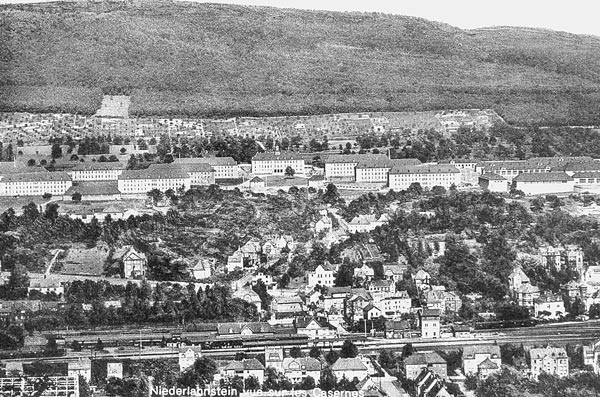
The site was built for the rearmament of the Wehrmacht: two barracks of thirteen and ten and a half hectares, begun on 1 September 1937 and completed on 13 November 1938, named after the artillery generals Adolf von Deines and Georg Bruchmüller. An artillery regiment staff moved in that November, and the barracks also held a veterinary hospital for army horses. Air raids killed at least eight soldiers, destroyed the drill hall and badly damaged an accommodation building and the armourer’s shop. American troops occupied the barracks on 27 March 1945.
The barracks before the camp
| Detail | Record |
|---|---|
| Construction begun | 1 September 1937 |
| Completed | 13 November 1938 |
| Area | 13 and 10.5 hectares (two barracks) |
| Named after | Artillery generals Adolf von Deines and Georg Bruchmüller |
| Occupied by American troops | 27 March 1945 |
| French occupation use, renamed after General Billotte | From 1947 |
| Handed to the Bundeswehr | July 1956 |
Sources for this section
A barracks camp beside Koblenz
The Niederlahnstein camp was separate from Gneisenau-Kaserne in Horchheim and Augusta-Kaserne in Pfaffendorf. In April 1945 the occupation authorities allocated different national groups to these compounds; the initial list described the Bruchmüller barracks as accommodation for Russians. Later accounts show how quickly its population changed.
The complex contained about forty substantial, multi-storey blocks. Ten served displaced people and another handled transit, while the French army used the remainder. Converted outbuildings held two chapels, stores and a police post. Repairs gradually transformed damaged accommodation, and an October 1948 inspection described a garden and an improved camp shop.
An early and unsympathetic outside view survives. The British head of the Hanau displaced-persons camp recorded that Italians were sent from Hanau to Niederlahnstein from late May 1945 on their way to Italy, and that a rumour was going round Hanau that Niederlahnstein was a bad camp. Visiting on 19 June he found it holding 6,700 people, run by American military rather than civilians, and clean, but its army atmosphere unpleasant; on 2 July he noted that residents could only go out with a pass. Some of those transferred from Hanau made their own way back.
Arrivals and a changing population
Polish transports from Frankfurt arrived on 15 June 1945, followed by former forced labourers from Hanau and Limburg. Within days the Polish group numbered 3,352. Overcrowding left some arrivals in garages, attics and corridors. These movements were transfers between places of refuge inside Germany, before any later journey to a home country or an overseas destination.
Most of the June 1945 arrivals had come from the Römerstadt and Sachsenhausen camps, and the transports were organised by the Americans with British cooperation. Poles were not the only group: Italians, French, Belgians, Dutch, Czechs and Estonians arrived too, and the Italians, more than 3,500 of them, had already taken the better buildings. Antagonism under the first British administration was sharpest with the Italians, and in mid-September 1945 they were moved to other centres, wrecking many rooms as they went. The Poles then overhauled the barracks: roofs repaired, rooms repainted, windows fitted, a field altar and theatre stage completed, and a chapel brought into use in October, with the Polish scouts prominent in the work. The papal nuncio visited at the beginning of November 1945 and the camp chaplain, Father Jurga, led the service in the new chapel.
Further residents arrived when the Lebach camp closed in March 1947. Its remaining Polish population was moved to Bad Kreuznach and Niederlahnstein. That transfer belongs to the reorganisation of camps in the French occupation zone as the Saar’s administrative position changed.
Journeys through Niederlahnstein
| Route | Purpose or context |
|---|---|
| Frankfurt, Hanau and Limburg → Niederlahnstein | Accommodation after liberation, June 1945 |
| Lebach → Niederlahnstein / Bad Kreuznach | Camp consolidation, March 1947 |
| Niederlahnstein → American occupation zone | Departure of most Jewish residents |
| Niederlahnstein → Austria / Czechoslovakia → Poland | Repatriation route used by Polish transports |
Sources for this section
Who administered the camp
The first camp administration was British, under a lieutenant colonel. The camp was then assigned to the northern area of the French occupation zone with a French colonel as commandant and a liaison officer who worked closely with the Polish camp administration, while UNRRA took charge of relief. The French supported most of the Polish cultural and economic initiatives, and Polish accounts single out the care given to children’s education and health. The French military department responsible for supplying and administering the region’s camps, known as the PDR, was itself based at Niederlahnstein.
Schools, worship and shared meals
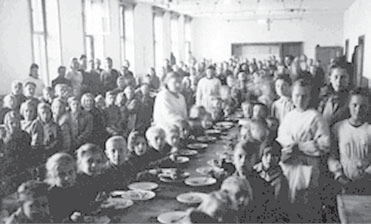
The Polish community organised a kindergarten, school, choir and theatre group. Its Polonia football club began on 28 June 1945. More than a hundred scouts took part in camp life, divided into troops including two for girls; young people helped in workshops and meal services, although relief staff objected to work by minors. Boys were generally employed in the joinery making toys, in the shoemaker’s workshop and in the kitchen, girls in the sewing room and serving meals in the canteen. The surviving dining-room photograph shows children and adults sharing long communal tables.
Scouting here was not self-contained. From June 1945 the troops in the camps around Koblenz were run from the Gniezno camp at Horchheim, and the Gneisenau theatre troupe gave a guest performance at Niederlahnstein in July 1945. The camp’s population divided into recognisable groups: young people from small towns and villages, Home Army soldiers who arrived straight from prisoner-of-war camps, and survivors of concentration camps who were mostly ill and exhausted, many of whom died in the local hospital.
Illness often required treatment outside the barracks. The St Joseph hospital at Niederlahnstein was requisitioned for serious cases and operations from the Gneisenau camp as well. Koblenz archival research identifies Niederlahnstein residents among the patients of the Kemperhof hospital: between 1947 and 1950 that hospital recorded 403 foreign patients, nearly all from the three barracks camps. This places Niederlahnstein within a wider network of care rather than treating it as an isolated settlement.
Different communities, different counts
The counts that survive answer different questions. A visiting British camp director put the whole population at 6,700 in June 1945; the Polish community alone reached 3,352 within three days of the first transport; and by the end of 1946, after the number of Poles in the French zone had fallen by nearly 70 per cent, fewer than 1,500 people were left at Niederlahnstein, which was why the Allies began consolidating the Polish camps. For 307 people in the Koblenz municipal database the barracks were the first recorded place of accommodation.
The Ukrainian population estimate concerns Ukrainians specifically. Separate Jewish buildings operated for a much shorter period, from December 1946 to June 1947. Most of their residents soon moved to the American occupation zone. The declining Jewish figures below therefore describe one community’s departure, not the closure of the entire Niederlahnstein camp.
Population snapshots
| Date or period | Population counted | Number |
|---|---|---|
| 19 June 1945 | All residents (visiting camp director’s report) | 6,700 |
| Initial camp, 1945 | All displaced people | More than 7,000 |
| June 1945, first Polish arrivals | Poles | 3,352 |
| 1945, on arrival | Italians | More than 3,500 |
| Postwar Ukrainian survey | Ukrainians | More than 300 |
| End of 1946 | All residents | Fewer than 1,500 |
| December 1946 | Jewish residents | 490 |
| January 1947 | Jewish residents | 73 |
| February 1947 | Jewish residents | 35 |
| April 1947 | Jewish residents | 17 |
| May 1947 | Jewish residents | 8 |
Departure and closure
Repatriation split the Polish community: people from territories now inside the Soviet Union faced different choices from those whose homes remained in Poland, and the lists of those willing to return produced visible divisions. Children left in December 1945, 54 of school age and ten from the kindergarten, with further family transports in 1946. A train of nearly twenty goods wagons left on 30 June 1946 under American infantry escort, because those travelling feared looting by the Red Army; it went by way of Offenburg and reached Moravská Ostrava on 5 July. Trains from Niederlahnstein were routed towards the Swiss border and then through Austria and Czechoslovakia to avoid the Soviet occupation zone.
The end of the camp is dated differently by different sources. A German account gives 1948 as the closing year, while research in French records dates the evacuation of the residential camp to August 1949 and of the transit camp to that autumn. French occupation troops had in any case begun taking the barracks over from 1947, renaming them after General Billotte, and the site passed to the Bundeswehr in July 1956. Twenty-four former residents of the camp lie in a grave field of their own in the Niederlahnstein cemetery.
Sources
- Sur les traces des camps de personnes déplacées dans les anciennes zones françaises en Allemagne et en Autriche
Julia Maspero, in Après les camps, Academia · 2019
Printed pages 176–178, original French archival reports, building allocation and evacuation in August/autumn 1949. Full indexed passage read.
- Obóz polski w Niederlahnstein w latach 1945–1946
Artur Ossowski, Institute of National Remembrance, Biuletyn IPN 3 (14) · March 2002
Printed pages 66–69: Polish arrivals, institutions, scouting and repatriation. Original dining-room photograph on page 67.
- Niederlahnstein: Jewish DP camp
Nürnberger Institut für NS-Forschung und jüdische Geschichte des 20. Jahrhunderts · 7 July 2022
Separate Jewish buildings, dated Jewish population and December 1946–June 1947 institutional phase; barracks image credited to Stadtarchiv Lahnstein.
- The Refugee Experience: Ukrainian Displaced Persons after World War II
Canadian Institute of Ukrainian Studies Press · 1992
Ihor Stebelsky, printed page 27: Ukrainian community exceeding 300 at Niederlahnstein in the French zone.
- Lebach
Deutsches Polen-Institut, Lebenszeichen · Accessed September 2026
March 1947 closure and transfers from Lebach to Bad Kreuznach and Niederlahnstein.
- Eine Kaserne als Wartesaal
Petra Weiß, Stadtarchiv Koblenz, Horchheimer Kirmeszeitung · 2005
Printed pages 83–89: spring 1945 distinction between Niederlahnstein and the three Koblenz barracks camps.
- Forced labour and postwar displaced persons in Koblenz
Landesarchivverwaltung Rheinland-Pfalz, Unsere Archive 49 · April 2004
Printed pages 29 and 35: hospital records connect Niederlahnstein and other nearby DP camps with the Kemperhof; pooled figures not attributed to one camp.
- Rittersturz-Kaserne (formerly Deines-Bruchmüller-Kaserne)
Wikipedia (German) · Accessed September 2026
Article read in full: construction 1937–1938 and naming, American occupation 27 March 1945, three diary entries of Harry Heath (British head of the Hanau DP camp, quoting Alice Noll’s 2021 edition), 6,700 residents on 19 June 1945, closure dated 1948, 24 former residents buried in their own grave field at the Niederlahnstein cemetery, French renaming after General Billotte and handover to the Bundeswehr in July 1956. Encyclopaedia article; its 1948 closing date conflicts with Maspero’s French-archive dating and both are given on this page.
Last researched 13 September 2026