Nova Howerla
Displacement in Europe
Neumarkt in der Oberpfalz, Bavaria, Germany · 28 November 1945 to 22 July 1949
Nova Howerla was a Ukrainian displaced persons settlement at Neumarkt in the Upper Palatinate, registered from 28 November 1945 until 22 July 1949. Schooling, a camp newsletter, a sports society and youth gatherings connected its residents with neighbouring communities.
Introduction
Nova Howerla was a Ukrainian displaced persons settlement at Neumarkt in the Upper Palatinate, registered from 28 November 1945 until 22 July 1949. Schooling, a camp newsletter, a sports society and youth gatherings connected its residents with neighbouring communities.
A history in dates
- 28 November 1945Registered opening of the camp as AC 93-260.
- 6 December 1945The sports society Burevii is founded in the camp.
- 19 December 1945Date of a Holos Hoverli issue catalogued by UVAN.
- 24 August 1946UNRRA summary counts 1,406 Ukrainians.
- 16 April 1947Plast held a public campfire for residents.
- 31 May 1947UNRRA summary counts 1,001 Ukrainians.
- 1947The Burevii football team takes second place in the regional class.
- 2 January 1948PCIRO summary counts 929 Ukrainians.
- June 1948Hromada printed tracing notices with Nova Howerla return addresses.
- Summer 1948Kobasa recalls remaining Drummond residents transferring here.
- From September 1948The assembly-centre number becomes NBO 429.
- 22 July 1949Registered closure of the camp.
Sources for this section
- Arolsen Archives DP-Camp Verzeichnis, row 1326: Nowa-Howerla
- Dzerkalo sportovykh tovarystv, in Almanakh Rady Fizychnoi Kultury 1945–1948
- The Annals of UVAN, volume XVI, 1984–1985, nos 41–42
- Ihor Stebelsky, Table 8: Ukrainians in the UNRRA or IRO Camps of the United States Zone of Germany
- Na slidi, no.1, July 1947
- Hromada, no.12, second June issue 1948
- Oleksander Kobasa, A short history of Drummond camp, Vyzvolnyi shliakh, December 1995
Registration and administration
The Arolsen inventory registers the camp as Nowa-Howerla at Neumarkt in the Upper Palatinate, opening on 28 November 1945 and closing on 22 July 1949. Its recorded nationalities are Ukrainian and Polish. Its assembly-centre number was AC 93-260, which became NBO 429 from September 1948.
It was administered by UNRRA Team 56 at Neumarkt, with Fuller recorded as team director from January 1946 and Matthews as field supervisor. From November 1946 it fell under the area teams at Nuremberg and Weiden within the Amberg area A 4. No capacity figure is recorded for the camp at any date.
The same team administered other Ukrainian sites that must be kept separate from this one: an administration centre at Neumarkt which closed in the spring of 1947, the Drummond camp with a recorded capacity of 1,420, a group of Ukrainians living privately at Neumarkt, Princeton at Pollanten and Markville at Forchheim. Their registrations and figures belong to them.
Registration of the camp
| Field | Recorded value |
|---|---|
| Inventory name | Nowa-Howerla, Neumarkt in der Oberpfalz |
| Opened | 28 November 1945 |
| Closed | 22 July 1949 |
| Recorded nationalities | Ukrainian, Polish |
| Assembly centre | AC 93-260, later NBO 429 |
| UNRRA team | 56 Neumarkt |
| Capacity | not recorded at any date |
Sources for this section
The camp’s own newsletter
The Ukrainian Free Academy of Sciences catalogued an issue of Holos Hoverli dated 19 December 1945. Its description identifies a mimeographed information weekly for residents of the Ukrainian settlement Nowa Howerla in Neumarkt. This records the camp community using its own publication early in the postwar period.
Sources for this section
Population through 1946 and 1947
The comparative returns record 1,406 Ukrainians in the UNRRA summary of 24 August 1946, 1,001 in the UNRRA summary of 31 May 1947 and 929 in the summary compiled for the Preparatory Commission of the International Refugee Organisation on 2 January 1948. Stebelsky also gives 1,067 from questionnaires collected during 1946 and 1947, without a single reporting date.
These are four separate observations made by different bodies and not a count of everyone who passed through the camp. Stebelsky’s narrative places Neumarkt among the largest Ukrainian camps in the zone, at over 1,000 people.
Ukrainians recorded at Nova Howerla
| Reporting period | People | Basis |
|---|---|---|
| UNRRA summary, 24 August 1946 | 1406 | UNRRA Statistics and Reports Branch |
| UNRRA summary, 31 May 1947 | 1001 | UNRRA Statistics and Reports Branch |
| PCIRO summary compiled 2 January 1948 | 929 | Preparatory Commission for the IRO |
| Questionnaires collected during 1946 and 1947 | 1067 | Central Representation of the Ukrainian Emigration |
| Almanac of the Council for Physical Culture, undated | 1,020 | Ukrainian sports almanac, camp inhabitants |
A sports society from the first winter
The Munich almanac of the Ukrainian Council for Physical Culture records that the society Burevii was founded at Neumarkt on 6 December 1945 in the Ukrainian camp Nova Howerla, which it gives as having 1,020 inhabitants, and that sporting activity had already been carried on in the camp since August of that year. Its chairmen were Osyp Kliuk and Mykhailo Sharan, with Yurii Dytso and Oleksander Muts also active.
The society ran nine sections: gymnastics, football, men’s volleyball, table tennis, athletics, chess, boxing and skiing. Its football team played in the regional class and took second place in 1947. The almanac’s separate survey of the zone’s football names Burevii, dated 15 August 1945, as one of the four oldest Ukrainian teams in the American zone.
The almanac’s figure of 1,020 inhabitants is its own undated count for the camp and is not one of the UNRRA or IRO returns. It is close to the 1,001 Ukrainians recorded in the UNRRA summary of 31 May 1947 but was not compiled on the same basis.
A gathering place for Plast
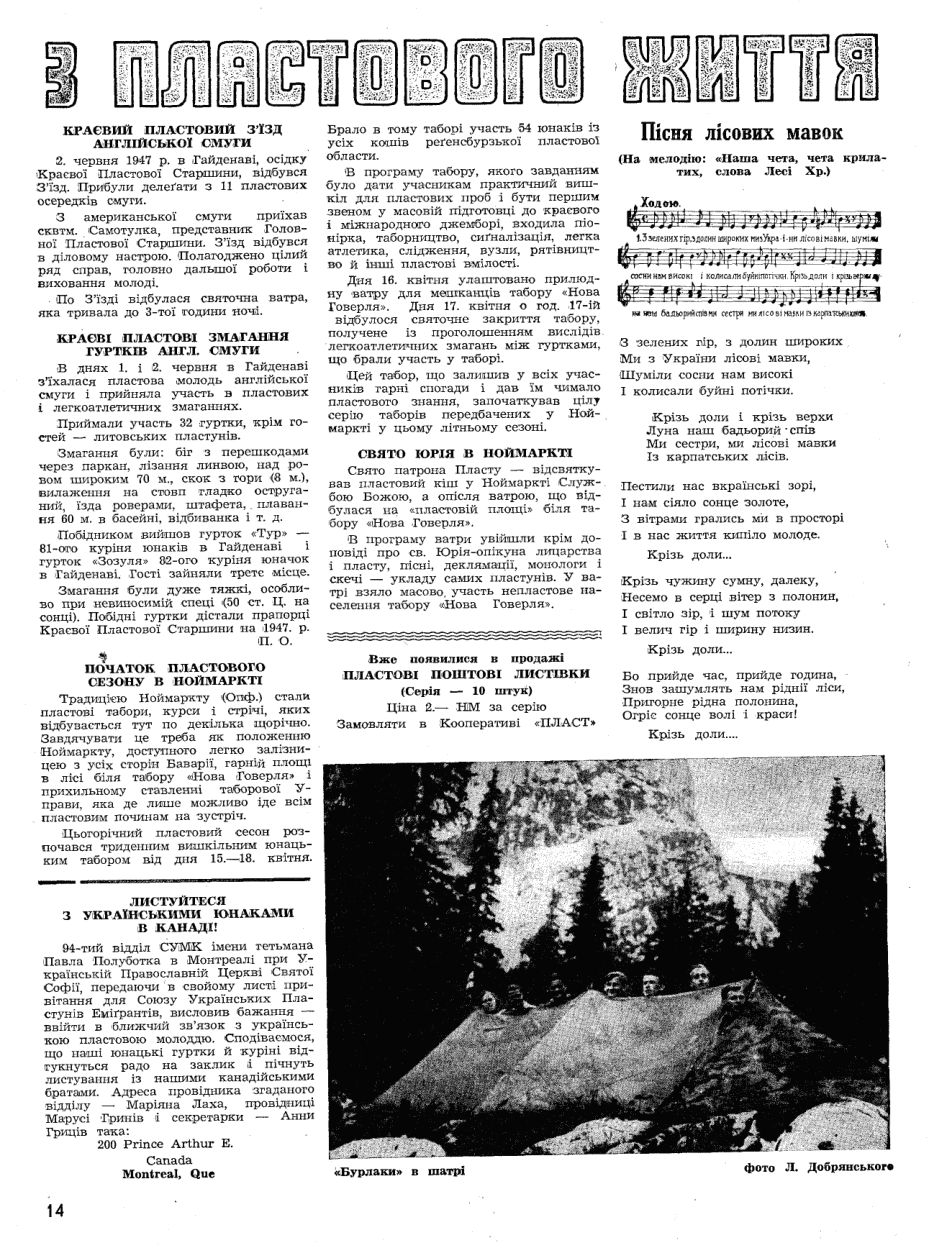
In 1947, Na slidi described Neumarkt as a regular meeting place for Plast camps and courses. Rail connections, a suitable woodland clearing beside Nova Howerla and a supportive camp administration helped make this possible. A spring training gathering brought 54 boys from groups across the Regensburg scouting area. They practised pioneering, campcraft, signalling, athletics, tracking, knots and rescue skills.
Sources for this section
Residents at the campfire
On 16 April 1947 the scouts held a public campfire for Nova Howerla residents. A separate St George celebration began with a church service and continued with songs, recitations, monologues and sketches at the scouting ground beside the camp. The report notes a large attendance by residents who were not themselves scouts. These gatherings brought organised youth activity into the wider community’s social life.
Sources for this section
School and worship across camp boundaries
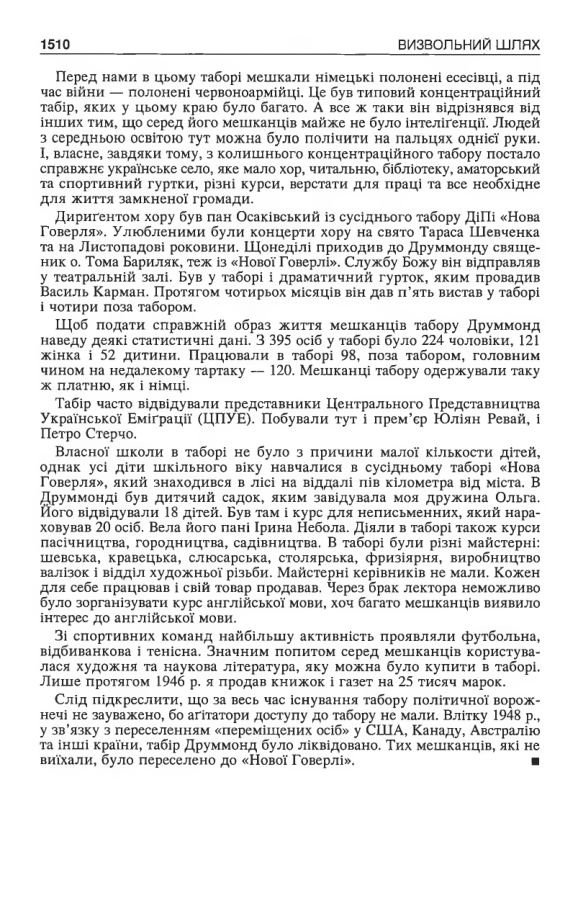
Former Drummond resident Oleksander Kobasa recalled that his camp’s school-age children attended school at nearby Nova Howerla, which he placed in woodland about half a kilometre from Neumarkt. Drummond’s small number of children did not support its own school. His memoir also names Osakivskyi from Nova Howerla as Drummond’s choirmaster and Father Toma Baryliak as the priest who came each Sunday to celebrate services there.
Connections with Drummond
| Connection | Account |
|---|---|
| School | Drummond children attended Nova Howerla’s school |
| Choir | Osakivskyi came from Nova Howerla |
| Religious services | Father Toma Baryliak visited Drummond on Sundays |
| Summer 1948 | Remaining Drummond residents transferred to Nova Howerla |
Sources for this section
Letters from a Ukrainian camp at Neumarkt
Two letters written from a Ukrainian camp at Neumarkt in 1947 survive in a family history collection. In September the writer described living in wooden barracks in a camp about two kilometres from the town and separated from it by forest, with about 700 people from Ukraine, some working inside the camp and some in German factories, and with himself and his wife teaching in the camp school. In December he described people leaving little by little for Belgium, the Netherlands, Canada and work in England, with others hoping for Venezuela, the United States, Brazil, Argentina and Paraguay.
The collection heads these letters simply as Neumarkt and does not say which of the town’s Ukrainian camps the writer lived in. Both Nova Howerla and Drummond were open on that date, and the distance he gives does not match the half a kilometre recorded in the Drummond memoir for Nova Howerla. They are evidence about Ukrainian camp life at Neumarkt rather than about this camp in particular.
Searching from a camp address
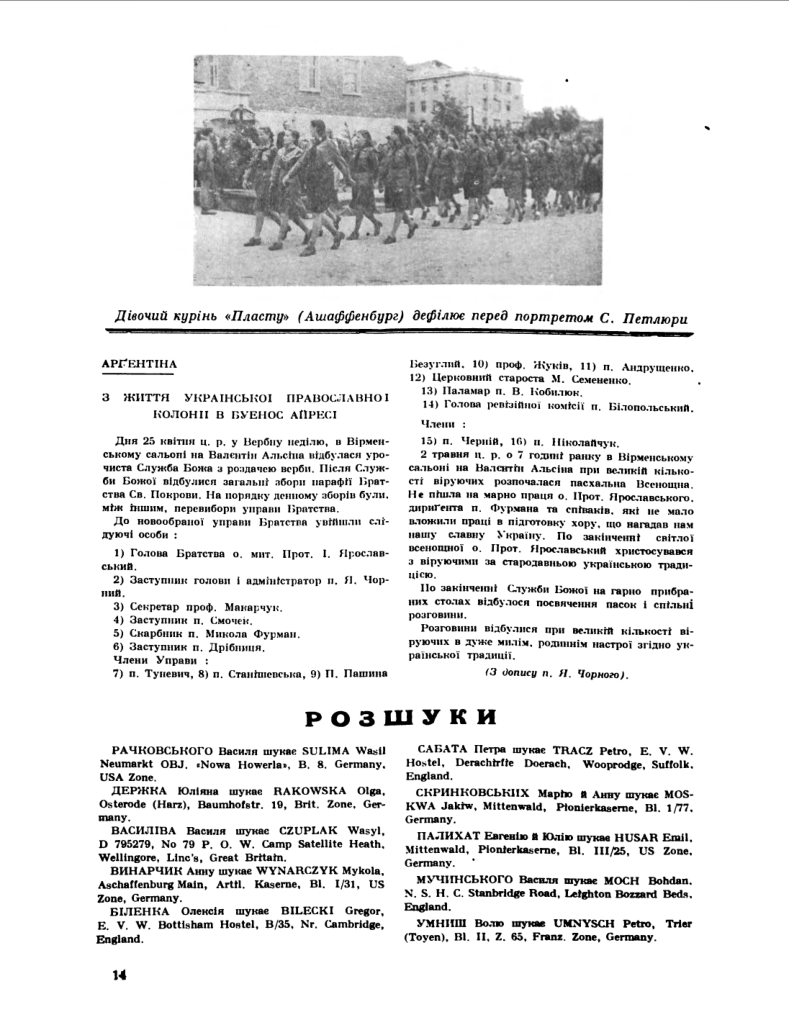
In June 1948, residents used Nova Howerla as a return address for searches published in the Paris Ukrainian journal Hromada. Wasyl Sulima sought Wasyl Rachkovsky, giving Neumarkt and “Nowa Howerla” in his address. On the following page, Matwij Lopuszanski sought Henryk Liutostavsky and likewise named the camp. These small notices connect the camp to the wider effort to find people separated by war. They establish published contact addresses, rather than proving the whereabouts of the people being sought.
Tracing notices, June 1948
| Person placing notice | Person sought | Printed page |
|---|---|---|
| Wasyl Sulima | Wasyl Rachkovsky | 14 |
| Matwij Lopuszanski | Henryk Liutostavsky | 15 |
Sources for this section
Transfers and departure
Kobasa dates Drummond’s dissolution to summer 1948, during overseas resettlement, and recalls that residents who had not emigrated moved to Nova Howerla. The two facilities remained distinct even as people, schooling and religious services linked them.
The inventory gives a closing date of 22 July 1949. A 2025 historical study by Leonid and Liudmyla Kushnir, citing United States congressional hearings, places the closure by 30 September 1949. The administrative date is the more precise of the two and the study’s date is consistent with it.
Sources
- Ihor Stebelsky, Table 8: Ukrainians in the UNRRA or IRO Camps of the United States Zone of Germany
Ukrainskyi Istoryk / The Ukrainian Historian 3 · 1986
Printed page 53 for the table headings and source notes and printed page 56 for the Neumarkt (Nova Howerla) row, visually checked. In the 1992 book printing the same figures stand in Table 7, printed pages 47–51.
- DP camp inventory, entry 1326
Undated
Catalogue identity checked in register audit; underlying records not yet read.
- Hromada, no.12, second June issue 1948
Undated
Cover and printed 14–15 visually inspected. Contemporary tracing notices explicitly name Nowa Howerla; exact publication day not stated.
- Na slidi, no.1, July 1947
Undated
Printed 14, original visually read: Neumarkt Plast training and St George festivities. Short training camp is separate from permanent DP camp; text gives 15–18 April but closing 17 April, so precise full range omitted.
- Oleksander Kobasa, A short history of Drummond camp, Vyzvolnyi shliakh, December 1995
Undated
Printed 1509–1510, PDF 103–104; original memoir visually read. Author lived at Drummond; Nova Howerla specifically named for school, visiting priest, choirmaster and 1948 transfers.
- The Annals of UVAN, volume XVI, 1984–1985, nos 41–42
Undated
Printed 438, entry 71, visually inspected: Holos Hoverli, weekly for Nowa Howerla residents, surviving item 19 December 1945. Catalogue entry, not original newsletter.
- Leonid Kushnir and Liudmyla Kushnir, Ukrainians in the Nazi camp Neumarkt (2025)
Undated
In Russian Aggression against Ukraine(2014–2025): Metaspaces of War, pp 128–136. Printed 135–136 reviewed. Closure attributed to authors citing 1950 US House appropriation hearings, p 854; underlying hearing not read. Their 1039 December 1947 figure is different scope from Stebelsky 929 Ukrainians and not merged.
- Arolsen Archives DP-Camp Verzeichnis, row 1326: Nowa-Howerla
Arolsen Archives · Inventory of 26 October 2023
Opening 28 November 1945; closing 22 July 1949; Ukrainian and Polish; AC 93-260, later NBO 429; UNRRA Team 56 Neumarkt; team director Fuller; field supervisor Matthews; area teams Nuremberg and Weiden; area A 4 Amberg. No capacity recorded. Neighbouring Neumarkt rows 1323, 1324 and 1782 read and kept distinct.
- Dzerkalo sportovykh tovarystv, in Almanakh Rady Fizychnoi Kultury 1945–1948
Molode Zhyttia, Munich · 1951
Printed pages 22, 27 and 79 read from the original scan with Ukrainian optical character recognition and checked against the page images. Entry 18 covers Burevii at Neumarkt and names the camp Nova Howerla with 1,020 inhabitants.
- Neumarkt Displaced Persons Camp: letters of 22 September and 12 December 1947
dpcamps.org, Michigan Family History Network · Letters dated 1947
Two letters from a Ukrainian displaced person at Neumarkt, submitted to the site by Nolan Hathaway and read in full. The page does not identify which of Neumarkt’s Ukrainian camps the writer lived in, and the writer is not named here.
Last researched 12 September 2026