DP-Camp F, Ohmstede
Displacement in Europe
Oldenburg · Germany · DP camp: May 1945 to 1961
The wartime Eastern-worker transit camp on the old racecourse at Ohmstede, in the north-east of Oldenburg, became the city’s largest DP camp after its liberation on 3 May 1945 and, from 1950, the Latvian Colony, the largest Latvian settlement in the Federal Republic. The Arolsen inventory lists it as DP-Camp F and records Ukrainians among its residents; a 1954 census of the camp counted six.
Introduction
Ohmstede is a former village in the north-east of Oldenburg, absorbed into the city in 1933. Its racecourse, laid out from 1905 between what are now Rennplatzstraße, Schellsteder Weg and Hochheider Weg, was covered with wooden barracks in 1942 and for the next nineteen years the site was a camp: first a transit camp for forced labourers from the East, then a DP camp under British and UNRRA administration, and from 1950 the Lettische Kolonie, the Latvian Colony, under the city. The Arolsen Archives inventory records it as DP-Camp F, Ohmstede, one of the lettered series of Oldenburg camps grouped under assembly centres 223 and 224 and UNRRA Team 146. Its nationality line, predominantly Estonian, Latvian and Lithuanian, but also Polish, Ukrainian and Russian, is shared by all the lettered Oldenburg camps and documents a Ukrainian presence without giving a count.
The site is unusually well documented. Katharina Hoffmann’s 1999 University of Oldenburg dissertation covers the wartime camp and the first year of the DP period from city and military government files; Günter Heuzeroth’s 2014 study of Baltic refugees in the Oldenburg region, published by the city, follows the camp to its demolition and draws on Ole Sparenberg’s 2000 article in the Oldenburger Jahrbuch; the Stadtmuseum Oldenburg presents the site in its online city exhibition.
Sources for this section
- DP camp inventory, entry 386: DP-Camp F, Ohmstede, Oldenburg
- Baltenflüchtlinge nach dem Zweiten Weltkrieg im deutschen Exil. Dargestellt an den Baltenkolonien im Oldenburger Land
- Ohmstede
- Die Geschichte der Rennplatzsiedlung
- Ausländische ZwangsarbeiterInnen in Oldenburg während des Zweiten Weltkrieges
- Rennplatz (Stadtausstellung)
A history in dates
- 1942The Organisation Todt builds the Ostarbeiter transit camp on the Ohmstede racecourse for up to 3,000 forced labourers.
- May 19442,112 people are registered in the camp; a typhus epidemic runs from May to July 1944.
- October 1944 to January 1945A Latvian police unit and transports of Latvian refugees are held in the camp.
- 3 May 1945Canadian troops liberate the camp; it becomes a reception and assembly camp for DPs.
- 1 June 1945An UNRRA welfare report lists 3,081 people at Ohmstede, recorded as the Russian camp.
- August 1945The Soviet DPs concentrated at the Rennplatz camp leave the city for repatriation.
- 1 May 1946A list of Latvian camps in Germany printed in Mūsu Pagasts records a DP camp at Ohmstede, Rennplatz 2.
- 20 May 1946The city housing office reports about 1,000 people in the Ohmstede/Rennplatz camp, nationalities not stated.
- 28 October 1949A city survey counts 52 barracks with room for 760 people and about 1,000 residents.
- 1 July 1950The camp passes from the IRO to the City of Oldenburg and becomes the Latvian Colony.
- 27 October 1952The city decides that the Ohmstede barracks will remain as its last foreigners’ camp under the official name Lettenlager.
- 1954A count gives 609 residents, among them 504 Latvians and 6 Ukrainians.
- 1959 to 1961The Rennplatzsiedlung is built on the site; residents move out from late 1960 and the last barrack is demolished in 1961.
Sources for this section
- Baltenflüchtlinge nach dem Zweiten Weltkrieg im deutschen Exil. Dargestellt an den Baltenkolonien im Oldenburger Land
- Rennplatz (Stadtausstellung)
- Die Geschichte der Rennplatzsiedlung
- Ausländische ZwangsarbeiterInnen in Oldenburg während des Zweiten Weltkrieges
- Latviešu nometnes Vācijā (Latvian camps in Germany), Mūsu Pagasts, numbers 1–2
- Ohmstede
The Eastern-worker transit camp on the racecourse
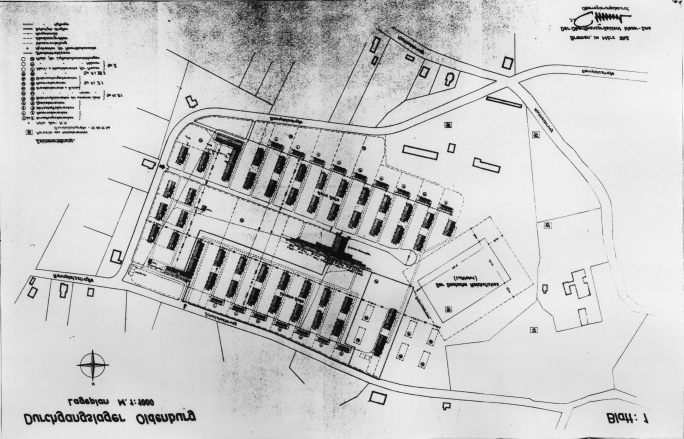
In 1942 the Organisation Todt built 45 wooden barracks on the racecourse in a first phase, with more added a year later; the Stadtmuseum counts 43 barracks. The complex was designed as the Ostarbeiter-Durchgangslager Ohmstede, a transit camp for up to 3,000 women and men brought from the East for forced labour, and it served the regional labour office as its central distribution point: workers were passed on from here to farms, industry and municipalities across the Oldenburg region. The camp had a sick bay, a maternity barrack, a delousing station, wash-houses and showers, a large kitchen block and an arrest barrack. Each residential barrack was meant for 75 people in three rooms of 25. The site was fenced with wire and guarded by civilians, and the district labour office administered it.
In April 1944 the camp registered 1,694 foreigners, of whom 1,205 were male and 435 female Eastern workers and 54 were Poles; by May 1944 there were 2,112, and towards the end of the war the camp held almost 4,000 people. Some 40,000 people are estimated to have passed through it. More than 324 people died in the camp, most of them in a typhus epidemic in 1944; about thirty further deaths came in an Allied bombing raid on 17 April 1945, though the sources differ on whether these were camp inmates or prisoners of the adjoining prisoner-of-war camp. Of the dead, 111 were children, many of them not yet three years old, among them infants born in the camp’s maternity barrack. They were buried in a mass grave at the western end of the Ohmstede parish cemetery, which is now a memorial with an Orthodox cross and plaques in four languages.
Baltic people were already present in the camp before the end of the war. A Latvian police unit of about a thousand men arrived in October 1944 with their weapons, horses and vehicles, some with their families; in January 1945 the regional labour office complained that transports of Latvian refugees, around 800 old people, infants and large families, had left the camp useless for labour allocation and closed to other transports.
Liberation and the DP camp
Canadian troops entered Oldenburg in the first days of May 1945 and reached the camp on 3 May. At that moment a mixed population of many nationalities was living in the more than forty barracks, and the Rennplatz camp turned from a transit camp into a reception and assembly camp for DPs. UNRRA Team 146 opened a registration and reception centre for the city in an old beer hall; Heuzeroth records that the British military government administered the Rennplatz camp itself until UNRRA took it over. An UNRRA welfare report gives the position on 1 June 1945: Ohmstede, listed as the Russian camp, held 3,081 people, the largest concentration of Soviet DPs in the city. Those Soviet DPs left the city in August 1945 as repatriation was completed.
Once the Soviet DPs had gone, the emptied barracks filled with Baltic DPs, above all Latvians, who had moved from camp to camp since their flight in 1944 and 1945 and who soon formed the majority. On 20 May 1946 the city housing office reported about 1,000 people in the Ohmstede/Rennplatz camp without being able to state their nationalities. The camp was overcrowded: some newcomers had to live in field tents supplied by the British and fetched water from a house on Rennplatzstraße. A sanitary barrack with a water tap, a wash kettle, a washroom and latrines served the residents of two residential barracks, and two large kitchens prepared the meals. A city survey of 28 October 1949 counted 52 barracks and calculated room for 760 people at ten square metres each, while about a thousand were living there. Until 1950 the residents were under the authority of UNRRA and, from the summer of 1947, the IRO, which could transfer them to other camps and whose permission they needed to travel.
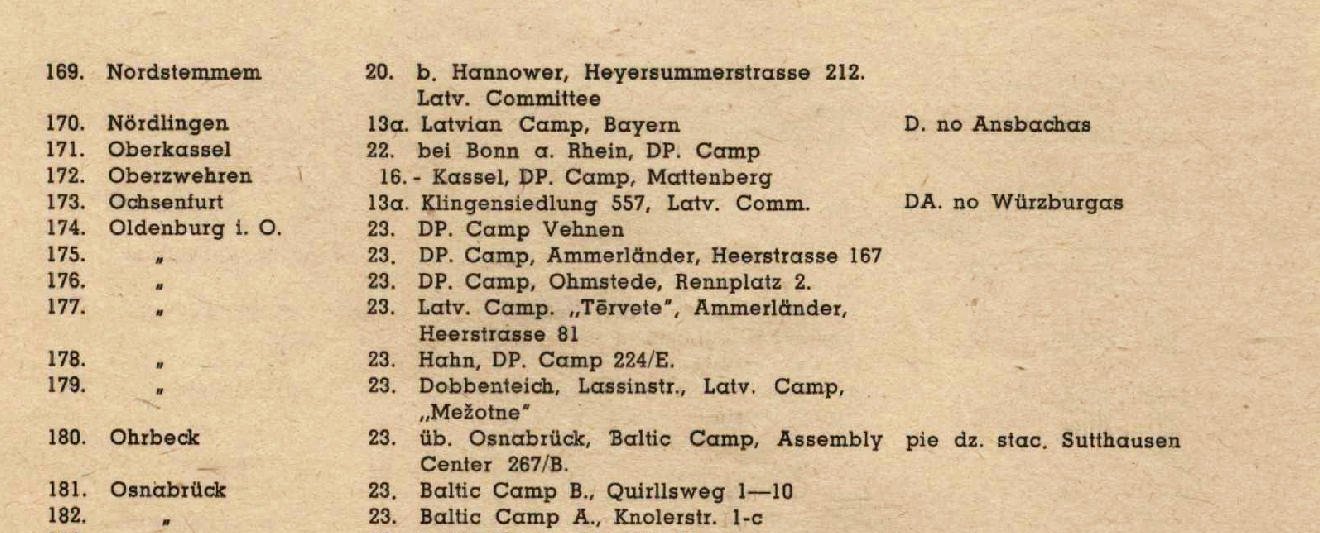
The camp appeared in the Latvian emigration press within a year of liberation. A list of Latvian camps in Germany printed in Mūsu Pagasts on 1 May 1946 includes, among several Oldenburg entries, a DP camp at Ohmstede, Rennplatz 2, in postal district 23.
Recorded occupancy of the Ohmstede/Rennplatz camp
| Date | Occupancy | Recorded as | Document |
|---|---|---|---|
| April 1944 | 1,694 | 1,205 male and 435 female Eastern workers, 54 Poles | Labour office registration, cited by Heuzeroth |
| May 1944 | 2,112 | Camp inmates | Labour office registration, cited by Heuzeroth |
| Spring 1945 | almost 4,000 | Forced labourers and refugees at the end of the war | Heuzeroth; Stadtmuseum gives over 4,000 |
| 1 June 1945 | 3,081 | Russian camp (Soviet DPs) | UNRRA welfare report of 1 August 1945 (Stadtarchiv Oldenburg, Best. S 2 Nr. 3), cited by Hoffmann |
| 20 May 1946 | about 1,000 | Nationalities not stated | City housing office to the Oldenburg interior ministry (Staatsarchiv Oldenburg, Best. 136 Nr. 18885), cited by Hoffmann and Heuzeroth |
| 28 October 1949 | about 1,000 | Residents in 52 barracks with calculated room for 760 | City document (Staatsarchiv Oldenburg, Best. 262-1 Nr. 3), cited by Heuzeroth |
| 1954 | 609 | 504 Latvians, 60 Germans, 18 Lithuanians, 8 Poles, 6 Ukrainians, 4 Belarusians, 2 Hungarians, 1 Romanian, 1 Finn, 5 stateless | Sparenberg 2000, cited by Heuzeroth |
| 1 September 1960 | 364 | Residents during the winding-up of the camp | Report of the Latvian pastor, 19 September 1960, cited by Heuzeroth |
Sources for this section
Schools, opera, cinema and church
The Baltic camp developed a full communal life. The Stadtmuseum records schools, a Latvian opera and evening film shows in a kind of cinema; a German neighbour remembered that the cinema and the camp hairdresser were used by Germans as well, that many Latvians played instruments and that Germans came to the camp’s concerts and performances. A 1954 list of communal rooms names a library with books in several languages, a doctor’s room, two shops, a hairdresser and a kindergarten. A Latvian Lutheran congregation held services, Bible study, youth meetings and Sunday school in the camp; by 1960 the camp children attended German schools and received weekly supplementary lessons in Latvian language, history and geography, and plays, concerts, lectures and dances were still being organised.
Emigration hollowed out the community. The Urdze family’s history of the settlement puts the number of Latvians and Estonians who left the camp for Britain, the United States, Canada, Australia and Sweden between 1945 and 1950 at about 4,000; only the fit could go, and the sick, the old, invalids and large families stayed behind. From 1 July 1950 responsibility passed to the German authorities: a British liaison officer had warned the mayor on 29 September 1949 that the Oldenburg DP camps would remain as resettlement camps and be handed to German administration, and in November 1949 the city proposed to concentrate DPs unfit for work in the Rennplatz and Sandweg camps. The city calculated that about 500 residents of the Latvian Colony would need social assistance.
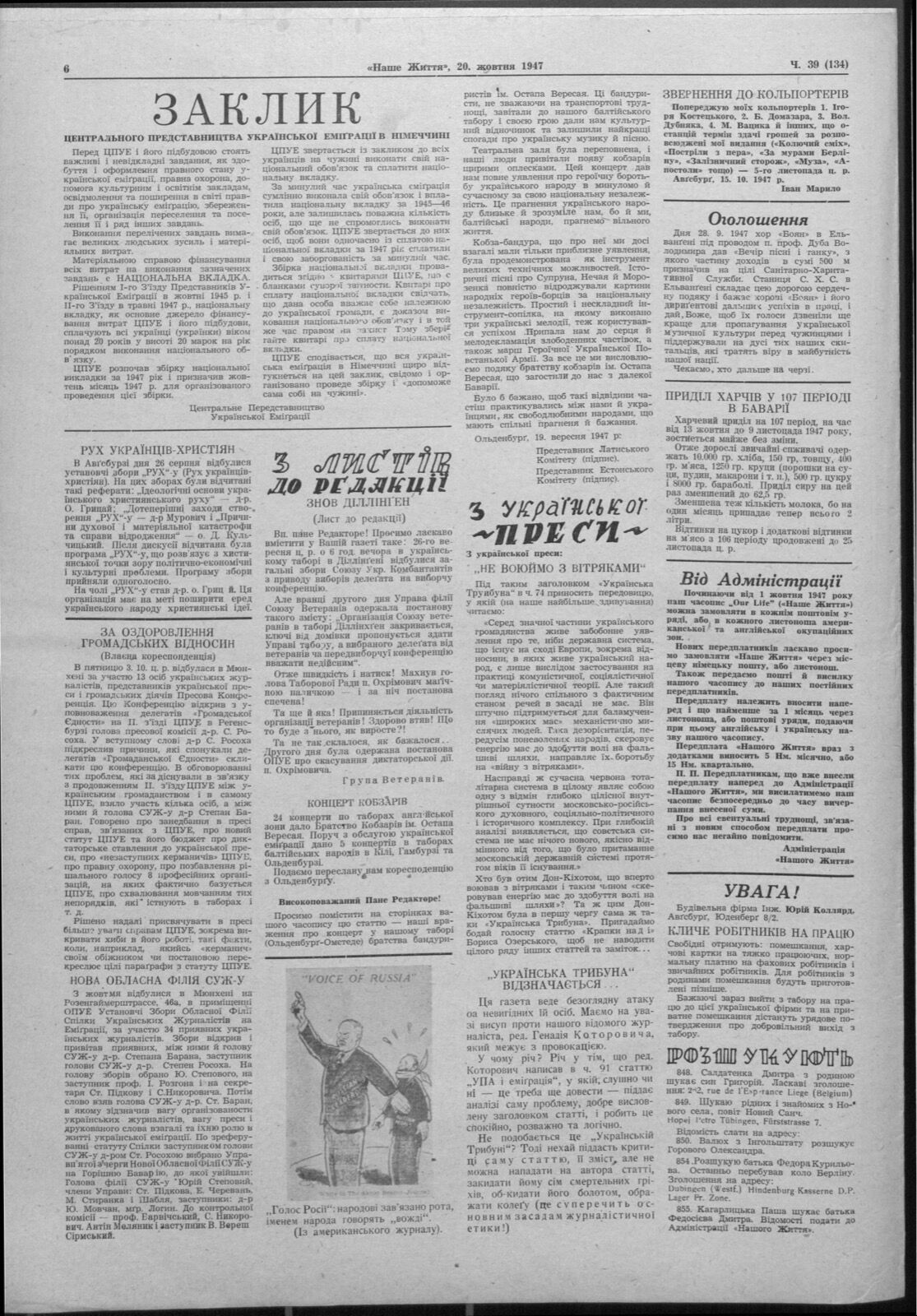
One evening at the camp is recorded in the Ukrainian press. In October 1947 the Augsburg weekly Nashe Zhyttia reported that the Ostap Veresai Brotherhood of Bandurists had given twenty-four concerts in the camps of the British zone and, besides serving the Ukrainian emigration, five concerts in the camps of the Baltic peoples at Kiel, Hamburg and Oldenburg; and it printed a letter sent from Oldenburg on 19 September 1947 by the representative of the Latvian committee and the representative of the Estonian committee. They asked the editor to publish their impressions of the concert given in their camp, which they named in the letter as Oldenburg-Ohmstede. The bandurists, they wrote, had come to their Baltic camp in spite of transport difficulties and had given them a cultural rest and the best memories of Ukrainian music and song. The theatre hall was overfull and their people greeted the kobzars with warm applause. The concert had given them a full idea of the heroic struggle of the Ukrainian people, past and present, for its national independence, a striving close and comprehensible to them because the Baltic peoples also longed for a free life. The kobza-bandura, of which they had until then had only an approximate notion, had been shown as an instrument of great technical possibilities, and the historical songs of Suprun, Nechai and Morozenko fully revived the picture of the people’s hero-fighters for independence; the simple sopilka, on which three Ukrainian melodies were played, was also a success. They had taken to heart the recited topical verses and the march of the Ukrainian Insurgent Army, thanked the brotherhood for coming to them from distant Bavaria, and wished that such visits might be practised more often between themselves and the Ukrainians as freedom-loving peoples with common aspirations and desires.
The Latvian Colony and the Rennplatz estate
Under city administration from 1950 the camp, with about 1,000 residents, was the largest Latvian settlement in the Federal Republic. A note of a departmental meeting on 27 October 1952 records that the Ohmstede barracks were to remain as the city’s last camp for foreigners while the other camps were wound up one by one, and that the site received the official name Lettenlager; residents and neighbours called it the Lettische Kolonie. A 1954 count gave 609 residents: 504 Latvians, 60 Germans, 18 Lithuanians, 8 Poles, 6 Ukrainians, 4 Belarusians, 2 Hungarians, 1 Romanian, 1 Finn and 5 stateless people. In the same year tuberculosis was diagnosed in 18.3 per cent of the residents, attributed to damp, poor hygiene and overcrowding. A psychiatrist from Bethel who visited in March 1958 described the mental toll of thirteen years of barrack life.
In 1955 the city and the housing association GSG planned a housing estate on the camp site, and from the beginning of 1959 the first blocks of the Rennplatzsiedlung rose while the barracks came down. On 1 September 1960 the camp still held 364 people. Residents moved into the new flats from late autumn 1960, the last of them by the end of 1961, when the last barrack was demolished. The street names Rigaer Weg and Kurlandallee, a Latvian Lutheran church opened on Kurlandallee in 1964 and the Kulturzentrum Rennplatz, which grew out of the Latvian youth and cultural centre, mark the site today. About 300 Latvians still lived in Oldenburg in the 1970s.
Sources
- DP camp inventory, entry 386: DP-Camp F, Ohmstede, Oldenburg
Arolsen Archives · 26 October 2023
Catalogue row for the camp: region DP British, district 30 H, assembly centres AC 224 and AC 223, UNRRA Team 146, nationality line and archive references. No opening, closing or capacity figures are given.
- Baltenflüchtlinge nach dem Zweiten Weltkrieg im deutschen Exil. Dargestellt an den Baltenkolonien im Oldenburger Land
Günter Heuzeroth, Autorenteam für kritische Geschichtsschreibung in Weser-Ems, Oldenburg 2014; PDF hosted by the City of Oldenburg · 2014
Full PDF read: chapters on the Ostarbeiter transit camp (pp. 23 to 25), liberation and the DP camp (pp. 25 to 31), residents’ memories (pp. 32 to 36), statistics to the demolition (pp. 37 to 46, citing Sparenberg, Oldenburger Jahrbuch 100, 2000, and Stadtarchiv/Staatsarchiv Oldenburg files) and the move to the Rennplatzsiedlung (pp. 47 to 50).
- Ausländische ZwangsarbeiterInnen in Oldenburg während des Zweiten Weltkrieges
Katharina Hoffmann, dissertation, Carl von Ossietzky Universität Oldenburg (OOPS repository) · 1999
Full PDF read for the description of the Rennplatz camp as the labour office’s central transit camp (p. 86), the section on Displaced Persons in the city (pp. 269 to 276) with the UNRRA reception centre, the report of 1 June 1945, the housing office list of 20 May 1946 and the departure of the Soviet DPs in August 1945.
- Rennplatz (Stadtausstellung)
Stadtmuseum Oldenburg · Accessed 12 September 2026
Museum page read for the 43 barracks, the death toll, the liberation on 3 May 1945, the schools, Latvian opera and cinema, the city takeover in 1950 and the figure of about 1,000 residents.
- Ohmstede
Wikipedia (German) · Accessed 12 September 2026
Wikitext checked for the location of the district, the conversion of the barracks into the DP camp known as the Lettenlager, the 1960 demolition, the street names, the 1964 church and the 1970s figure; footnotes to Brumanis 2006, GSG Oldenburg and Aina Urdze 2011 noted.
- Über Ohmstede
Bürgerverein Ohmstede · Accessed 12 September 2026
Local association page read as corroboration of the wartime camp, the Lettenlager and the 1960 demolition; it largely reproduces the Wikipedia text.
- Die Geschichte der Rennplatzsiedlung
Memorial website for Pastor Paulis Urdze (paulis.urdze.lv) · Accessed 12 September 2026
Unsigned family history page read for the typhus epidemic of May to July 1944, the April 1945 bombing and the estimate of about 4,000 emigrants between 1945 and 1950; used only where it agrees with Heuzeroth or the Stadtmuseum, except for the emigration estimate, which is attributed to it.
- Das DP-Lager bei Wehnen
Audra Brinkhus-Šaltys, Annaberger Annalen 19 · 2011
Read for the statement that the Oldenburg camps at Ohmstede, Sandplatz, Unterm Berg and Ammerländer Heerstraße lasted into the 1950s and for the transfer to German administration on 30 June 1950.
- Oldenburg (Oldb), section on the post-war period
Wikipedia (German) · Accessed 12 September 2026
Wikitext checked for the sentence on the British DP camps and their survival into the 1950s, which cites Ole Sparenberg, Vom Ausländerwohnlager Ohmstede zur Rennplatzsiedlung, Oldenburger Jahrbuch 100 (2000), pp. 177 to 199; the Landesbibliothek viewer for that article was blocked on the day of research.
- Durchgangslager Oldenburg, Lageplan M. 1:1000, Blatt 1, March 1942
Stadtarchiv Oldenburg, Best. 137 Nr. 4358; reproduced in Ausländische ZwangsarbeiterInnen in Oldenburg während des Zweiten Weltkrieges · 1942
Site plan of the transit camp drawn for the Oberbaurat Weser-Ems at Bremen in March 1942, showing two long double rows of barracks between Rennplatzstraße and the racecourse with a key to accommodation, kitchen, sick and delousing huts and air-raid trenches. Reproduced on page 117 of the dissertation; the plan is credited to the Stadtarchiv Oldenburg, which states no reuse licence.
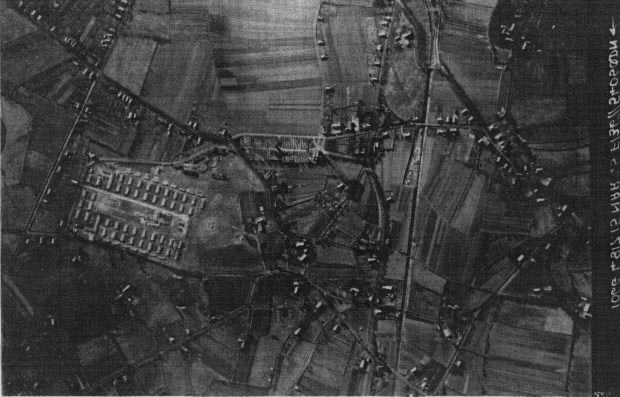
- Canadian air-force vertical photograph of the Rennplatz, Oldenburg, 15 March 1945
Stadtmuseum Oldenburg; reproduced in Ausländische ZwangsarbeiterInnen in Oldenburg während des Zweiten Weltkrieges · 1945
Aerial photograph taken by the Canadian forces seven weeks before the camp was liberated, showing the barrack rows of the transit camp at the top left of the frame with the racecourse and the Ohmstede field pattern around them. Reproduced on page 118; the print is credited to the Stadtmuseum Oldenburg, which states no reuse licence.
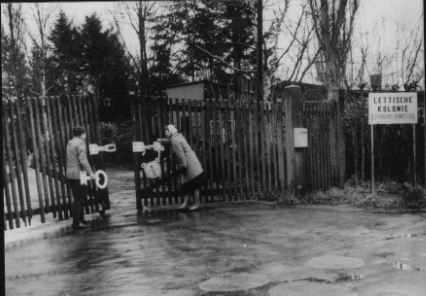
- Eingangstor zur Lettischen Kolonie an der Rennplatzstraße
H. Sokolowski, private collection; reproduced in Günter Heuzeroth, Baltenflüchtlinge nach dem Zweiten Weltkrieg im deutschen Exil · undated, 1950s
The camp gate on Rennplatzstraße with its board reading LETTISCHE KOLONIE. The accompanying text records that at times a second sign stood at the entrance reading ‘OHMSTEDE / LATVIAN / DISPLACED PERSONS CAMP, ASSEMBLY CENTRE 223, CONTROLLED BY 11/40 DPACS’, and a matching Estonian version. Reproduced on page 45 of a study published on the City of Oldenburg website; the photograph is credited to a private collection and no reuse licence is stated.
- “Концерт кобзарів”, Nashe Zhyttia (Наше Життя), number 39 (134), 20 October 1947, page 6
Ukrainian Museum-Archives of Cleveland, DP Camp Periodicals Collection, via the Internet Archive · 20 October 1947
Marked in the collection as public domain or an orphan work and offered under CC BY-NC-ND 4.0. Nashe Zhyttia was published at Augsburg by the cultural and educational department of the Ukrainian camp there. The page prints a letter sent from Oldenburg on 19 September 1947 by the representatives of the Latvian and Estonian committees about a concert given in their camp at Oldenburg-Ohmstede.
- Latviešu nometnes Vācijā (Latvian camps in Germany), Mūsu Pagasts, numbers 1–2
Mūsu Pagasts, 1 May 1946; facsimile and English translation reproduced by latvians.com · 1 May 1946
Facsimile sheet 4 of 6 read for list number 176, item (202), which records “23. DP. Camp, Ohmstede, Rennplatz 2.” under Oldenburg i. O., among several Oldenburg entries. The site reproduces the newspaper under a fair-use statement and supplies its own translations; the list’s compiler is not named.
Last researched 12 September 2026