Orlyk Camp
Displacement in Europe
Strub, Bischofswiesen, near Berchtesgaden, Germany · 1946–1950; surviving records to 1951
A Ukrainian community in the Bavarian Alps combined a secondary school, theatre, sport and a publishing programme. Many of its first residents came from Karlsfeld.
Introduction
Orlyk occupied former rifle barracks at Strub, near Berchtesgaden. With more than 2,000 Ukrainians in the late 1940s, it was one of the larger Ukrainian camps in the American occupation zone. Its institutions joined everyday services with education, organised sport and cultural work.
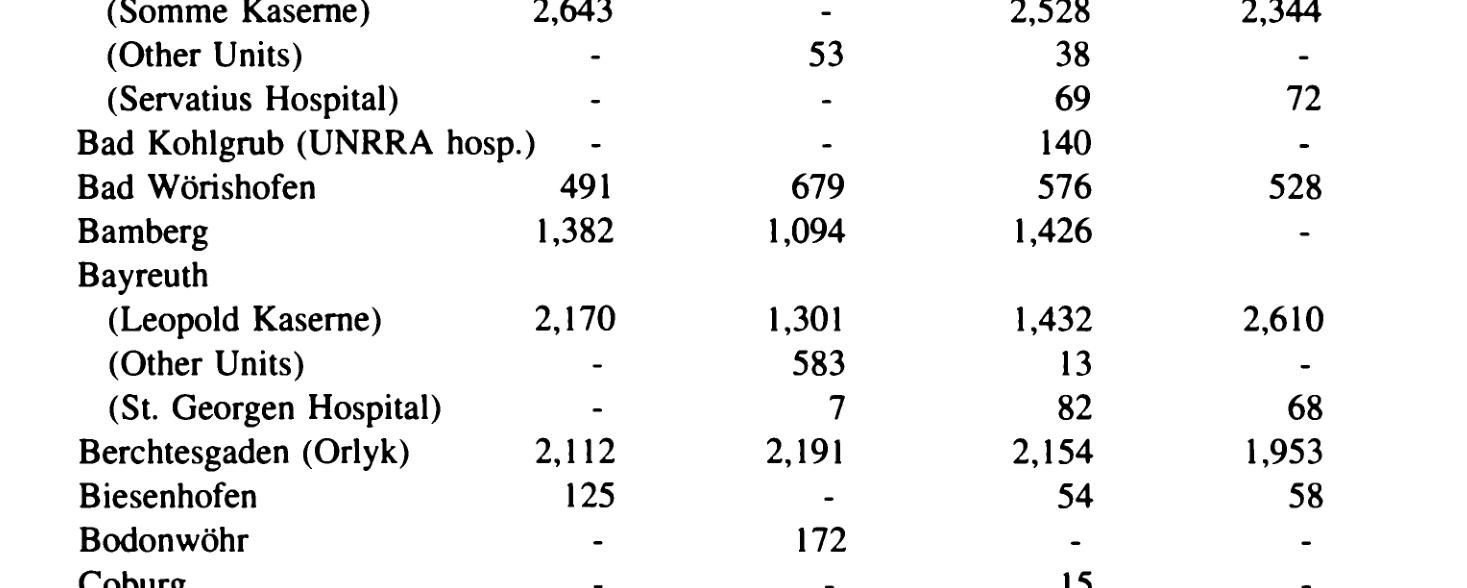
The Internet Encyclopedia of Ukraine places Berchtesgaden (Orlyk) among the Ukrainian camps of the American zone holding between 2,000 and 5,000 people, alongside Karlsfeld, Augsburg, Mittenwald, Regensburg, Aschaffenburg, Bayreuth, Neu-Ulm, Leipheim and Dillingen. The Encyclopedia of Modern Ukraine dates the Ukrainian camp at Berchtesgaden from 1945 to 1951 and gives its population as over 2,500.
In a comparative study of postwar Ukrainian migration, Julia Lalande observes that Ukrainian camps in Germany often carried Ukrainian names, among them Camp Orlyk in Bavaria and Camp Lyssenko, which implied the existence of a “little Ukraine” within the borders of Germany. She grounds the close identification of many Ukrainians with Orlyk and his group in their strong anti-Russian feeling combined with a dedication to self-determination, a feeling that found expression in the name of the camp and in the journal Orlyk at Berchtesgaden.
A history in dates
- September 1937Construction of the barracks at Strub begins.
- 4 May 1945French and American troops occupy the barracks, which afterwards house displaced persons.
- July 1945The Ukrainian gymnasium that later moved to Berchtesgaden is founded.
- 13–20 May 1946Three transports bring 1,842 people from Karlsfeld.
- 1 June 1946The Samopomich cooperative is established.
- 2 June 1946The camp is formally opened.
- June 1946Orlyk magazine begins publication; the sports club is founded.
- 16 June 1946A group of 179 arrives from the Kościuszko camp at Bad Reichenhall.
- 1947–1948The secondary school occupies a block of nine classrooms.
- 24 July 1947The poet Andrii Harasevych dies in the mountains near Berchtesgaden.
- April 1948The last issue of Orlyk magazine appears.
- 1950The secondary school closes as students and teachers emigrate.
The barracks before the camp
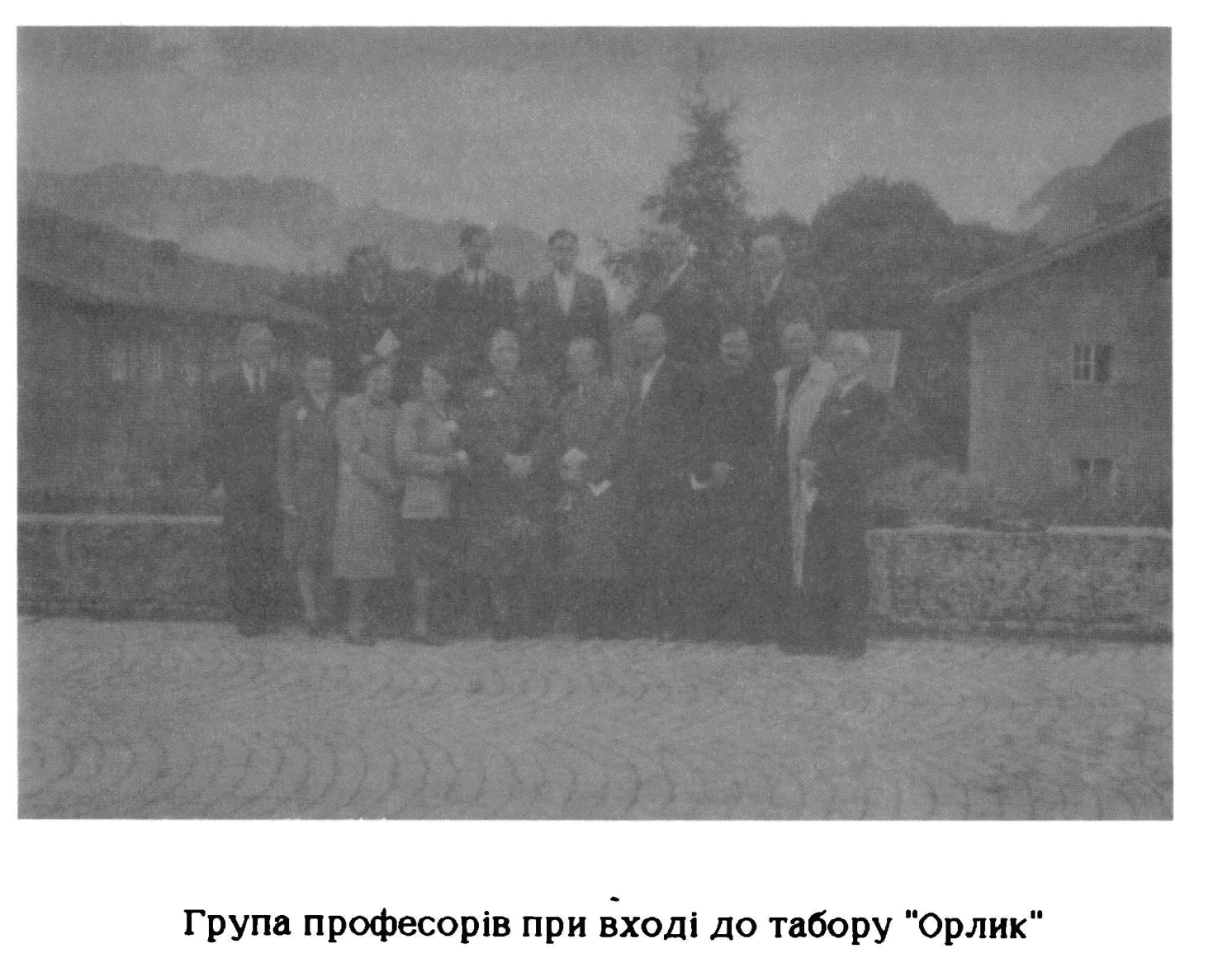
Work on the barracks at Strub began in September 1937 to designs by the Munich architect Bruno Biehler. The II Battalion of Gebirgsjägerregiment 100 moved in on 11 November 1938. French and American troops occupied the site on 4 May 1945, and it was afterwards used to house displaced persons. The German army returned in July 1957, and the buildings were named the Jägerkaserne on 17 June 1967.
Sources for this section
Arriving from other camps
Research based on the camp’s first journal issue records 1,842 people arriving from Karlsfeld in three transports, on 13, 15 and 20 May 1946. Forty-one came from the international Insula camp on 11 June and 179 from the Polish Kościuszko camp at Bad Reichenhall on 16 June; others were admitted on individual application. The study gives the camp’s population at that point as 2,059. The opening ceremony was held on 2 June 1946, after the first arrivals.
Unlike most of the assembly centres in the American zone, Orlyk was wholly Ukrainian. Its residents came from every part of the country and from a wide range of ages, trades and social backgrounds, and the study treats the task of governing so mixed a group as the camp administration’s first problem.
Groups arriving in 1946
| Came from | Date | People |
|---|---|---|
| Karlsfeld, three transports | 13, 15 and 20 May 1946 | 1,842 |
| Insula camp | 11 June 1946 | 41 |
| Kościuszko camp, Bad Reichenhall | 16 June 1946 | 179 |
Sources for this section
Governing the camp
A management board headed by Toma Lapychak ran the camp, answerable to general assemblies of residents and to elections contested by three groupings: a non-party civic union, a non-party workers’ and peasants’ list, and the society of Ukrainian political prisoners. Lapychak also edited the camp’s journal.
Professional life reorganised itself around associations. The study records a teachers’ community of 62 members, a medical section of eleven doctors, an association of engineers and technicians with 60 members, and a group of foresters and woodworkers numbering twenty.
Professional and youth associations
| Association | Members |
|---|---|
| Plast, eight groups | 266 |
| Sports society Orlyk | about 250 |
| Teachers’ community | 62 |
| Engineers and technicians | 60 |
| Choir Boyan | 42 |
| Choir Trembita | 32 |
| Foresters and woodworkers | 20 |
| Medical section | 11 |
Sources for this section
Running a small town
Orlyk’s surviving records reveal the practical organisation behind the settlement. Correspondence linked its council with local organisations and the American military administration. Budgets, receipts and payroll records document the management of services, while health and welfare papers and a law-and-order committee show how ordinary needs were handled.
Radio scripts and communiqués provided ways to communicate with residents. School programmes and theatre broadsides record an organised cultural calendar. The archive also preserves material from the literary and artistic association MUR and the cultural-educational division of the central Ukrainian representation: the camp was connected to a much wider intellectual network.
Housing arrangements tried to keep families together: small rooms were prioritised for families with young children and for sick residents, while larger rooms served as shared dormitories. The Samopomich cooperative, established on 1 June 1946, offered another form of practical self-organisation. It had 811 members by 24 June and had gathered 8,272 marks in shares and entrance fees. It ran a shop selling food at small mark-ups to hold down black-market prices, worked with knitting workshops in the camp, and sold off the beer left behind by the barracks’ previous occupants — 2,850 litres of it by 24 June 1946.
Both a Greek Catholic and an Orthodox church served the camp, each with its own choir: Trembita with 32 singers and Boyan with 42. A literary and artistic club founded on 22 June 1946 ran sections for writers and journalists, theatre, scholarship, music and the visual arts, and kept its own library. The camp theatre’s first production, Mirandolina, opened on 15 June 1946.
Institutions recorded at Orlyk
| Institution | Activity preserved in the records |
|---|---|
| Camp Council | Minutes, correspondence and communications |
| Health and Social Services | Welfare administration |
| Committee for Law and Order | Community administration |
| Secondary school and Plast | Education and scouting |
| Sports Club Orlyk | Minutes, accounts, diplomas and inter-camp correspondence |
| Theatre and artistic organisations | Programmes and broadsides |
Sources for this section
A school carried from Karlsfeld
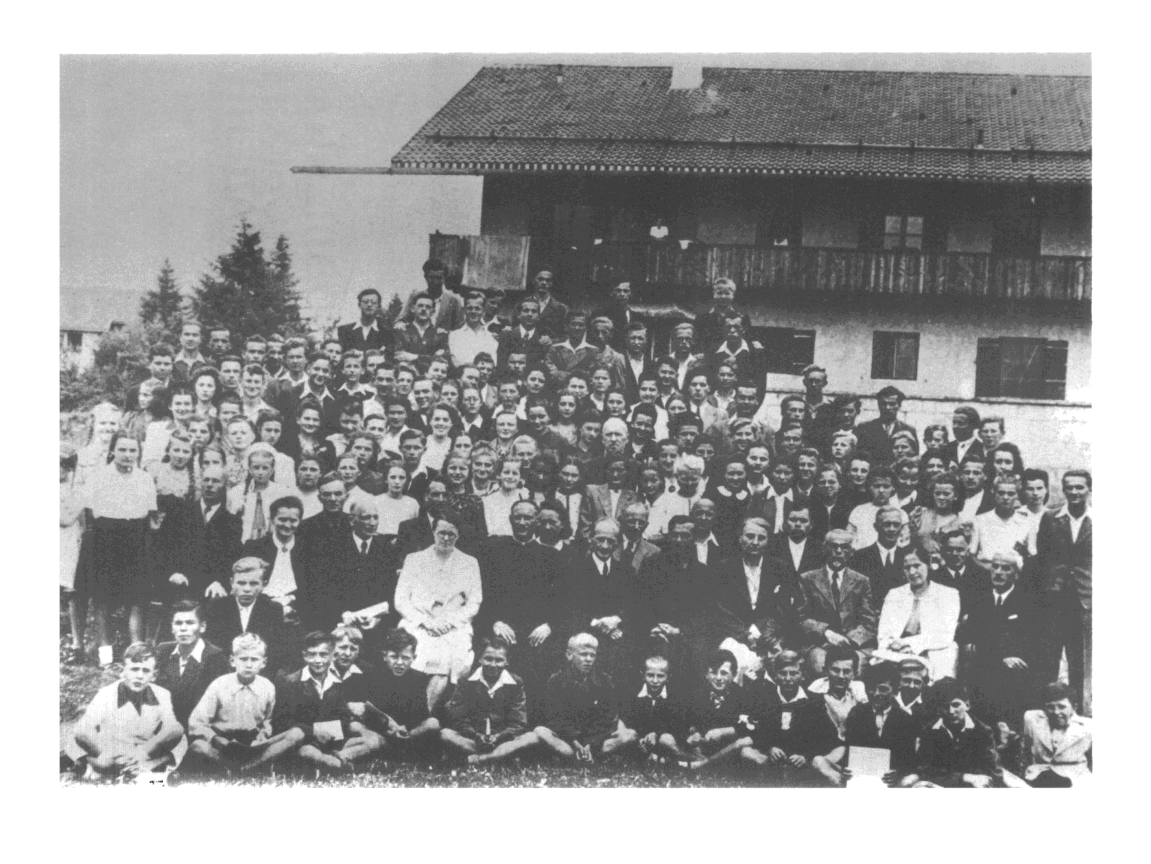
The secondary school continued an institution begun in Munich and Karlsfeld. It had been founded in July 1945 under Volodymyr Radzikevych, reached 562 pupils in the 1945–46 school year and had 42 teachers by November 1945. After Karlsfeld closed it moved to Berchtesgaden, where in 1946–47 it taught 226 students outside the camp, in the area called Zaporizhzhia. In 1947–48 it occupied a block of nine classrooms. Its final director, from 1949 to 1950, was Vasyl Stetsiuk.
The school-leaving examination was taken by 123 pupils in 1945–46, while the school was still at Karlsfeld, then by 59 in 1946–47, 21 in 1947–48 and 29 in 1948–49; 232 pupils graduated in all. Departures brought teaching to an end in 1950.
The secondary school was one of several. In its first weeks the camp also ran an elementary school of five classes with 106 pupils, a commercial school with 55, a girls’ vocational school with 23, a kindergarten with 73 children, a music school with 55 pupils and an art studio with nine.
Schools recorded in the camp’s first weeks
| School | Pupils |
|---|---|
| Gymnasium | 204 |
| Elementary school, five classes | 106 |
| Kindergarten | 73 |
| Commercial school | 55 |
| Music school | 55 |
| Girls’ vocational school | 23 |
| Art studio | 9 |
Sport and youth organisations
The Ukrainian Sports Club Orlyk was founded in June 1946 within the Ukrainian Council for Physical Culture. The society had about 250 members, senior and junior football teams and men’s and women’s volleyball teams, while Plast enrolled 266 young people in eight groups.
Harvard’s collection preserves correspondence, minutes, financial records and diplomas, alongside material from the school and Plast scouts. Exchanges with the Zaporizhzhia club in Aschaffenburg place local activity within a network of camp sport.
Harvard also identifies political, student, musical and theatre groups at the camp. Sport was therefore one part of a broader community infrastructure that offered residents education, collective activity and a sense of continuity while permanent settlement remained uncertain.
A magazine reaches beyond the camp
The magazine Orlyk appeared from June 1946 to April 1948: 22 numbered issues in 21 instalments. It was produced at first by cyclostyle at the camp and later printed by Stanislav Sliusarchuk’s press in Munich. Its early focus on camp life broadened from the sixth issue into a monthly forum for cultural and social discussion, and it kept its editorial independence from the camp administration.
Contributors included the scholars Leonid Bilets’kyi, Yurii Boiko-Blokhin, Petro Holubenko and Borys Krupnyts’kyi; the magazine also printed verse by Yurii Lypa, Oleh Olzhych and Olena Teliha, together with press reviews, book notices and a cultural chronicle. The Encyclopedia of Modern Ukraine names Ostap Hrytsai as editor of the literary monthly, while the Ostroh Academy study identifies Toma Lapychak as editor-in-chief.
The camp also published an illustrated catalogue for a Ukrainian art exhibition in 1946. Its Berchtesgaden-Strub imprint anchors the exhibition to this particular settlement. Another 1946 camp publication, Vatra, survives in the Ukrainian Museum-Archives periodicals collection, extending the evidence beyond a single magazine title.
The Internet Encyclopedia of Ukraine records Orlyk as one of ten Ukrainian periodicals licensed by the American military authorities, and dates its run from June 1946 to March 1948, a month earlier than the April 1948 closing date given by the Ostroh Academy study. Both give a total of 22 issues.
Publications connected with the camp
Writers at Strub
Writers, journalists and publicists lived at the camp. The novelist Katria Hrynevycheva died there and is buried in the town cemetery. The poet Andrii Harasevych, born in Lviv in 1917, had studied at Charles University in Prague, taught in a camp gymnasium and performed as a pianist; he was killed in a mountaineering accident near Berchtesgaden on 24 July 1947.
Sources for this section
What survived the camp years
Archives now preserve different parts of Orlyk’s life: Harvard’s holdings are particularly strong on sport, while the Shevchenko collection covers administration and cultural activity. The school’s anniversary book preserves photographs and educational history. Together they connect the buildings at Strub with institutions that continued in emigrant communities overseas.
Two further holdings of the Shevchenko Scientific Society bear on the camp. Its archives hold the Volodymyr Doroshenko papers, many of whose items relate to DP Camp Orlyk, together with the minutes of two meetings of the Uchytelska hromada in Philadelphia in 1952. Its library in New York holds the camp archives for 1945 to 1950 published on four CD discs, catalogued as not for loan.
Sources
- Displaced persons camps
Internet Encyclopedia of Ukraine · 1984; online edition
Overview identifies this camp among the larger Ukrainian communities of the American zone, in the 2,000–5,000 band.
- Berchtesgaden (Orlyk) DP Camp Records
Harvard Ukrainian Research Institute · Records 1945–1951
Full collection description inspected.
- The journal Orlyk in Berchtesgaden
National University of Ostroh Academy · 2022
Full study inspected; author analyses the complete journal run. The listed arriving groups do not add exactly to the study’s own figure of 2,059, so both are reported as the study gives them and no total is calculated here.
- Collection on the Orlyk Displaced Persons camp
Shevchenko Scientific Society Archives · Collection 016; records 1945–1950
Catalogue-level description: administrative and cultural records.
- Commemorative Book of Ukrainian Gymnazium in Berchtesgaden
Former students and supporters · 1997
Original pp. 11–12 and 1946 school group photograph inspected. Page 11: “At the beginning, namely during the 1946/47 school year, the Gymnazium was located in a building outside of camp wall and had 226 students. In the 1947/48 school year, the Gymnazium was moved to one of the camp buildings”, quoted from the scanned English translation with its OCR errors corrected.
- A guide to Ukrainian special collections at Harvard University
Harvard Library · Collection guide
Institutional Archives: Orlyk sports club founded June 1946.
- Publications by Ukrainian Displaced Persons and Political Refugees in 1945–1954
University of Alberta archival bibliography · 1988
Printed p. 175: Exposition of Ukrainian art, Berchtesgaden-Strub, 1946, 15+8 pp.
- Vatra, 1946, No. 1
Ukrainian Museum-Archives / Diasporiana · 1946
Original publication catalogue identifies Orlyk camp as publisher and 39 pages; issue contents not asserted.
- Берхтесґаден
Encyclopedia of Modern Ukraine · Online edition
Full article read: camp dated 1945–1951, over 2,500 Ukrainians, list of institutions, the literary monthly and its editor, and the writers who died at the camp.
- Jägerkaserne (Bischofswiesen)
German Wikipedia · Accessed 13 September 2026
Article read in full for the barracks’ construction from September 1937, the 1938 garrison, the occupation of 4 May 1945, the displaced-persons use and the postwar military history.
- Берхтесгаден
Ukrainian Wikipedia · Accessed 13 September 2026
Section on the Orlyk camp read; its enrolment, staffing, classroom and matriculation figures are drawn from the 1997 commemorative book of the gymnasium.
- Орлик (часопис)
Ukrainian Wikipedia · Accessed 13 September 2026
Article read for the magazine’s contributors and the change of content after the fifth issue; it cites O. Yas in the Encyclopedia of Ukrainian History, vol. 7.
- Гарасевич Андрій
Encyclopedia of Modern Ukraine · Online edition
Biographical entry read: born Lviv 13 August 1917, died near Berchtesgaden 24 July 1947; studies in Prague, teaching in a camp gymnasium, work as a pianist.
- Ukrainian Population Migration after World War II, Table 7
Ihor Stebelsky, in The Refugee Experience, Canadian Institute of Ukrainian Studies Press · 1992
Scan published by diasporiana.org.ua; no reuse licence is stated by the holder. Page image rendered from the digitised volume and the camp’s row read visually.
- Julia Lalande, “Building a Home Abroad”: a comparative study of Ukrainian migration
Universität Hamburg, doctoral dissertation · 2006
Printed page 65 and footnote 112 read: Ukrainian camps in Germany often carried Ukrainian names, among them Camp Orlyk in Bavaria and Camp Lyssenko, implying a “little Ukraine” within Germany, and the identification with Orlyk and his group grounded in anti-Russian feeling combined with a dedication to self-determination.
- Volodymyr Doroshenko papers, Identifier 021
Shevchenko Scientific Society Archives
Catalogue listing read: many items in the papers relate to DP Camp Orlyk, and the collection also holds the minutes of two meetings of the Uchytelska hromada in Philadelphia in 1952. Only the catalogue entry was read.
- Archives DP Camp “ORLYK”, Berchtesgaden, West Germany, 1945-1950
Shevchenko Scientific Society library, New York
Library catalogue record read: the camp archives for 1945 to 1950 published on four CD discs, held at the society’s library and marked not for loan. The discs themselves were not consulted.
- Orlyk, in the Internet Encyclopedia of Ukraine
Canadian Institute of Ukrainian Studies · 1993
Entry read: a monthly journal of cultural and community affairs published in the displaced-persons camp at Berchtesgaden from June 1946 to March 1948, 22 issues in all, one of ten Ukrainian periodicals licensed by the US military authorities, edited by Toma Lapychak.
Last researched 12 September 2026