Pamplona Provincial Prison
Displacement in Europe
Pamplona · Spain · 1943–1944
For Ukrainians escaping across the Pyrenees, reaching Spain did not immediately mean freedom. An original account traces several weeks in Pamplona’s provincial prison and transfer by train to Miranda de Ebro on New Year’s Day 1944, in a movement of foreigners that the military archive’s own index describes.
Introduction
Pamplona’s provincial prison formed part of a wartime route from occupied Europe into Spanish internment. A Ukrainian eyewitness describes crossing the Pyrenees in October 1943, spending several weeks here and being sent onwards to Miranda de Ebro. The institution was a prison holding several categories of detainees; its Ukrainian connection concerns transit through detention, rather than a postwar Ukrainian settlement.
Sources for this section
A history in dates
- 1900Funds are secured for a new provincial prison; building takes seven years under the architect Julián Arteaga.
- 28 September 1908Prisoners move into the new provincial prison at San Roque.
- 1936After the military coup the prison fills with political prisoners; 1,536 are held on governors’ orders in that year.
- 18 November 1942A physician born in Czernowitz crosses the Pyrenees on foot; arrested six days later, he is sent to Pamplona prison.
- 16 December 1942He is moved from Pamplona prison to Miranda de Ebro, interned there under a false identity.
- October 1943Two Ukrainians cross the Pyrenees at Orbaizeta and are registered as Russians before being sent to Pamplona.
- 1 January 1944The eyewitness account records transfer by train to Miranda de Ebro in a party of thirty-six.
- December 1945The prison holds 392 men and women.
- 2012The prison building is demolished.
- 2018The site becomes the Parque de la Insumisión.
- 2023The former entrance is reinstalled as a memorial.
Sources for this section
- Informe sobre centros de detención y espacios de cautividad en Pamplona, 1936–1945
- Navarra reconstruye la puerta de la antigua cárcel franquista de Pamplona y la convierte en lugar de memoria
- Physicians imprisoned in Franco Spain’s Miranda de Ebro “Campo de Concentración”
- Ukrainian account of detention in Pamplona and transfer to Miranda
- Prisión Provincial
The prison at San Roque
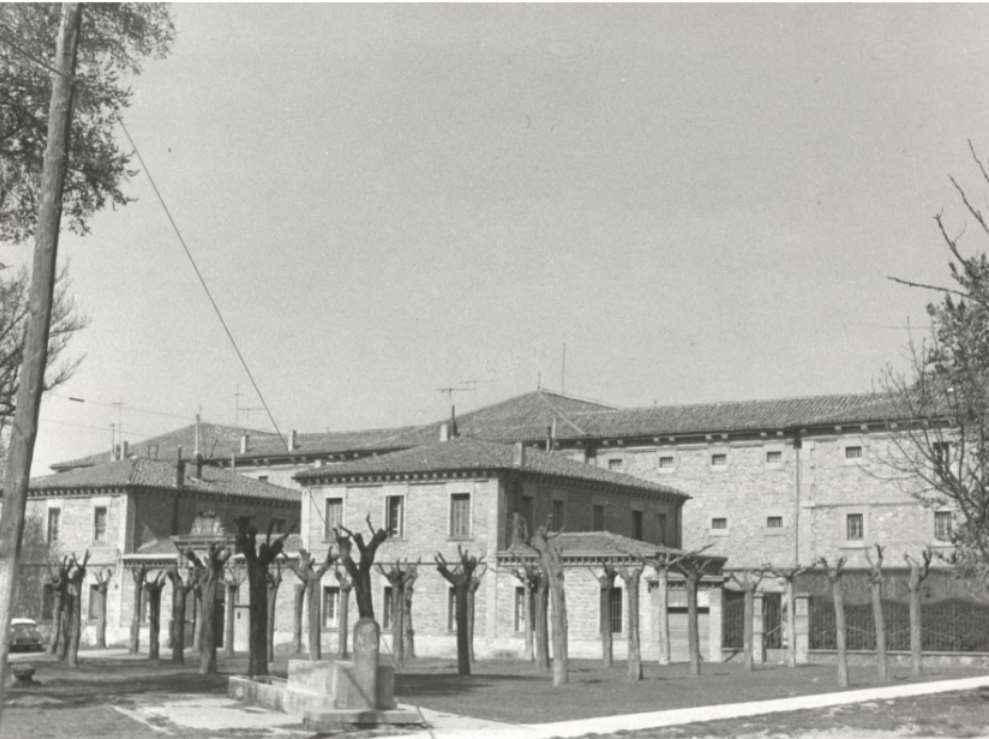
The prison stood in the San Juan district, on the site now occupied by the Parque de la Insumisión. Prisoners moved here on 28 September 1908 from the older prison at Plaza de San Francisco. The new building had 194 cells, four courtyards and three floors arranged around a square plan. It remained in use long after the Second World War.
The decision to replace the medieval prison on the Plaza de San Francisco was taken in 1900, when the money was finally found. Building took seven years under the architect Julián Arteaga. The report notes that correctional thinking of the day, including Bentham’s panopticon, reached Pamplona with the new building, although the plan adopted was square rather than radial. The prison also took prisoners from the district gaol at Estella, gave inmates access to a library, and allocated work according to a classification of prisoners as reliable, semi-reliable or dangerous. Women had their own section.
Sources for this section
A prison on the frontier route
Pamplona’s place in this story followed from geography. The Guadalajara index to the Miranda admission files states that foreigners detained in Navarre arrived at the camp accompanied by the file and interrogation carried out at the Pamplona police station by the Cuerpo General de Policía. It describes roughly sixteen thousand people of some seventy nationalities held in civil and military prisons, Civil Guard posts, frontier commissions, reception camps, boarding houses and hotels before being moved under Civil Guard escort to Miranda. The prison was one link in that chain, and the police interrogation it mentions was carried out by a different body from the prison itself.
The presence of foreigners in the town was acknowledged in Francoist prison administration. The annual report of the Patronato de Redención de Penas for 1947, quoted in the Navarre study, singled out Pamplona because of its nearness to the Pyrenean frontier, said the town therefore had the largest number of foreigners under government supervision, and described them as people without a country or a home who were mostly fleeing prisoner-of-war camps. Relief work in Pamplona involved the local Patronato delegation, the charity secretariat of Catholic Action and a body for the assistance of foreign refugees known as OCARE.
A study of the physicians interned at Miranda de Ebro documents the same route a year earlier. Stanislaus Seidner, born in Czernowitz, a city that then belonged to Romania and after the Second World War became part of Soviet Ukraine, crossed the Pyrenees on foot on 18 November 1942. He was arrested six days later and sent to Pamplona prison, and on 16 December he was moved to Miranda de Ebro, where he was interned under the false identity Paul Alavouette.
Sources for this section
- Los expedientes personales de ingreso en el Depósito de Concentración y Clasificación de Personal Extranjero de Miranda de Ebro (Burgos). Índice nº 13
- Informe sobre centros de detención y espacios de cautividad en Pamplona, 1936–1945
- Physicians imprisoned in Franco Spain’s Miranda de Ebro “Campo de Concentración”
Escape, assistance and onward transfer
The Ukrainian account begins at the foothill village of Orbaizeta, where the two men crossed out of occupied France in October 1943. The post commander answered their attempt to explain that they were Ukrainians by correcting them to Russians and proposing a toast to Stalin. They were then taken to Pamplona and shut in the provincial prison for several weeks. The memoir recalls implements for torture still fixed to the walls of the cell, and an official who smiled, observed that Ukraine had a great deal of wheat, and wrote Russian.
While detained, they received help through the International Red Cross and the American Friends Service Committee, the Quaker relief body. A Mrs Moore from the American embassy in Madrid visited them, and they were sent thirty-five pesetas a week and extra food. The assistance did not change their classification: to the Spanish authorities they remained Russians and communists.
On the morning of 1 January 1944, at about six o’clock, an officer of the prison guard read out their names and told them to get ready. They were moved to a large cell holding a couple of dozen men, given back their belongings with anything valuable missing, tied together in pairs with chains or rope and marched to the railway station. The party numbered thirty-six, mostly French, with a Russian émigré from Belgium, a Canadian airman who had escaped the Germans and several Jews. Miranda is about eighty kilometres away, but they did not reach the camp gates until about two in the afternoon. The group’s total does not establish how many were Ukrainian.
Sources for this section
A prison with several histories
The prison also held people caught in Spain’s Civil War and Francoist repression. The Navarre government’s memorial service records 1,536 people held on governors’ orders in 1936 alone, and the killing of prisoners taken out to Valcaldera, Ibero, Etxauri and El Perdón. Press reporting of the memorial site gives 7,364 people passing through the prison from 1936 onwards, of whom at least 425 were killed.
The government-commissioned historical report records that the prison direction claimed more than two thousand men in 1940, then 864 men and women in December 1940 and 392 in December 1945, after which the population fell away to between one and two hundred through the 1950s. Pamplona was classed as an ordinary-service prison within the Sixth Zone alongside Bilbao, Burgos, Logroño, San Sebastián, Soria and Vitoria. These are prison-wide figures, not counts of foreign refugees or Ukrainians, and they place the individual transit account within a much larger institution.
Prison-wide population and scale
| Measure | Figure | Scope |
|---|---|---|
| Cells in the 1908 building | 194 | Architectural provision, with four yards and three floors |
| Held on governors’ orders, 1936 | 1,536 | Political detainees in that year alone |
| Claimed by the prison direction, 1940 | More than 2,000 | Statement in the prison service annual report |
| Recorded prisoners, December 1940 | 864 | Men and women |
| Recorded prisoners, December 1945 | 392 | Men and women |
| Passed through the prison from 1936 | 7,364 | Cumulative, of whom at least 425 were killed |
| Party transferred to Miranda, 1 January 1944 | 36 | Mostly French; the Ukrainian share is not stated |
The site today
The building was demolished in 2012. The site became the Parque de la Insumisión in 2018, commemorating the later movement against compulsory military service. The former entrance received protected memorial status in 2020 and was reinstalled in 2023. The surviving doorway connects the present park with the prison’s different generations of detention.
The prison’s successor, the Centro Penitenciario de Pamplona, stands on the Santa Lucía hill near the San Jorge district, so the San Roque site carries none of the later prison’s history.
Sources
- Informe sobre centros de detención y espacios de cautividad en Pamplona, 1936–1945
Universidad Pública de Navarra / Instituto Navarro de la Memoria
Original report, printed pages 45–48 and 59. Establishes San Roque site, 1908 prisoner transfer, architectural capacity, dated population counts and the municipal archive photograph.
- Ukrainian account of detention in Pamplona and transfer to Miranda
Almanac of the Ukrainian National Association, 1971
Original printed pages 134–139: October 1943 Pyrenees crossing, weeks in Pamplona, Ukrainian self-identification, relief assistance and transfer on 1 January 1944. No inmate names reproduced.
- Prisión Provincial
Instituto Navarro de la Memoria
Official memorial entry: prison demolition, park designation, protected memorial status and restoration of the entrance. The report’s documented 1908 transfer is preferred over the portal’s 1907 opening date.
- Los expedientes personales de ingreso en el Depósito de Concentración y Clasificación de Personal Extranjero de Miranda de Ebro (Burgos). Índice nº 13
F. Javier López Jiménez, Archivo General Militar de Guadalajara, Ministerio de Defensa · 2003, revised February 2018
Index to the Miranda admission files, read from the cached copy at research-workers/section-completion/spain-sources/dcme-agmg-indices.pdf. Its introduction states that foreigners detained in Navarre reached Miranda with the file and interrogation made at the Pamplona police station, and describes the wider network of prisons, Civil Guard posts and frontier commissions. The police station is a different institution from the provincial prison.
- Navarra reconstruye la puerta de la antigua cárcel franquista de Pamplona y la convierte en lugar de memoria
eldiario.es, Navarra edition; cross-checked against Paz y Convivencia, Gobierno de Navarra · retrieved 13 September 2026
Supplies the figures of 7,364 people passing through the prison from 1936 and at least 425 killed, and the reconstruction of the gateway. The Gobierno de Navarra memorial entry supplies the 1,536 held on governors’ orders in 1936 and the killing sites at Valcaldera, Ibero, Etxauri and El Perdón.
- Dibujos de Javier Ciga en su paso por la Prisión Provincial
Fundación Ciga, reproduced as Imagen 6 in ‘Informe sobre centros de detención y espacios de cautividad en Pamplona, 1936–1945’, Instituto Navarro de la Memoria · Drawings undated; report published by the Instituto Navarro de la Memoria
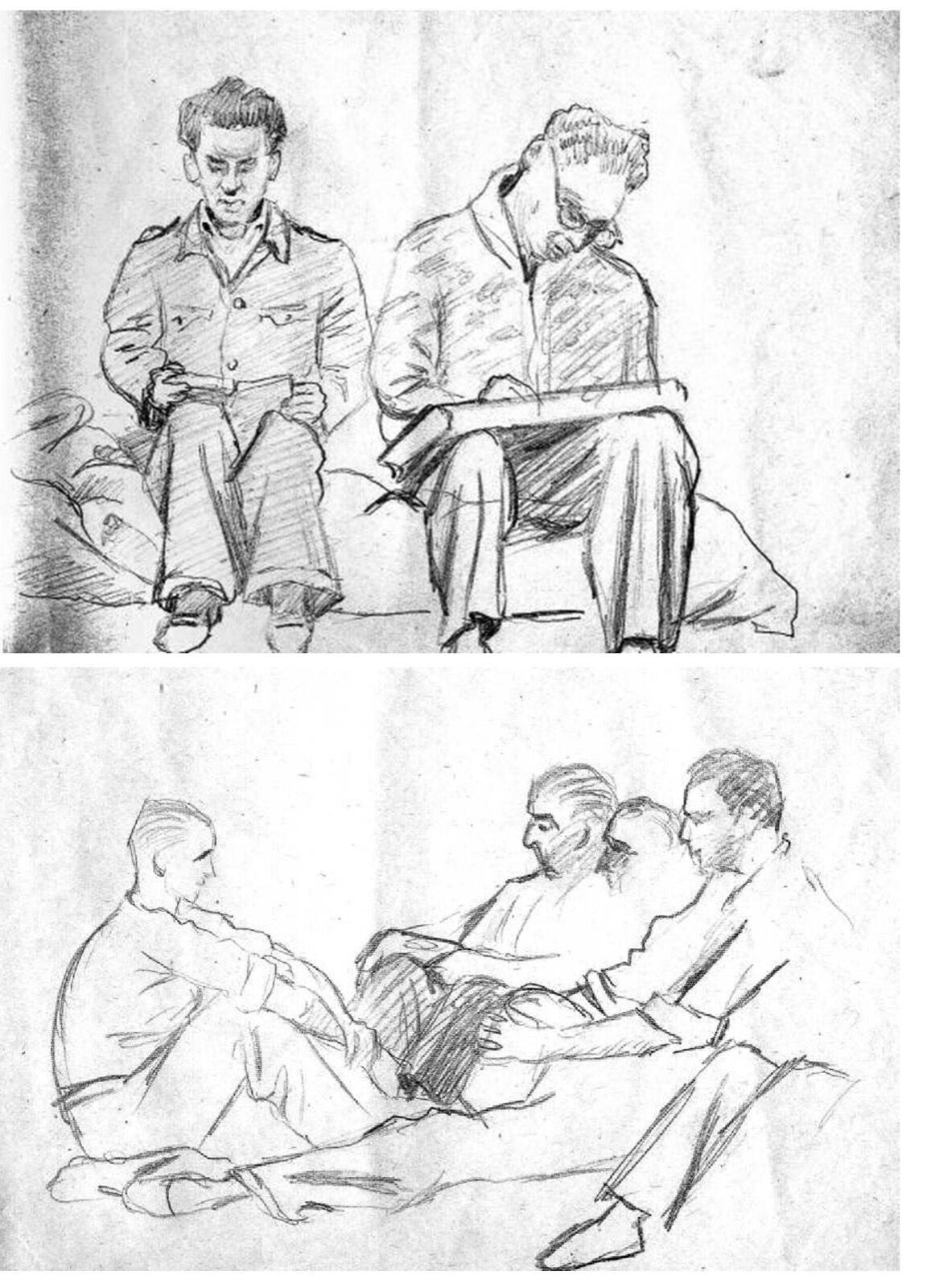
Two pencil drawings made by the Navarrese painter Javier Ciga during his own imprisonment in the Prisión Provincial of Pamplona, reproduced as Imagen 6 on page 60 of the report and credited there to the Fundación Ciga. The upper sheet shows two men seated on the floor against a wall, one of them drawing; the lower shows four men sitting together on the floor. Neither the foundation nor the report states a reuse licence.
- Physicians imprisoned in Franco Spain’s Miranda de Ebro “Campo de Concentración”
Medical History, Cambridge University Press; Esther Cuerda-Galindo · 2023
Peer-reviewed article, read in the section ‘Fate, exile or return home: what did the doctors do after Miranda de Ebro?’ for the biography of one physician who passed through Pamplona prison in 1942 on the way to Miranda de Ebro.
Last researched 13 September 2026