Aufbau Camp
Displacement in Europe
Pfarrkirchen · Germany · 1945–1949
A boarding school on the edge of Pfarrkirchen was requisitioned in September 1945 and held Ukrainian and Russian displaced people for three and a half years. Published population returns record several hundred Ukrainians at the town, and one former resident’s recollection places her family there for three years before they left for Canada.
Introduction
Aufbau Camp took its name from Pfarrkirchen’s former Aufbauschule. The camp inventory identifies the residential institution and its annexes as DP 8, with Ukrainian and Russian residents, opening on 15 September 1945 and closing on 24 March 1949. An oral-history interview independently places a Ukrainian family at the named Aufbau camp from 1945 until 1948.
A history in dates
- 1906–1907The town completes the school and boarding buildings on Arnstorfer Straße.
- 1938The Bavarian state takes over the school and introduces the Aufbauschule; the boarding house is renamed Deutsches Schulheim.
- 1945A military hospital occupies the school and boarding buildings; the boarding institution closes.
- 15 September 1945The inventory records the opening of DP 8 Aufbau and annexes.
- 1945An interviewed former resident recalls her family’s arrival at Aufbau Camp.
- 31 May 1947The UNRRA summary records 359 Ukrainians at Pfarrkirchen.
- 31 October 1947The inventory records accommodation capacity of 500 for Aufbau and its annexes.
- 2 January 1948The PCIRO summary records 416 Ukrainians at Pfarrkirchen.
- 1948The interviewed family leaves after three years at the camp.
- 1948/49With the building still occupied, 566 German pupils are taught in the boys’ school, inns and other premises.
- 24 March 1949Administrative camp closure is recorded.
- 22 April 1949The school history dates the return of the main building to educational use.
- September 1949The boarding institution reopens as the Staatliches Schülerheim.
The building before 1945
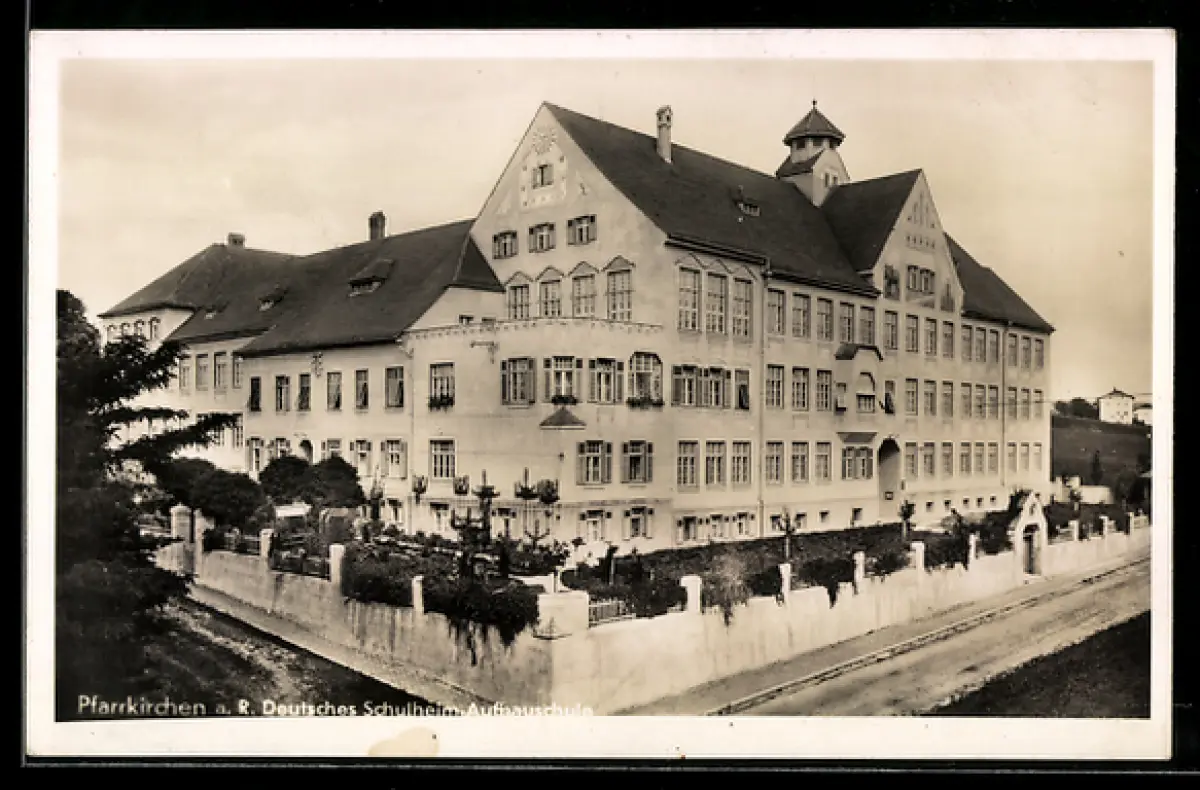
The town of Pfarrkirchen built the complex on Arnstorfer Straße by 1906 for its agricultural school, with an attached boarding wing that was occupied at the end of 1907 and took a hundred pupils from the start. The Bavarian state took the school over in 1938 and introduced the Aufbauschule, the course that led directly to university entrance; from 1938 the boarding house was renamed Deutsches Schulheim and its clerical management removed. When the Realschule and agricultural classes were run down at the end of the 1942/43 school year, the official title of what remained became Deutsches Schulheim, secondary school for boys.
In 1945 a military hospital occupied both the school and the boarding building and the boarding institution closed. The surviving postcard shows the named school building, rather than a generic view of Pfarrkirchen.
The camp and its annexes
The administrative record lists Assembly Centre 93-411 and the later code NBO 425. It associates the facility with Teams 545 at Pfarrkirchen and 539 at Eggenfelden. The capacity figure of 500, recorded on 31 October 1947, covers the entry for Aufbau and annexes; it does not establish how many Ukrainians lived inside the principal school building. The archive reference points to holdings and change reports for Pfarrkirchen under document identifiers 82022347 to 82022397, which have not been read.
The word annexes has a concrete meaning in the same inventory. A separate entry for Schalldorf, a village in the Pfarrkirchen district, carries the assembly-centre numbers AC 93-284 and AC 93-411 A and the same pair of relief teams. The A suffix marks it as an annexe of the Aufbau entry. Schalldorf was its own place with its own record, and its figures should not be read as Pfarrkirchen figures.
The residential camp in the inventory
| Record | Detail |
|---|---|
| Camp designation | DP 8 Aufbau and annexes |
| Assembly centre | AC 93-411 |
| Later code | NBO 425 |
| Relief teams | 545 Pfarrkirchen; 539 Eggenfelden |
| Opening | 15 September 1945 |
| Capacity, 31 October 1947 | 500 |
| Recorded nationalities | Ukrainian and Russian |
| Closure | 24 March 1949 |
| Registered annexe | Schalldorf, AC 93-411 A |
Sources for this section
How many Ukrainians
Ihor Stebelsky’s published table of Ukrainians in the assembly centres of the American zone gives Pfarrkirchen 500 in the questionnaire returns collected during 1946 and 1947, 359 in the UNRRA summary of 31 May 1947 and 416 in the PCIRO summary of 2 January 1948. The table counts Ukrainians only, so these are neither capacity figures nor total camp populations, and the entry is for the town rather than for a named building. Schalldorf appears separately with 373 in August 1946 and 66 in May 1947, a fall consistent with the closing interval the inventory gives for that annexe.
Ukrainians recorded at Pfarrkirchen and at its Schalldorf annexe
| Source and date | Pfarrkirchen | Schalldorf |
|---|---|---|
| Questionnaire returns collected 1946–1947 | 500 | not listed |
| UNRRA summary, 24 August 1946 | not listed | 373 |
| UNRRA summary, 31 May 1947 | 359 | 66 |
| PCIRO summary, 2 January 1948 | 416 | not listed |
Schooling after displacement
A 2012 University of Alberta thesis draws on an interview with a former Ukrainian resident who had fled the Lviv region as a child. Her family reached Aufbau in 1945. She recalled completing three years of gymnasium during her displaced-persons years, which the thesis places at gymnasiums in other camps — Karlsfeld first, then Dinkelsbühl, then Dillingen in Bavaria — rather than at Pfarrkirchen. The family then moved to Edmonton. The account documents residence at Aufbau and the recovery of interrupted schooling elsewhere; it describes one family’s experience, rather than a transfer of every camp resident.
Sources for this section
Returning the buildings to education
The German school reopened as an Oberrealschule in 1946, but it could not go back into its own premises. The school history records that the building was held by the military hospital until 1946 and then by the refugee organisation, so that in the 1948/49 school year its 566 pupils were taught in the rooms of the boys’ school, in inns and in other buildings around the town. Two institutions were therefore competing for the same site throughout the camp years.
The inventory records the camp’s closure on 24 March 1949. The school history dates the return of the main building to the school to 22 April, followed by extensive renovation, and the boarding institution reopened as the Staatliches Schülerheim in September 1949. These dates describe successive administrative and building changes rather than a single event.
Sources
- DP camp inventory: Pfarrkirchen, Aufbau and annexes
Arolsen Archives · 26 October 2023
Record 1367: Ukrainian and Russian residents, DP 8, AC 93-411, later NBO 425, Teams 545 Pfarrkirchen and 539 Eggenfelden, opening 15 September 1945, capacity 500 on 31 October 1947, closure 24 March 1949, ITS documents 82022347–82022397. Record 1427 for Schalldorf carries AC 93-284 and AC 93-411 A and the same teams, closing between 31 October 1947 and 30 January 1948.
- Ukrainian Canadians: The Manifestation of Cultural Identity through Folk Ballads
Victoria Shevchenko, University of Alberta, 2012 · 2012
Original thesis, printed pages 133 and 146: interview recollection of Aufbau residence in 1945–1948 and three years of secondary schooling. Unverified institutional and degree claims excluded.
- Gymnasium Pfarrkirchen: history and boarding house
Wikipedia, citing school anniversary histories · Retrieved 13 September 2026
Raw article text read: the 1906–1907 building on Arnstorfer Straße, the 1938 Aufbauschule and Deutsches Schulheim, the 1945 military hospital, occupation until 1946 by the hospital and then by the IRO, 566 pupils taught elsewhere in 1948/49, return of the building on 22 April 1949 and reopening of the boarding house in September 1949. Tertiary account; the underlying anniversary volumes were not inspected.
- Postcard: Deutsches Schulheim-Aufbauschule, Pfarrkirchen
Historical postcard reproduced by Oldthing
Original image visually inspected; printed caption identifies the building. Exact photograph date unstated.
- Ukrainians in UNRRA and IRO camps of the American zone: Table 7
Ihor Stebelsky, in The Refugee Experience, Canadian Institute of Ukrainian Studies Press, 1992 · 1992
Table 7, printed pages 47–51. Pfarrkirchen: 500 in the 1946–1947 questionnaire returns, 359 on 31 May 1947, 416 on 2 January 1948. Schalldorf: 373 in August 1946, 66 on 31 May 1947. Column assignment checked against the x-positions of the digits in the PDF text layer. Ukrainians only; the author warns that zone totals are unreliable because not all camps are listed.
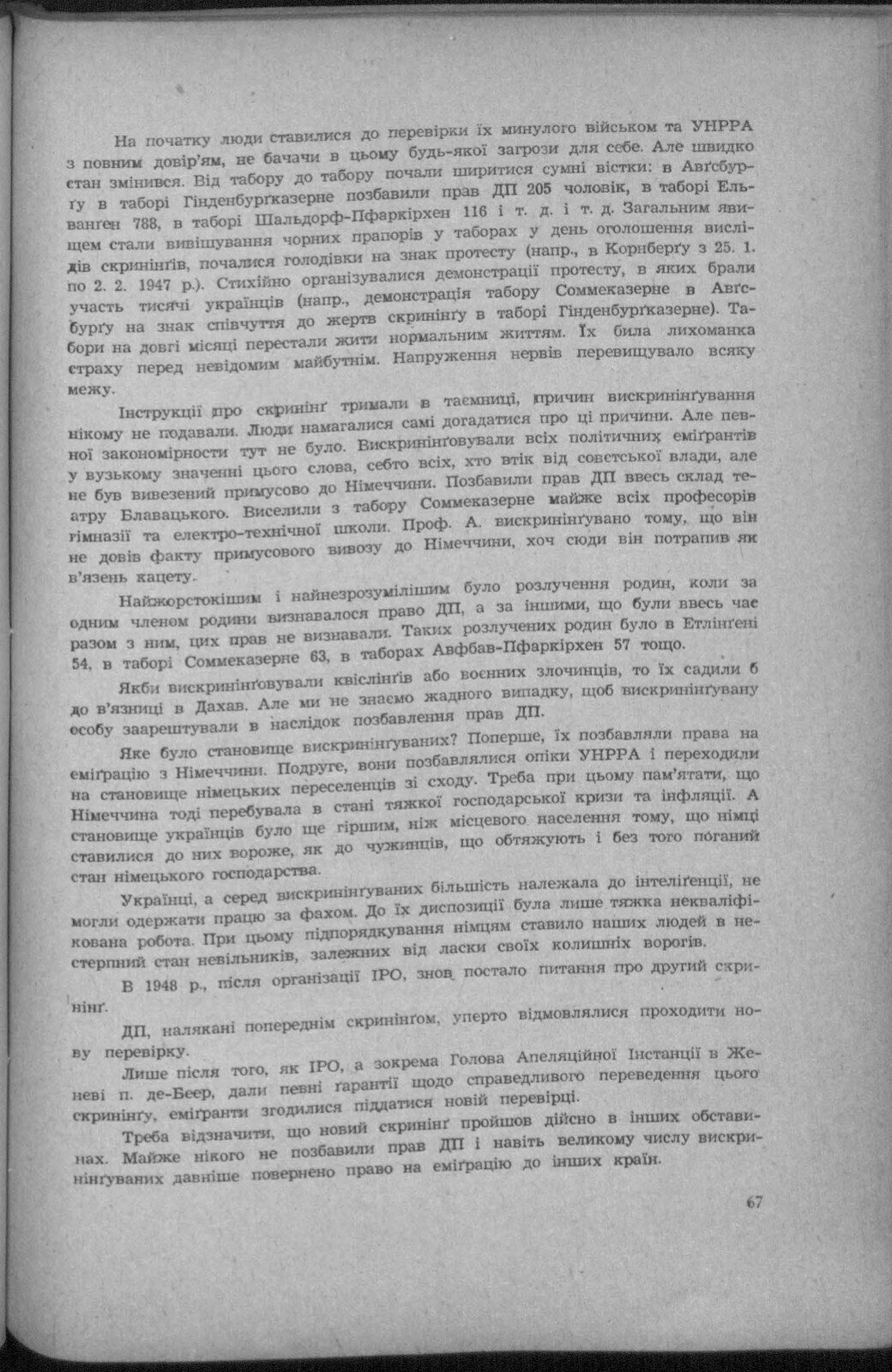
- Сьогочасне й минуле: вісник українознавства, page 67
Naukove tovarystvo im. Shevchenka, Munich and New York; digitised in the Ukrainian Museum-Archives of Cleveland Displaced Persons Camp Periodicals Collection with the United States Holocaust Memorial Museum · Postwar revival of the journal founded in 1939
Page of a Ukrainian scholarly account of the screening of displaced persons, which states that where one member of a family was deprived of displaced-person status the rest were not, and counts the families split in this way: fifty-four at Ettlingen, sixty-three in the Somme-Kaserne camp and fifty-seven in the Aufbau-Pfarrkirchen camps. The digitised item is marked by the holding libraries as public domain or an orphan work and is offered on the Internet Archive under a Creative Commons Attribution-NonCommercial-NoDerivatives 4.0 licence; the page is reproduced whole and unaltered.
Last researched 13 September 2026