Pionier-Kaserne
Displacement in Europe
Aschaffenburg, Bavaria, Germany · 1946–1949
Pionier-Kaserne held the largest Ukrainian community in Aschaffenburg, with a camp hospital, a reading room, a technical school and the presses of a Ukrainian weekly. It closed in February 1949 and returned to military use as Fiori Barracks.
Introduction
Pionier-Kaserne stood on Schweinheimer Straße in Aschaffenburg. The former engineers’ barracks housed one of the city’s largest Ukrainian displaced communities, alongside Polish and Latvian residents. It later became the American Army’s Fiori Barracks.
Its history belongs to the stage of displacement within Germany. It offered accommodation and camp services while people considered their next move; it was separate from Lagarde, Artillerie and Bois-Brûlé, even when residents took part in shared community events.
Sources for this section
A history in dates
- 1936The Pionier barracks are built on Schweinheimer Straße and Engineer Battalion 15 moves in.
- 5 March 1945The commander of the engineer replacement battalion is made battle commandant of the city.
- 20 August 1946The inventory records the camp’s administrative opening date.
- August 1946A return records 2,261 Ukrainian residents.
- 21 October 1946Pionier residents join worshippers from Artillerie and Lagarde for a shared church celebration.
- 22 December 1946About 314 residents vote in the election of camp leaders.
- December 1947A return records 1,836 Ukrainian residents.
- 15 June 1948A funeral procession leaves the camp hospital chapel for the municipal cemetery.
- 24 August 1948Nineteen adults complete a literacy course in the camp.
- 9 February 1949The camp inventory records closure.
- 21 March 1949The military government orders the remaining buildings cleared by 5 April.
- September 1949The first American infantry units occupy the rebuilt barracks.
- 11 May 1950An aerial photograph records the site after the displaced-persons period.
- 1952The barracks are renamed Fiori Barracks.
Sources for this section
- Aschaffenburg als amerikanischer Militärstandort: Vom Kriegsende bis zur Konversion
- Inventory of displaced-persons camps
- The Refugee Experience: Ukrainian Displaced Persons after World War II
- Geschichte der Ukrainisch-Katholischen Kirche in Deutschland vom Zweiten Weltkrieg bis 1956
- Nedilia: Ukrainian independent weekly, Aschaffenburg
- Aschaffenburg: Pionier Camp photographs and recollections
The barracks and its camp administration
The Pionier barracks were built in 1936 on Schweinheimer Straße, the first of four new complexes put up for the Wehrmacht at Aschaffenburg, and Engineer Battalion 15 moved in that October. During the war the site housed Engineer Replacement Battalion 9, whose commander was appointed battle commandant when Aschaffenburg was declared a fortress on 5 March 1945. The fighting of that spring ended with the barracks in American hands.
The camp appears as Assembly Centre 264 or AC 91-264 and later UF 305, with an administrative opening recorded on 20 August 1946. The camp inventory identifies UNRRA Team 612. A publicly shared camp-police document also bears the wording Pioneer Casern and Team 612, independently connecting the name and administrative team.
Camp identifiers and recorded capacity
| Record | Value |
|---|---|
| Assembly centre | AC 264 / AC 91-264 |
| From September 1948 | UF 305 |
| UNRRA team | Team 612 |
| Capacity, 31 October 1947 | 2,000 |
| Recorded closure | 9 February 1949 |
The hospital, the churches and the camp societies
A former resident’s account describes a hospital at Pionier, while identifying Lagarde as an important cultural centre for the neighbouring camps. The camp newspaper confirms the hospital from the other side: a notice of October 1947 gives its office as room 10 at Pionier Kaserne, and the funeral of the press historian Professor Arkadii Zhyvotko set out on 15 June 1948 from the hospital’s Orthodox chapel in the camp for the municipal cemetery, led by children from all the Ukrainian schools of the town.
Pionier residents joined people from Lagarde and Artillerie for a large church celebration on 21 October 1946. More than 3,000 worshippers attended the anniversary of the Union of Brest at a Roman Catholic church in the city’s outskirts. The contemporary report records a shared gathering rather than a service confined to Pionier.
The camp had a church of its own, visited with those of Lagarde and Artillerie by a Canadian relief delegate on 1 February 1947, and a church choir that sang at residents’ funerals alongside the camp’s Ukrainian police. A Prosvita reading room in block VI served as the meeting hall, a branch of the Union of Ukrainian Women held commemorative evenings there, and the Ukrainian Teachers’ Association and the Students’ Community of Aschaffenburg both gave the camp as their address.
Schooling, trades and the printing press
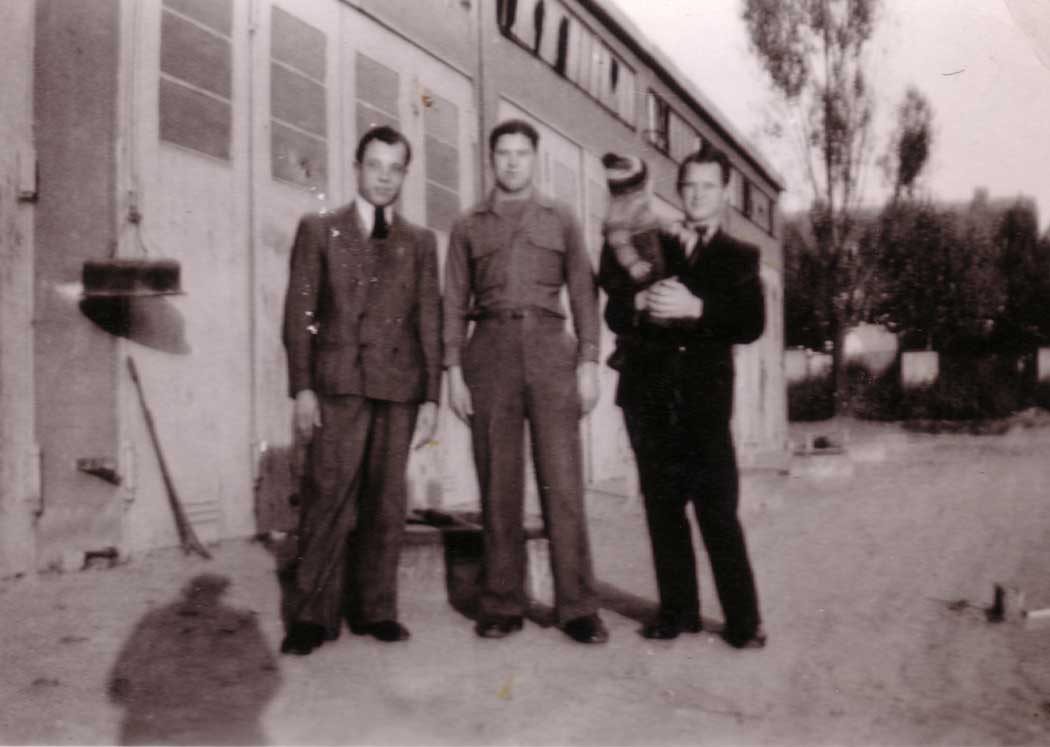
Vocational teaching was organised inside the barracks. In 1948 the Training and Technical Combine invited applications to its directorate at Pionier Kaserne 4/314, asking candidates to name the department they had chosen. A course for adults who could not read ended on 24 August 1948 with nineteen graduates, who had spent three months learning the Ukrainian alphabet and were to go on to the Latin one.
The camp was also a publishing address. The Ukrainian independent weekly Nedilia, which reported on all the Aschaffenburg camps, printed its imprint as Aschaffenburg, Schweinheimer Straße 50, the street of the Pionier barracks, and it was distributed as far as Britain, Canada, the United States and South America.
Institutions recorded inside the barracks
| Institution | Where recorded |
|---|---|
| Camp hospital with Orthodox chapel | Hospital office, room 10; funeral of 15 June 1948 |
| Prosvita reading room, block VI | Notice of a meeting on 19 May 1948 |
| Training and Technical Combine, block 4/314 | Admissions advertisement, 30 May 1948 |
| Literacy course for adults | Nineteen graduates, 24 August 1948 |
| Church choir and camp police | Thanks published after a funeral, 1948 |
| Branch of the Union of Ukrainian Women | Commemorative evening for Olha Kobylianska |
| Nedilia weekly, Schweinheimer Straße 50 | Masthead imprint of the newspaper |
Sources for this section
One of the larger Ukrainian communities
The Ukrainian return for August 1946 records 2,261 residents. The figure was 2,070 in May 1947 and 1,836 in December 1947. The separate questionnaire series collected during 1946–1947 gives 1,999. In each of these returns Pionier was the largest of the town’s camps.
Size did not mean the strongest camp life. When leaders were elected in the four Ukrainian camps on 22 December 1946, only about 314 people had voted at Pionier by midday, some 17 per cent of those entitled and the lowest turnout of the four, against more than 95 per cent at Bois-Brûlé.
The inventory’s capacity entry is 2,000, dated 31 October 1947. It describes the planned accommodation figure, not a complete headcount. The resident returns and capacity record were compiled at different times and for different purposes.
Ukrainian residents in successive returns
| Return | Ukrainian residents |
|---|---|
| 1946–1947 questionnaire collection | 1,999 |
| August 1946 UNRRA return | 2,261 |
| May 1947 UNRRA return | 2,070 |
| December 1947 PCIRO return | 1,836 |
Life beyond one barracks
Across Aschaffenburg, Ukrainians maintained representative and welfare organisations to help with legal problems, material needs and overseas resettlement. Pionier belonged to that broader community, while retaining its own camp identity and population returns.
Sources for this section
From Pionier to Fiori Barracks
The inventory records the end of the DP camp on 9 February 1949. On 21 March 1949 the director of the local military government wrote to the city requiring every building in the Pionier and Lagarde barracks still used by German offices to be cleared by 5 April; the barracks had served for almost four years as accommodation for displaced people and as the depot of the municipal vehicle fleet and fire brigade.
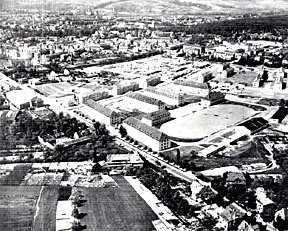
The first units of the 18th Infantry Regiment moved into the rebuilt Pionier barracks in September 1949, and in 1952 the compound was renamed Fiori Barracks after Private First Class Nanti I. Fiori. A photograph dated 11 May 1950 shows the compound after the camp period, rather than depicting refugees still living there.
What the records preserve
The city archive’s reorganisation of UNRRA material has made wartime employment papers and later investigations easier to connect. The camp’s administrative identifiers provide a more precise starting point than the town name alone, especially because Aschaffenburg had several distinct camps.
Sources for this section
Sources
- Inventory of displaced-persons camps
Arolsen Archives · 26 October 2023
Camp-specific register entry; Excel serial dates decoded using 1899-12-30. Capacity is not a census.
- The Refugee Experience: Ukrainian Displaced Persons after World War II
Canadian Institute of Ukrainian Studies Press · 1992
Ihor Stebelsky chapter, table 7: headers p. 47, Aschaffenburg rows p. 48, source notes p. 51. Four returns have different collection dates and methods.
- Aschaffenburg als amerikanischer Militärstandort: Vom Kriegsende bis zur Konversion
Geschichts- und Kunstverein Aschaffenburg; Christian Th. Müller · 2016
Municipal archive-hosted monograph. Barracks building programme and garrison PDF pp. 19–21; the fortress order of 5 March 1945, PDF p. 24; clearance order of 21 March 1949, occupation by the 18th Infantry Regiment and the 1952 renaming after Private First Class Nanti I. Fiori, PDF pp. 59–61.
- Aschaffenburg
Encyclopedia of Modern Ukraine / National Academy of Sciences of Ukraine · 2001
Ukrainian camp network, city-wide representative institutions and education. Lagarde gymnasium is not reassigned to other barracks.
- Aschaffenburg military installations: historical photographs
US Army Germany historical collection · Various photographic dates
Barracks identities and attributed historical photographs; later military photographs are labelled with their actual dates.
- UNRRA: Originaldokumente digital erfasst und verzeichnet
City and Collegiate Archive of Aschaffenburg · 4 August 2022
Institutional account of wartime forced-labour documents and post-war UNRRA investigation records, catalogued in 2021–2022.
- Geschichte der Ukrainisch-Katholischen Kirche in Deutschland vom Zweiten Weltkrieg bis 1956
Harrassowitz; Bernadetta Wojtowicz · 2000
Pages 170–171: October 1946 Union of Brest anniversary; more than 3,000 worshippers from Lagarde, Pionier and Artillerie. Based on contemporary church report of 31 December 1946.
- Aschaffenburg: Pionier Camp photographs and recollections
Displaced Persons Camps / Michigan Family History Network · Public contributions; accessed 2026
Pionier-specific camp-police document, hospital recollection and later aerial photograph. Personal details and unrelated political assertions excluded.
- Nedilia: Ukrainian independent weekly, Aschaffenburg
Ukrainian Museum-Archives of Cleveland / United States Holocaust Memorial Museum · 1946–1949
Digitised run of 1,053 pages, CC BY-NC-ND 4.0. Issues used: no. 54, 7 January 1947 (camp elections and turnout); 9 February 1947 (visit to the three camp churches); 19 October 1947 (hospital office at the camp); no. 124, 16 May 1948 (Prosvita reading room, block VI); no. 128, 30 May 1948 (Training and Technical Combine, block 4/314); 20 June 1948 (funeral from the hospital chapel); 12 September 1948 (literacy course); masthead imprint, Schweinheimer Straße 50. No residents are named.
Last researched 13 September 2026