Raitersaich Camp
Displacement in Europe
Raitersaich · Germany · 1946–1949
Twenty-one wooden barracks built for a Luftwaffe flying school became a displaced-persons camp in the woods between Raitersaich, Clarsbach and Buchschwabach. By December 1947 it held 866 Ukrainians, who built a Greek Catholic church there and left it behind for the German expellees who followed them.
Introduction
Raitersaich Camp occupied the accommodation area of a former military airfield in Middle Franconia, in a strip of woodland roughly 200 by 300 metres between the villages of Clarsbach, Raitersaich and Buchschwabach. The Arolsen inventory records it as Raitersaich / Air-Depot, an American-zone assembly centre opened on 20 August 1946 and classified for Jewish and Polish-Ukrainian displaced people. The published Ukrainian population table counts 866 Ukrainians there in December 1947, which makes this one of the substantially Ukrainian camps of Middle Franconia rather than a marginal entry in the register.
A history in dates
- Autumn 1938 to spring 1939The flying field is cleared and twenty-one barracks are built in the wood.
- 18 or 19 April 1945The engines of the remaining aircraft are blown up before the Americans arrive.
- April 1945The US Army takes over the airfield grounds and the barracks.
- Late summer 1946Displaced people begin to be admitted while the American depot is still being wound down.
- 20 August 1946The inventory records the assembly centre as opening.
- 31 May 1947The UNRRA return counts 13 Ukrainians at the camp.
- 31 October 1947The DP inventory records accommodation capacity of 1,000.
- December 1947The successor organisation’s return counts 866 Ukrainians at the camp.
- 30 March 1948The Ukrainian Greek Catholic camp church is consecrated.
- Late 1948 to early 1949German expellees move in as the displaced people leave; the church is made over to them.
- 17 June 1949Closure date recorded for the DP camp.
- 17 May 1950SV Raitersaich is founded following contacts between villagers and the expellee community.
- 1957The camp stands empty and the huts are demolished, apart from the church and the school.
- December 1959The camp church is given up when Maria Königin at Clarsbach is consecrated.
- 2021A photographic survey records surviving traces around the former airfield.
The airfield and its barracks before 1945
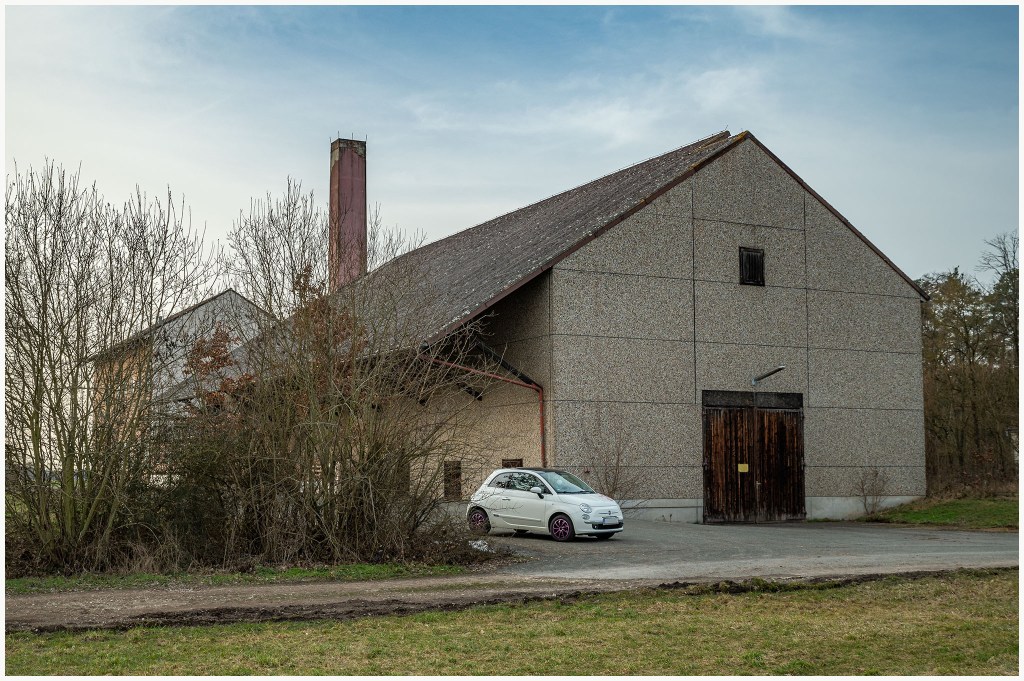
The local historian Gerhard Deeg traced the site back to 1938. Woodland south of the Raitersaich to Buchschwabach road was cleared between the autumn of 1938 and the spring of 1939 and sown with grass to make a turf flying field. North of the road, clearings were cut in the wood and twenty-one substantial wooden barracks were put up along a single camp street, with trees left standing between them so that the accommodation was hard to see from the air.
The field served as a training ground for the airbase at Fürth-Atzenhof, first for glider and elementary flying instruction and later for a squadron of the fighter-training wing based there. The same barracks were used for three-week Hitler Youth military-training courses. An Allied reconnaissance photograph of September 1944 shows the barracks hidden in the wood, a hangar and a flight-control building beside the field, and aircraft on the grass. On 18 or 19 April 1945, shortly before the Americans arrived, the engines of the remaining aircraft were blown up.
Sources for this section
From American depot to displaced-persons camp
American supply, engineer and signal units took over the camp and the field. There were enough of them that a tent city with a field kitchen had to be pitched alongside the barracks. The flying field itself was returned to the farmers who had owned it, while the barracks area was declared a restricted zone marked out with red and yellow boards.
The two uses overlapped. Deeg records that the admission of displaced people began in the late summer of 1946 while the Americans were still winding the depot down, that the first arrivals worked as helpers for the American units, and that the last American personnel left in the late autumn of 1946 or early in 1947. The Arolsen inventory’s opening date of 20 August 1946 falls inside that overlap. A local site survey published in 2021 gives a simpler sequence of American occupation until 1947 followed by displaced persons; the fuller local account should be preferred where the two differ.
The camp in the administrative record
The inventory identifies assembly centre AC 93-391, later OMF 323, with UNRRA Team 548 at Ansbach. Capacity was listed as 1,000 on 31 October 1947. That is accommodation provision for the whole camp, not a count of Ukrainian residents. The inventory records closure on 17 June 1949, which ends this administrative camp entry rather than the use of the huts.
Ihor Stebelsky’s published table of Ukrainians in American-zone camps carries the site under the spelling Fuerth (Reitersach). It shows 13 Ukrainians in the UNRRA return of 31 May 1947 and 866 in the successor organisation’s return compiled on 2 January 1948 for December 1947. The two returns are seven months apart and the jump between them reflects transfers into the camp rather than natural growth. Deeg’s account of the camp’s capacity, up to 800 people in the provisional housing, is of the same order as the December 1947 Ukrainian figure.
The camp in administrative records
| Record | Detail |
|---|---|
| Facility name | Raitersaich / Air-Depot |
| City in the register | Raitersaich, Kreis Fürth |
| Recorded categories | Jewish, Polish-Ukrainian |
| Opening | 20 August 1946 |
| Assembly centre | AC 93-391; later OMF 323 |
| UNRRA team | Team 548, Ansbach |
| Recorded capacity | 1,000 on 31 October 1947 |
| Closure | 17 June 1949 |
Ukrainians recorded at the camp
| Return | Ukrainians | Scope |
|---|---|---|
| Questionnaire returns, 1946 to 1947 | No figure | Fuerth (Reitersach) row |
| UNRRA, 24 August 1946 | No figure | Fuerth (Reitersach) row |
| UNRRA, 31 May 1947 | 13 | Fuerth (Reitersach) row |
| PCIRO, December 1947 | 866 | Fuerth (Reitersach) row |
A Ukrainian church built in the wood
The clearest surviving trace of the Ukrainian community is its church. Deeg records that a group of Greek Catholic Ukrainians had been living as displaced persons at Obernzenn, where UNRRA had given them material for a church hut. The group was transferred to Raitersaich while that building was still going up, so the work at Obernzenn stopped. At Raitersaich they began again with their chaplain, named in the account as Fedasuck, using the parts brought from Obernzenn together with doors, windows and a small turret they made on site.
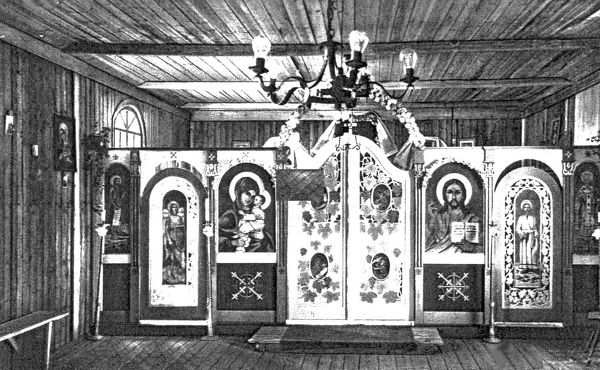
Their church was consecrated on 30 March 1948, before the German expellees arrived. A photograph taken in May 1949 shows the interior: a painted wooden iconostasis of five panels across the width of the hut, separating the sanctuary from the nave, with a chandelier above and plain boarded walls and ceiling. Deeg describes the congregation as Greek Catholic, and also as orthodox; the Ukrainian Greek Catholic Church is an Eastern church in communion with Rome, and the eastern furnishing of the hut is what the second description reflects.
When the Ukrainians left in 1948 and 1949 they made the church over to the Catholic expellees who followed them, a gift recorded in a letter of thanks that Deeg reproduces in part. The iconostasis was taken out and pews were put in. The building outlasted the camp, and served the surrounding villages until the church of Maria Königin at Clarsbach was consecrated in December 1959.
Sources for this section
Life in the camp
Deeg’s account of the displaced-person years is unflattering to the administration rather than to the residents. After the Americans withdrew, the people in the camp were supervised by UNRRA staff and then by officials of the International Refugee Organisation in their blue uniforms, but no regular paid work was organised for them. Men spent time at Raitersaich station or helped on the surrounding farms, and there was poaching and pilfering; the chronicler also records two fatal shootings involving camp residents and local men, in July 1946 and in January 1948. He judges the enforced idleness of up to three years an intolerable state of affairs. Numbers fell steadily as people emigrated, chiefly to Canada and Australia.
The physical camp is documented in detail only for 1954, by which time its residents were German expellees. The plan Deeg reproduces numbers twenty-six installations: residential huts, latrines and a wash hut, a multi-purpose economy hut with a communal kitchen, dining hall, shop and small inn, a culture hut with a stage and a cinema, the camp administration and a doctor’s room, a well shaft, a raised water tank and a transformer house. Across the road stood the camp church and, in the former flight-control building, the camp school. The church dates from the displaced-person years; the huts, the well shaft and the flight-control building that became the school were already on the site.
Sources for this section
The expellee camp and the end of the site
German expellees from Pomerania, East Prussia, Silesia, Hungary and above all the Sudetenland moved in at the end of 1948 and the beginning of 1949. A branch of the Fürth adult education college ran vocational courses in the camp from the spring of 1950, and the Fürth clothing manufacturer Gustav Schickedanz lent it sewing machines, five electric machines at first, then fourteen, and twenty-nine by early November 1950, on which women’s fabric belts were made. The local sports club traces its origins to friendships between villagers and the expellees; SV Raitersaich was founded on 17 May 1950 on a sheep pasture on former airfield land.
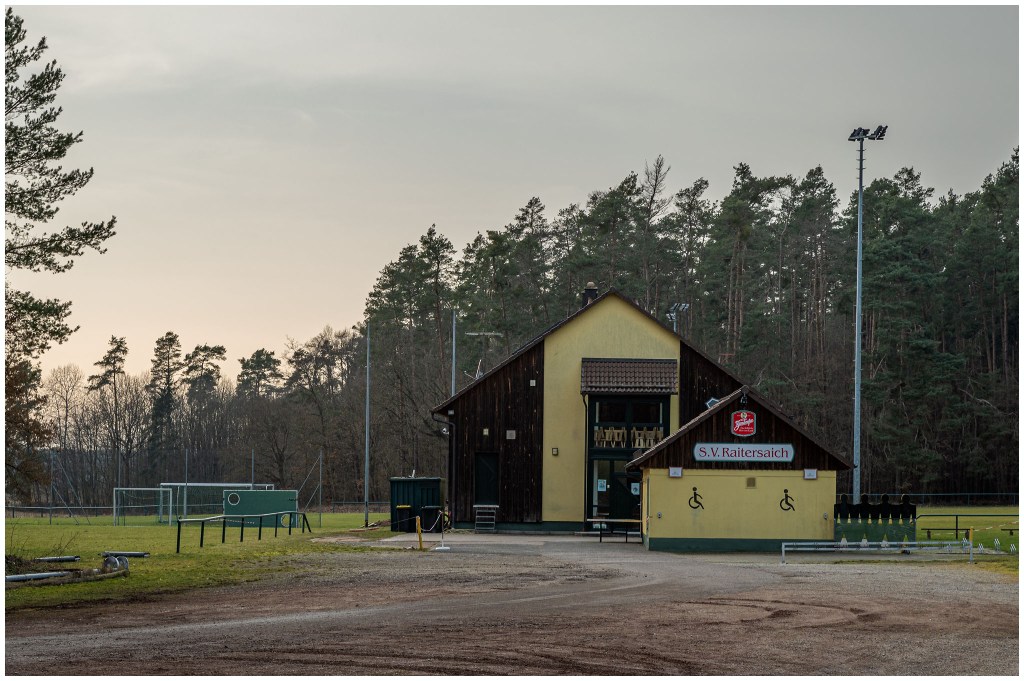
No one was living in the camp by 1957 and the huts were pulled down quickly, with two exceptions. The church stayed until December 1959 and the camp school served the children of Clarsbach and Raitersaich until a new school was built at Raitersaich in 1960. A photographic survey of 2021 found the sports ground on part of the former accommodation area, woodland over the rest, the well shaft and the raised water tank still in the trees, and an industrial building at Am Flugplatz 1 keeping the airfield’s name. The camp church and the memorial that once stood beside the road are both gone.
Sources
- DP camp inventory: Raitersaich / Air-Depot, record 1393
Arolsen Archives
Catalogue record 1393: Jewish and Polish-Ukrainian classification, opening 20 August 1946, capacity 1,000 on 31 October 1947, AC 93-391, later OMF 323, Team 548 Ansbach, closure 17 June 1949. No archive reference is given for this record.
- Flugplatz Buchschwabach
Arne Marenda, Bauzeugen, 23 February 2021
Original photographic site survey inspected. Identifies the former airfield and accommodation area, sports ground, water installations and Am Flugplatz 1, and records that the camp church and memorial no longer survive. Its dating of the American and DP phases is less exact than the Heimatverein account.
- Die Geschichte des SV Raitersaich
SV Raitersaich
Club institutional history: friendships with expellees at the camp, foundation on 17 May 1950, first ground on the former airfield and subsequent relocation. The club’s founders are the later expellee community, not the earlier displaced residents.
- Gerhard Deeg, Ein Lager, seine Menschen und eine Kirche (1938 bis 1959)
Heimatverein Markt Roßtal e.V., after a chronology published by the Catholic parish of Christkönig, Roßtal
Full local history read in an archived copy of 25 March 2023, with its photographs and captions. Covers the 1938 clearance and 21 barracks, the flying school and Hitler Youth courses, the 1944 aerial photograph, the American depot, the arrival of displaced people from late summer 1946, camp administration by UNRRA and the IRO, the Greek Catholic church brought from Obernzenn and consecrated on 30 March 1948, the 1954 site plan, the expellee years and the demolition of 1957.
- Ukrainian DP population table, Table 7
Ihor Stebelsky, in The Refugee Experience, 1992
Printed page 49, row Fuerth (Reitersach): no figure in the 1946 to 1947 questionnaire returns or the UNRRA return of 24 August 1946, 13 in the UNRRA return of 31 May 1947 and 866 in the PCIRO return compiled on 2 January 1948 for December 1947. Page rendered from the PDF at 300 dpi and read visually to check the column assignment.
Last researched 13 September 2026