Roselies-Kaserne
Displacement in Europe
Braunschweig, Lower Saxony, Germany · Displaced-persons accommodation, 1945–1959
Known within its Ukrainian community as Camp I. Franko, Roselies-Kaserne housed displaced people from the Baltic states and Ukraine in seven barrack blocks from 1945. It kept shops, chapels and a bilingual school until the site was cleared for the Bundeswehr at the start of 1960.
Introduction
Roselies-Kaserne stood on Rautheimer Straße beside Braunschweig’s Lindenberg neighbourhood. After the Second World War, the former military buildings housed displaced people and German refugees. Ukrainian residents also knew their camp as I. Franko, a name preserved on the reverse of a historical photograph.
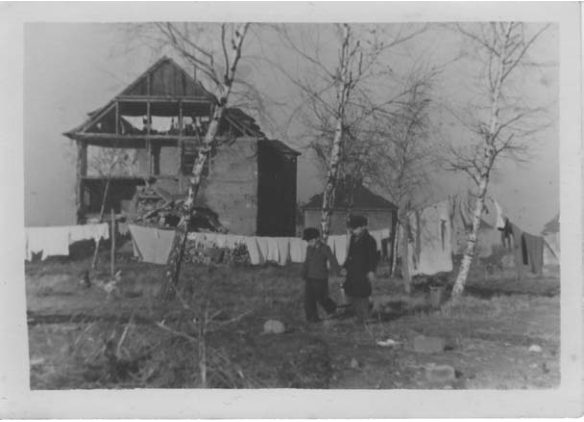
A Ukrainian caption written on the back of a photograph of one bomb-damaged block gives the community’s own account of the place: the Ukrainian camp I. Franko, Rosalies barracks in Braunschweig, army barracks of seven blocks, established in September 1945, with 1,400 residents at the start of whom 470 were foreigners and 930 Ukrainians, and existing until 1959.
Sources for this section
A history in dates
- 1938The military barracks are built and named after Roselies in Belgium.
- April 1945The departing army leaves buildings that become shelter for displaced people and refugees.
- September 1945The Ukrainian community dates the founding of Camp I. Franko in the seven blocks, with 1,400 residents.
- 1945–1947The Western Allies house displaced people mainly from the Baltic states and Ukraine.
- 1948–1951Residents are predominantly Ukrainian.
- February 1949A Ukrainian paper prints a correspondence address at the Rosalies barracks under 64 DPACS.
- 1 June 1950The Braunschweig refugee office takes over the city’s former DP camps.
- October 1952A schedule of lettings records the shops and the six denominations’ rooms.
- April 1958The camp leader’s ten-year report describes employment and the two remaining foreigners’ barracks.
- 1959The resident population falls sharply during clearance.
- Early 1960The barracks are finally cleared; remaining households move to Rautheim flats or to Broitzem.
- 1962Bundeswehr units arrive at the barracks.
- 2003The military site closes.
- September 2018The Garden of Remembrance opens in the new neighbourhood.
From barracks to civilian shelter
Built in 1938, the barracks were named after the Belgian village of Roselies, where Braunschweig troops had fought during the First World War. The name connected the military site to that earlier battle and its destruction, rather than to a person called Roselies.
During the air raids from 1943, people from neighbouring Lindenberg used the barracks’ shelters. The southern block by Möncheweg was partly destroyed in 1944–45. After the army left on 12 April 1945, displaced people and refugees moved into the buildings, including the surviving part of the damaged block.
The barracks stood in Rautheim, then a separate village and only incorporated into Braunschweig in 1974. Bombing left Block IV half destroyed and one side of Block VII badly damaged, but all seven blocks were still usable for accommodation after the war. Between 1945 and 1947 the Western Allies housed mainly displaced people from the Baltic states and Ukraine here; from 1948 to 1951 the residents were predominantly Ukrainian.
Who ran the camp
Under Allied administration the camp ran itself to a considerable degree. In the first postwar years it had its own camp police, recruited from the younger and stronger residents, and a barrier at the main gate. A contemporary correspondence address printed in the Paris Ukrainian paper Hromada in February 1949 places the barracks under 64 DPACS, a British-zone displaced-persons assembly-centre staff, and names the site itself rather than the city.
German administration followed in 1950, when the Braunschweig refugee office took over the city’s former DP camps; there were then six camps in the city holding 5,200 people. Instructions from the provincial president that July laid down that the camp leader should be a German and the camp warden a displaced person. Camps for foreigners were financed entirely by Lower Saxony, while camps for German refugees were subsidised at 85 per cent.
Sources for this section
Work, school and worship
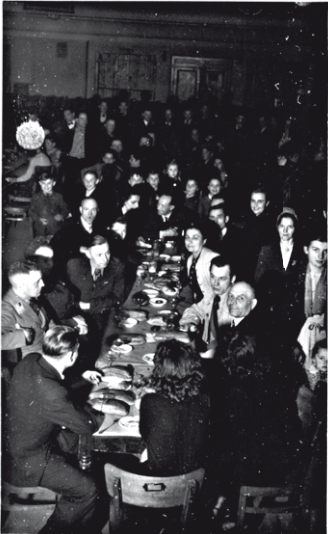
Part of the site was let commercially. There were two food shops, a store the residents called the Konsum that sold Ukrainian goods, a canteen, a bakery, a butcher and a dairy shop, together with a resident doctor who handled general care, births and the vaccinations required for emigration. The shops made little money because residents had so little, and much was bought on credit. Rooms were also let to associations, at rents negotiated by size and turnover according to a schedule of October 1952.
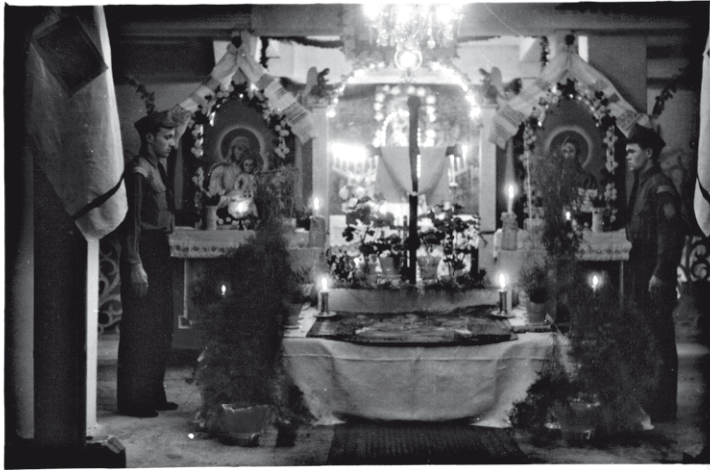
Six religious traditions shared the complex, each with its own room recorded in that schedule: a chapel in the drying loft of Block II used for both Roman and Greek Catholic services, a Russian Orthodox chapel in Block I, an autocephalous Orthodox chapel in the drying loft of Block V, a Baptist church in Block II and a Protestant prayer room in Block III. Films were shown for an entrance fee in the canteen.
The camp had what was called a national school, though without a building of its own: children were taught in both Ukrainian and German, the Ukrainian-language and religious lessons being given by a Ukrainian teacher in his private rooms. A German kindergarten occupied the former maternity rooms, and about half of the children attending it came from the neighbouring Lindenberg settlement rather than the camp.
The surrounding neighbourhood remained part of this story. A local sports association used camp space, and the Martin Chemnitz Lutheran congregation had a prayer room there until 1959. Some Ukrainians who stayed in Germany settled nearby, continuing a connection that the district historian recorded decades later.
Rooms of worship recorded in the letting schedule of October 1952
| Denomination | Location |
|---|---|
| Roman and Greek Catholic | Block II, drying loft |
| Russian Orthodox | Block I, room 51 |
| Autocephalous Orthodox | Block V, drying loft |
| Baptist | Block II, room 75a |
| Protestant prayer room | Block III, room 23 |
Sources for this section
Two different population records
Municipal returns document the camp’s shrinking population during the 1950s. These count all residents, rather than Ukrainians alone. Across that decade an average of 600 to 650 homeless foreigners lived at Roselies alongside about 100 ethnic Germans, Germans and former displaced people, and roughly 250 of the total were children under fourteen.
The separate Ukrainian population series uses Braunschweig as its reporting locality. It records 902 in 1946–47, then 1,007 in May 1947 and 1,083 in July 1949. Because the city had several accommodation sites, those figures cannot simply be treated as Roselies totals.
Roselies residents
| Date | Residents |
|---|---|
| June 1953 | 645 |
| June 1955 | 662 |
| June 1957 | 557 |
| June 1958 | 572 |
| June 1959 | 406 |
| December 1959 | 53 |
Ukrainians recorded under Braunschweig
| Date | Ukrainians |
|---|---|
| 1946–1947 | 902 |
| May 1947 | 1,007 |
| December 1947 | 906 |
| July 1949 | 1,083 |
| December 1950 | 346 |
| August 1951 | 295 |
Leaving the camp
German administration took over in 1950. A ten-year report by the camp leader in April 1958 recorded a large number of residents in work, mostly in forestry and farm labour, craft workshops and a well-regarded radio workshop on the site; the city’s two remaining foreigners’ barracks then held 2,139 people, former displaced persons and Germans together. Only four families from Roselies were recorded up to that year as having returned to their country of origin. Municipal returns still counted 53 residents at the end of 1959.
The federal camp clearance programme of 1959–60 required Roselies to be emptied by the end of 1959 so that the property could pass to the Bundeswehr. Negotiations with the then independent municipality of Rautheim over replacement flats were slow, and some of the new units proved too expensive, so households swapped into older and cheaper flats elsewhere in the village. Those who could not be housed at the final clearance early in 1960 moved to the Broitzem barracks in the west of the city. The outcome was that Ukrainian and Polish families again ended up living close together in single estates.
Civilian accommodation eventually gave way to military use again. The city’s memorial account records the arrival of Bundeswehr units in 1962 and the barracks’ closure in 2003. Housing development began in 2008, with several old buildings retained in the northern part of the site.
Sources for this section
Remembering the site
In September 2018, the city opened a Garden of Remembrance on Eulerstraße. Its Belgian stone and espalier fruit trees express a partnership with Aiseau-Presles, the municipality containing Roselies. The memorial connects the place name with the consequences of the First World War and a later commitment to reconciliation.
Sources for this section
Sources
- Vom ukrainischen DP zum heimatlosen Deutschen
Anne-Kathrin Topp, Forschungsstelle Osteuropa, University of Bremen, Arbeitspapier 112, December 2010
Original full study inspected, especially pp 18–20,60,65,69. Municipal camp statistics and anonymous historical photographs; contemporary signature E 56 III 6. No names of residents reproduced.
- Garten der Erinnerung
City of Braunschweig
Official memorial text: construction 1938, DP/refugee accommodation, Bundeswehr 1962, closure 2003, housing from 2008 and memorial 2018. Official simplified 1958 enddate differs from 1959 municipal resident statistics.
- Geschichte der Roselies-Kaserne
Wolfgang A. Jünke, district local historian, Südnachrichten 4/2007
Original historical essay checked: air-raid shelter use, bomb damage, DP/refugee occupation, local shops, sports and Lutheran prayer room until 1959.
- Ukrainians in the Displaced Persons Camps of Austria and Germany, Table 7
Ihor Stebelsky, Ukrainian Historical Review 1986, pp 50–52
Braunschweig city counts 902/1007/906/1083/346/295. Kept geographically separate from exact Roselies camp counts.
- Hromada, no 3–4 (27–28), February 1949
Hromada, Paris; digitised by Diasporiana · Accessed September 2026
PDF page 15, family-tracing column, printed line rendered at 400 dpi and read directly: a correspondence address at “Braunschweig, Rosalies Barracks, 64 DPACS, Germany”. Personal names not reproduced. Establishes the writer could be reached at Roselies, not that the people sought lived there.
Last researched 13 September 2026