Rosenhaven
Displacement in Europe
Ny Vestergade, Odense · Denmark · 1945–1946
A theatre and restaurant in the middle of Odense, requisitioned by the Germans in 1944, became an open camp in May 1945 for several hundred Soviet citizens stranded in Denmark, among them people from Ukraine. They spent a summer in the town, performed at Odense Theatre and were repatriated in August, after which Austrian refugees occupied the buildings until the camp closed in March 1946.
Introduction
Rosenhaven housed people from Ukraine among the Soviet citizens stranded in Denmark after German captivity. The camp occupied a former theatre and restaurant in central Odense. Danish records often called its residents Russian, a description that covered people from several Soviet republics.
The buildings were those of Odense Folketeater and Restaurant Rosenhaven in Ny Vestergade. The German occupation authorities requisitioned them on 1 May 1944, chiefly to billet soldiers, and renamed them Deutsches Haus; the troops also used the place as a cinema. After the liberation local people removed two letters so that the sign read Deutsche Aus, Germans out. The buildings stood empty for a few weeks before the first Soviet arrivals.
Sources for this section
A history in dates
- 1 May 1944The German occupation authorities requisition the theatre and restaurant and rename them Deutsches Haus.
- May 1945Soviet displaced people enter Rosenhaven after the buildings have stood empty for a few weeks.
- 7 June 1945The Red Cross takes over camp management.
- 21 June 1945The refugees are invited to an event at Odense athletics stadium organised by the Danish Communist Party.
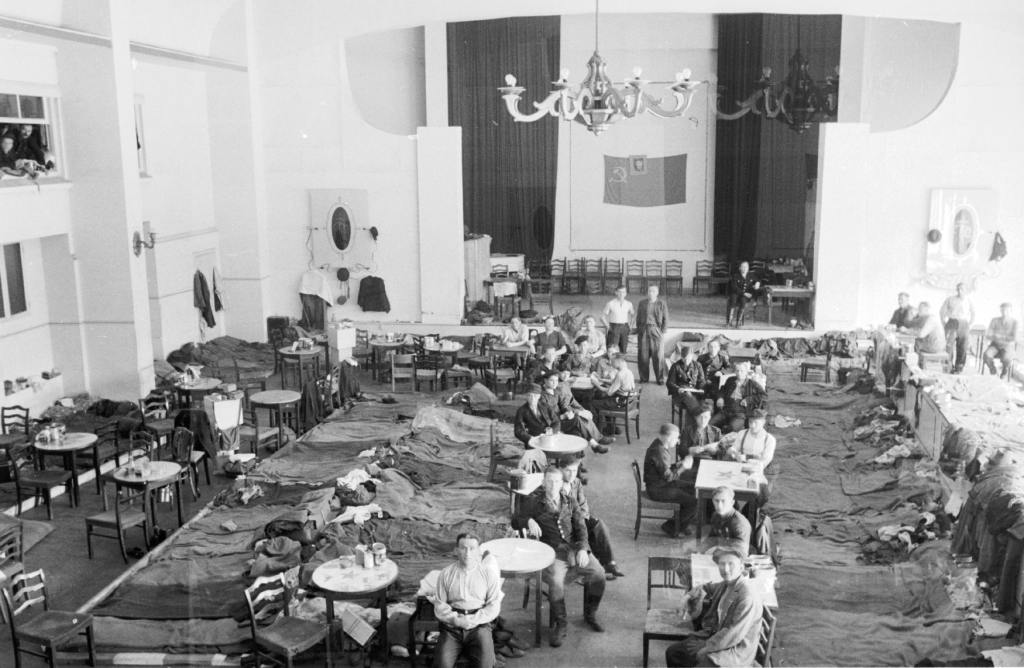
- 26 June 1945A photographer records the sleeping hall with its rows of beds and a Soviet flag above the stage.
- 28 June 1945Fyens Stiftstidende publishes a special issue in tribute to the refugees.
- 17 August 1945The last Soviet residents leave by train; the mayor speaks at the station.
- October 1945About 300 Austrian refugees move in.
- January 1946The Austrians are transferred to other camps despite protests.
- March 1946The refugee camp closes.
From captivity to a city-centre camp
The resistance initially arranged accommodation in the buildings. Danish Red Cross management began on 7 June 1945. Unlike a remote barracks compound, Rosenhaven placed displaced people within the everyday life of the town, close to the park at Munke Mose.
Around 230,000 refugees reached Denmark over the winter and spring of 1944 and 1945, most of them German but about 34,000 not. At the liberation the Danish authorities became responsible for both groups and decided to house them separately and on different terms. Non-German refugees could move freely outside the camps and have contact with Danes, which German refugees could not. Their care was handed to the Danish Red Cross, which tried to divide the camps by nationality, and during May 1945 the Soviet refugees on Funen were gathered at Rosenhaven. Most camps, German and non-German alike, were placed outside the towns; Rosenhaven was the exception.
The men had reached Odense by their own efforts. An artillery captain told a local paper that they had got away from their German guards in south Zealand and reached Nyborg with help from the resistance, then marched to Odense to ask the Red Cross for help. Most were soldiers of the Soviet army who had been in German captivity and were moved to Denmark in the last months of the war as the Red Army advanced. About sixty of the refugees were women.
Refugees in Denmark, winter and spring 1944 to 1945
| Category | Number |
|---|---|
| All refugees arriving in Denmark | About 230,000 |
| Of whom non-German | About 34,000 |
Sleeping in the theatre
A photograph taken on 26 June shows how a public hall became shared accommodation: beds line the walls beneath chandeliers, tables and chairs fill the middle, and a Soviet flag hangs above the stage. People sit beside their beds and gather around tables. The room still looks unmistakably like a theatre.
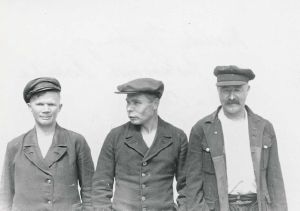
Another museum photograph preserves a closer view of three men at Rosenhaven during the same summer. Their varied jackets and caps contrast with the wide view of the crowded hall. Together, these images record both the communal surroundings and the people passing through them.
Supply was the largest practical problem of the first months. Tobacco, clothes and shoes were short, and from May 1945 the resistance movement organised collections for the Soviet refugees which Fyens Stiftstidende reported, printing the thanks that followed. Among the smaller complaints, one resident wrote in the communist paper Trods Alt that they slept in makeshift dormitories and had little to do.
One Soviet resident told a journalist in June 1945 that the stay in the Odense camp amounted to “a sad existence in idleness”, despite the local population’s hospitality and friendliness. The remark survives in an endnote to a study of non-German displaced persons in Denmark, which cites Morten Baarvig Thomsen’s account of the camp.
A summer among the townspeople
Residents staged four successful performances at Odense Theatre. Music and dance reached an enthusiastic audience despite the language barrier, and the proceeds supported people on Soviet-occupied Bornholm. On 17 August, the town gathered at the station as the departing former prisoners boarded a train; the mayor addressed the farewell.
The performances began with a newspaper description of music inside the camp: a reporter sitting in one of Rosenhaven’s crowded rooms, an incomprehensible language around him and now and then an accordion, a balalaika or another instrument accompanying the conversation. A refugee actress led the resulting cabaret, helped by the theatre’s head stage manager, a communist and a member of the local Freedom Council committee. She did not leave on the August train: she had been picked for a national tour billed as Russia thanks Denmark.
There were other public occasions. On 21 June 1945 the Soviet refugees were invited to Odense athletics stadium for an event organised by the Danish Communist Party, at which its chairman spoke, and a special issue of Fyens Stiftstidende on 28 June carried a tribute to them. The nickname Russerhaven attached itself to the place.
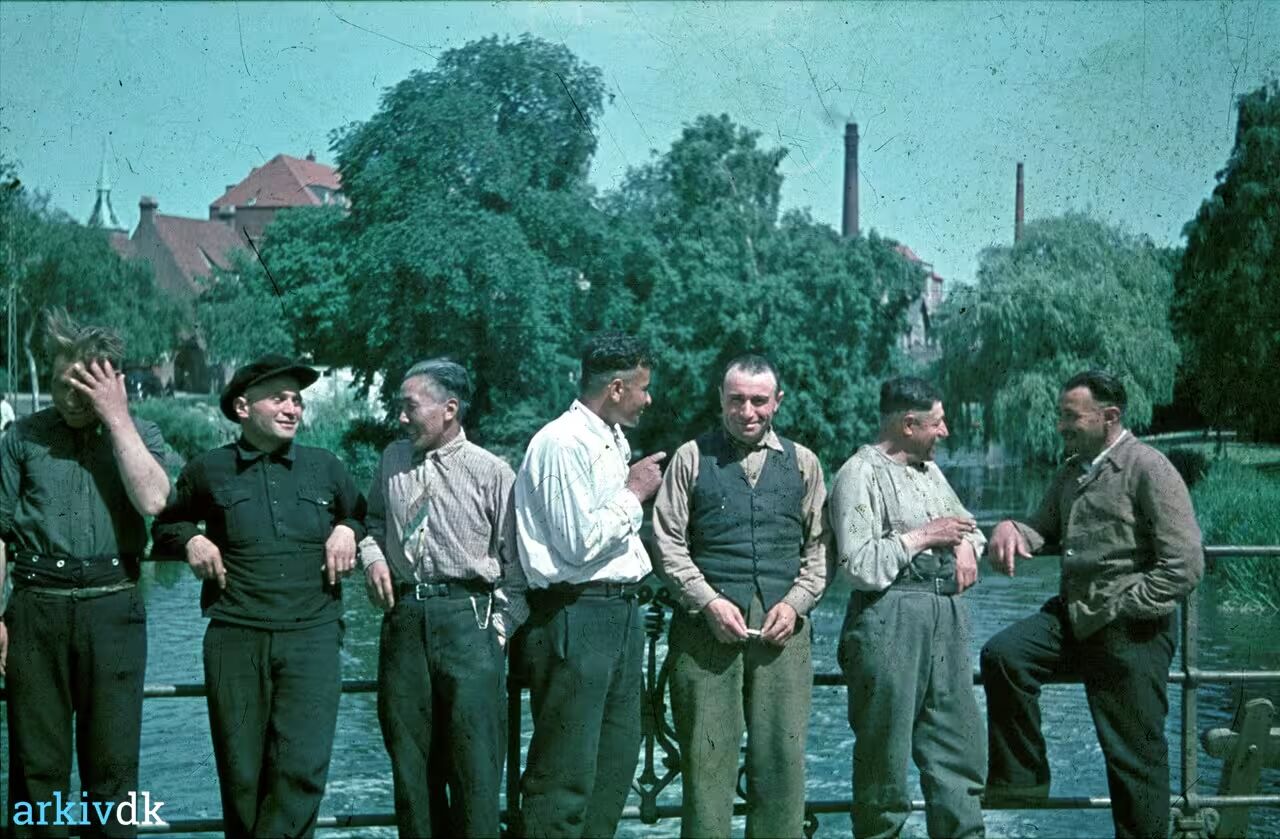
A colour photograph in Odense City Archives places seven former prisoners on a bridge at Munke Mose between May and August 1945. It captures an ordinary pause outdoors: men leaning on the railing, talking and enjoying the sunshine. The park became part of their lived surroundings, beyond the camp’s sleeping quarters.
Return and the next residents
Freedom to move around Odense did not mean freedom to choose whether to return: Soviet citizens were repatriated even against their wishes, under the decision taken by the allied powers at Yalta in February 1945 that they could be sent back by force. The last of them left Rosenhaven on 17 August 1945.
After their departure, about 300 Austrians occupied Rosenhaven from October 1945. They had at first been classed as German refugees because of the annexation of Austria in 1938, a ruling later reversed. They spent the winter there, short of warm clothing, and protested at their transfer in January 1946 to other camps including Tarp near Esbjerg, threatening a hunger strike; a letter to the Danish Red Cross said they would regard the move as a punishment, for cultural, church and private reasons and because of the raw maritime climate of the west coast, and it carried eight pages of their signatures. The transfer went ahead. Rosenhaven closed as a refugee camp in March 1946; the buildings are now used by Teater Momentum and Den Fynske Opera.
Successive resident groups
Sources for this section
Sources
- Rosenhaven: lejr for ikke-tyske flygtninge i Odense, 1945–1946
Ida Kjær Larsen and Morten B. Thomsen, Lex / University of Southern Denmark · Accessed September 2026
History updated 17 March 2026. Requisition and renaming, national refugee figures, Red Cross responsibility and separate terms, the explicit note that the residents came from several Soviet republics including Ukraine, collections and supply problems, the stadium event, Yalta and forced repatriation, and the Austrian phase and closure.
- Russiske flygtninge optrådte på Odense Teater
Johnny Wøllekær and Jørgen Thomsen, Historiens Hus / Odense Stadsarkiv · Accessed September 2026
Local archival history: about 550 residents including some sixty women, the captain’s account of the escape and march to Odense, Red Cross takeover on 7 June, the Fyens Stiftstidende description of music in the camp, the theatre cabaret and its organisers, and the departure on 17 August.
- Odense: Rosenhaven, summer 1945
National Museum of Denmark, Freedom Museum photograph archive · Accessed September 2026
Historical photograph; museum rights status: no known rights.
- Seven former prisoners at Munke Mose, 1945
Odense City Archives, B20762; photographer Carl Adolf Bjørn Jensen · Accessed September 2026
Dated May–August 1945 by the archive.
- Da Sovjetunionen kom til Odense
Morten Baarvig Thomsen, Fynske Årbøger 2025, pp. 296–319 · Accessed September 2026
Further reading: peer-reviewed article published 8 November 2025. Bibliographic record and abstract read; the article itself was not consulted, and no statement on this page rests on it.
- Sovjetiske krigsflygtninge i Odense
Rasmus Christian Falsberg and Morten Baarvig Thomsen, Odensebogen 2025 · 2025
Further reading named by Historiens Hus at the foot of source 2. Not consulted.
- The Tasks of Peace: Rebuilding Western European Societies after World War II
Søren Werther Kjær Rasmussen (ed.), Aalborg University Open Publishing and Nord Academic · 2026
Chapter 5, 'In the Absence of a Plan: The Rehabilitation of Non-German Displaced Persons in Denmark, 1945 to 1953', note 42 on page 218 consulted. The note reports a Soviet displaced person telling a journalist in June 1945 that the stay in the Odense camp was a sad existence in idleness despite local hospitality, citing Morten Baarvig Thomsen's article in Fynske Årbøger 2025, page 87.
Last researched 13 September 2026